


Do you have questions about this story? Or information to share? Reach out to Maya Shimizu Harris at maya@wyofile.com.
CASPER—Witness testimony during a trial this week in U.S. District Court paints a broader picture of the Wyoming Boys’ School’s environment at the time of a former resident’s allegations of abuse.
“It was a culture of total control and domination, and really, not in any way responsive to the psychiatric situation of these kids,” said Stuart Grassian, a Massachusetts psychiatrist who reviewed documents, images and video of the school to provide an opinion about the nature of confinement at the facility and its likely effects on residents. His evaluation was based in part on a report from the national nonprofit Council of Juvenile Justice Administrators, which visited the school for a day in 2023 when Blaise Chivers-King, the former resident who is suing the school, was no longer at the facility.
Chivers-King testified in more detail Tuesday about the school’s culture, describing his arrival at the facility. Staff told Chivers-King to keep his eyes down and not to look around, the former resident testified. During his intake, staff shaved his head. “I felt like a hopeless sheep,” Chivers-King said. A defense attorney had earlier compared the school’s practice of cutting residents’ hair to similar requirements in the military and on certain sports teams.
During a typical day at the facility, Chivers-King described staff announcing over the intercom, “You’re still in the Wyoming Boys’ School, this ain’t the dream no more.” At meals, Chivers-King wasn’t allowed to talk with his peers. When he was finished eating, the former resident said he pushed back his chair, put his hands on his knees, said “done, sir” and looked down.
Chivers-King is one of six former boys’ school residents who sued the facility in 2024. The school, which detains delinquent boys ages 12 to 21, is a 38-acre residential facility near Worland that’s overseen by the Wyoming Department of Family Services. Chivers-King, who spent time at the boys’ school between 2020 and 2022, alleged school staff violated his 14th Amendment rights by placing him in isolation, using excessive force and infringing on due process.
Dale Weber, the school’s superintendent and a defendant in the case, acknowledged that staff required boys to look forward at times and walk in single-file lines from the dorm to the school, during which risk management officers watched on four wheelers. Staff also barred the youth from freely speaking to each other, verbally or nonverbally, Weber testified.
“We try to make sure that the boys aren’t communicating nonverbally because most of the time, it doesn’t lead to good things in a facility like ours, but we know they do it, and we can’t really control it,” he said.
The defense has argued that these control measures were needed to maintain safety. Weber testified that during a softball game held between boys’ school residents and another team, residents began talking on the sidelines about attacking a staff member with a bat and running away.
Weber became superintendent of the school in March 2022 after the previous superintendent, Gary Gilmore, retired. Prior to that, he was the school’s deputy superintendent, but took over as interim superintendent for a stretch of time when Gilmore was on medical leave. Gilmore was the subject of a human resources investigation when he returned.
Weber initialed and approved special management plans for detention stints that are part of the case, but testified that he was often left out of decisions related to Chivers-King’s confinement while Gilmore, who is no longer alive, was still at the school.
Weber described Gilmore’s management style as “very authoritarian.”
“I don’t believe I had any authority to challenge his decisions.”
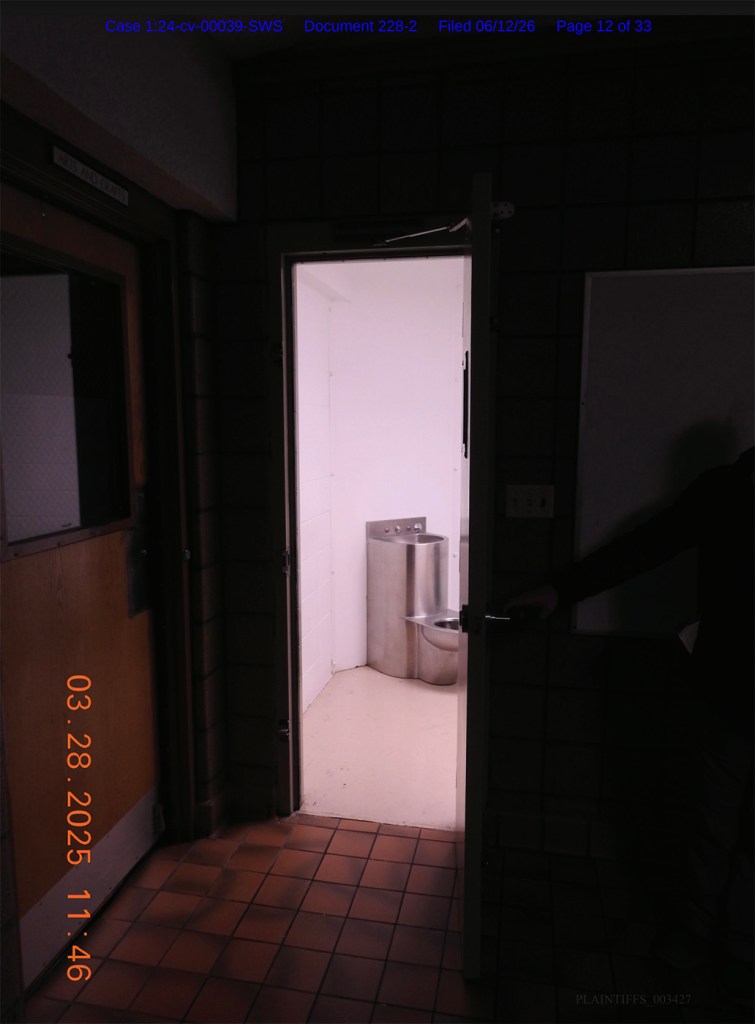
The jury listened to hours of the plaintiff’s attorneys going through logbook entries Thursday that documented staff’s interactions with Chivers-King while he was confined on multiple occasions in cinderblock detention rooms at the state facility.
Based on those entries, Chivers-King on most days interacted with other people for less than an hour and was only let out of the room to take a shower. Attorneys showed the jury documents that outlined a schedule showing activities that a day in detention was supposed to include, such as school and reading assignments. Logbook entries didn’t reflect that Chivers-King received such assignments on most days he was in detention, nor do they show that a mental health practitioner visited Chivers-King when he was harming himself.
The defense highlighted that school policies didn’t require staff to log every interaction with a student in detention. Weber testified Thursday that he expected staff to communicate with Chivers-King through the door during required checks every 15 minutes and, if he was being safe, to open the door and interact with him. “I believe that even though the logbooks don’t show it, I believe that staff were in and out of the room, having conversations with him,” Weber said, acknowledging that he didn’t have first-hand knowledge of this.


Defense attorneys have argued that Chivers-King’s confinement was necessary for safety and to prevent disruptions for other kids. Weber described Chivers-King, who was 15 when first admitted to the boys’ school, as “a pretty big kid, pretty strong.”
“He was unpredictable, volatile. We believe he presented a fairly significant danger,” Weber testified. This was particularly concerning, Weber said, because Chivers-King was in a dorm with some of the “youngest, smallest students.” Though Chivers-King had on multiple occasions assaulted staff, Weber said he had no knowledge of the former resident ever assaulting one of his peers.
Staff expected Chivers-King to demonstrate a “credible” commitment to being safe by having two consecutive days of good behavior in detention before he could be released. This predetermined amount of detention time is central to attorneys’ argument that staff violated the 14th Amendment, which protects detained people from arbitrary punishment.
The trial is the first of several concerning former residents’ accusations of abuse against the school. The next is scheduled to start Dec. 7.