

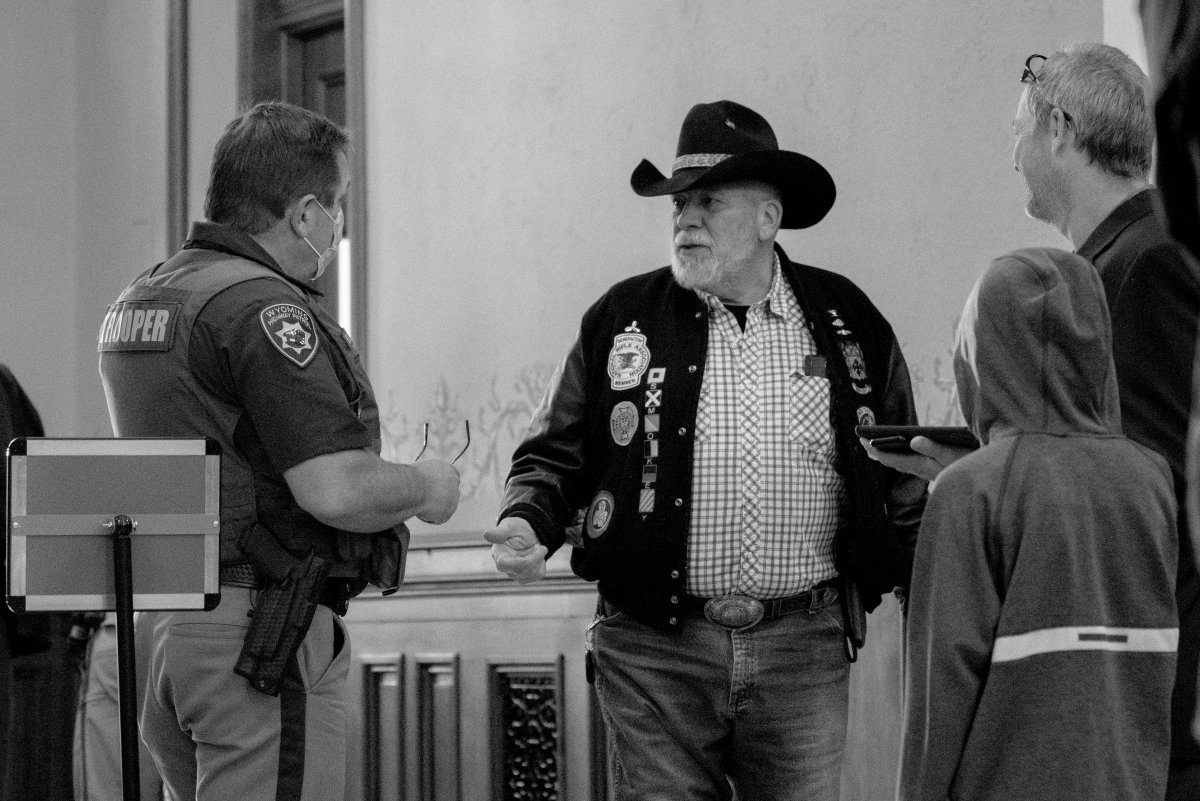
In what might be a security first, visitors to Wyoming’s statehouse on Jan. 12 were subject to a state trooper’s wave with a metal detecting wand and a bag search.
State troopers implemented the measure for the visiting public on the first day of the 66th Wyoming Legislature. The decision came in the wake of Jan. 6’s armed insurrection at the U.S. Capitol in Washington D.C. and following a warning from the FBI about possible unrest at the 50 state capitol buildings.
Officers manning the checkpoint informed visitors they could not bring weapons into the building, Highway Patrol Sergeant Jeremy Beck said. Interactions on Jan. 12 were civil, he said. One man returned to his car before coming back to enter the statehouse, presumably to drop off a weapon, Beck said.
A security checkpoint for the public entering the “people’s house” to observe the Legislature could be a first for Wyoming, two longtime lawmakers and one longtime legislative observer told WyoFile. Precedents came because of a visiting dignitary, such as former-Vice President Dick Cheney, said Marguerite Herman, a former statehouse reporter and current legislative liaison for the League of Women Voters of Wyoming.
“It wouldn’t have been connected to an event, it would’ve been connected to a visitor of some high profile,” Herman said.
Sen. Charles Scott (R-Casper), the Legislature’s longest-serving member, recalled enhanced security somewhere in the state during a visit from former-President Ronald Reagan. “The secret service gets real uptight about things and you can’t blame them,” he said. A Casper Star-Tribune article on Reagan’s history with Wyoming notes several trips here but none to the Capitol building.
Other than such visits, neither Herman nor Scott could remember a time when the public or lawmakers were searched coming into the Capitol. That’s not to say it couldn’t have happened, however. “That kind of minor nuisance is so common in our society these days you hardly notice it anymore,” Scott said.
Over two decades of service — first as a representative, then a senator and ultimately Senate president — Cheyenne Municipal Judge Tony Ross does not remember any security measures comparable to this week’s, he said. Ross served on the legislative committee that oversaw the recent years-long project to restore the Capitol building. That committee considered the installation of more permanent metal detectors but ultimately rejected the idea, he said.
“The overall objective at the time was to keep the Capitol as open as possible,” Ross said. “Nobody would have anticipated the kind of stuff going on now.” Like others interviewed, he hoped the enhanced security will be just a temporary measure. “Everybody needs to simmer down, calm down and get through this as peacefully as possible and hopefully we return to normal,” he said.
Wyoming is an outlier in not having metal detectors in place already. Before the riot in D.C., at least 32 state capitols had metal detectors in place, Mick Bullock, public affairs director for the National Conference of State Legislatures, told WyoFile.
The measures were unfortunately necessary, Scott said. “You put up with these things and take the measures necessary so that Democracy can continue,” he said. Wyoming is “kind of unique in that we haven’t bothered,” until now.
