

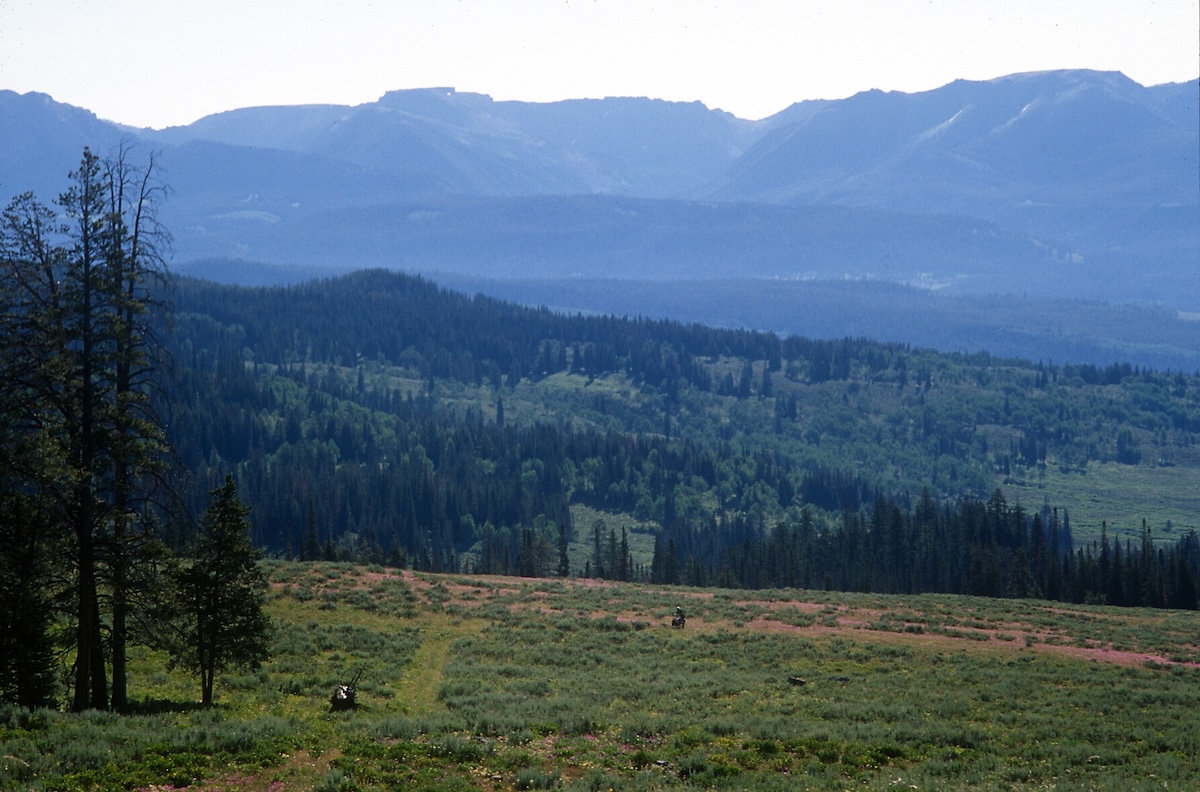
What a difference a year makes.
By most accounts, 2025 was a difficult year for the champions of America’s public lands. Challenges came from almost every front, including Wyoming’s own statehouse, where Senate Joint Resolution 2 called for the transfer of all federal land in Wyoming (except Yellowstone National Park) to the state. It was defeated in the Senate by a single vote.
Opinion
This year, however, Wyoming reached a monumental turning point. Rather than calling for the transfer — and eventual selloff — of our state’s 30 million acres of public lands, the Wyoming Legislature passed a resolution that calls on Congress to recognize the value of keeping our public lands in public hands. Flanked by legislators, hunters and outdoor advocates, Gov. Mark Gordon signed the bill late last week in a public ceremony.
Senate Joint Resolution 9, “Keeping public lands protected and decisions local,” requests our federal leaders affirm Wyoming’s freedom of access to public lands while recognizing the need for responsible development, local input and multiple-use management including recreation, agriculture, energy and conservation.
By passing this resolution in the 2026 legislative session, state lawmakers showed us they’re not only listening to us, but they’re willing to go on the record and take action toward keeping Wyoming’s outdoor traditions and way of life intact.
As the primary sponsor of SJ 9, Sen. Eric Barlow, R-Gillette, deserves recognition for leading this remarkable change in tone at the Capitol to reflect the people’s voice. Also deserving of praise are the no less than 38 lawmakers across both chambers who signed on as co-sponsors of the bill, and the whopping 81 who ultimately voted in favor of passing it. This sends a strong signal that our elected leaders recognize that keeping public lands in public hands is a fundamental Wyoming value that deserves to be carried forward for future generations. It gives businesses like ours, and the local economies tied to public land access, greater certainty that these lands won’t be privatized.
We saw that during testimony in support of the bill when dozens of everyday residents — schoolteachers, miners, outfitters, ranchers, small business owners, hunters, anglers, conservationists and many more — spoke up with a unified voice of caring for the places that shape our lives, livelihoods and local economies. These Wyomingites shared stories with legislators that exemplified how much they value Wyoming’s public lands as the common ground that provides our communities with local jobs, freedom of access for recreation opportunities, wildlife habitat, clean water and so many other benefits that make our way of life possible.
More importantly, our legislators and governor listened. They recognized that public lands matter to us, and we value keeping them public because they are woven into the Wyoming way of life and the freedoms we enjoy.
That’s a far cry from where state leaders stood just a year ago and cements a reliable foundation that small businesses like ours can build upon with confidence moving forward. By acknowledging that Wyoming’s future is grounded in our heritage, this resolution allows us to swap uncertainty with a commitment to stay the course — building a working economy while respecting the outdoor traditions that define who we are. This is a testament to how united we are around our public lands.
It’s important that we not only recognize the importance of these public lands in shaping what Wyoming is today, but also protect them in order to protect Wyoming’s quality of life for tomorrow. These lands are both an essential economic generator and an important conduit connecting us as one community grounded by a bond shared across generations. They are the places we work and play, live and learn, escape and reconnect, let go and embrace challenges — and that must not be diminished.
Elsewhere across the West and from our nation’s capital, proposals may continue to emerge that would transfer or sell off millions of acres of our public lands to states that can’t afford to manage them, or private interests that would profit from them at the public’s expense. Should those sell-offs become reality, this great American legacy will be gone for good, imperiling our economy and taking our outdoor traditions away with them.
Here in Wyoming, we can stand united behind the promise offered by SJ 9 that codifies our state Legislature’s commitment to protecting the public lands that support our communities and sustain our quality of life. Thank you, Sen. Barlow, members of the Wyoming Legislature, and Gov. Gordon for listening to the input from the thousands of people in our state who recognize the importance of these lands and the weight of this moment. This session’s momentous turn of events is an achievement worth celebrating and will go a long way toward maintaining Wyoming’s outdoor heritage and economy for generations to come.
Update: The subtitle was changed to clarify the resolution’s support for protecting public lands. —Eds.

Thank you Steve and Ellen. Beautifully written.
Thank you Ellen and Steve for your thoughtful editorial, and thank you WyoFile for publishing it, where it can be read by a statewide audience. The internet gives citizens opportunities that we didn’t have even ten years ago to find out the voting records of those running for office. It also gives us opportunities for demanding government transparency and exposing situations that go against the public interest. There’s not much we can do about the DC swamp, but we can sure demand better from Wyoming.
I’d be happy to aid the efforts by pointing to the opportunities to do things better.
The change of heart from our ‘reps’ is from the power of the people. There will be many more attempts by the right to sell our PUBLIC LANDS. Stay alert, and be ready to fight the fight. Do not let your guard down.
Yes, huge acreage tracks of existing State lands have already been sold by Freedom Caucus maniacs. We read about these sales every day. (crickets) There were discussions last year to allow very small amounts of specific and targeted BLM land to be sold for housing expansion around a few spots like Kemmerer only after local and State input and recommendations provided. Of course this was all blown totally out of proportion with the gimmick that half our State was fixing to be sold. The only large acreage restrictions I’m aware of have been from the feds concerning both the Buffalo and Rock Springs RMPs (resource management plans). The risk of large scale land restrictions demonstrably comes much more from the feds than from the State. Stinks that we rent half our State from the feds on an unconstitutional basis. This new bill helps provide a stance, but I’m not sure how much bite it has when push comes to shove from the feds. Looks more like a free ‘Barlow for Governor’ add to me.
Wyoming has sold about 800,000 acres of state land. That’s huge.
But the bottom line is that if we want to keep local support for public land, BLM and FS have to be managed for multiple use. Nothing will erode support for public land faster than managing them like they are a National Park.
Well stated, and no NACs! (natural asset companies) for some pie in the sky green scam.
Via Grok:
Wyoming manages state trust lands (primarily school and institutional trust lands, about 3.6 million acres currently, originally granted ~4.2 million at statehood) through the Office of State Lands and Investments (OSLI) and the Board of Land Commissioners. These lands are held in trust to generate revenue (mainly for schools) via leases, mineral rights, and occasional sales or exchanges when beneficial to the trust.
State trust lands are not routinely sold on a large scale. The focus is long-term value and sustainable revenue. Sales, acquisitions, and exchanges occur under specific rules (e.g., Chapter 26 of Board Rules), often to consolidate holdings, improve access, or resolve inholdings.
Key points from available information:
Since 2006, the Land Transaction Program completed about 80 transactions (sales, acquisitions, exchanges), resulting in a net gain of over 30,000 acres of publicly accessible state trust lands (as of recent OSLI FAQs). This indicates more land acquired or exchanged in than sold outright.
Revenue from land sales is minimal compared to leases (e.g., in older reports like FY 2021-2022, land sales contributed ~0.05-0.08% of other trust revenue).
Historical sales include notable cases like inholdings in Grand Teton National Park: The state sold parcels to the federal government (e.g., Antelope Flats in 2016 for $46 million, and the 640-acre Kelly Parcel in late 2024 for $100 million, with proceeds potentially used to acquire other federal lands).
No evidence of widespread or recent large-scale sales to private buyers or companies in the current period (up to March 2026). Discussions often revolve around federal public lands (BLM/Forest Service) proposals to sell or transfer, which Wyoming lawmakers opposed in 2026 via resolutions (e.g., SJR9, signed by Gov. Gordon, rejecting broad disposals).
A 2026 legislative proposal (HB55 by Rep. Jacob Wasserburger) aimed to sell 30,000–200,000 acres of non-trust state lands (not revenue-generating trust lands) in 10-acre parcels at $1/acre for housing, but this targeted “unnecessary” lands and was not yet enacted or implemented based on available info.
One comment in public discourse mentioned Wyoming having sold ~800,000 acres historically, but this likely refers to cumulative disposals over decades (including early statehood adjustments or exchanges), not recent activity.
It doesn’t matter how long ago land was sold. My comment is about PUBLIC LAND. All public land. Do you not know the difference between state land and federal land? You might want to read the headline. You should also acknowledge the attempt at selling thousands of acres.