

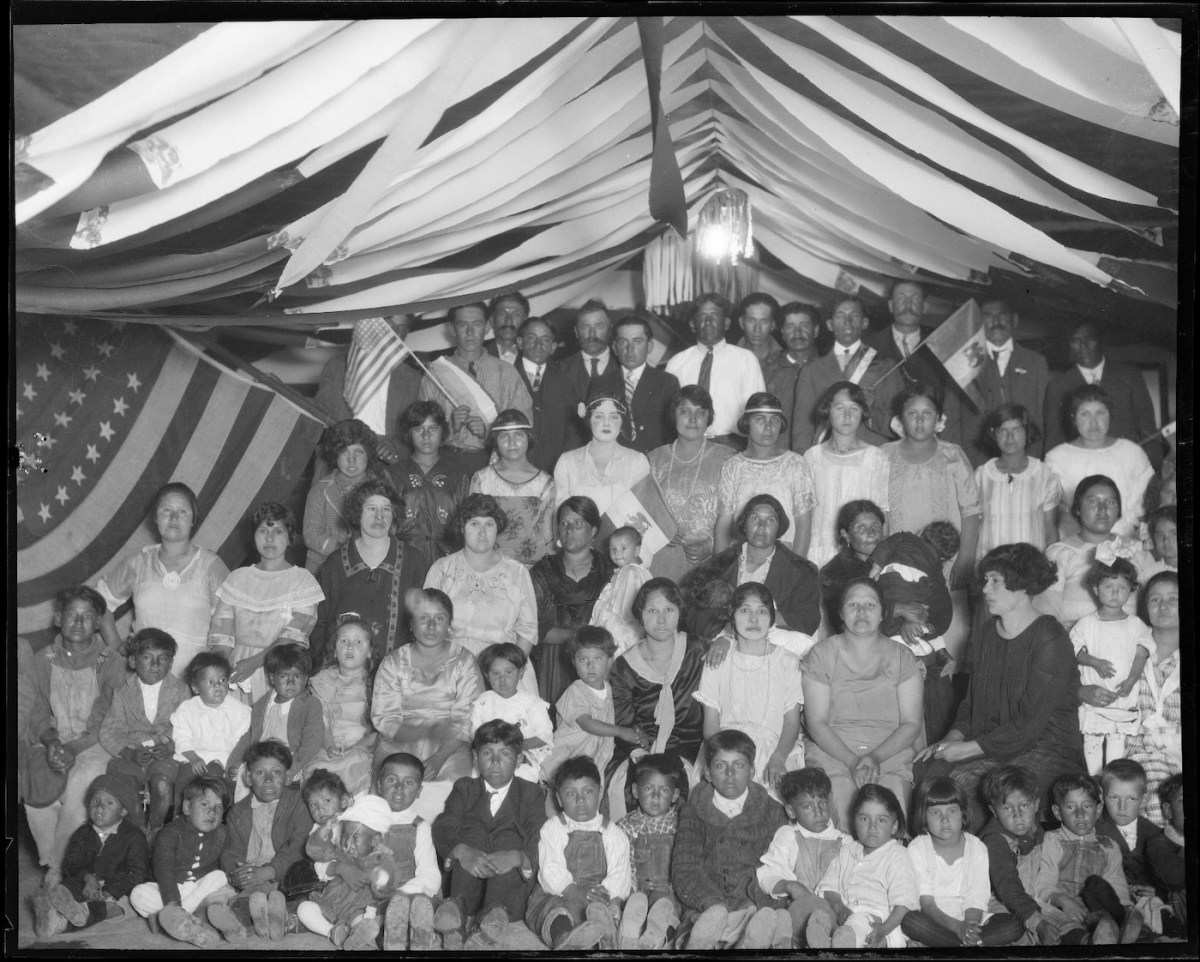
Growing up in the Bighorn Basin, Ismael Dominguez described himself as feeling distinct, as a Mexican-American in a majority white state, but also connected to a heritage of immigrant laborers who flowed to northern Wyoming to work its sugar beet fields and then built community.
Dominguez, who studied metalsmithing and sculpture at the University of Wyoming and today lives in Laramie, is honoring his roots — quite literally through his creation of a several foot high replica of a sugar beet — in a new art exhibit on display in the Laramie Plains Civic Center.
Called Migración: Betabeleros, the exhibit celebrates the migrant workers whose wearying work was the backbone of the sugar beet industry in the Bighorn River Basin. His artwork incorporates historic photographs, like the one atop this week’s Photo Friday, with textile sculptures of fields and the houses workers lived in — including the house Dominguez grew up in, he told a crowd that gathered in Laramie for the exhibit’s March 8 opening.
“This work is an homage or offering to my ancestors and living family members who carried themselves and our lineage through the fields,” Dominguez wrote in a statement introducing the work. “So I could have the privilege of never having to know that kind of manual labor.”
Dominguez was joined at the opening of his exhibit by two University of Wyoming linguistic scholars, Chelsea Escalante and Conxita Domènech. In 1927, the Powell Tribune ran a weekly publication called La Pagina Espanol. The Spanish language paper only operated for one year, publishing 23 editions inserted in the Tribune and sponsored by the Great Western Sugar Company.
The newspaper documents the development of a community within a community in the Bighorn Basin, the two professors said, including clear segregation. The newspaper ran notices welcoming migrant workers to the local movie theater and to a Fourth of July celebration, Escalante said. But it also directed the betabeleros and their families to separate themselves.
“We want you to go to the movie theater, but please stay only on the western side, because that is your site,” Escalante said, characterizing the newspaper’s language. “You cannot sit on the eastern side. That’s for the white people. At the Fourth of July celebration, it was ‘come to the Fourth of July celebration’… But come at 4 p.m., after the Anglo celebration.”
The exhibit runs in the Gorgon Gallery, in room 332 of the Laramie Plains Civic Center, until April 30. Dominguez plans to show it in Powell and Cheyenne, though he said Friday he had not yet pinned down the dates. The exhibit includes testimony, both written and played aloud, from his relatives, recounting their time in the fields and the betabelero community.
Dominguez is calling for more people to share memories about Wyoming’s sugar beet industry. Stories can be submitted online at lpccwy.or/gorgongallery or in an email to awallace@lpccwy.org.

Excepted from my Wyofile report 14 years ago:
This summer in the Bighorn Basin, there was the conspicuous absence of a sight seen for many decades: migrant farm-worker families toiling with hoes in the beet fields, their camper-topped pickup trucks with Texas plates parked by the road.
With the soil saturated by heavy rains, you would expect to see, along with thriving crops, a riot of sprouting weeds attacked by squads of busy field workers. But — save for a few hardy, insurgent Canadian thistles — there are no weeds in the long, neat rows of leafy sugar beet plants. And so, no workers.
Why no weeds? “Roundup Ready” beet seeds — genetically modified organisms (GMO), already tailored for corn, soybeans and cotton, came to the Bighorn Basin in 2009. Almost all area farmers have taken to planting beet seeds engineered to resist the mortal effects of Monsanto’s Roundup herbicide.
My wife and I were in Puerto Vallarta 15 years ago or so and we took a cab ride. The cabbie asked where we were from and we told him Wyoming. He knew quite a bit about Wyoming. He told us that he had spent time in Worland working sugar beets. That’s a pretty long commute for work when you think about it.
There were a lot of beet farms in the Riverton area where I grew up, and housing for the summer workers joined our place on the south. One day I, a 5 foot 14 year old female was buck raking our hay field when they drove by to go to their housing. It was an old stacker & if I overloaded it I had to stop and lift the fork while the tractor was running to get it off the ground. A truck load of laborers drove by as I was lifting it and ran off the road watching. They must have thought I was one strong little girl.
and to think, the esteemed state senator from Torrington, Cherie Steinmetz, the unFreedom caucus mouthpiece and wanna be SS Maga Field Marshall , would of salivated at the opportunity to detain these people and LOCK’EM UP!
I was sorry to miss the opening of Ishmael’s show in Laramie. I was unaware of his family’s heritage. I look forward to seeing it and learning more when it comes to Cheyenne.