

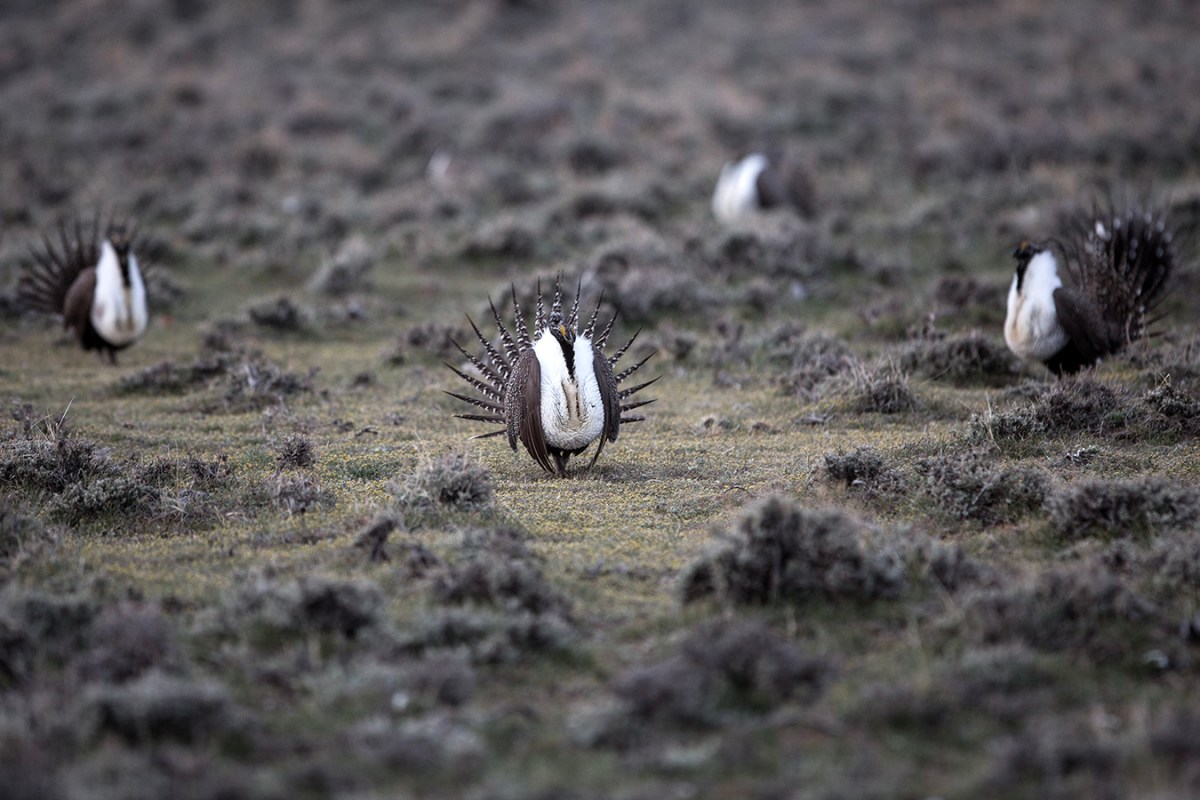
A new lawsuit argues that the Bureau of Land Management’s recently revised sage grouse plans for Wyoming and Montana are inadequate to reverse population declines that have continued to plague the beleaguered bird.
Filed by Earthjustice on Thursday in the U.S. District Court of Montana, the 68-page complaint contends that the Trump administration in 2025 did away with conservation safeguards implemented under the Obama administration. Those safeguards prevented federal wildlife officials from listing sage grouse under the Endangered Species Act 11 years ago.
“The Trump administration is basically gutting those plans, and reneging on the commitments it made in 2015 to protect the sage grouse,” Earthjustice senior attorney Mike Freeman told WyoFile on Friday. “They really just ignore the science and haven’t faced up to the question of whether these plans put sage grouse on a trajectory towards extinction.”
Earthjustice is representing the Montana Wildlife Federation, The Wilderness Society and Defenders of Wildlife. U.S. Secretary of the Interior Doug Burgum — who oversees the BLM — is listed as the primary defendant.
The complaint argues watered-down plans have enabled continued sage grouse declines in Wyoming and Montana, which encompass “over half” the remaining sage grouse in the world and are a “critical bulwark” for the population.

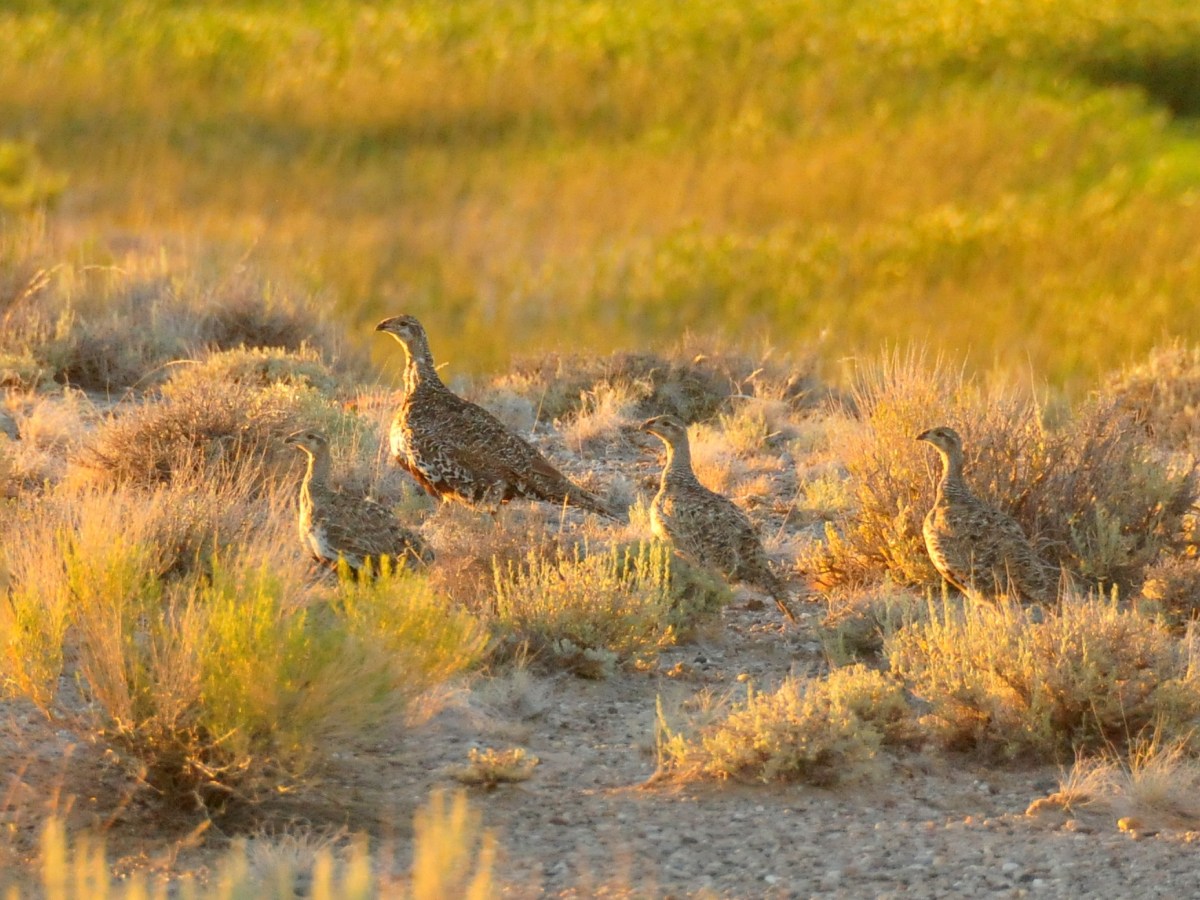
“[W]hile BLM’s management prescriptions have changed, the plight of the sage-grouse has not,” Earthjustice’s lawsuit states. “The species remains in decline, with populations diminishing by 13% across eastern Wyoming and Montana, and 24% in western Wyoming, since 2013.”
Earthjustice’s complaint is the second lawsuit of this sort.
On March 2, Advocates for the West sued the BLM on behalf of seven conservation groups who disagree with the agency’s entire nine-state policy, which covers 65 million acres of sage grouse habitat in Montana, California, Colorado, Idaho, Nevada, North Dakota, South Dakota, Utah and Wyoming.
Some claims in the two lawsuits echo each other. Both, for example, take issue with the BLM no longer prioritizing oil and gas infrastructure outside of sage grouse habitat. The two lawsuits also cite the federal agency abandoning a “targeted annual warning system” that was intended to flag sage grouse subpopulations where the birds are in trouble.
Because both lawsuits were filed in the U.S. District Court of Montana, they may be consolidated.
“We’ll see what the court wants to do,” Freeman said. “It’s very possible.”

Gov. Mark Gordon’s office told WyoFile in a statement on Friday that the state is weighing whether to intervene in the case. The governor lauded Wyoming’s sage grouse policy, and said the state is “continuing to adapt the [policy] with best-available science.”
“Wyoming has been and continues to be a pioneer in sage-grouse protection and management, supported by over 60 years of experience,” Gordon said.
In the BLM’s late 2025 revision, the agency deferred to the states, including Wyoming.
Wyoming houses roughly 40% of the sage grouse left in the world, largely as a result of having the most intact remaining sagebrush ecosystem.
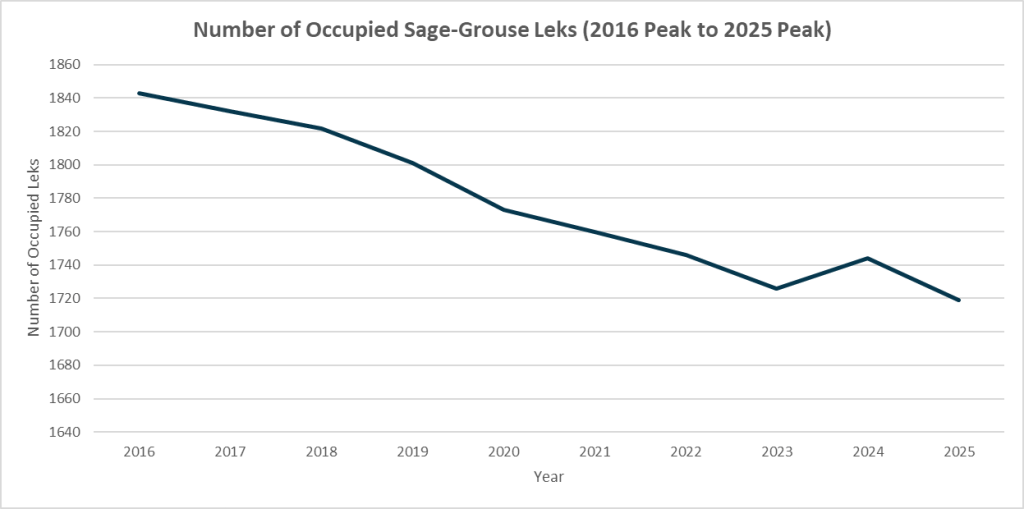
Still, despite temporary cyclic population upswings, grouse numbers have stayed in a long-term decline, Wyoming Game and Fish Department data shows. Between 2016 and 2025, the number of occupied sage grouse leks — where the birds strut and breed — fell 6.5%, from roughly 1,840 to 1,720.
The recent population declines detailed in Earthjustice’s complaint (13% in eastern Wyoming and 24% in western Wyoming) come from a 2024 U.S. Geological Survey study, according to Freeman.
Earthjustice is asking the federal court to strike down the BLM’s 2025 sage grouse plans for Wyoming and Montana, reverting to the Obama administration-era 2015 plans.
Attorneys argue violations of the National Environmental Policy Act, Administrative Procedure Act and Federal Land Policy and Management Act.
The latter statute is the “core law” that governs how the BLM is supposed to manage public lands, Freeman said.
“Part of BLM’s central mandate is that it needs to maintain sustainable populations of native species,” he said. “It can’t just run our public lands to maximize oil and gas development and let species like the sage grouse go extinct.”
There are at least two reports out that were prepared by numerous professionals that I’m hoping are part of the suit. The reports layout exactly what sage-grouse need and how they should be managed.
If you really want to help the Sage Grouse out do something with the Magpies and Raven, Crows they do more damage to the nest and chicks.
What’s New, the BLM has ignored ” best available science” for decades.
The BLM follows the, ” best available local political science” in there decision making.
If you want to witness destruction of Sage Grouse habitat on public lands, look no further than the Cody Wyoming BLM District. Severe overgrazing of drought stricken BLM ground has been going on for years and the range managers apparently just look the other way. There’s not much left out there, cow patty city, munched down grass nubs and a very tired and anemic looking sage brush. The watering areas are deeply grooved and stomped on by the cattle and many of these creek bottoms and reservoirs are so mangled up that little to no water is held back. When you see a cow and her calf out there, the grazing “fee” is $1.35 a month for the pair, so nearly free grazing for the rancher and extremely bad news for the Sage Grouse, Antelope, Mule Deer and other critters that depend on a healthy desert environment to live on. Ya, you can complain to the BLM, they’ll brand you as an uneducated rube and a liar and scoff you out of there building
Meh. These groups sue about EVERYTHING but do absolutely nothing to improve habitat on the ground. They are just a bunch of lawyers getting rich off of taxpayers by abusing EAJA. Their argument might have some merit, but it would have far more credibility if it was coming from someone else.