


FREMONT COUNTY—Lander Burton, who lives in the town she was named after, has a night-owl toddler. Sometimes when she and her little one are up in the wee hours, Burton, who has asthma, checks the air quality.
That’s what she was doing one night in early June when she was surprised by her smartphone’s report an air quality index of over 100 — which is unhealthy for certain sensitive people.
“I was like, ‘whoa,’” she said. That’s the kind of readings she would see in her former home of Los Angeles, and the kind of air quality she wanted to escape when she moved to Wyoming a couple years ago.
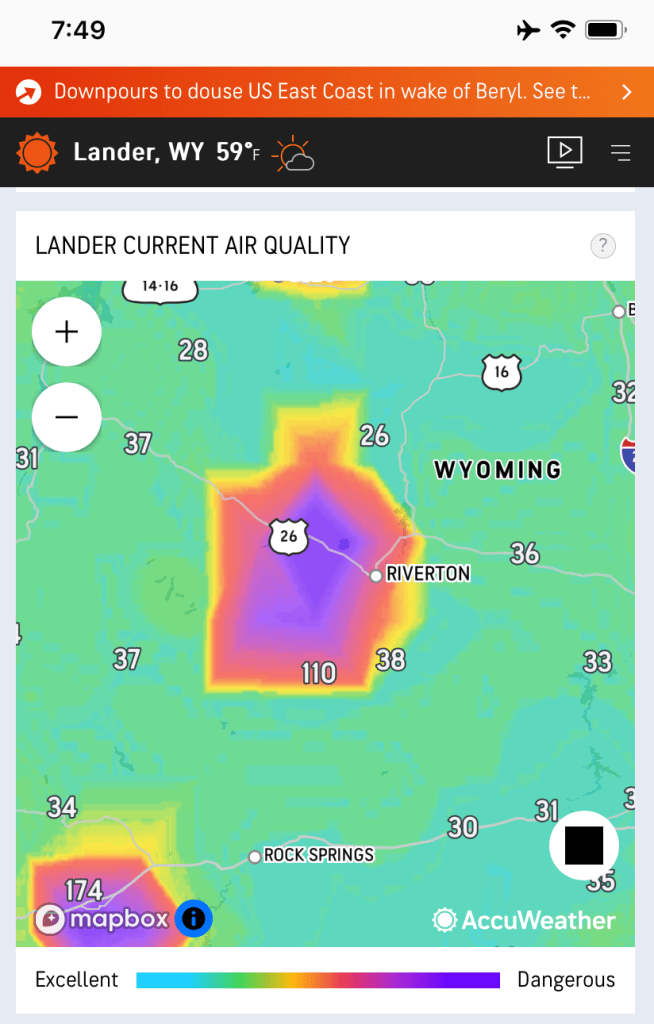
“And then I [checked] the next couple nights,” Burton continued. “Same readings, and it was always this like, bull’s eye [of hazardous air quality] over Pavilion-Kinnear-Wind River Reservation.”
The poor conditions seemed to peak before dawn and then improve by mid-morning, she said. That seemed weird too, different from patterns she’s long observed. Concerned, Burton began scanning a broader assortment of monitoring sources, and things got even stranger. Some readings of central Wyoming air quality were good while others showed dangerous levels of airborne particulates and other pollutants.
And those dangerous ones climbed into scary numbers — 200s, 300s and higher on some days. The U.S. Air Quality Index categorizes anything over 200 as “very unhealthy” and over 300 as “hazardous.”
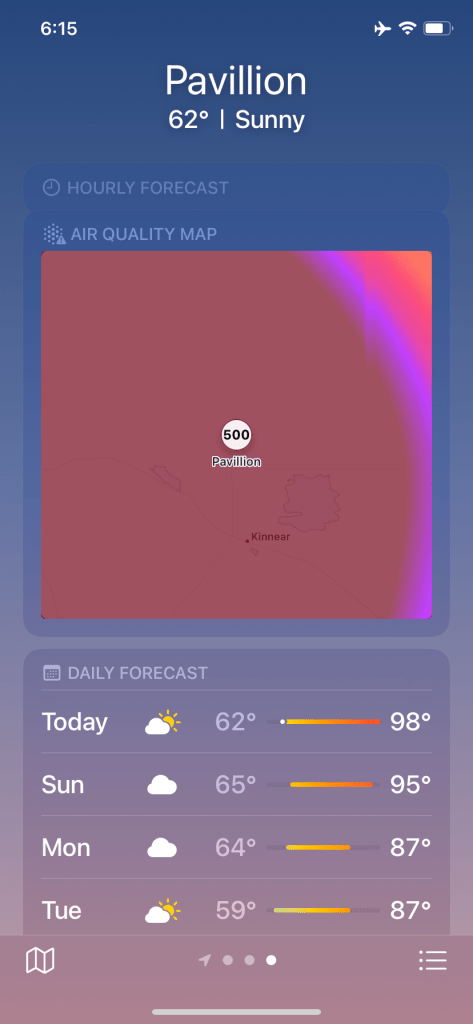
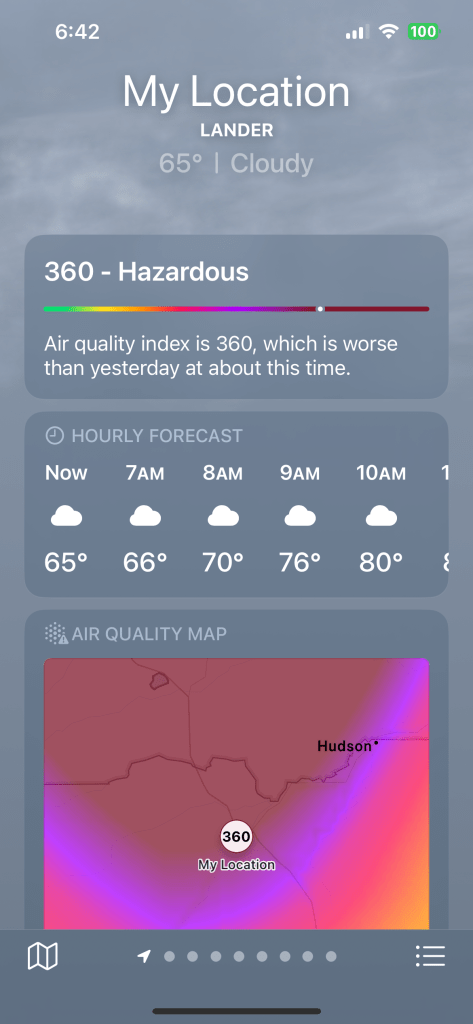
Burton isn’t alone. Other county residents have been worried about the air they breathe this summer and confused by inconsistent — and at times contradictory — reports.
The disparities and resulting confusion stem not from any nefarious cover-up, according to a U.S. Environmental Protection Agency official, but rather from differences between how the government and private third-party monitors measure, calculate and communicate air quality.
“Third party air quality data often display different air quality indices and color categories,” Aaron Worstell, environmental engineer for EPA Region 8 Air Resources Division, wrote in an email that the Wyoming Department of Environmental Quality forwarded to WyoFile in response to questions. “This is confusing, potentially misleading, and leaves the public with conflicting messages.”
The agency’s response doesn’t satisfy Burton, however. For her, questions remain about what is causing the discrepancies and if the agencies have truly ruled out harmful pollution sources.
Air quality 101
The Wyoming Department of Environmental Quality ensures that air quality in Wyoming is monitored and maintained per the National Ambient Air Quality Standards, according to the department’s air quality division. The agency follows standards to ensure certain particulates and gasses remain under specific levels.
As part of that task, DEQ operates and maintains a network of ambient air quality monitors around Wyoming. The agency loads its air data into the U.S. Environmental Protection Agency’s Air Quality System database using that agency’s standards, and posts its air quality readings on wyvisnet.com. The same results are posted on airnow.gov, a partnership of the EPA, National Oceanic and Atmospheric Administration, National Park Service, NASA, Centers for Disease Control, and tribal, state and local air quality agencies.
The EPA maintains official Air Quality Indices for five major pollutants — ozone, particulate matter, carbon monoxide, nitrogen dioxide and sulfur dioxide — and uses individualized standards for each. For example, ozone is measured using an eight-hour average. But the presence of particulate-matter-2.5 — a type of pollution consisting of airborne particles 2.5 micrometers in diameter or smaller — is reported through a 24-hour average of individual readings.
By contrast, private sources of air quality monitoring and reporting — like those often affiliated with smartphone apps and online weather forecasting sites — don’t necessarily use the same methods or standards as the government.
Private companies typically obtain or calculate their air quality data through a number of methods, Worstell with the EPA wrote in his email response, “such as permanent and temporary regulatory monitoring sites, multiple models, satellite data, weather forecasting and meteorological information, low-cost sensors, algorithms, machine-learning techniques, forecasts, etc.”
These companies often utilize different color and quality indices, he continued, which can also lead to public confusion.
“It is important to point out that anytime you see third parties reporting an ‘instantaneous’ PM2.5 number, AQI, or anything other than the NowCast value for averaging times of less than 24 hours, they are not following EPA’s methodology,” he wrote.
Air quality reports in Apple’s iPhone’s weather app, for example, come from BreezeoMeter, which acquires data through “sensing stations, artificial intelligence and machine-learning algorithms,” according to a venture capitalist website description. BreezeoMeter staff did not respond to an email query by publication time. The company is owned by Google.
But here’s an example of the differences that can pop up: On July 26, the iPhone weather app reported an air quality index of 360 for Lander, which is “hazardous.” But airnow.gov reported levels of 51-100, according to the site’s archive, which is “moderate.”
Unlike the state, however, these sites report PM10 values in addition to PM2.5 in Fremont County, Burton pointed out. That makes her wonder if high levels of PM10 that aren’t monitored and therefore not detected in the area are causing the discrepancies.
The state began monitoring air quality in 1989 with a PM10 monitor, according to wyoviz.net, and added a continuous PM2.5 monitor — which detects the smaller particulates — in 2001.
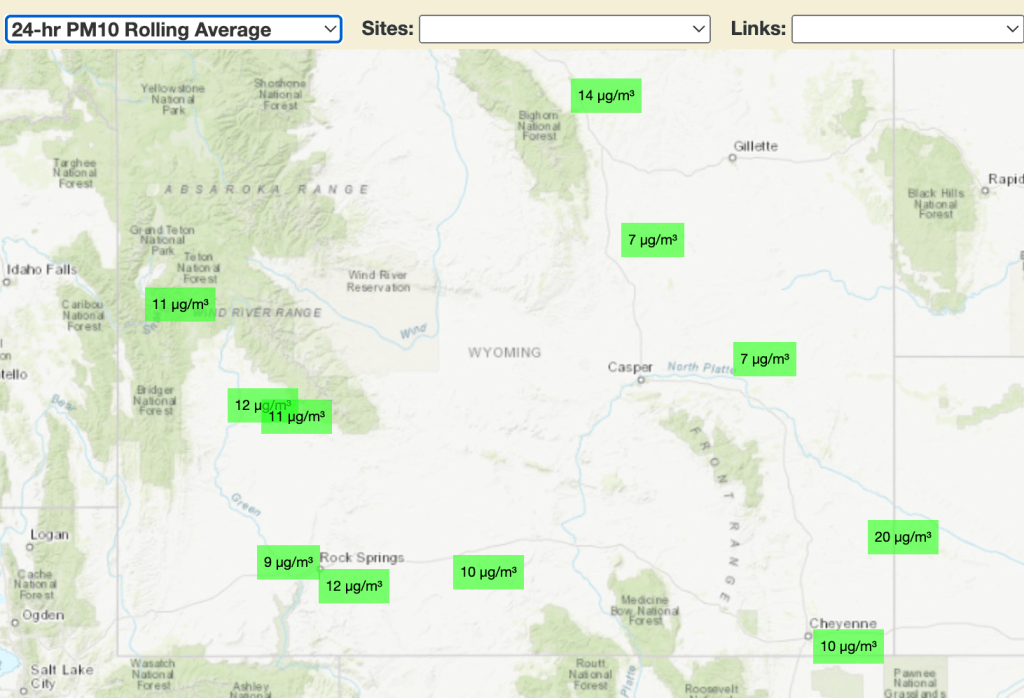
Currently, however, there are PM2.5 monitors in Lander, Riverton and South Pass, but no PM10 monitors in Fremont County, according to an EPA spokesperson.
“The WDEQ anticipates installing continuous PM10 in Lander once a viable location can be established,” Kimberly A. Mazza, public information supervisor for DEQ, told WyoFile in an email.
And after examining DEQ data of PM10 through its other sensors, Worstell concluded, “we believe that the elevated PM10 values shown in these screenshots are inconsistent with the regulatory monitoring data for the specified days.”
When there is an absence of regulatory PM10 monitoring, as there is in central Wyoming, Worstell continued, companies will likely try to calculate air quality concentrations using any other information they have. “In our experience, these techniques can lead to inconsistent datasets and egregious errors. Unfortunately, the EPA or Wy DEQ has no control over how private companies determine air quality nor what they decide to report to the public.”
Not mollified
Despite the government agencies’ reassurance, Burton wonders why, lacking PM10 monitors in central Wyoming, they haven’t taken the action to rule out PM10 pollution by simply monitoring PM10. She is also concerned that there isn’t better monitoring on the Wind River Indian Reservation, given longstanding concerns about energy-development-related pollution and the bull’s eye patterns that often show up in reports.
Three months after first noticing harmful levels, Burton still feels a little nervous about how the air affects her own health, that of her family and the many people who live in the area because they enjoy spending time outside.
Richard Mathey fits in that category. The 74-year-old retired attorney lives north of Lander and walks every morning on a trail system near his home. He often checks air quality on his phone, Weather Underground and airnow.gov before he walks, he said, and has encountered some eyebrow-raising reports this summer.
“This morning’s being a good example, both the Weather Underground and the Apple weather stations had moderate-to-poor air quality,” Mathey said on Aug. 21. Airnow, meanwhile, showed very good quality, he said. “So who’s a guy supposed to believe?”
The explanations the agencies have given, he also said, don’t fully satisfy the question of why the independent companies would show such alarming levels.
“And they are alarming,” Mathey said, adding that he would like to be more assured that he’s receiving accurate information.
“You look out the window and you can’t really tell all that much about air quality,” he said. “I would like to know whether the air is unhealthy or especially hazardous. I would refrain from walking” if it was.

The reason for the huge discrepancies is because the independent reporting companies are trying to drive the climate narrative and make everyone believe we are all doomed.
Again, thank you Katie. Thorough, fact-based and logical reporting is refreshing …er….ah…stop choking…! We felt it and now we know why.