


The U.S. Supreme Court today declined to hear Carbon County ranch owner Fred Eshelman’s appeal of a lower-court ruling that corner crossing to reach public land is legal. The decision affects access to 2.44 million acres of public land in Wyoming and more in five other states.
The Supreme Court put Eshelman’s failed lawsuit, “Iron Bar Holdings, LLC v. Cape, Bradly H., Et al.,” on its list of rejected appeals, which the court published Monday morning. The order ends a five-year fight that pitted the public’s right to access public land against private property rights.
Bradly Cape and three hunting friends corner crossed — stepping from one piece of public land to another where the two intersected with two pieces of Eshelman’s private ranch — momentarily passing through the airspace above Eshelman’s property. Even though the Missouri men never set foot on his land, Eshelman sued them for trespassing.
The hunter’s attorney, Ryan Semerad, said the Supreme Court affirmed centuries-old tradition and laws that public land is held in trust by the government for all Americans. The ruling applies to 2.44 million acres in Wyoming alone.
“That means something,” he said of the trust principle. “That’s real, it’s sturdy. We’re just thrilled.”
“Where you have checkerboarded land and there are public parcels that are only accessible by corner crossing [and] the only way to get to it is at its section corners, the private landowners can’t stop you.”
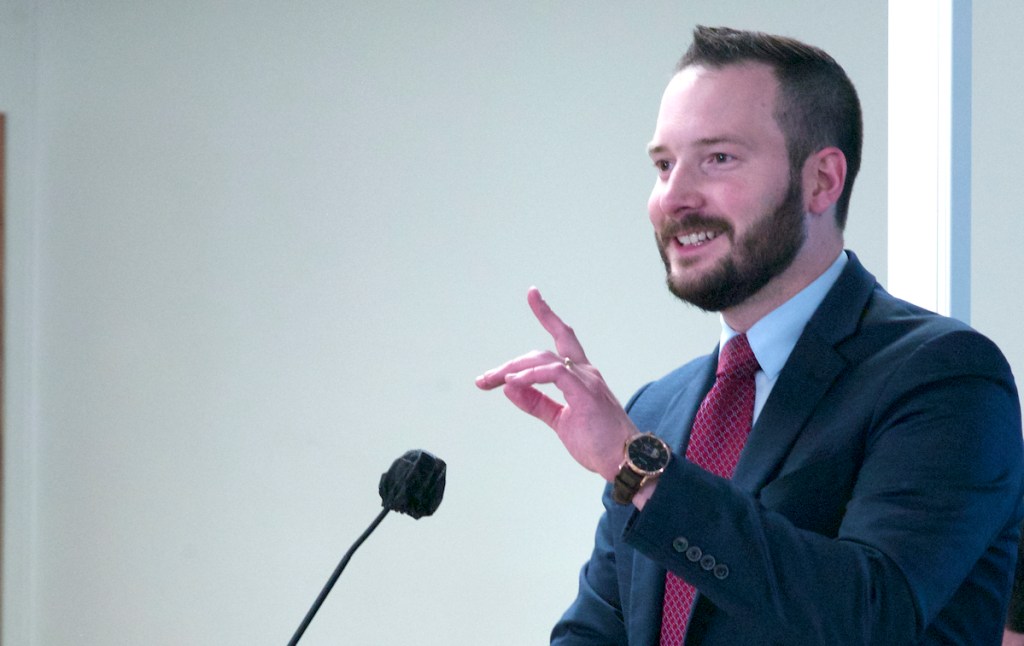
Ryan Semerad
“Awesome,” was Cape’s reaction. “We never thought one time that we were doing something wrong.”
Chief U.S. District Judge Scott Skavdahl had sided with the hunters in the first ruling on the federal civil suit. The 10th Circuit Court of Appeals backed Skavdahl and Eshelman appealed that decision to the Supreme Court. A Carbon County jury had previously found the hunters not guilty of criminal trespass in Carbon County Circuit Court.
The case grew out of southern Wyoming, where land ownership resembles a checkerboard of alternating square-mile sections of public and private property.
“Where you have checkerboarded land and there are public parcels that are only accessible by corner crossing [and] the only way to get to it is at its section corners, the private landowners can’t stop you,” Semerad said. “They can’t call the sheriff. They can’t sue you for trespass as long as you don’t touch or damage their property.”
1885 law
Eshelman’s lead attorney, R. Reeves Anderson, said he was not authorized to comment following the Supreme Court’s decision not to take up the case. Eshelman, a North Carolina resident, couldn’t be immediately reached.
The hunters’ legal arguments relied on the 1885 Unlawful Inclosures Act, which prohibits blocking public access to public land, including by fencing and using threats and intimidation. Some landowners, law officers, agencies and agriculture groups have interpreted various corner-crossing cases to insist that corner crossing is trespassing.
In a criminal case separate from Eshelman’s civil suit, the Carbon County attorney, at Eshelman’s insistence, in 2021 charged Cape, Philip Yoemans, Zach Smith and John Slowensky with misdemeanor criminal trespass.
Three of the hunters corner crossed to reach public land surrounded by Eshelman’s 20,000-acre-plus Elk Mountain Ranch in 2020. All four corner crossed to hunt on wildlife-rich Elk Mountain in 2021.
A six-person Carbon County jury found them not guilty in 2022, returning a verdict in less time than it took a hungry reporter to order and consume a quickly made taco salad from Rose’s Lariat café in Rawlins.
The Supreme Court decision today was almost as swift and certain. It filed the order without comment or dissent.
“It’s just an immediate sign they have reviewed the matter in as short a window as possible,” Semerad said of the Supreme Court. “They looked at it and said, ‘We don’t need to do anything here,’ at least that’s my interpretation.”
The order spans the 10th Circuit’s jurisdiction across Wyoming, Colorado, Utah, New Mexico, Kansas and Oklahoma. Had the Supreme Court heard the case, whatever decision it reached would have applied across all 50 states.
Mixed feelings
Cape said he was torn over whether it would have been better for the Supreme Court to take the case and expand the 10th Circuit decision across the country — an uncertain proposition — or settle for what he, his companions and the rest of the country won in the 10th Circuit. Semerad, too, said he had mixed feelings.
“There’s just this little nugget in me that’s like, I wanted to go do the fight,” he said of the now-disappeared prospect of arguing the case in front of nine justices. “But that is totally personal. I just wanted to throw some more punches.”
“But for now, this is where the book closes.”

Cape and friends had been hunting in Wyoming the year before they first corner crossed. They stumbled across Elk Mountain and talking to nearby ranchers they learned it was thick with elk to the point neighbors had to protect their haystacks from the herd.
Eshelman, they were told, didn’t allow the general public to hunt on his ranch or to corner cross to reach public land enmeshed in his holdings. By blocking corner crossing, Eshelman reaped for himself the bounty of property belonging to all Americans, the hunters contended.
Cape did some research and found a real estate agent’s listing for the ranch around the time Eshelman bought it in 2005. That listing described the ranch as consisting of both private and public property, amounting to 50 square miles or about 32,000 acres.
The ranch on the 11,156-foot-high Elk Mountain was listed for $19.9 million at the time. Court rulings, the listing stated, give the ranch owner exclusive access to the enmeshed public land.
“Reading that is first what got me to looking into such a thing,” Cape said of corner crossing. “It just didn’t make sense to me,” he said of the notion that corner crossing was illegal.
The legal case Cape found, a 1970s saga known as Leo Sheep, dealt with the construction of a road, also in Carbon County, across a common checkerboard corner. The Supreme Court said the government did not have the right to build a road that invaded private property.
Fence builder
Cape owns the All-Type Fence company in Cuba, Missouri and knows something about property lines, he said.
“All I wanted to do was walk and hike and hunt and cross the corners,” he said. “So that [Leo Sheep] case didn’t have any relevance [to] me. I kind of realized what was going on, that it [the real estate listing and similar claims] was just propaganda trying to keep people out.”
He briefed his hunting buddies — a high school music teacher, a mechanic and an employee at his company.
“Once I found this [Leo Sheep case] and figured this out kind of on my own and then relayed that information to them, they never doubted me,” he said. “They were good to go.”
Cape credited Semerad and fellow attorney Lee Mickus, the Wyoming chapter of Backcountry Hunters and Anglers and others. Backcountry Hunters raised funds to wrangle the case through the courts for five years, ensuring the men had the funding necessary to stand and fight in court.
Eshelman is a wealthy pharmaceutical magnate, a significant political donor to conservative causes and a philanthropist who’s given millions to his alma mater, the University of North Carolina. He’s also a hunter and conservationist who placed significant development restrictions on thousands of acres of private ranch land that he bought and sold around Elk Mountain.
Backcountry Hunters’ fundraising got a boost when Steven Rinella, an author, hunter, conservationist and television personality who founded The Meateater, featured the corning crossing saga in his broadcasts.
“Our money, like doubled overnight,” Cape said. “So it was pretty easy to see early on that the support that we had was incredible.”
Also incredible, Cape said, is what he learned.
“It’s just one of those life journeys that you don’t suspect,” he said. “You learn all kinds of stuff about the legal system.
“I didn’t realize … there was that much propaganda built up, selfishness.” Cape said. Landowners “just kind of made that stuff up as they went along,” he said, something that was “kind of shocking to me.”
Semerad looked ahead. “It’s a solid foundation upon which to think about how to orient your life,” he said. “There’s going to be bad actors who have their own intentions, who want to treat these public resources — like our public lands — as a private kingdom.
“But every time they do that, they are cutting against American tradition and history, and they’re going to lose and there’s going to be a way to beat them.”
In my opinion, controversy and tension is going to remain on the topic of corner crossing. Yes, the legalities have been established now via the judicial system, but the practical implications for landowners and the public are anything but clear. “Corner crossing parties” sound great in social media posts, but ask any deputy sheriff if that’s a good idea in reality.
Time for the public land agencies – including State Lands – to begin work to figure out a way to make it less contentious. In my opinion, that is exchanges that create more contiguous blocks of private, BLM, USFS, etc. Unlikely that an outgoing governor will take on this mess, but I’m hoping the next one does.
Bravo to Ryan Semerand. You did some fine legal work there, my friend.
RAWLINS, Clifford you are right about the spelling I didn’t proofread what my phone spelled. Angus, you’ve really been on top of this. It’s been A long journey for the four hunters and the lawyers and the journalist and all of us following this historic story, Good Job Thanks
Great job of investigating reporting over a span of years, Angus. I am so relieved the US Supreme Court supported the citizens and didn’t bend to a wealthy person.
Thanks, Angus! Not only are you our favorite “Cracker Journalist”, you are a pit bull on a story. 82 corner-crossing columns? Wow!
Excellent job of chasing and reporting this whole thing, Angus. Thank you.
I’m Really pleased that the discussion was on the side of the hunters ,there are too many rich land owners taking advantage of of public land as their own and profiting off of land that belongs to the public therfore I’m so pleased the judges made the right decision.
Angus – been meaning to do this for months. I apologize for not doing this sooner. Your reporting on this issue has been nothing short of stellar. Thanks for your hard work and painstaking research. You’re the real deal, my friend.
awesome , lets now move on to high water marks being public in wyomings waterways as well as the river/ lake bottom and public access to the largest landlocked public property in the lower 48 called the fortification in northeast wy.
We are lucky we live in Wyoming for many reasons. One of them is Federal Judge Scott Skavdahl. He is the judge who heard the evidence and after much thought, conducting much of his own research published a judgment which was approved of by the 10th Circuit Court of Appeals and the United Supreme Court. Please keep that in mind the next time you read about Federal judges.
Due to federal overeach granted by the Supreme Courts lack of regard for the Constitution, which violates the Constitution and private ownership Im posting a 10k fee prepay requirement for crossing corners on my property enforced with motion cameras.
Anyone found on the property day or night could potentially be found the following day.
Go for it! Will you also take it to the Supreme Court? Looking forward to the outcome. Hope you got lots of money.
I charge you $10000 for the trespass of MY public land.
Shirley your rant is a bit’o sarcasm! Can I paypal or venmo you? LOL!!!!!!!!!!!!!
and what are you going to do if you “found me” Mr. Anderson?
Watch’a gonna do? Don’t be surprised if you get “found”, Michael
Would you PLEASE tell everyone where your property is located so that we can arrange a Corner Crossing Party at the earliest possible convenience. It will be a blast!
Do what you want on your own land; the court only banned you from stealing public land.
The 1885 Unlawful Inclosures Act, which prohibits blocking public access to public land, including by fencing and using threats and intimidation.
Mr. Cape, bravo! You’ll be hearing a lot of that. As a non-lawyer myself who doesn’t like “no” for an answer, I deeply admire your insisting to understand the details when somebody gives you an answer. As you figured out, an interpretation of the law that doesn’t seem to make sense in your situation may actually not control.
My attorney in Jackson used to warn me, “Phil, be sure to state that you are not an attorney, because sometimes you can sound like one…” Okay, Hank. “Mr. Cape, I am not an attorney.” That said, I enjoyed very much the details you shared with Angus Thuermer for this story. Thank you. You will have some angry hornets buzzing around you for a while. Be careful to not say anything the hornets can make an issue about.
My father grew up in Texas and Oklahoma; he and Mom described themselves as “Okies who went the wrong way,” raising me in the northeast. The public lands are a fascination of mine. You and the team you have pulled together just made a big change in public lands law. Be proud.
But a word of caution to all: When I grew up it was expected that a hunter could cross the countryside, including on private lands, at will. It was courtesy to stop in at the farmhouse and let them know you were there and ask permission. Asking permission would often mean a slice of hot pie and good coffee when your day ended. Dad made some friendships with landowners that lasted many years. He was cautious, and never left any trace behind larger than a pheasant’s innards.
The change in attitude covers America so far as I can see. Private land owners in the Northeast, who would have thought it was rude to do, Post their land now.
You have won a sweet victory for access to Our public lands. But I imagine a group of Yahoos driving a rented crane truck up to a corner and hoisting provisions for a week-long frat party over. I can imagine an online ad to recruit people who want to do that, for a price. I hope we who want to keep this access will leave our campsite cleaner than we found it, and not let our access be a burden on the fee owners. I hope we can all just get along. Persevere.
Next, access to the hight water line on streams and rivers. Carry on.
Thank you to all who did the right thing in this case. And as I said before the price of a good Missouri jumping mule just went through the roof.google
Thank you to everyone who donated money to the public side of this fight, but most of all to the hunters and the lawyers who had the courage to take this on their shoulders for all of us.
Like others who wrote before me, I feel that portable ladders are for the young, and that alternatives could be developed to help less abled folks legally and safely access public lands. But for now WOOT WOOT!!
Oh No! Magagna and his posse of Welfare cowpokes just lost another freebie that they thought was in the bag. Don’t think that the end of this saga will mean the end of the rancher bluff charge trying to scare you off public land and with the Game & Fish in their pocket, don’t expect any hunter harassment charges to be filed.
Justice is served. It’s just too bad the Supreme Court did not get to benefit from ‘tacos at Rose’s Lariat’.
These four hunters from Missouri deserve a Super Bowl like parade probably in Rawlings. Backcountry hunters group and Steve Rinella and all the folks that financially supported this huge win for the general public should be honored in this win for the public. I am stunned that four average guys whipped a billionaire in court.
Rawlings?
No Kings and now, No Kingdoms for the likes of Eshelmen. Let’s also not forget the other groups like the Wyoming Stockgrowers Association that signed up to support Eschelmen’s Supreme Court petition. They are no friends of public land owners and users. I imagine Jim Magagna is probably crying like a little baby over this victory for the common man. And no Jim, you still cannot dictate which corner I choose to cross.
Although I have little ability to do corner crossing,due to my age,I find the Supreme Court ruling a win for able and future enthusiasts. This was a correct and just upholding of the lower Wyoming court ruling.
Wonder what happened to Eshelman’s ranch go’fer, the ‘do you know how much money my boss has’ dude? A lot of characters in this story, starting with a smooth talking real estate agent touting exclusive public lands, a billionaire pretend cowboy bully and his thug crew of local sellouts hazing and harassing the hunters on public lands. Can’t forget to mention our own esteemed game and fish department that were too chickenshit to write hunter harassment tickets and the corrupt Carbon county attorney office who falsely charged the Missouri Four. Not sure if these Missourians have any legal recourse but I’d love to see them sue the Eshelman team and his crew of corruption back to the stone ages
You bring up an important point about this whole case. I can tell you with absolute certainty that the actions of Eshelman’s employee violated both the letter and spirit of the hunter harassment statute. The Attorney General needs to investigate why there was no citation from G&F on this case.
PAST DUE RULING. Now, where are the resources to bring fair justice? DAMAGES to the public by elite? Maybe the ridiculous HOT SHOT lawyers for Eschelman, would like to make some more money??? What a bastardized case of fair and lawful public rights. Obviously the lawyers were cut from the same cloth as Eshelman. More than PATHETIC
Hurray! The people win. Now thousands of Wyomingites should stage corner crossing parties !
I was hoping for a “What’s next?” section to this article. It would be great to see a concerted effort on the part of landowners and public land managers to identify and clearly mark the affected corners to minimize future conflicts over trespassing.
Glad for this good news. I’m not a hunter, but I appreciate these men taking a stand over 5 years to protect public access to public land. The only remaining question seems to be “Did they get their elk?”
This is excellent news. Now seems like a good time for some entrepreneur to come up with a permanent corner crossing structure to be left at popular hunting areas.
Surprise surprise
Hurray, I was afraid that the Supreme Court was going to hear the appeal. This is great news for the American public whether you are a hunter / angler or not, this is you land.
Wyoming Fish and Game is hating life. I’ve called them a couple times about the corner crossing issue. The last time was today after the SC non-ruling. From their tone of voice, they wish this issue would go away and the bigshots keep the public off their public land. My guess is that they are very embarrassed about this situation since they should have been fighting for this right decades ago. They also know there will be lots of folks out there this week crossing corners and that they will be running the tires off their rigs dealing with all of the hunters taking back their rights to public land.
I’ve never found Wyoming G&F to be anti public access. In fact, quite the contrary. But as a state agency, they answer to the governor–who is a politician. G&F is also a law enforcement agency. As such, they take direction from the Wyoming attorney general. It is the governor’s and AG’s who have been giving G&F direction when it comes to the confusing laws about corner crossing. Now that the courts have clarified and decided what is and isn’t legal, I’m betting that G&F is in full support.
Now to a bigger problem most sportsmen will face. In my experience, most corners are not marked. Further, I’m not sure who is going to pay for surveyors to go out and mark them. But the sooner corners are marked, the sooner sportsmen can use the public lands that belong to them.
If there’s no corner pin, then hunter, landowner and game warden don’t truly no where the corner is. It’s up to the state to prove it’s case regarding trespassing so in lieu of a definite marker, the OnX will be just fine. Heck, that’s what the game warden uses. In the case of a missing corner, then it should be no deal if one uses OnX. The landowner won’t just be allowed to guess and certainly has the right to pay for a surveyor, at his/her expense
OnX is interesting on hunt boundries. While the orders say the area is divided by, for instance Willow Creek, OnX shows straight lines zigging and zagging. Not the creek.
A victory in the campaign to protect public lands against privatization–against enclosure of our common lands. But the war continues.
I’m glad things worked out so Wyoming sportspeople can actually use more of their public lands. Hopefully people who decide to legally corner cross will do so responsibly.
It’s over, Eshelman. Your fallacy of having sole control of public lands owned by the Citizens of the United States came crashing down at SCOTUS. Your ownership of the admiring (or bought) Wyoming Game and Fish Dept, Carbon County Wyoming Sheriff and the Carbon County Wyoming Attorney’s Office ended up being MEANINGLESS. For some supposed Billionaire with a PhD, you ain’t quite so brilliant, are ya Eshelman?! Too bad that you fell for a glossy brochure from some slick realtor that sold you on a Wyoming ranch with 1,000’s of acres of “private” BLM sections. It’s been floating around that you’ve claimed to sell out and leave Wyoming if you lost this case. I’ll help you pack, just say when! PS: can’t wait to send you a nice Christmas Card
How about that? A bully with more money than he knows what to do with it lost.
Perfect
Is this a perfect example of somebody with a bunch of money using the threat of a lawsuit and legal expenses to get their way because they know most people don’t have the resources to keep fighting? Now we need to get access to private land in the farm welfare bill and CRP programs. If farm/ranchers are going to take the taxpayers money for farm welfare programs, access needs to be tied to the money. If they don’t like it, don’t take the taxpayers money.
Whoa, nobody has the right to access private land without the landowners permission. I’m guessing you have a specific issue that is driving your comment.
THIS IS THE ISSUE
+3
Taxpayers subsidize U.S. agriculture through a combination of direct payments, insurance subsidies, and other programs, with figures varying by year and program type. For example, in 2020, government payments reached a high of \$55.3 billion, largely due to pandemic-related aid. The Congressional Budget Office projects that highly subsidized federal crop insurance will cost taxpayers \$101 billion from FY24–33, while programs like Price Loss Coverage (PLC) are projected to cost an additional \$33 billion during the same period.
Total government payments: Reached a peak of \$55.3 billion in 2020, influenced by pandemic-related aid, according to USAFacts.
Farm bill programs (FY24-33 projection): The Congressional Budget Office (CBO) projects costs for the following programs over the next decade, as noted by Taxpayers for Common Sense:
Highly subsidized federal crop insurance: \$101 billion
Price Loss Coverage (PLC): \$33 billion
Agriculture Risk Coverage (ARC): \$19 billion
Farm bill disaster programs: \$10 billion
Crop insurance premiums: In 2022, government subsidies for farmer premiums amounted to a record \$11.6 billion. The government also pays for the administrative costs of private insurance companies, projected to be about \$2 billion per year from 2024 through 2033.
Long-term average: Since 1933, farm subsidies have added an average of \$17.6 billion to farm income each year (adjusted for inflation).
Ha, you must referring to Madam Chairman Tim French of Powell, the self described rugged individualist – don’t need no gub’mint handouts….other then the 100’s of thousands of Ag subsidy dollars payments received that the Madam Chairman doesn’t think you know about
I would suggest that if you have issues, and it seems that you do, it would behoove you to take it up with your Congressional delegation. They are the ones that are responsible for all of the bills that you mentioned.