

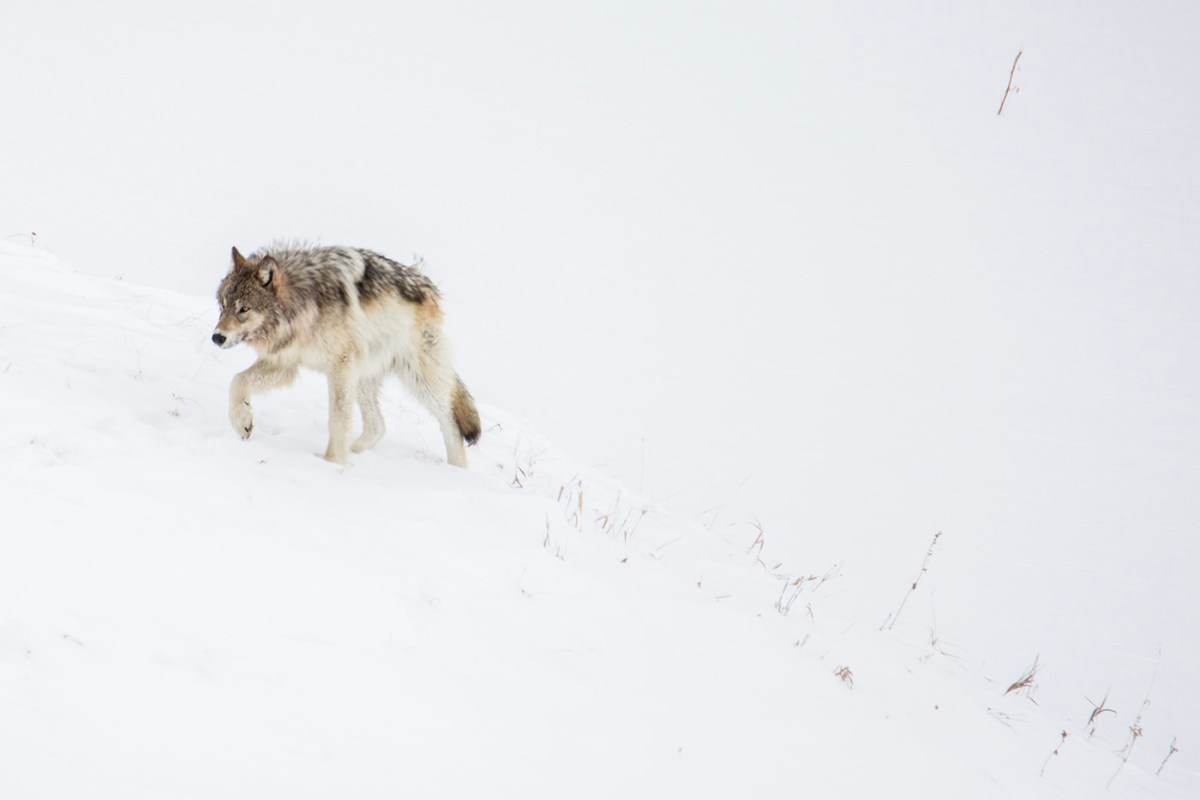
A flare up of a disease that’s especially lethal to wolf pups took a toll on Wyoming and Yellowstone National Park wolf numbers in 2025, reducing biologists’ counts to a level last seen when wolves were still reestablishing following the species’ historic 1995-96 reintroduction.
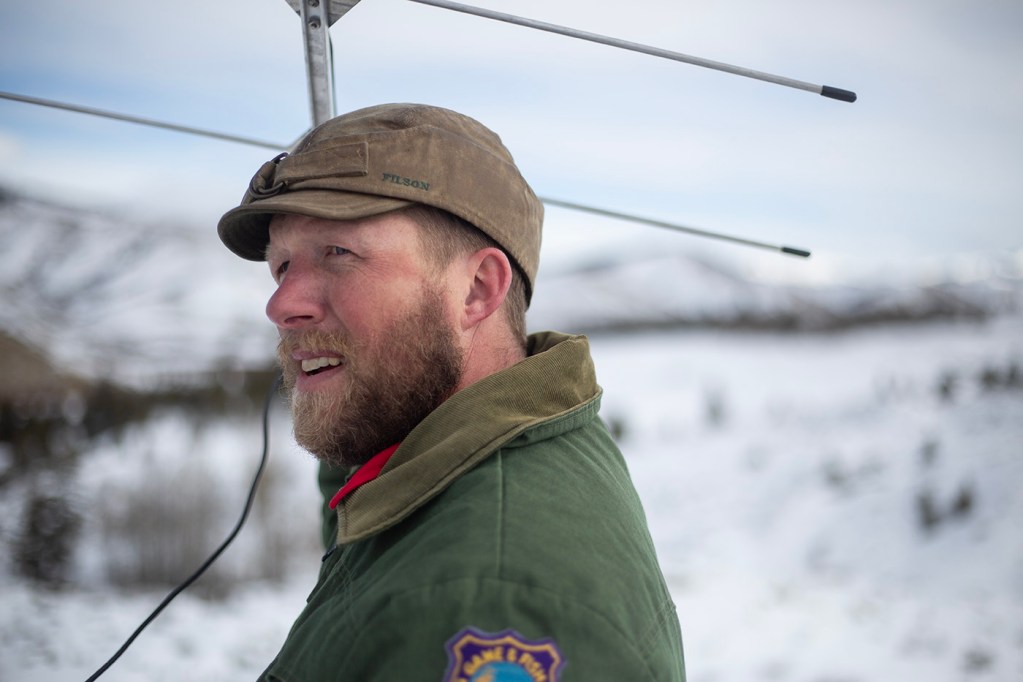
“It was the lowest number of wolves in 20 years,” Wyoming Game and Fish Department wolf biologist Ken Mills told WyoFile. “That was definitely during the population creep stage, so they were still establishing in the state.”
All signs point toward canine distemper being the primary reason Wyoming’s statewide wolf population plunged to a minimum count of 253 wolves and 14 breeding pairs at the end of 2025, Mills said.
Distemper was detected in 64% of animals in the northwestern Wyoming zone where wolves are classified as “trophy game.” While adults can survive the contagious virus, which is a measles-like affliction in canines, it’s “quite lethal” for pups and only an estimated “31 to 34” of the 87 documented born pups lived to the end of the year, a survival rate of just 37%, according to Game and Fish’s 2025 wolf monitoring report.
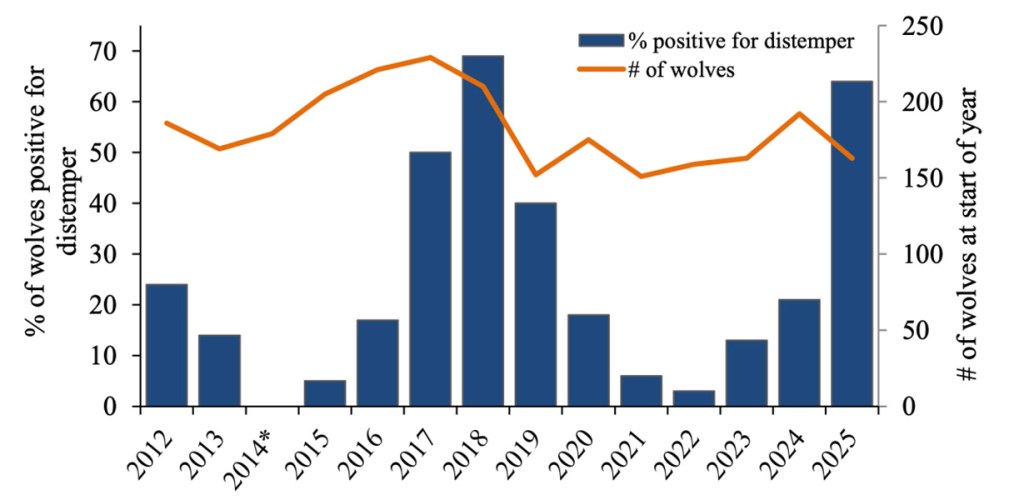
In the past, distemper was a density-dependent disease that surged when populations were high, Mills said. It last flared up in 2018, which wasn’t long after a two-year period where wolves were protected from hunting by the Endangered Species Act and populations — and conflict — were higher.
The 2025 flare up was the first time Mills documented lots of distemper when wolf numbers were not particularly high. The occurrence has him searching for alternative explanations.
“Could it be cyclical? Yeah,” the Pinedale-based biologist said. “However, these are potentially eight-year cycles, and it takes a lot of time to collect data and understand what’s going on.”
There’s cause to believe that distemper will abate in Wyoming wolves this year. When Yellowstone wolves have experienced outbreaks, the event lasts a year and then there’s recovery, Mills said. And the Wyoming population now has more antibodies and resistance built up and so is in good shape to recover itself, he said.
But in 2025, distemper hurt Wyoming wolf numbers, which was a first.
Before that, “we really haven’t had a canine distemper outbreak that has caused a population-level effect,” Mills said.

In 2024, Mills and his biologist counterparts detected 330 wolves and 24 breeding pairs statewide. The estimated 253 wolves and 14 breeding pairs in 2025 means the raw wolf count tumbled by 23% and the reproductive segment fell by 42%.
Of those, 132 wolves in 22 packs that included 10 breeding pairs dwelled in the mountainous portion of northwest Wyoming in the “trophy game” area. There were nine wolves in three packs and no breeding detected on the Wind River Indian Reservation. And in the zone where Wyoming manages wolves as predators — where they can be killed by any means without limit — there were 28 wolves in five packs, including one breeding pair.
The remainder of Wyoming’s wolves — 84 wolves running in seven packs that included three breeding pairs — dwelled in Yellowstone National Park, according to the state’s monitoring report.
The park’s public affairs officers, whose office has been inundated with inquiries about a recent grizzly bear attack, did not respond to WyoFile’s request for an interview before this story published.
The overall number of Yellowstone wolves has dipped into the 80s twice before, in 2012 and 2018. But by other measures, 2025 was a tough year that the park population had not experienced since the reintroduction era. The distemper outbreak appeared to be “synchronous” in Wyoming and Yellowstone, and pup production and survival was also dismal in the national park, Mills said.

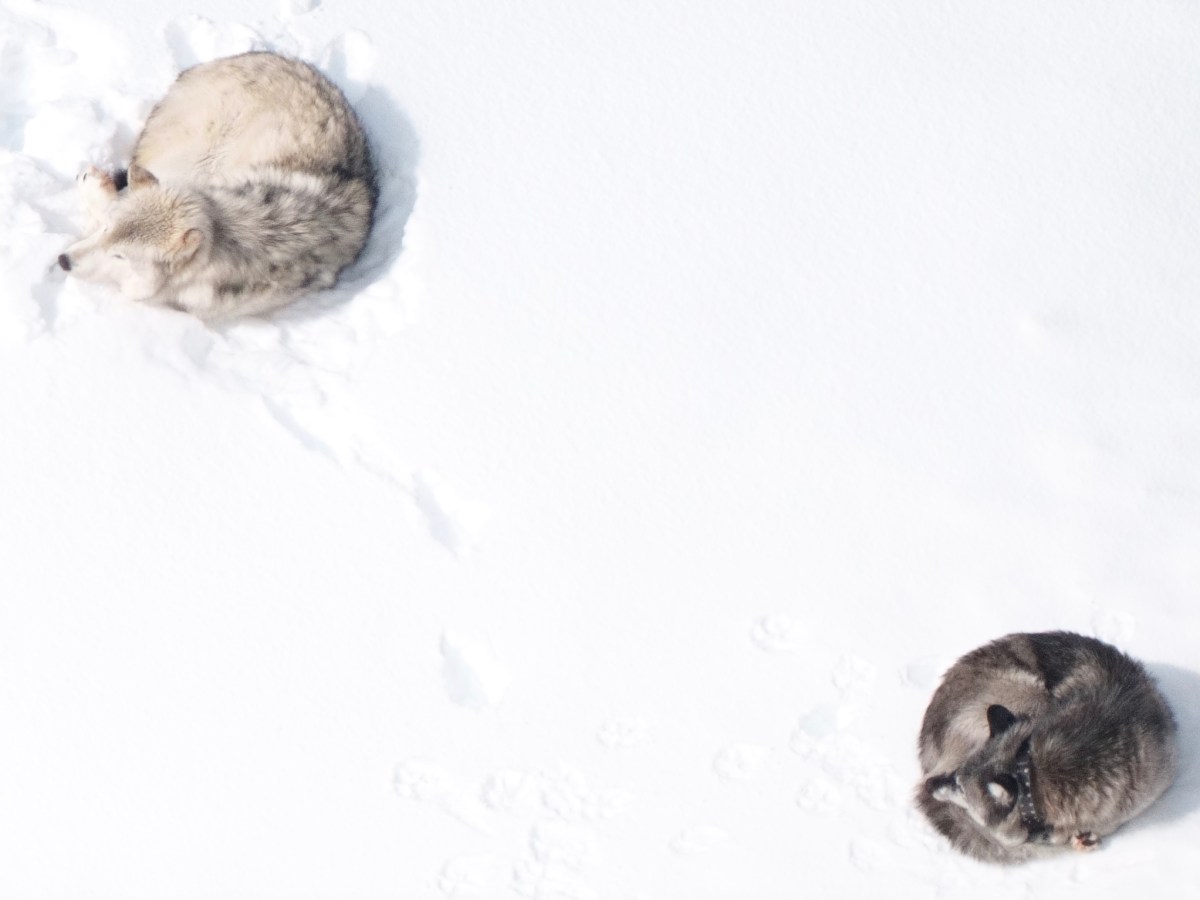
“Seventeen pups survived in Yellowstone,” he said, “which was the lowest they ever recorded.”
Outside of Yellowstone, Game and Fish will consider the lower wolf population when its biologists and wardens are setting fall 2026 hunting seasons (hunting isn’t allowed in the park, though park wolves frequently leave). That proposal isn’t public yet, but Mills anticipates that there will be a “surplus” of animals and a wolf hunting season, even if mortality limits are reduced.
Wyoming’s relatively few wolves have enabled the state to manage with precision and a degree of predictability, although the surge of distemper interrupted a long run of population stability. Still, the unexpected disease outbreak left Mills feeling good about Wyoming’s plan for managing its wolves.
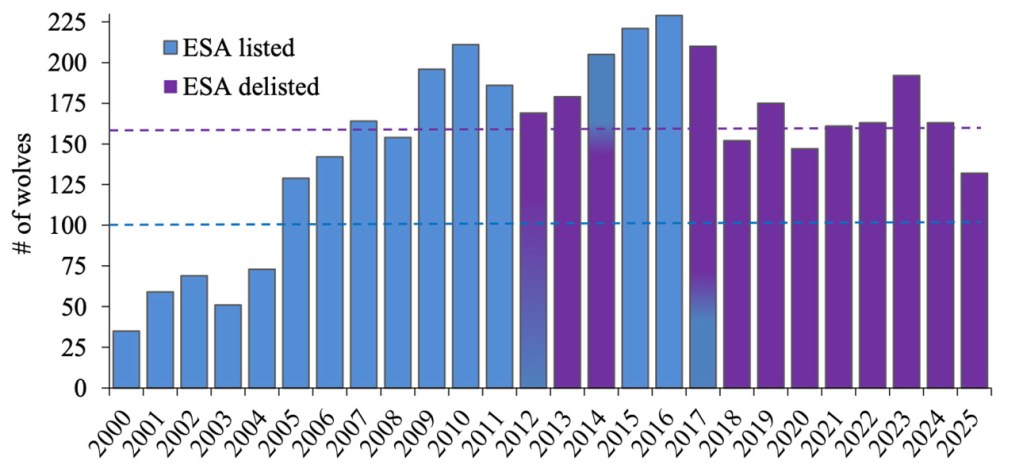
“We set up the population objective of 160 wolves to be able to accommodate an event similar to what we experienced, and still meet our minimum recovery criteria,” Mills said.
That recovery criteria includes 10 breeding pairs outside of Yellowstone in Wyoming’s trophy game area. Mills’ 2025 surveys detected exactly 10 packs with pups in that zone.
“We met the minimum,” Mills said. “It actually worked exactly as we intended.”

If you read through all of the comments on this excellent article, you discover why wolves have charisma–both negative & positive–for humans–& this is why it would be terrible to have their existence threatened. Trying to achieve the minimum number that would help them survive is not a good strategy when diseases could wipe them out. Certainly on public lands, the preservation of wolves should take priority over cattle.. as George Wuethner proved in his boo, Welfare Ranching, ranchers on public lands are being subsidized by the public and should not have the right to threaten a species that is important to ecosystems.
Our forefathers had common sense, which is not so common anymore, they should have left things the way they were.
Why do I see such dramatic tooth erosion in the article ‘s opening ?
As a dental hygienist for over 40 years I was alarmed. Why? Please help this iconic species ! There is more at play here than meets the eye .
A). I thought the author clearly states that commenting ideals that are not directly relevant lacks decorum. However, it seems that people have mistook this as a platform to push their ignorant agenda.
B) Perhaps Minnesota would be open to negotiate transplanting wolves to Wyoming. Since we’re overpopulated here.
The estimated population of wolves in Minnesota have actually recently declined.
Hunting is part of life. All the animals in the wilderness are important. Everyone is going to have an opinion but facts are fact. We need them around as much as if not more as we do cities.
We need to help the wolf population why are we allowing trophy hunting to begin with!!! Over 95% of the animals are no longer. When will it end!!!! All animals are beautiful in they’re own right. We have taken so much land from all animals it just breaks my heart!!! 💯
This is not very hard to figure out. Not once was the fact mentioned that we have an extremely high rate of wolves killed by illegal means in Wyoming. Do you game Wardens even investigate wolves killed illegally. I think not. Not once was Wyoming game wardens mentioned in the Cody Roberts case. As far as we residents are concerned we never heard what the states envolment was in that case. Wyoming is notorious for the anti-wolf stance. Most hunters are not even aware that only Alpha Pairs mate. Most hunters mistakenly believe they are conservationists. That pretty much makes the Dept of Fish and Gane a joke when it comes to saving the Wolf population in this stat.e
No sad to hear this. The whole “reintroductuon” has been a disaster for ranchers.
After the forests have burned, and those who rape it have been rounded up and put in cities where they can be better monitored, the wolves will again reclaim it, as the Apex Alpha God’s that they are, and always were meant to be. They’re truly more evolved than those redneck trailer atv motorcycle trash who are delerious with hate and penis envy for the wolf.
That is wonderful news. Darn shame it didn’t kill all of them!
I think it is a tragedy that wolves can be killed as trophy, they are a really necessary part of the ecosystem as are bison, elk, and deer/ antelope, and all our other lesser but nevertheless nessecery animals as beaver, rabbit, skunk, squirrel, and opossom, even snake, and fish, owl, and
eagle, and hawk. Even caribou and moose. Bear too. We must protect our wildlands, Absolutely. For ourselves and.our posterity. And our trees too, and meadows. And streams and waterways. Please, and thank you.
I grew up next to a natural wildlife area in New England. Every 7 years distemper swept thru the racoon population but interestingly in that population it was the adults that had higher death rates. We’d find the orphan babies – stinking cute – but knew enough to leave them be.
Yes it is cyclical. This is the problem with our highly educated ” expert” class. Lots of book learning but no real life experience. If I knew this as teenager 60 long years ago how can they not know it today. In part because they are so busy w their agendas and theories they don’t do the simplest and most important thing- pay attention. This is what farmers and hunters do and people who want to survive.
I don’t believe for a minute that disease is killing wolves, it’s open season all year long on them, poachers, hunters, ranchers are shooting them for fear of game and livestock disappearing.
I have one goal in mind in corresponding here and that is to be able to do my small part in protecting what is left of our diminishing wildlife.
I needed some great news
I think disposable gloves should be used when checking for signs of disease. Then changing them after every check. Seems like the disease would be spread otherwise.
So happy that the wolves have been introduced over the years to increase the vital need they provide to the entire ecosystem. I hope and pray that discontinues for generations to come.
I find it so selfish that people hunt these beautiful and amazing animals. You kill the wolves because they kill what God intended them to and blame them for the decline in the deer and moose populations when actually I dont think nature would make a predator that takes out the strongest, kind of stupid don’t u think. Why doesn’t mankind blame the real culprit….the predatory trophy killers, that kill the bloodlines that are designed to make the herds stronger ..you people make me sick. Just like you kill the bears and cougars that attack people in Their park. Don’t want to get attacked, then be stupid when you camp. I truly bless the actual biologist that are trying to conserve these animals, and think it’s amazing when you get the opportunity to earn a little of their trust and get rare opportunities of interaction with them.. we are supposed to b the good stewards, and instead, we hunt and destroy till it’s gone. Bless you that try to help and admire, and for the others, may you reap what you brought to yourself
They don’t just kill wolves for trophies. They are trying to manage their out of control population that is decimating the rest of the wildlife population. Of course this entire disaster was caused by liberal groups pushing their agendas on government agencies that are taxpayer funded. These wolves are also passing parasites on to unknowing humans. Humans who like to hike and recreate in nature. It’s not always about the “Evil” hunter.
Hey
We have ample replacement wolves in Alberta Canada.
Hopefully parvo will be next.
The lower the wolf numbers the better for a possible recovery of the GYE elk/moose population.
Too bad you don’t feel the same way about humans. Way too many of them. We could have more wolves, grizzlies, wolverine and lynx if you weren’t for people like you.
Chad- sorry to inform you that Elk and Moose population numbers in northwest Wyoming and the GYE are not affected much by predators , as you seem to constantly imply. Wolves bears and big cats are not driving down ungulate populations. Climate change, habitat loss, and diseases are far more consequential ( the latter acutely affecting Moose more than any other mortlaity factor ) .
Elk herdcount numbers around Cody ( both native and migratory ; summer + winter ) are way over Game & Fish objectives. The region is heavily populated with and shared with wolves, grizzlies, and cougars . That dynamic is natural and working.
Please don’t conflate what you don’t know.
I’ve personally witnessed it since invasive canis lupus occidentalis was released.
75-90% cut in elk herds wherever the wolves went, from Sunlight Crandall in Wyoming, North Yellowstone herd Gardner MT, Clearwater of Idaho to the Strawberry Wilderness of Oregon. Ungulate deserts, where thriving herds once lived.
Dewey, nothing you can try and “explain” away transfers 12-15 calves per 100 cow elk to anything other than wolf predation. and 12-15 per 100 cows results in the collapse of western US elk herds that have happened.
I dont think that you are dumb, maybe it is willful ignorance?
A grey wolf is a grey wolf. They’re not invasive species.
See, Chad, you don’t even have the correct predator in your cross hairs. Bears (both grizzly and black) kill and consume more elk calves in the GYE than wolves. Published work based on good sample sizes and proper analyses. That’s a glass house you live in, maybe you should put the stones down.
Do you spend any time reading scientific literature, Chad? Because your opinion here lacks any important nuance and demonstrates a lack of understanding of complex elk and moose ecology in Wyoming, including the GYE. Moose did not arrive in Wyoming until the 1800s, but, co-existed in WY and further west and north in the Rockies with many more wolves. Elk have co-existed with wolves in WY and elsewhere for thousands of years, since arriving in North America. You think wolves are their major or only population limiting factor, now? No role for development and habitat fragmentation/degradation, other predators, invasive plant species, fences/roads/disrupted migration corridors, climate change and drought affecting forage quality, diseases and parasites including arterial worm, CWD, brucellosis, and winter ticks, etc? Go read, Chad. You can start with Arthur Middleton’s and Paul Cross’s works.
Canis Lupus Occidentalis, Todd.
Invasive sub species and a crime against nature to have released them out of their NATIVE habitat in the lower 48.
I read plenty, I just make sure to remove rose colored glasses when doing it.
Chad this answer would earn you a failing grade. Not in college. In junior high. Facts and evidence support arguments. Your illogical emotional musings do not. Canis lupus is one species.They’ve now been there for ~30 generations. They’ve adapted to their environment and fill the same niche as the original native wolves. That humans eradicated.
Todd, They unnaturally transplanted Canis Lupus Occidentalis, where canis lupus nubilus was the native sub species
If California were to try and bring grizzlies back do you support releasing Ursus arctos middendorffi (Kodiak) where Ursus arctos californicus(California grizzly) once inhabited?
That is how bad an argument you are making is.
One gray wolf is not the same as different sub species of gray wolf, as one brown bear is not the same as a different subspecies geographically separated.
Okay, Chad. I’d love to hear your opinion on releasing elk back into West Virginia. Those aren’t NATIVE elk to WV, you know, since humans killed them off in the first place.
I second that!
This is so typical of a remark. Proves hunters are not Conservationists.