

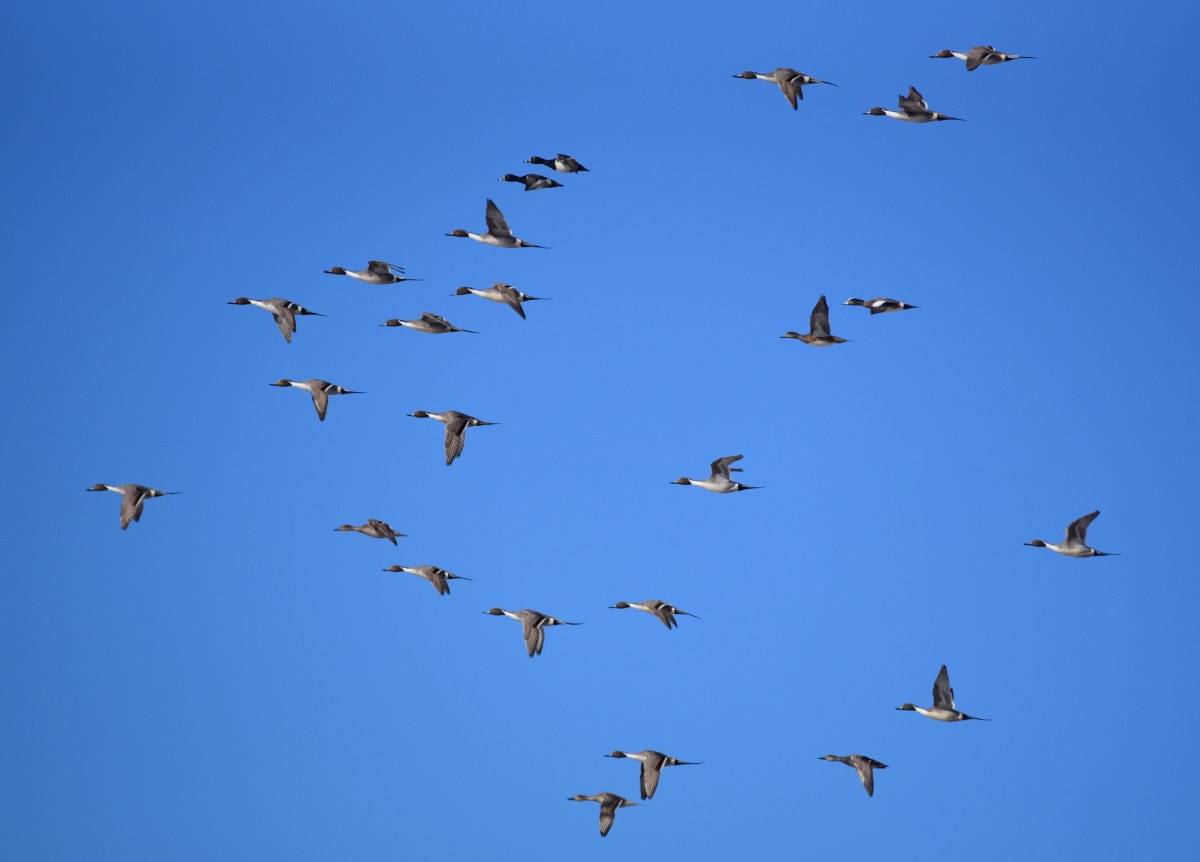
There is much to love about spring in Wyoming, and I would like to suggest one more way to appreciate the natural beauty of our state.
Opinion
On May 9 some 440,000 birds migrated across Carbon County. They traveled northeast at a speed of about 30 mph. We didn’t notice them because they were flying mainly between 9 p.m. and 3 a.m. but also because they were flying at about 3,000 feet.
Even though I can’t see them, knowing an epic journey is unfolding above me instills a sense of wonder and awe I find comforting, given the tumult in the world right now.
Among the birds migrating north across Carbon County were Bullock’s orioles (just appeared last week!), yellow warblers, black headed grosbeaks and blue-winged teals. The American avocets showed up on May 2 when we had an epic 1,264,200 fly over. Mostly, we are seeing waterfowl, but the ruby-crowned kinglets and their cousins will show up any day now.
I know this because I follow a site called Birdcast. Designed by Cornell Labs, it tracks bird migrations across every county in the contiguous United States every spring and fall. Their website — birdcast.info — tells a great story about how they came to be able to make such predictions following the development of more and more sophisticated radar equipment and satellites.
At the end of the day, the system relies on normal people observing the lives of the birds around them and reporting what they see. Sometimes we don’t see birds so much as we hear them. I know the grosbeaks are in Carbon County because I heard one on the grounds of the Wyoming Frontier Prison, though I never spotted it. I can’t identify anything other than the common birds in the neighborhood by sound, but another Cornell Labs program can.
The Merlin Bird ID app can be downloaded for free on your phone and has a recording function that can identify birds by their songs, chirps, cackles or other noises. I’ve used it across the U.S. and in Honduras. Yesterday, it picked the brown-headed catbird out of a cacophony of starlings, grackles and red-winged blackbirds (the latter of which seems to have an unusual presence in Rawlins this spring).
It has been well substantiated that birds are the direct descendants of dinosaurs. Scientific American has a short summary about how we know this, but it is increasingly likely that birds evolved from theropods: velociraptors, T. rexes and the like. So it turns out The Flintstones was a documentary! We still walk the planet while millions of dinosaurs fly overhead.
Somehow, that seems to put the absurdity of the moment, of any moment, into a new frame. And a new frame is always helpful.
So while you are enjoying spring as it splashes color across our landscape, look up and enjoy how your county plays a part in the flight of the dinosaurs, one of the greatest planetary migrations in the world. Just keep your mouth closed.
Dave, what a beautiful essay! My love for waterfowl and other bird watching started during my early years on trips along the Green River above the city of GR. One of the commenter’s mentioned an unusual mix of northern pintails, American widgeon, and bluebills (scaup). The photo by Tom Koerner, obviously taken during spring, does indeed show a very unusual mix. But if you look very closely at the ‘bluebill’ pair, they actually look like a pair of ring-necked ducks. Hint: check out the bills.
This is a very nice piece. Thanks for writing it, Dave Throgmorton, and thanks to WyoFile for posting it.
It’s been an exciting few weeks at the bird feeders in Ft. Laramie, WY. I’ve recorded Lazuli Buntings which are one of my favorites. They are so colorful! Many others are showing up. What about hummingbirds? Anyone observing hummingbirds?
I also use Birdcast and Merlin, in the same ways the author does and with the same benefits. Highly recommended! Btw, last night 992,100 birds crossed Albany Co., WY 🙂
Beautiful photo!!!
How did the widgeons and bluebills get caught up with all those magnificent Pintails?!?!?
Cornell Lab of Ornithology is a great resource for anyone interested in birds, even brown-headed cowbirds and gray catbirds.