


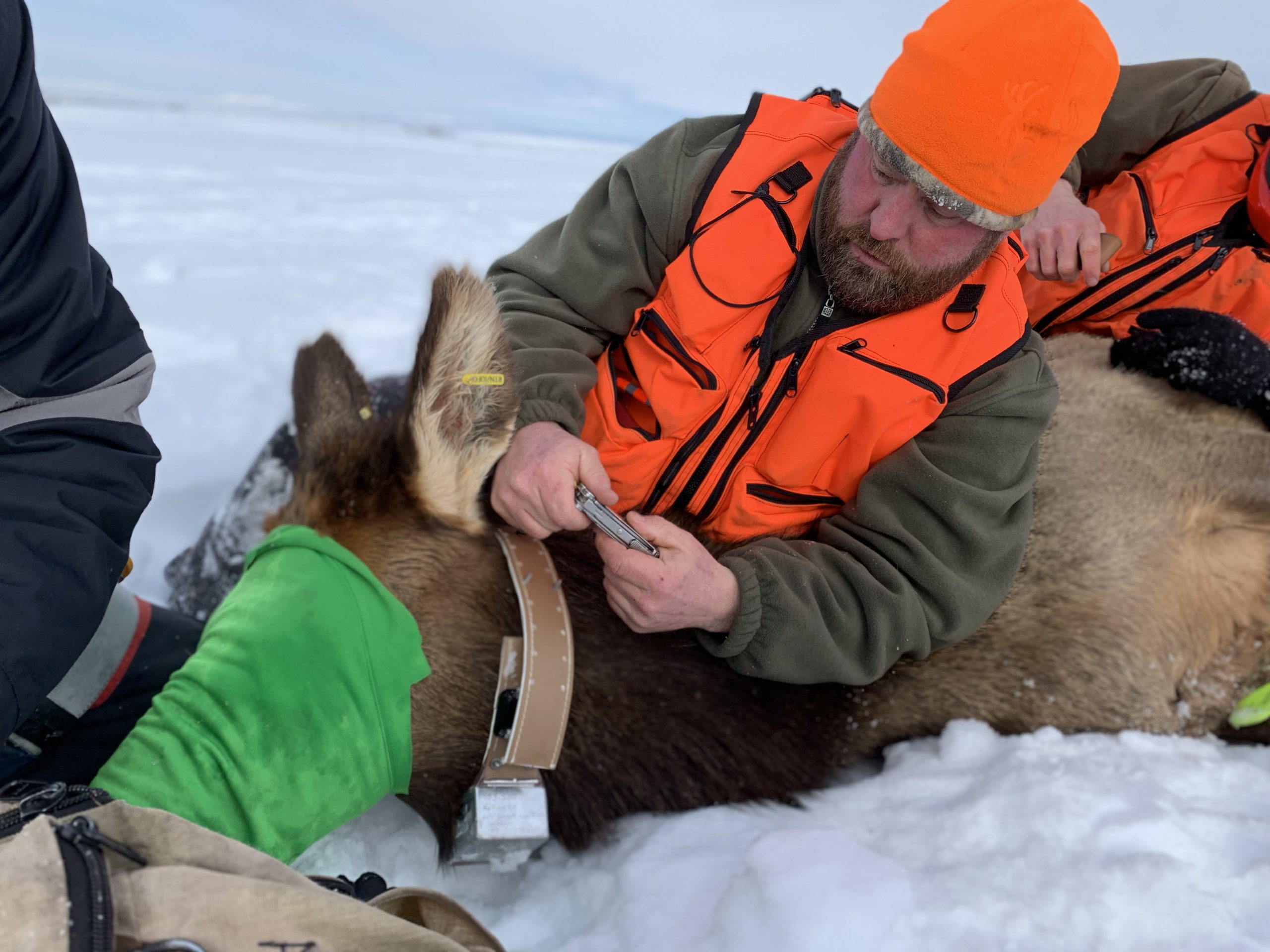
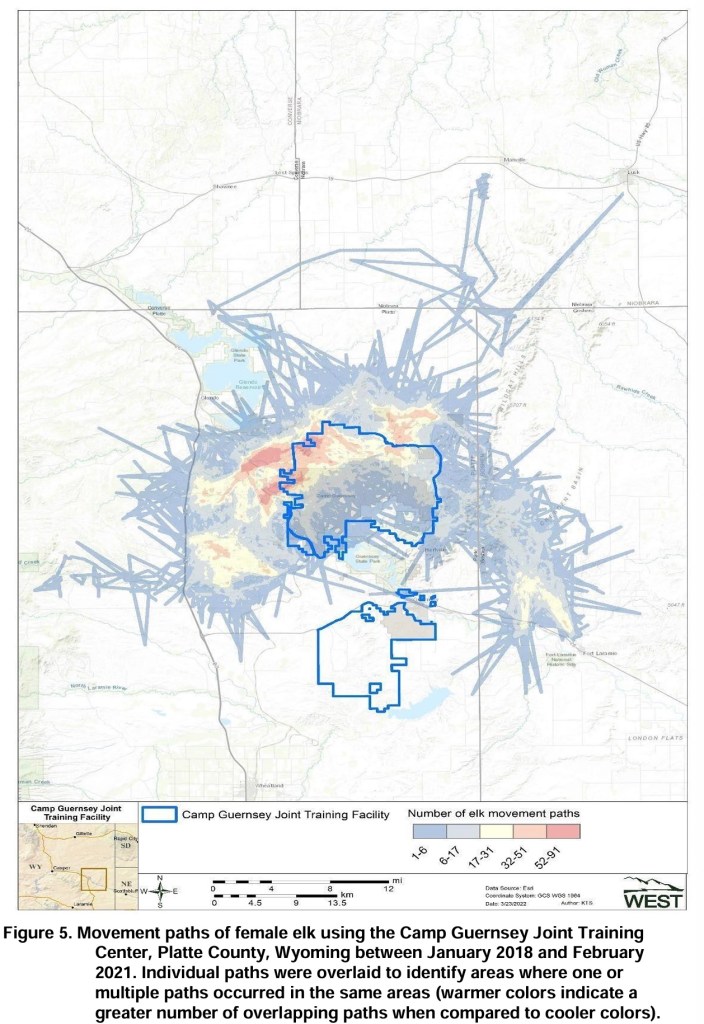
In the middle of winter — starting in 2018 stretching into 2021 — contracted helicopter capture crews managed to subdue 42 cow elk from what’s known as the Rawhide Herd. GPS collars adorned the new southeastern Wyoming research specimens, amassing data that subsequently answered many basic biological questions.
The branch of government that commissioned the work might come as a surprise: the Wyoming Military Department. It’s because a good chunk of the Rawhide Herd’s habitat doubles as Camp Guernsey Joint Training Center. These Platte County wapiti not only have to avoid hunters’ bullets and arrows each fall. They also have to cope with aerial training missions, artillery explosions, gunfire on the range, and the bustle of hundreds of soldiers sharpening their skills.
The military and, in turn, state wildlife managers learned a lot, according to a Western EcoSystems Technology report that the Wyoming Game and Fish Department published in its annual update for the Laramie Region. Military training activities displaced elk, especially in winter, and during those times they sought out rugged areas. Surprisingly, animals tended to choose higher elevations during the coldest months of the year. But largely, the herd summered and wintered in the same region — they didn’t migrate.

“There’s really no traditional migration or seasonal movements like you’d see in a mountain herd, where they’re getting pushed down because of weather,” Game and Fish biologist Keaton Weber said.
The insights Weber and colleagues gained during the research are giving them a leg up in an unrelated change underway for the Rawhide Elk Herd. It’s among a handful of Wyoming elk herds that are being counted for the first time.
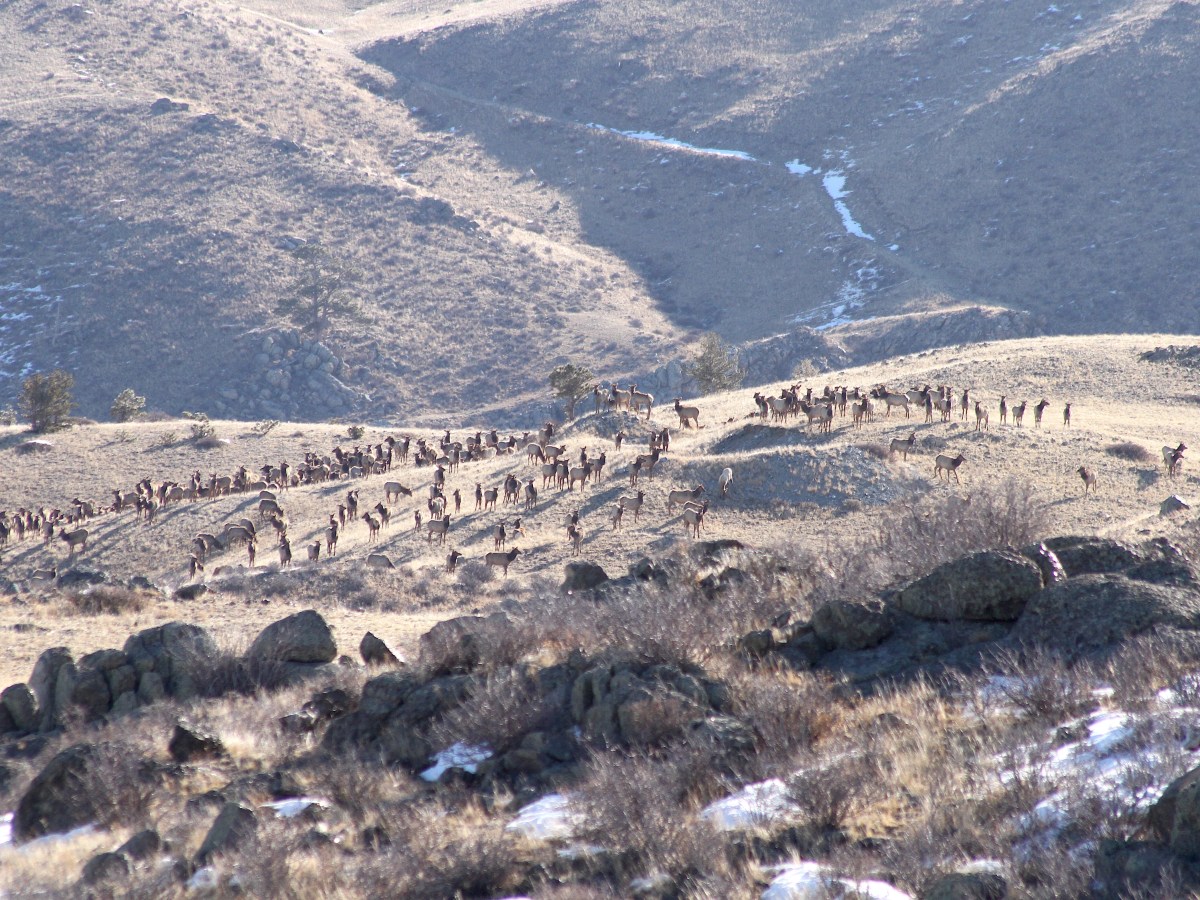
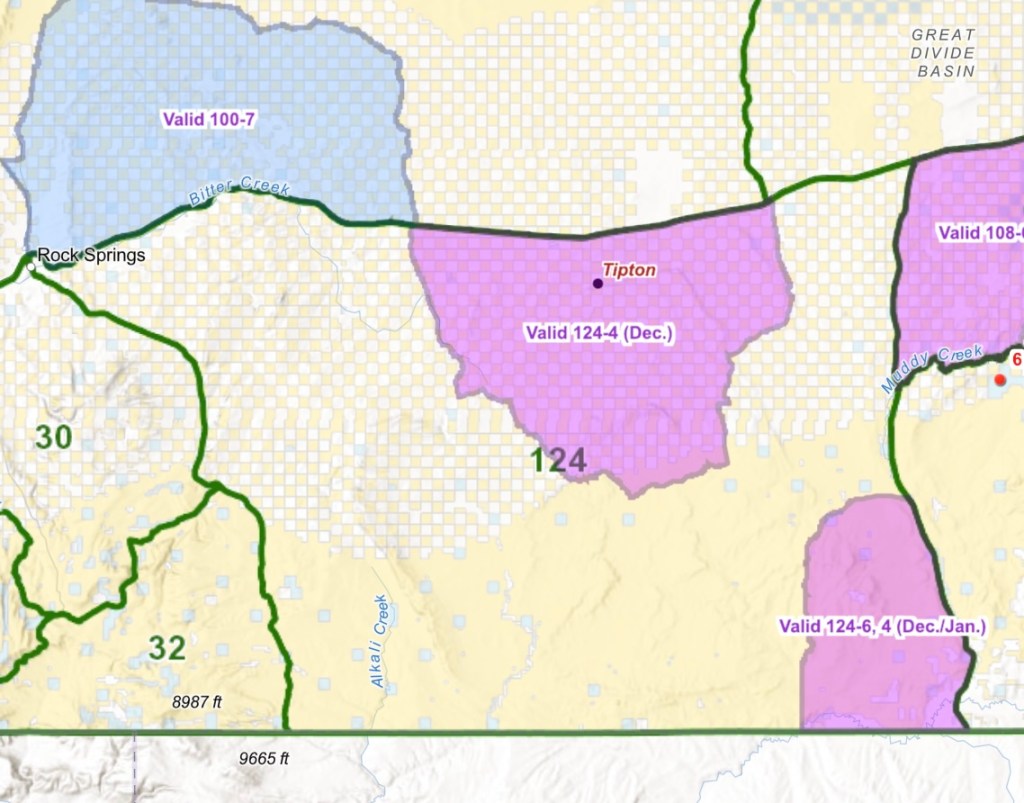
“We’ve never managed this [herd] based on population,” Weber said. “It’s because it’s 90-plus percent private land. It’s a really difficult herd to manage that relies on access, just like the Laramie Range herds.”
According to Game and Fish Deputy Chief of Wildlife Justin Binfet, four other hard-to-count elk herds were in this same position. They include: the Targhee Herd, residents of the western Tetons along the Idaho state line; the Uinta Herd, which straddles the Utah state line in far southwestern Wyoming; the Petition Herd, denizens of the southern Red Desert; and last, the Pine Ridge Herd, which calls ranchland north of Casper home.
“It really is meaningful to have estimates for herd numbers, where you can,” Binfet said. “But it’s also really challenging. It is not nearly as easy as some folks think it is. Elk can move long distances, they respond to pressure, they’re pioneering into new spaces — and they can quickly move in and out of the state.”
The changes in how to manage these herds stem in part from the state’s dissatisfaction with the current approach, which is based on “satisfaction.”
“I think it was a good idea to start with,” Binfet said. “But [satisfaction-based objectives] proved problematic in their practice, a decade and a half later.”
It’s a system that Game and Fish started using with seven elk herds and several other pronghorn and mule deer herds starting around 2010. All were problematic or costly to estimate because of diffuse distributions, lots of private land or factors like ungulates that cross state lines, Binfet said.
The way it’s worked is that herds are considered to be achieving the objectives when more than 60% of landowners and hunters report being satisfied with the herd’s status. But administering that system has been a challenge, Binfet says. Surveying enough landowners in a herd area annually can be a ton of work, he said, and lacking satisfaction scores can have multiple meanings — it can mean both perceptions of too many, or not enough elk.
Another cause for the change was Wyoming’s recently revised compensation program for grass that’s eaten by elk and other ungulates, Binfet said. The new payment plan, which was preceded by a legislative fight, uses calculations that change if a herd is under or over its population objective.
Establishing population targets for the first time can be complicated, even “scary,” he said. There’s no existing hard data to go off of. And in places, like the Petition Herd’s habitat in the Red Desert, there are “massive geographic expanses” with elk at low densities.
“If you classify or don’t classify one giant group of 900 elk, it can really skew your assessment,” Binfet said.
Wildlife managers are leaning into technology to help. In the Petition Herd area, for example, pilots flew over the region at roughly 3,000 feet off the ground and used infrared technology to help with counting. Artificial intelligence is also being used to help with tallying elk captured in aerial images.
But it’s still a work in progress.
North of Casper in the Pine Ridge Herd, the state agency is set on proposing a first-ever population objective of 1,500 elk, Binfet said. But assessments for other herds aren’t yet finalized, he added.
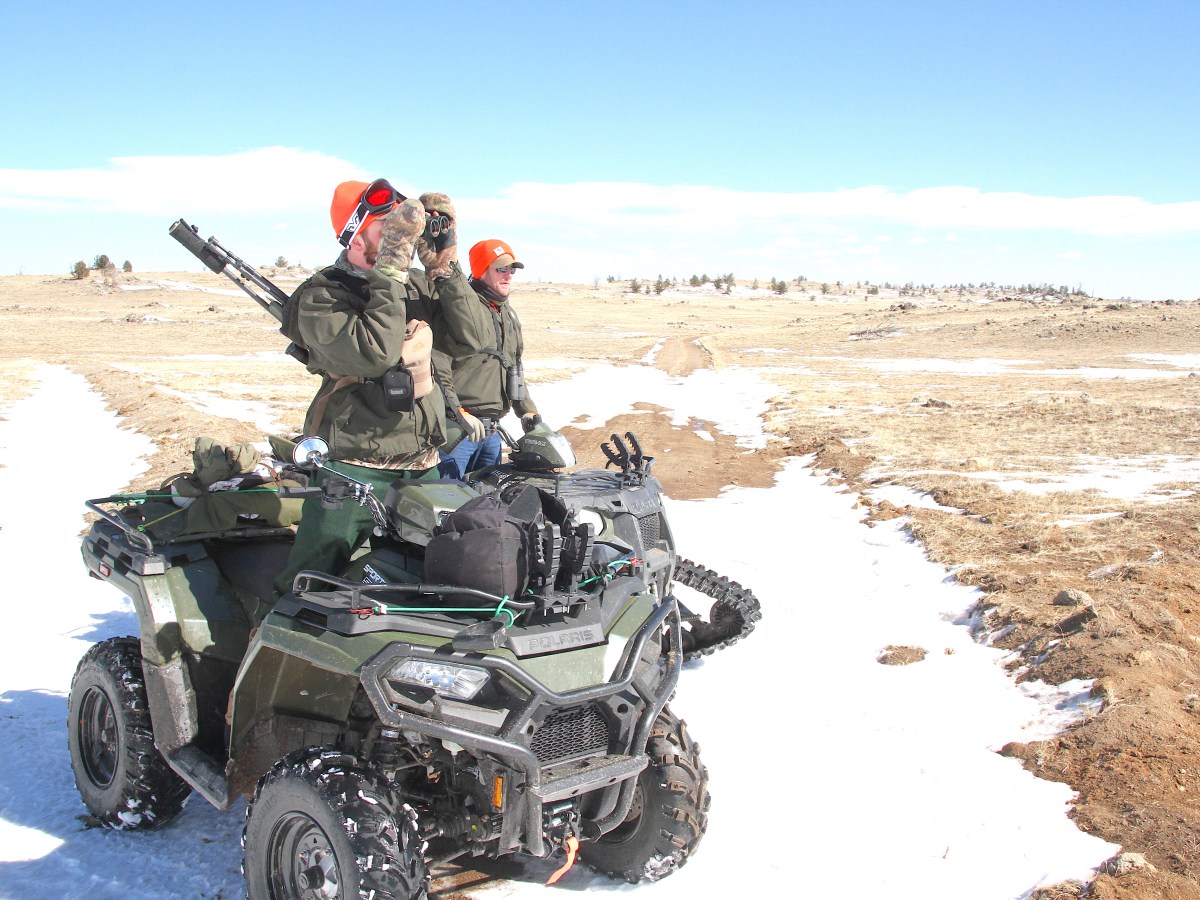
In the Rawhide Herd, in and around Camp Guernsey, a recent aerial survey estimated 830 elk, factoring in an adjustment based on animals’ “sightability” on the landscape, according to Weber, the Game and Fish biologist.
“We use that number with caution,” he said. “Due to these sightability designs and this herd being so unevenly dispersed across the herd unit. It was challenging. We think the number is low.”
The first-ever proposed population objective for the Rawhide Herd that Game and Fish rolled out to the public was 1,800 elk. It’s a number — along with the other herd goals — that the Wyoming Game and Fish Commission will review at its September meeting in Lander.
Wherever the number ends up, it likely won’t have much bearing on operations at Camp Guernsey, said Amanda Thimmayya, the Wyoming Military Department’s natural resource program manager. There’s an annual hunt at the training center — it doubles as the Broom Creek Hunter Management Area. But there are constraints to dialing the hunting pressure up in a place where it’s easy for savvy elk to take refuge, she said.
“We can only provide so much opportunity when we’re surrounded by private lands,” Thimmayya said.

I would like to get this kind of information on a regular basis. It is a good read, and it helps me to understand my home state
Great article, very interesting.
I believe that is an elk calf right there in the middle, like the photo caption points out?
You might want to change your attention photo to elk instead of deer, since the article is about elk Just sayin’.