
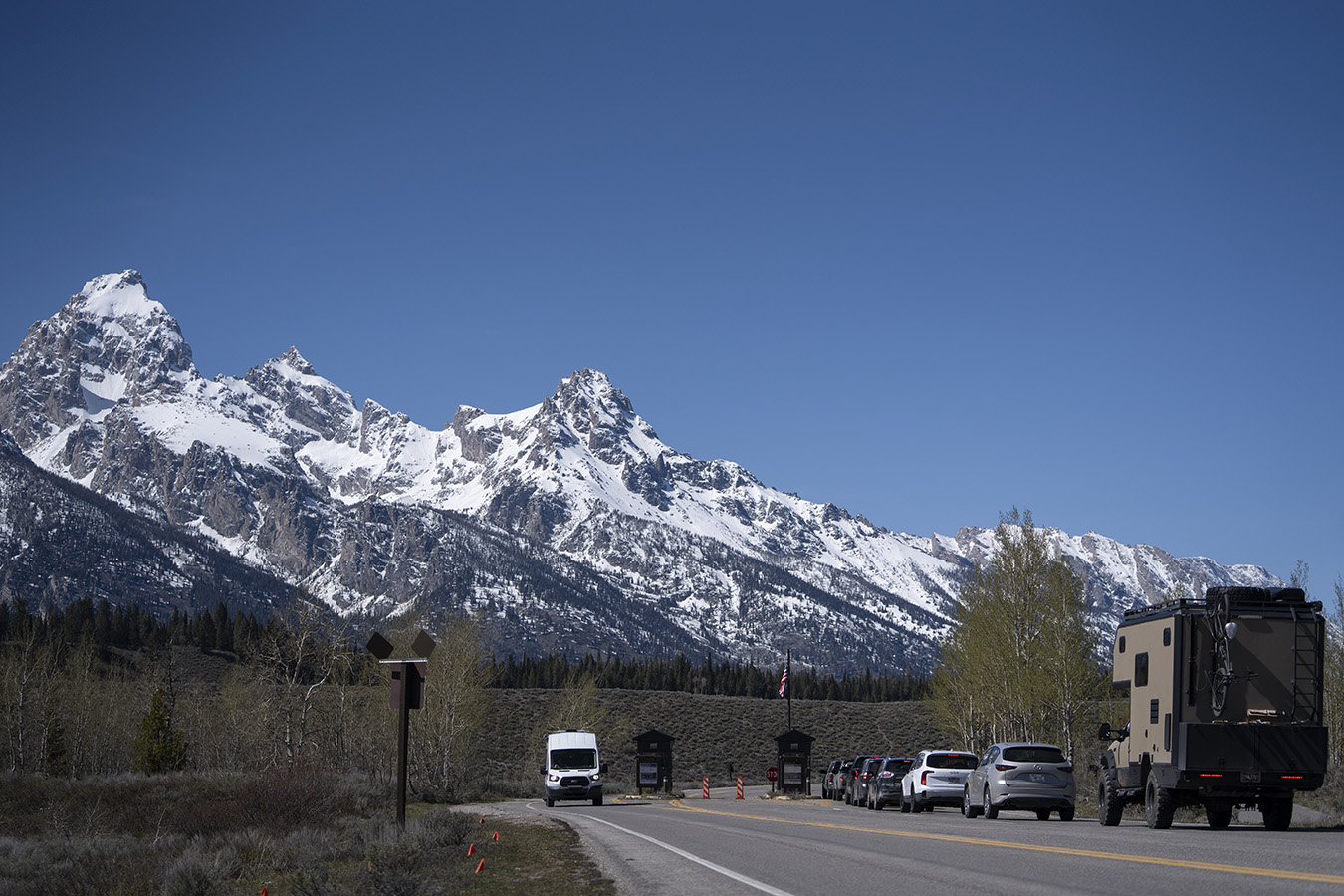


With low-elevation trails free of snow and temperatures in the mid-50s, tourists prepared to take advantage of Grand Teton National Park when the Teton Park Road gate lifted Friday.
By the afternoon, motorists were erratically pulling off the road to park on the shoulder with parking lots already full. Out-of-state plates dominated the Jenny Lake parking area, where families descended to the lakeshore to pose for photos. The Jackson Hole News&Guide spoke with a dozen groups about their experience at park entrance stations. Four had purchased passes online, four bought passes at another park and four paid at Grand Teton’s gate.
“It was a two-minute ordeal,” said Benjamin Smith, who bought his pass at Badlands National Park while moving to Victor, Idaho. “It wasn’t a big deal.”
But that hasn’t been the case for all visitors, particularly foreign travelers and tour groups, after the Trump administration instituted new fees this year for international visitors. The change was part of a “modernization” effort that created new digital park passes that can be purchased at Recreation.gov.
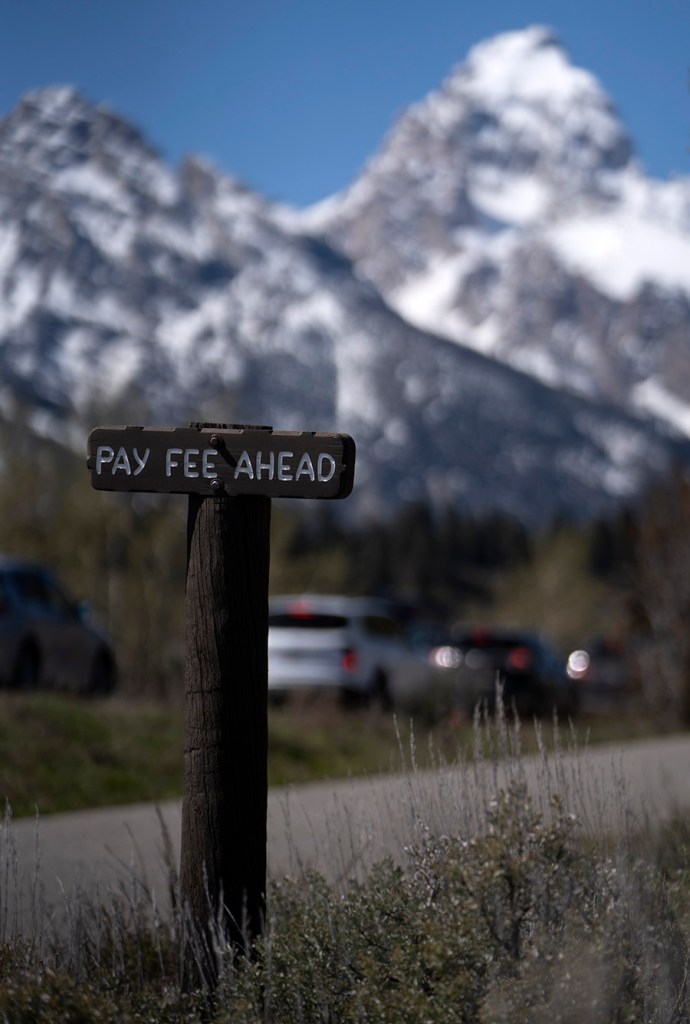
The National Park Service first unveiled in November a new $100 per-person surcharge for foreign visitors, aged 16 and up, at the nation’s 11 most-visited parks, including Grand Teton and Yellowstone. Entrance to both parks for a week costs $35. For a car with four foreign visitors, the same package could now cost $435.
However, that group could also buy an annual “America the Beautiful” pass, which is good for visiting all national parks and other federal recreational areas for one year. Previously, that pass cost $80 for everyone, including visitors who are not U.S. citizens. Now, it costs $250 for foreign visitors, more than a three-fold increase, but less than the per-person surcharge, in some cases.
“That was really sticker shock,” said Lisa Simon, CEO and executive director of the International Inbound Travel Association. “It was a huge jump in price.”
The international surcharge also applies to Acadia, Bryce Canyon, Everglades, Glacier, Grand Canyon, Rocky Mountain, Sequoia and Kings Canyon, Yosemite and Zion.
Grand Teton sold 253 “America the Beautiful” passes to foreign visitors from January 1 through May 4, generating over $60,000 in revenue, according to park figures provided to the News&Guide. The park also sold 102 per-person passes to foreign visitors, bringing in over $10,000.
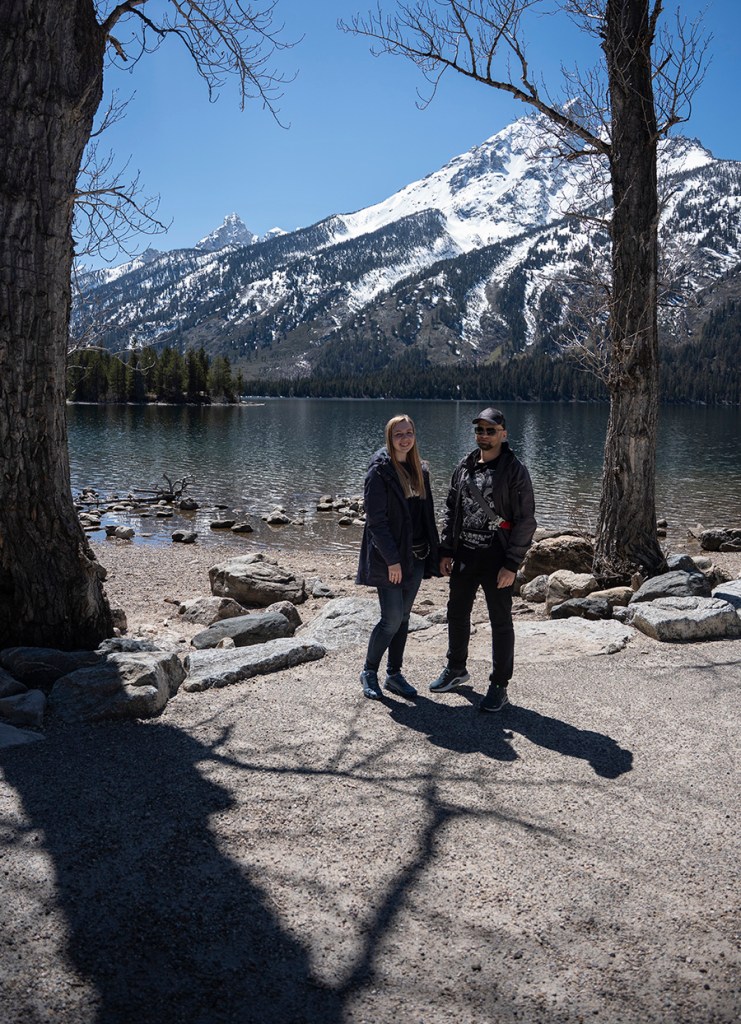
Michael Galkien and Maria Pavlova, a Russian couple visiting Grand Teton, purchased their pass online. They were worried when they heard the news about the $100 surcharge, but were sanguine about the $250 annual pass.
“The national parks are our goals,” Pavlova said. “We don’t like cities, we enjoy parks. They’re amazing, wonderful places, so it’s unavoidable.”
National park vacations still make financial sense to the couple and their friends as long as they visit multiple parks in one trip, said Galkien, who was more focused on the park’s four-legged residents than the surcharge.
“Where are the bears?” he asked.
More money for parks
Yellowstone and Grand Teton superintendents support the foreign visitor fee increases, they said Monday while attending the Cody Country Chamber of Commerce’s 74th Annual National Parks Day Luncheon.
Yellowstone’s Cam Sholly and Grand Teton’s Chip Jenkins met with Cody-area community members and business leaders at the lunch, recapping 2025 and providing park updates.
“This is something that should have happened a long time ago, so I really support the decision,” Sholly told the Cody Enterprise, adding that he expects the impact of the revenue collected from higher fees to be “substantial” for Yellowstone’s infrastructure. Twenty percent of the park’s visitors are foreign, Sholly said, and the park retains 80% of entrance fees, which it uses for infrastructure projects, staffing and other expenses.
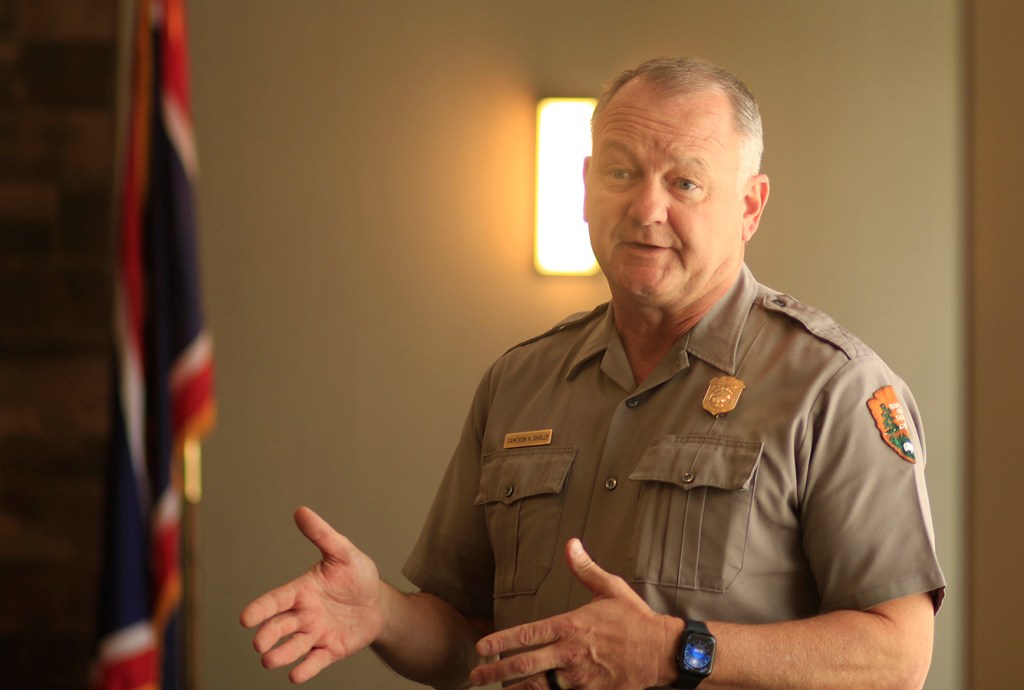
“We’re going to need this year, maybe another couple of years to see where that levels off, but I do think it’s going to be a significant help to us,” Sholly said.
Jenkins said Grand Teton uses visitor fees similarly, although that park only receives 10% foreign visitation on average. Of the $9 million historically generated by park fees, the park retains “about $6 million,” Jenkins said.
“I think you should actually view it in the context of all entrance fees, not just foreign visitor fees,” he added. “[Fees] play a really important role for us in terms of being able to address the maintenance backlog as well as help with operational expenses.”
The majority of park funding, Jenkins noted, comes “from Congress in terms of appropriated dollars,” but is augmented by entrance fees.
Both Sholly and Jenkins confirmed the 11 national parks affected by the policy change operate under a standardized system.
“We work under direction from Washington,” Sholly said. “All of the parks that are collecting the international fee will follow the same rules.”
Those parks, Jenkins added, have been in communication during the rollout and share information with each other.

“Because there are parks like Grand Canyon that get much heavier visitation in the winter, much heavier visitation from foreign nationals, the range of questions, the range of situations, they’re experiencing it first,” he said. “We get to use that in our training for our entrance gate rangers.”
Rangers, Jenkins said, have been instructed to ask one of two questions: “Is everybody in the car a U.S. citizen?” or “Is there anybody in the vehicle that is a foreign national?”
Both superintendents reported that the fee rollout in their parks was going well with Sholly saying, “So far, so good,” and Jenkins adding the caveat that, “It’s the time of year where our visitation is pretty low.”
However, those low visitor numbers, Jenkins said, have enabled Grand Teton to actively “work out the bugs” reported by southern parks that have seen greater traffic through the winter months.
The roll out
The first indication of change came in President Donald Trump’s executive order “Making America Beautiful Again by Improving Our National Parks.”
The July order directed Interior Secretary Doug Burgum to develop “a strategy to increase revenue and improve the recreational experience at national parks by appropriately increasing entrance fees and recreation pass fees for nonresidents in areas of the National Park System that charge entrance fees.”
Simon, the International Inbound Travel Association director, represents tour operators who work with international tours, travel agents and other types of travel buyers to bring customers to the United States. Her association didn’t quibble with Trump’s July order because they didn’t know whether the fee hike would be substantial.
“We could have been fighting from the day we got the executive order,” Simon said. “But if it had been $5, that would have been silly.”
The sticker shock came in November when the National Park Service announced detailed pricing. Parks had five weeks to implement the changes with the policy going into effect on Jan. 1.
“The industry, including our organization specifically, has had a great relationship with the National Park Service for decades,” Simon said. “They have typically given us 18 months notice, so that tour operators can actually build fee increases into their prices.”
Park staff have also been confused, she said. Tour operators were told that rangers likely wouldn’t board buses at entrances to check IDs.
“But that has happened,” Simon told WyoFile. “They’ve also pulled buses over and made all of the customers get off. People go buy their passes and then get back on the bus.”
In February, the National Parks Conservation Association called for pausing the increased fees, citing what the group saw as problems implementing the new rules.
‘Economics of Awe’
The Bozeman-based Property and Environment Research Center has long championed a foreign visitor’s fee. A 2023 white paper authored by Tate Watkins, director of publications and a research fellow for the center, argued: “If each international visitor to a U.S. national park paid a $25 surcharge, it could raise an estimated $330 million, nearly doubling total recreation fee revenue for the park system.”
Since the mid-2010s, Watkins noted, park visitation numbers have swelled above 300 million visitors annually — nearly the size of the entire U.S. population.
In a separate 2025 paper, “The Economics of Awe,” co-authored by three of the center’s research fellows — Watkins, Sara Sutherland, and University of Wyoming economist Stephen Newbold — found visitation to Yellowstone was “highly inelastic” in relation to entrance fees. That means consumer behavior and, consequently, visitation are unlikely to change because of a price hike for international travelers.
Of the 15% of Yellowstone visitors traveling from overseas, just 0.03% would reconsider or change travel plans, according to the researchers.
“A surcharge of $100 on international visitors would be estimated to generate $55.2 million in new revenue, enough to cover the entire park’s annual routine maintenance costs ($43 million), demolish the abandoned wastewater system at Old Faithful ($6 million), and make site improvements at Midway Geyser Basin ($5 million),” the authors wrote.
Who eats the cost?
Many tour group passengers had already paid admission for parks before the new fees rolled out. Responsibility for the fees fell on tour operators.
In European countries and Brazil, stiff consumer protection laws prohibit tacking on additional fees after purchase without allowing for cancellations, Simon said. Tour operators don’t want to risk their reputations or trigger cancellations, she said.
“They’re going to eat the charges,” Simon said.
Tour operators in national parks already pay a commercial entrance fee for vehicles based on their size. The average cost is $300 for a full-size motor coach, she said, noting she wasn’t sure of the exact rates for Yellowstone and Grand Teton. The new surcharge comes on top of the commercial vehicle fee.
Tour operators can’t purchase the annual America the Beautiful passes for their customers as the current system does not allow bulk, advance purchases. That’s causing problems for operators, though Simon said the Park Service is working on a solution ahead of Memorial Day. For locations that charge per-person rates, the service has said up to four people in a traveling party can be covered by the annual pass. But what defines a “traveling party” keeps changing, Simon said.
“First of all, they keep changing the rules in a very short period of implementation and secondly, a group tour, by nature and definition, is the traveling party,” she said.
Modernizing park passes
Of four parties interviewed by the News&Guide that purchased passes in Grand Teton, two reported having to show ID to enter the park.

Jack Cody, a Vermonter visiting with his two sons, was a member of one of those parties. An employee manning the gate asked the family if they were all residents of the United States.
Cody was more upset by the updated artwork on the pass. Along with the non-resident fees and digital passes, the “modernization effort” also added President Donald Trump’s visage to park passes.
“It’s a travesty that Trump’s face is on it,” Cody said.



Geat to see somebody step up to address the needs of our National Parks. PERC provided the visitor feedback needed to set the new fees.
Another GOP/TRUMP initiative. Why anyone who benefits from the tourist industry would vote for the GOP is beyond me.
Paul, the Europeans and Asians that inundate the Western US parks every summer, can fork out another grand.
It isnt going to cut tourism, maybe more americans will go to the parks if they arent quite as crowded.
Long overdue.
I wqas fortunate enough to grow up in the 40’s and 50s in a family that visited Yellowstone nearly every year. Now I am luchy to taqke soem grandkids once a year, Now it is so crowded and foreign languasge speaking out numbers the English speakers.
Despite che changes that are a worry, Ihope to continue visiting at elast once a year for the rest of my lifamily.
$100 is actually a very good deal for out of country visitors. And the price for buses really needs to increase. If you to to a National Park in Africa, the fee per person is well over $300/day.
Hopefully some foreign visitors will also visit other beautiful parts of the West and skip the overcrowded and trafficky national parks like Yellowstone.For years I had a cabin about thirty miles from the Parks but we stopped canoeing in them because there was no place to park. I hope Europe will retaliate by raising fees to the Louvre etc
Vicki: I’ve been to at least half a dozen western NPs in the past 5 years, in the past 10 probably a dozen from CA to WA to AZ to MT and in between. Unless you go in the complete off season they are overcrowded nightmares (Yosemite the worst). Too many tour buses too many rental RVs. Europeans tend to rent an RV out of LA or Vegas and do the entire western circuit lasting a month or more, Asians the tour buses.
Raising the prices to limit foreign visitors is at least 2 decades overdue.
Should have been more.
Foreigners can get annual pass for all parks for 250. That shouldn’t be an option.
100 per person 2 day pass per park