

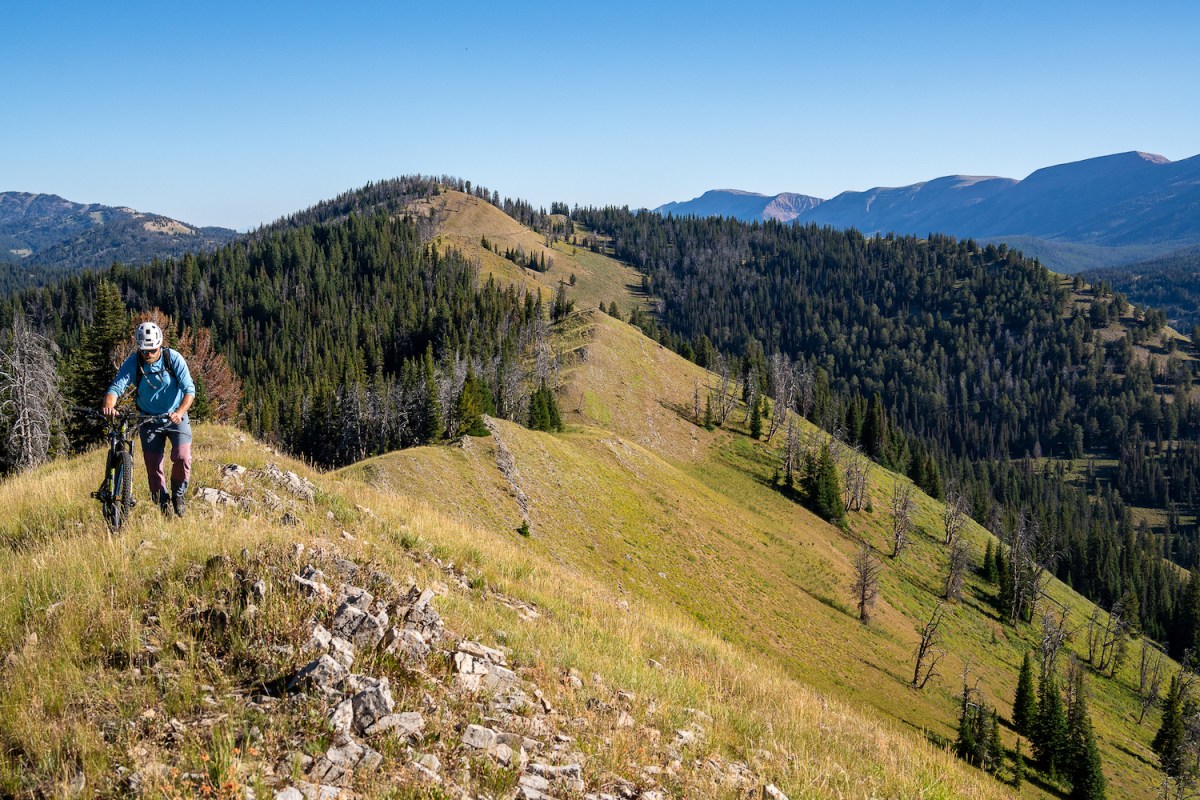
The Wyoming Range parallels the state’s western border, unfurling in a spine of ridges between Jackson and Kemmerer. Though the state’s namesake range, it’s not as widely known as the Tetons, Bighorns or Wind Rivers.
That oversight probably owes more to the Wyoming Range’s remoteness than its majesty, according to Bridger-Teton National Forest Kemmerer District Ranger Adam Calkins.
“It really is a beautiful location that just happens to be sandwiched between the Tetons and the Winds, and so it just gets lost in the shuffle,” Calkins said.
A Forest Service project to revitalize a 180-mile trail system in the range’s southern region could change that by drawing more users and easing access. Because of strapped budgets and lean staff, the Commissary Ridge trail network has gone largely unmaintained for 20 years. Today, erosion, overgrowth and fallen trees have made its trails difficult to navigate.
The Forest Service, in partnership with nonprofits and local governments, spent much of the summer inventorying the trails. Now it’s reaching out to the public for input before finalizing the specifics of trailhead parking improvements, tree clearing and other work.

The agency is asking the public, and particularly users of the Wyoming Range, to fill out a survey that will inform the project. It will also hold a public informational meeting Nov. 19 from 4-7 p.m. at Fossil Fuel Coffee Company in Kemmerer.
The project has a lot of potential for expanding recreational opportunities in a little-used area, Wyoming Pathways Executive Director Mike Kusiek said. “It’s super exciting.”
Off the beaten path
The Commissary Ridge Trail System, located on national forest land the agency manages as “roadless,” isn’t close to large towns or major highways. Users can access the system by driving from Kemmerer, Cokeville or La Barge.
The range is home to exceptional elk and mule deer habitat, and the bulk of users are hunters, Calkins said. But there is also potential for backpacking, hiking, camping and fishing. And that ties into the motivation for the project.
“We recognized the need — that the trails on the Kemmerer District hadn’t been maintained in over a decade, and that was a problem,” he said. “We didn’t have great access to these trails for hunters, for fishers, backpackers or for anybody else.”
The Forest Service district secured several partners to help it implement the project, including Wyoming Pathways, Friends of the Bridger-Teton, Tread Lightly! and Lincoln County.
Forest Service employees spent the bulk of the season hiking and inventorying roughly 80% of the system, which, all told, includes 17 trailheads and more than 30 separate trails. That work helped identify what is out there and what needs to be done to make trails safe and accessible — clearing deadfall, improving signage or shoring up erosion.

The agency has applied for several grants to help it pay for the work. Now, Calkins said, it wants to hear from the public to better understand which trails are used and where to prioritize improvements.
“We want to first start clearing and cleaning up the trails that the bulk [of] people are using,” he said, “and that’s why we’re looking for that public input.”
Facing significant budget cuts, the Forest Service is anticipated to forgo hiring non-fire seasonal workers in the next fiscal year, which will put more strain on full-time staff. Calkins does not foresee that affecting the Commissary Ridge project. Crews are anticipated to complete the work in three to five years, he said.
‘Just spectacular’
Though he works in the world of trail development, Kusiek of Wyoming Pathways knew very little about the southern Wyoming Range before the Forest Service contacted his organization — “probably, like a lot of people, almost next to nothing.”
After spending time exploring the area, he sees a ton of promise.
“It’s just spectacular,” he said. “I mean, it’s so beautiful in such a different way than anything else in Wyoming.”
Along with the hunters and hikers that already use it, Kusiek and Calkins see potential for expanded fishing, peak-bagging, mountain biking and other activities.

In a time when the state is embracing the outdoor recreation industry with initiatives like a new trust fund to grant infrastructure projects, Kusiek also believes this project fits into a goal to disperse outdoor visitors around the state. “Especially for legislators who are saying, ‘let’s bring visitors to places they aren’t already going,’” he said, “it’s perfect.”
It can also create better opportunities for the residents of southwest Wyoming who live near the range, Kusiek and Calkins said.
“Everybody that we’ve talked to in the city of Kemmerer is very excited about it,” Calkins said. “Most people, they’re very grateful that we’re recognizing this need and that we’re doing something about it or moving forward with it.”

What an absolute affront to hunters, both resident and not, to propose opening this area up and promoting it for increased human presence. The Wyoming and Salt Ranges are essential summer range for mule deer and elk (among other species); the former are of some of the highest trophy quality in the US. On the heels of a brutal winter, WGFD and the broader public are all too happy to ratchet down on hunting opportunity with antler point restrictions and shortened seasons- which is a fine and reasonable response, at least in the shortish term. But it is beyond insulting to deliberately reduce the recreational opportunity for the one of the few user groups of these mountains that actually tangibly supports healthy habitat through our license fees, then turn right around and open the entire area up to all kinds of other users who pay nothing in money OR sweat equity to help keep this habitat productive and intact. Worst yet they’re going to promote it to users who would primarily be using it in the same times of year when it’s so important for wildlife to be packing on the calories up in those “grocery stores”- not wasting calories running away from humans.
More is not always more, people. You would think the staff and volunteers of a Forest famed for its many backcountry gems would know that, but I guess not…
Be cautious about what you will sell.
If you build it, they will come. Who cares if there are dead falls, erosion, & overgrowth if you are non motorized. You simply step over or around it. Seriously people, do we need to sanitize nature for everyone. Can’t we ever leave things the way nature intended it to be. “Paved paradise, put up a parking lot.”
The Forest Circus should be disbanded. Leave things alone. People should be allowed to manage their own public lands and should do it responsibly.
I’m wondering if this is necessary. Why? I’m sure there are plenty of people who want to keep the Wyoming Range as wild as possible for mule deer, elk and moose. I am a Wyoming person, and we need to maintain our wild places. I certainly do!
Every improvement to transportation infrastructure brings more people. Need to think HARD whether or how much more people this area should have…..not only now but 20 years down the road (trail). What modes of travel will be permitted……foot, horse, Mtn bike, e bike, motorcycle, ATV?
Each permitted mode brings a lot more people traveling/impacting areas exponentially. How will wildlife be affected? Quality of hunting? USFS has legitimized uses that impact such areas greatly. How will local businesses advertise this recreational opportunity? Build it and they will come!!!!!!!!!
Good points. I see a couple of thresholds — non mechanical travel being the least concern, though it does impact wildlife far more than we want. There is likely no future non motorized bicycle category, as bikes often already means bikes, legally or not, and ebikes essentially means motorcycles. Motorized travel, as fun as it is, really destroys an area. Across the border here in Idaho that’s really degraded our public land in the last couple decades.
The future is now. Part of Wyoming’s transition away from fossil fuels is embrace of the sort of recreation opportunities talked about in the article. Hunting won’t go away, and even may increase as part of the larger effort to attract sustaining dollars to small towns. 99% of hikers, hunters, bikers, runners and explorers understand they have an impact on the environment. There will always be bad apples, but with heightened consciousness of personal impacts on the land personal responsibility will become the new norm. This ethic fits right in with the “Wyoming Way.”
The time when national forest and BLM lands are the playground of the few locals lies in the dustbin of the 20th century. For small towns to survive recreator dollars are absolutely necessary.
It’s almost as if we need to adapt, or grow into curmudgeons, longing for yesterday when everything was “better.”
Great points all around, and thanks for the comments. Yes, some hunters have done tremendous work in the Wyoming Range, so thank you. So it’s understandable that some get defensive regarding public land, though moving forward common ground best serves what is, and will be forever, public land. Public land is just that, public.
Hikers, hunters, runners, fisherman, etc…will have to work together to make this work.
I think it’s sad that there is no mention of the Back Country Horsemen who have working on parts of the trails for years.
Agreed, Back Country Horsemen have undertaken numerous projects clearing trails, reconstructing infrastructure, packing in construction material, etc… for many years. They have proven to be a valuable partnership with USFS.
We’re in the planning stages and would love to BCHorseman involved! Send me an email.
Please complete the survey linked in the article. Community input is the cornerstone of everything we do.
“The range is home to exceptional elk and mule deer habitat, and the bulk of users are hunters,”
So let’s ruin that. I too live in a small town that is foaming at the mouth for recreation industry, yes it’s an industry, dollars and wants to become the next Moab. I notice horse people, who also spend a lot of money aren’t mentioned and it’s unlikely accommodations will be made.
Leave it wild, they can hike around the school stadiums
It’s Wyoming? Unmaintained Trails(?) are an Oxymoron! I thought Condoms were supposed to be Safe! Leave the “Trails” where they lie.
Safe Easy Access is not Reality, but Impediments build Strong Character and Awareness.
Smells like a worthy(?) endeavor addressing a potential cure for the sad Mental Health of the Average Human in the US?
Maybe, planting a garden might be another?