

After most of the Wyoming Freedom Caucus’ top legislative goals failed this year, Rep. Rachel Williams, who heads the hard-line conservative group, told reporters they needed “reinforcements in Cheyenne.” On Tuesday, the caucus failed to reach that goal, instead losing majority control in the House and backsliding in the Senate.
The caucus, which officially formed in 2020, won majority control of the House for the first time in 2024. But when most of its top legislative goals fizzled in the 2026 budget session, the group’s leadership blamed the failure on lacking a supermajority in the House and insufficient support in the Senate.
But voters soundly rejected the caucus’ candidates during Tuesday’s primary.
Freedom Caucus-aligned lawmakers failed to wrest control of the state Senate from traditionalist Republicans, instead losing six caucus-aligned lawmakers — Reps. Chip Neiman, Ken Pendergraft, Daniel Singh, Ben Hornok and Paul Hoeft and Sen. Bob Ide — in Senate races. Neiman served as the House speaker in 2025 and 2026.
That means the Senate will likely have just five reliable Freedom Caucus votes from Sens. Cheri Steinmetz, Laura Pearson, Tim French and Troy McKeown and Rep. Abby Angelos. Pearson and French weren’t up for reelection this year. The other candidates will be uncontested in the general election. A number of other lawmakers who weren’t up for reelection this year — Sens. Brian Boner, John Kolb, Tim Salazar and Charles Scott — often vote with the Freedom Caucus, though sometimes deviate from its priorities.
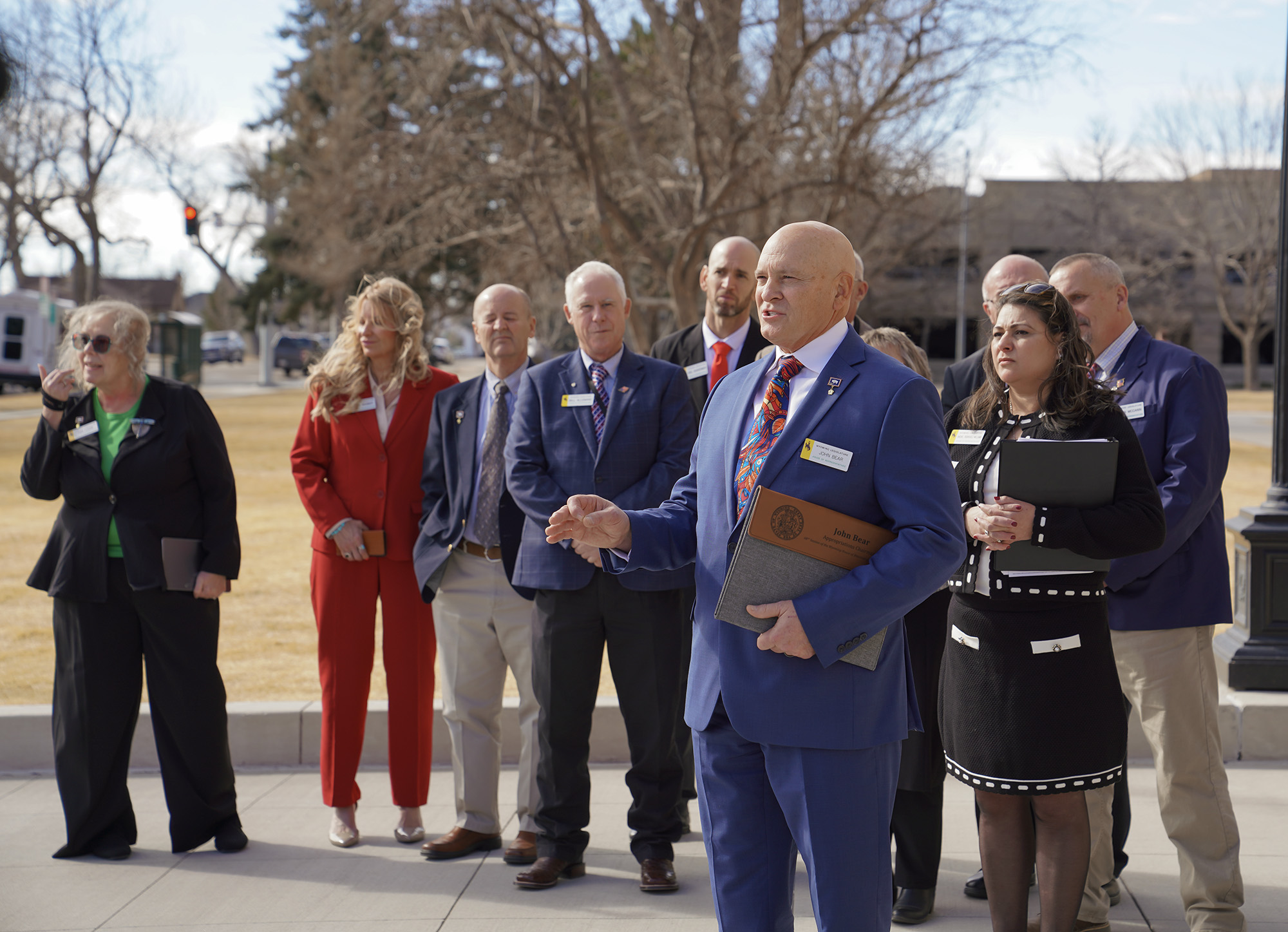
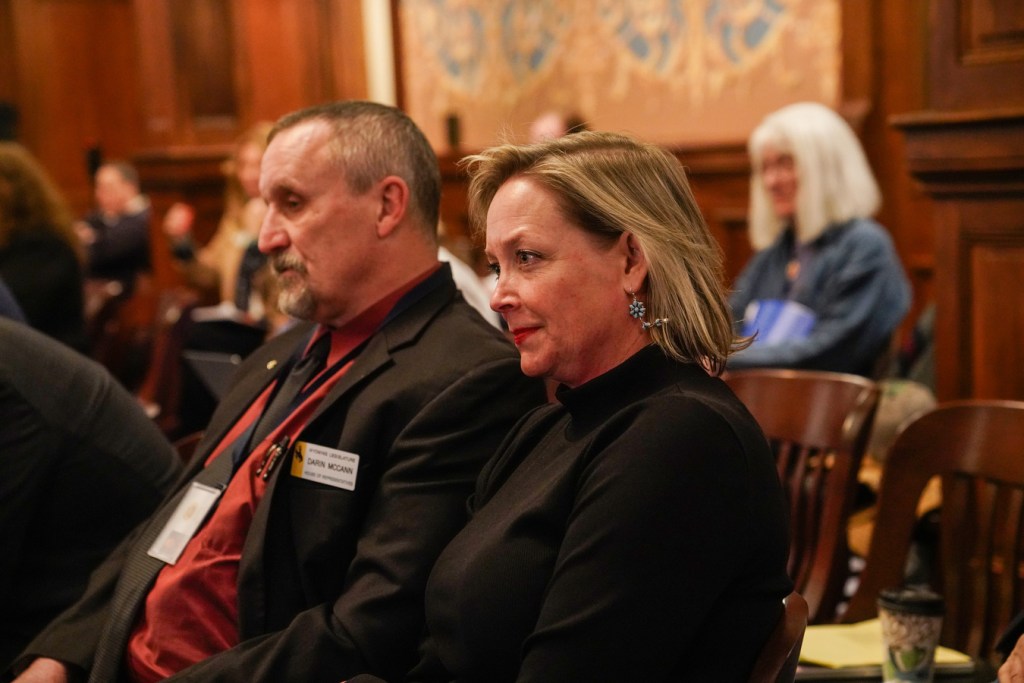
Meanwhile, in the House, the caucus lost 13 incumbents — Reps. John Bear, Joe Webb, Steve Johnson, Tony Locke, Jayme Lien, Gary Brown, Ann Lucas, Ocean Andrew, Darin McCann, Robert Wharff, Marlene Brady, Scott Heiner and Nina Webber. Bear formerly chaired the Wyoming Freedom Caucus and has served in the Legislature since 2021, and Heiner was the majority floor leader in 2025 and 2026.
The group also lost nine other seats after new Freedom Caucus-aligned candidates were unsuccessful in their primary races in districts now occupied by caucus-aligned lawmakers. It failed to win any new seats in the House.
The caucus will likely have 10 reliable votes in the House come January, with two more possible lawmakers that often vote in line with the group. It had a consistent majority in the most recent legislative session.
These numbers mean that the caucus has likely lost the power to obstruct two-thirds introductory votes required to introduce legislation in budget sessions.
Gail Symons, a long-time Wyoming politico and Freedom Caucus critic, said the closest comparison she could recall to a flip this dramatic occurred when the Freedom Caucus took over the House in 2024. “But this is a larger scale than that,” she said. “I mean, way larger scale than that.”
“I think what happened is they weren’t paying attention to whose ox was being gored,” Symons continued.
A number of Freedom Caucus-aligned lawmakers decided to leave their seats in the Legislature to run for state executive offices. Williams, the caucus chair, lost her race for secretary of state to Republican Robert Short. Rep. Scott Smith failed in his bid for state treasurer. And Rep. Tom Kelly, who is not a member but often votes with the group, came in second for state superintendent of public instruction. Non-Freedom Caucus candidates won in all of their districts.
“I think Wyoming voters really showed up,” Gov. Mark Gordon said in an interview with WyoFile on Wednesday about the primary election results. “I think what really gives me encouragement is that people are thinking about Wyoming in the future. They’re not, you know, lost in national politics and national talking points. I think it showed people really cared about the place we live.”
At a statewide level, Gordon noted that most of the candidates whom the Wyoming GOP had endorsed ahead of the primary elections — historically, the party has backed whichever Republicans won in the primaries — lost their races. In recent years, the divided party has fallen in step with Freedom Caucus priorities and boosted candidates aligned with the group.
“I think the lesson for the party is get back to what you’re supposed to do, which is to support Republican candidates, and not try to pick and choose. Let the voters do that for themselves,” Gordon said.
Williams didn’t immediately respond to a call and text from WyoFile inquiring about the caucus’ losses in the Legislature.
Jessie Rubino, the Wyoming state director for the State Freedom Caucus Network, pointed WyoFile to a statement the Wyoming Freedom Caucus had posted on Facebook around 1 p.m. Wednesday. The statement, titled “The WYFC Is Not Going Anywhere,” strikes a defiant tone.
“Last night’s results will not undo the policy wins we’ve delivered on behalf of the people,” the statement declares. The post notes tax cuts, school choice, voting restrictions and anti-trans legislation that the Freedom Caucus helped usher into law.
“These policy victories are having a positive impact on Wyoming families today.”
Caucus setbacks
After gaining majority control of the House in 2024, the Wyoming Freedom Caucus, an outgrowth of the Freedom Caucus in the U.S. House of Representatives, faced a series of controversies and challenges.
Last session, several Freedom Caucus allies, including Neiman, Bear and others who lost their races Tuesday, became embroiled in controversy after Teton County activist Rebecca Bextel handed out checks to caucus-aligned lawmakers on the House floor. In the run-up to Tuesday’s primaries, campaign mailers targeting Freedom Caucus candidates referenced this incident. One depicted Bextel as a puppeteer controlling candidates.
In the same session, the caucus faced an uphill battle when it attempted to slash funding for the University of Wyoming, the state’s lone four-year school, and other state institutions like the Wyoming Business Council. The group ultimately relented and agreed to mostly restore funding to Gov. Mark Gordon’s recommended amounts.
Seventeen of the Senate’s 31 districts were on the ballot this year. To gain a majority in the upper chamber, the Wyoming Freedom Caucus needed to win at least 14 of those races to bolster the two senators it endorsed in 2024 — French and Pearson.
To keep a simple majority in the House, the caucus and its allies needed to win at least 32 legislative races. However, the caucus had higher aspirations and said it would seek a supermajority in the House — a powerful voting bloc big enough to overcome the two-thirds vote required to successfully introduce bills during a budget session. To do so, it needed to win at least 42 races.
Since the last election, the caucus has come to depend on a majority in the House via members and allies. Going into Tuesday, that voting bloc had already shrunk by one after Rep. Joel Guggenmos, a caucus ally, did not file for reelection in May, citing his disqualification for temporarily living outside his Fremont County district.
A few days before 2024’s primary election, the Freedom Caucus endorsed a slate of 43 House candidates and four Senate candidates. In the same announcement, the caucus endorsed Donald Trump for president and Harriet Hageman for Congress.
No such endorsement slate was released this year, though two legislative candidates announced on social media that they’ve been given such endorsements, including Lyman’s Rep. Joe Webb and Karen Weber, who ran as a Republican for House District 5.
Some Republican primary victors — 14 in the House and three in the Senate — will face Democratic opponents in November’s general elections.
WyoFile reporter Maggie Mullen contributed to this story.
This is a breaking news story and may be updated.

Some of the credit should go to Common Sense Republicans for Wyoming which spearheaded the effort to educate voters about the Freedom Caucus, who they were, and what they were trying to do to Wyoming.
How much did the fight for public lands have to do with the upset?
Wyomingites don’t like to be strong-armed. And we don’t like corruption.
We love our university and we love our kids (who need good schools).
And many of us are tired of our president’s bullying tactics–which seem to be similar to Freedom Caucus’ method.
My question: Can the moderate Republicans choose ONE reasonable person for a write-in for our US Representative before November? I was sad to see TOO many options in the primary.
One could only hope Dorthy that a sensible alternative would step up.
With Hageman and Gray as the two republican choices the only other option is to vote for democratic candidates. At the very least, as far as I know, they are good, decent people.
Good riddance to this blight on our beloved Wyoming!
Turns out for people in wyoming “small government” ends where keeping the school and fire departments funded begins. Accepting bribes on the legislature floor also didnt help im sure.
I couldn’t be more pleased. So good to finally see the people of Wyoming taking those $1500 sacks of trash to the curb.
The FC not putting out public endorsements this year speaks volumes. The brand is as toxic as the product
Wyoming Republican Party voters report card:
Statewide: B+
National: F