
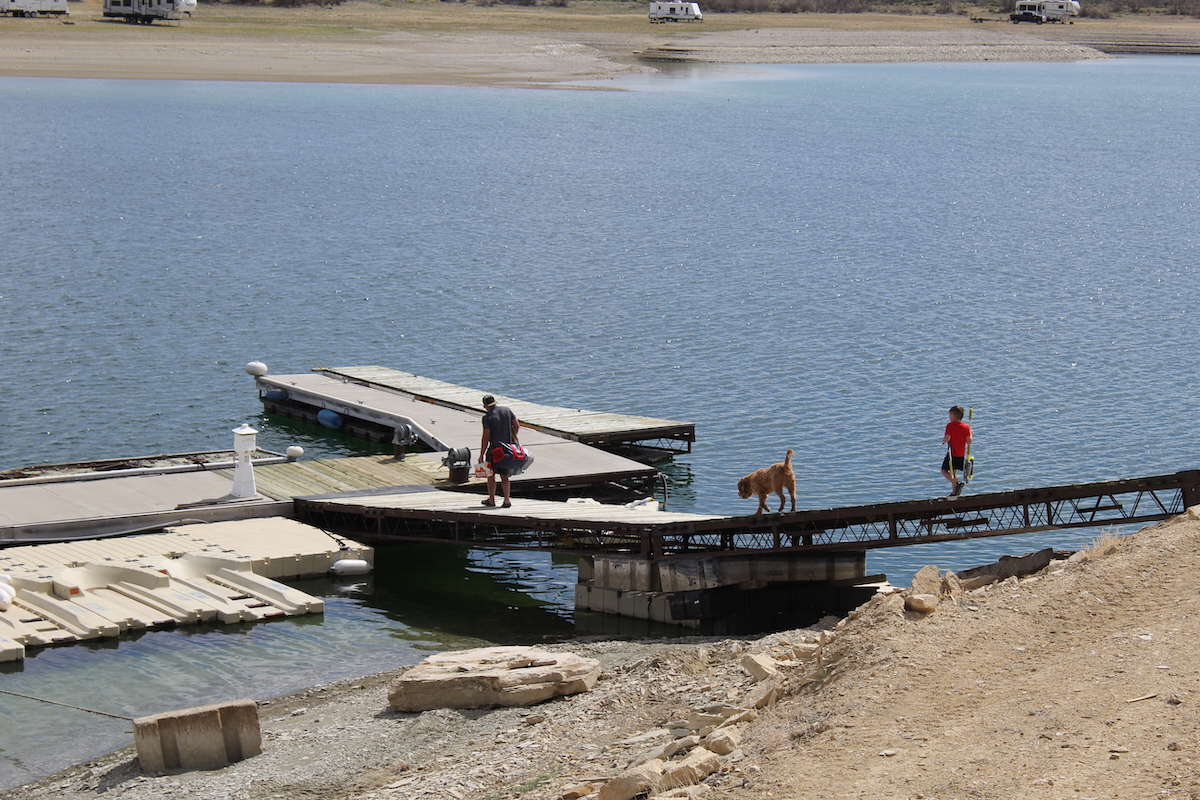


As campers with boats flocked to Buckboard Marina at the start of Memorial Day weekend, Tony Valdez was busy issuing refunds and repairing broken boat ramps. One older Green River man, who walked with two canes, left with his money refunded for the season after discovering he could not safely make it down to the boat slip. Due to dropping water levels at Flaming Gorge Reservoir, the ramp is now buckled, angling up and down like a pitched roof.
“It’s devastating, not just to me, it’s all the marina owners,” said Valdez, who owns Buckboard Marina, south of Green River. “It’s a big loss, and this is a big loss to the community.”
Along the cliffs and shoreline, darker and lighter lines of rock and sand trace the water’s elevations, showing where the water hits when the marina is full, where it hovered this spring and where it dropped after an initial “flush.” Valdez estimates the reservoir has dropped by 7 feet since April.
But that’s not the worst of it. Valdez anticipates that by the end of this summer, the reservoir will be as low as it’s ever been.
Why the drain?
For all its charm as a beloved recreation spot and its utility as a local economic driver, Flaming Gorge Reservoir owes its existence to a legal compact that essentially regards it as an insurance policy in times of drought.
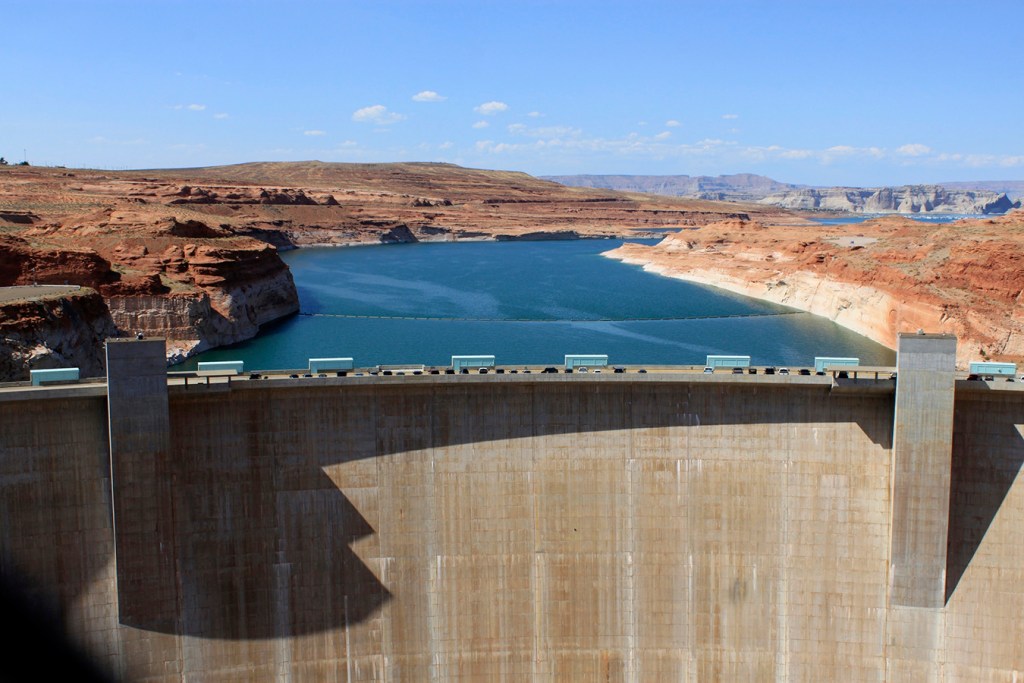
Its primary purpose, according to federal officials and Colorado River Compact scholars, is to serve as a backup water bank to help maintain the Colorado River system. Specifically, Flaming Gorge and a handful of other reservoirs in the upper Colorado River Basin states of Wyoming, Colorado, Utah and New Mexico are key to ensuring a minimum flow of 7.5 million acre-feet of water, on a running 10-year average, at Lees Ferry just downstream of Lake Powell, a massive man-made reservoir straddling the Utah-Arizona border.
Today, after more than 20 years of drought intensified by human-caused climate change, the Colorado River is in crisis, putting at risk massive agricultural irrigation operations that consume about 80% of its water. This past winter saw historically low snowpack in the Upper Colorado River Basin — a primary source for the river’s flow.
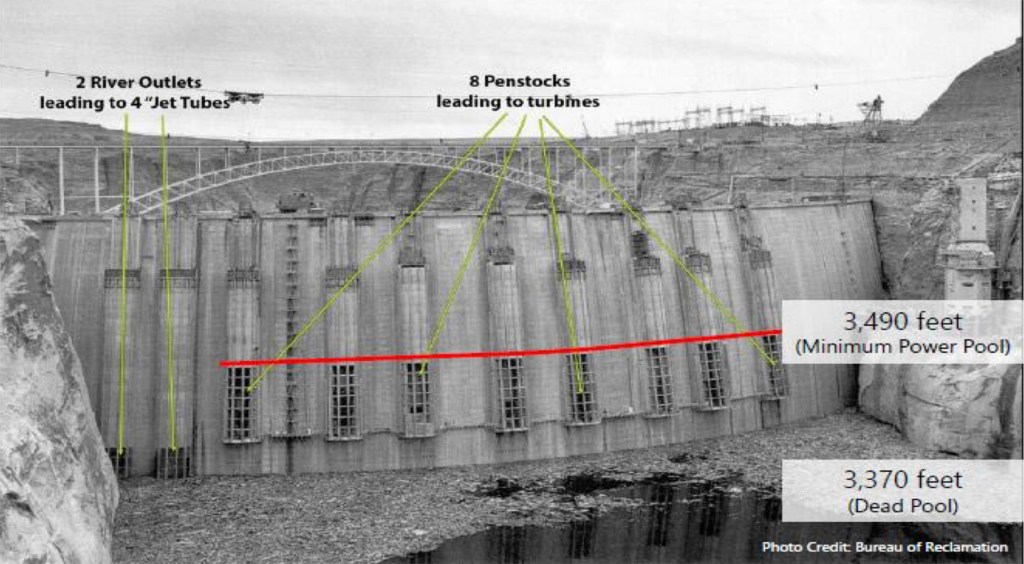
Combined with record heat in March, Lake Powell is at risk of dropping below Glen Canyon Dam’s “minimum power pool,” the point at which it can no longer produce hydroelectric power, according to water officials. If it falls even lower, the dam, which holds back Lake Powell, could be at risk of structural damage or unable to allow water to flow downstream.
The situation triggered a drought response operations agreement that calls for restricting releases from Lake Powell and an order to draw extra water from Flaming Gorge upstream. In total, water managers will release about 1 million additional acre-feet of water from Flaming Gorge in April 2026 through April 2027.
“These actions are expected to lower [Flaming Gorge’s] elevation by roughly 35 feet over the next year to approximately 59% of capacity,” the bureau said in April.
“The elevations are real critical,” Valdez said. At Buckboard Marina, high water has hovered between 6,030 and 6,040 feet above sea level over the past 50 years, he said. Dropping 35 feet could expose 400 feet of shoreline in some places, including marinas with boat ramps, he said.
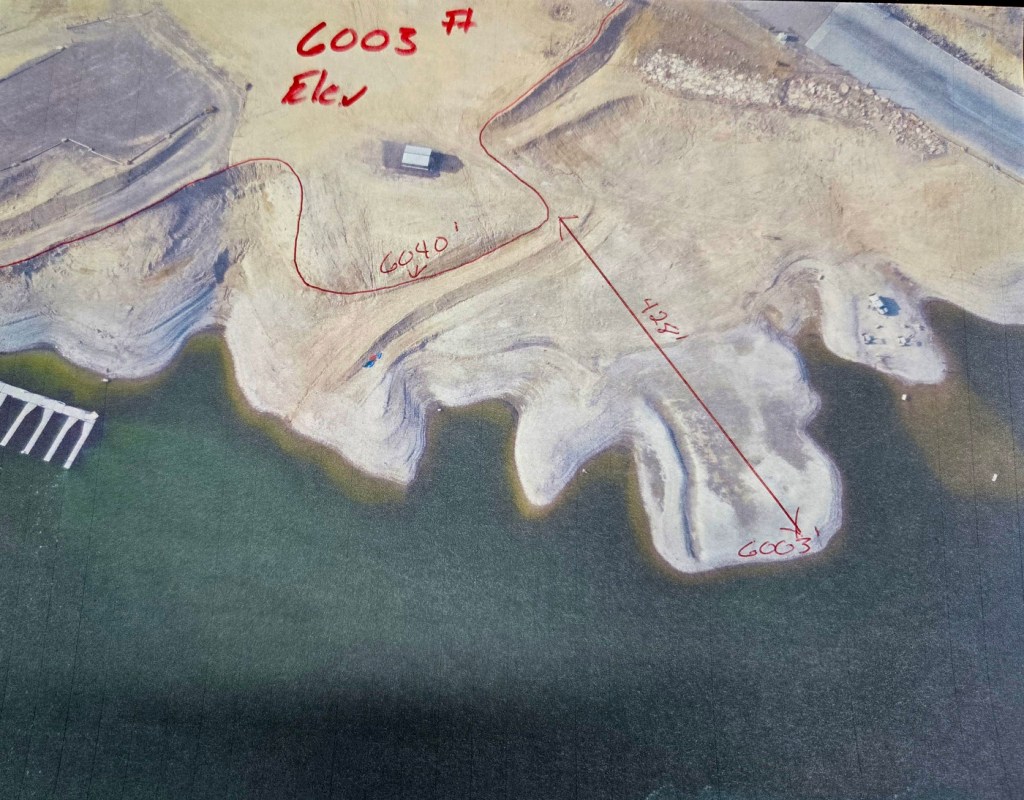
If the water elevation continues to retreat, it could reach a point where boats can’t be brought in or out.
“By September, this thing is going to be down to 6,000 feet. That’s it,” Valdez said. “Next year, if it goes below that, there’s no more marina here.”
Setting a course
Water managers set a course in April to “stabilize” Flaming Gorge’s outflow to about 1,100 cubic feet per second, representing the rate needed to achieve the 1 million acre-feet of extra water release, according to the bureau. On top of that, there are two previously planned “flushes” from the Gorge. The first, in early May, temporarily increased the outflow to about 8,600 cubic feet per second to enhance the proliferation of razorback sucker larvae, and a second 72-hour flush beginning June 8 will temporarily increase the outflow to about 4,600 cubic feet per second to discourage the proliferation of smallmouth bass.
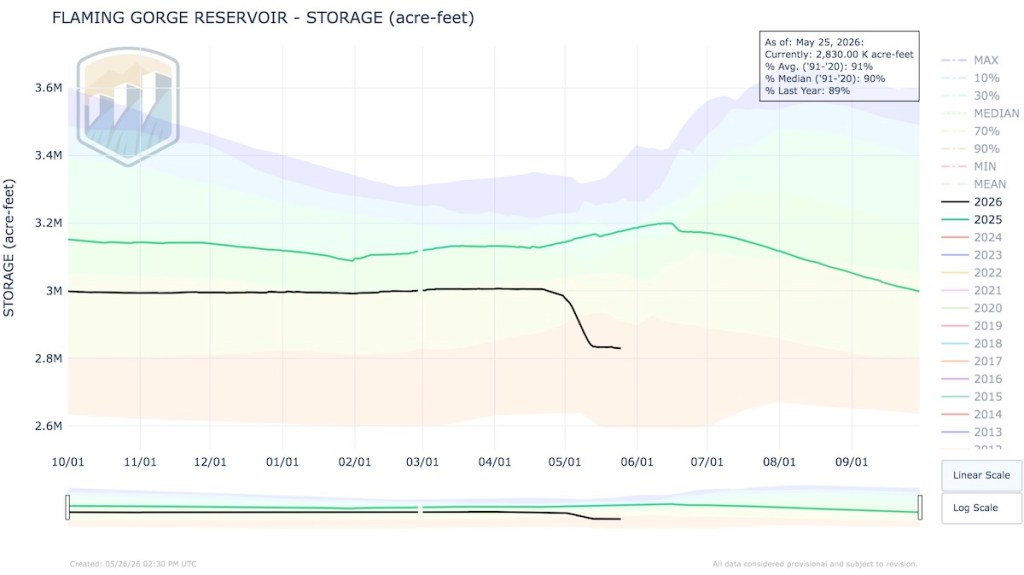
So far, Flaming Gorge has dropped from about 3 million acre-feet in April (or 82% capacity) to about 2.83 million acre-feet as of May 25. Meanwhile, water managers warn, “This release plan is subject to change depending on evolving river conditions and weather forecasts.”
Those evolving conditions include forecasted versus actual flows from streams feeding the system. For example, those “unregulated” or natural flows are forecasted to be much lower than normal: 70,000 acre-feet of water into Flaming Gorge during May (28% of average), 175,000 acre-feet in June (45% of average) and 84,000 acre-feet (42%), according to the Bureau of Reclamation.
Water officials caution that water flowing from the Flaming Gorge Dam could change, and that those recreating on the Green River below should monitor release schedules at this website. The bureau also noted, “Water will be colder than usual and will run high and swift during periods of elevated releases.”
Water floats recreation economy
Buckboard Marina went through a similar drop in water a few years ago. The Bureau of Reclamation began pulling water from the Flaming Gorge in 2021, and by 2022, the marina’s water level was at an all-time low. While the reservoir recovered somewhat in 2023 thanks to a good year for moisture, Valdez said, the reservoir has continued to decline since then.
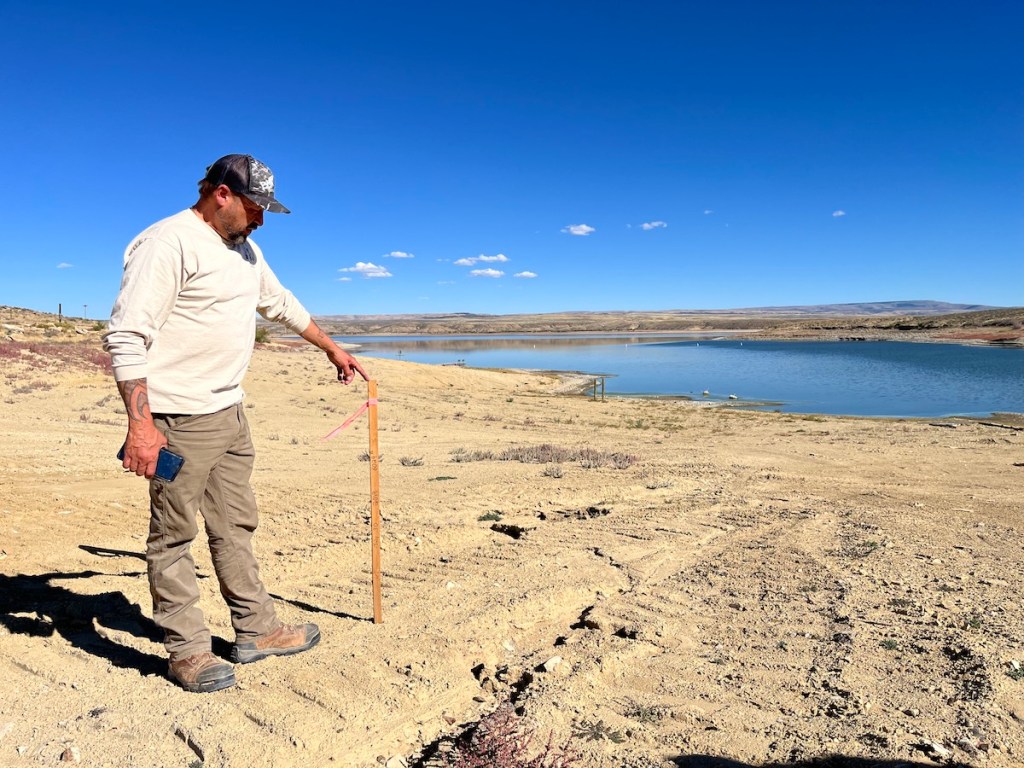
Kokanee salmon and trophy-sized lake trout draw tens of thousands of visitors to Flaming Gorge each year, supporting a recreational economy in southwestern Wyoming and northeastern Utah. But as the lake is drawn down, water recedes from shallow shorelines and fish are forced into a smaller space, essentially shrinking the fishery toward the dam side of the reservoir.
One of Valdez’s primary concerns is that water levels could drop below the ideal elevation for kokanee to spawn in the reservoir.
“I think people don’t realize the economic value it brings,” he said. “It is a big deal when you lose your kokanees.”
Already, kokanee are struggling to thrive in the reservoir.
Drinking water dries up
Valdez has already lost money this year just from people being concerned about water levels. He estimated that the marina lost roughly $30,000 in cancellations when discussions about releasing water began as early as February.
Other problems also start to arise as the water drops. The marina will lose access to drinking water at 6,010 feet, below their floating pump that supplies potable water. It’s only 7 feet away from the current level.
“That’s scary to me,” Valdez said.
The marina can truck in water from Rock Springs, but it costs about $1,200 to bring in 8,000 gallons, which lasts about two weeks. For Valdez, it feels “asinine” to lose water at a marina.
“Why would we run out of water on a lake?”
Water levels also impact the location of the fuel dock and fuel lines extending to it. If the reservoir sinks too low, it could cost up to $100,000 to adapt, he said.
Drawing down water levels quickly — as happened in early May — can damage marina structures. After the 2021-22 drawdown, Valdez said he spent about $130,000 in repairs.
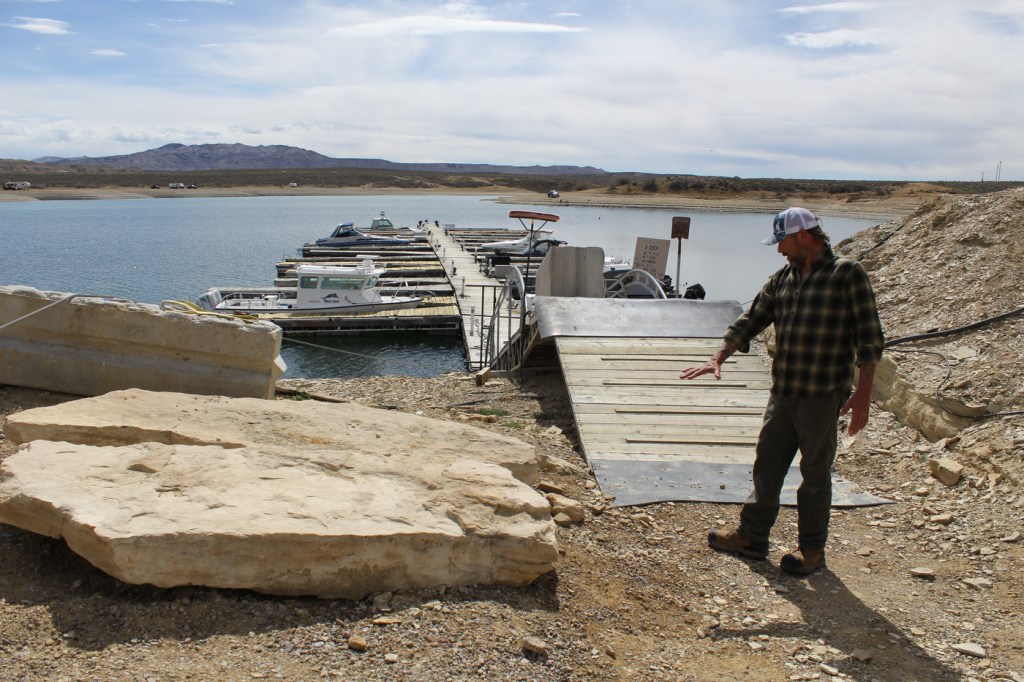
This time, he’d hoped to keep up. He and a group of 10 men worked to keep pace with the dropping water levels, repairing and modifying ramps. It wasn’t enough.
“The drop was dramatic enough to break all of our approaches, our bridges, our stuff, so it broke a lot of the welds, broke a lot of the structured steel, because it just vertically dropped too fast for the weight,” he said.
When structures go from water to land that quickly, the weight is too much for them to hold up, Valdez said.
“I’m re-rigging everything, and this is only a temporary fix ’til September, because that’s when the season ends.”
The marina should remain mostly functional until the summer season ends, he said. But with extra water releases set to continue through the winter, the lake could drop another 10 to 12 feet by the spring.
“We’re getting into numbers that I don’t even want to talk about,” Valdez said. “I mean, there’s no marina.”
What’s next?
“The guy with the boots on the ground that watches this every day,” as Valdez describes himself, can see what water managers can’t, and he questions whether official numbers and estimates match reality.
“It’s hard to watch this when it’s out of your hands.”
Valdez is critical of the 1922 compact, doubting the legal rationale of sending Wyoming water to places like Arizona. He also wonders about the role of local industries — refineries, coal-fired power plants and trona mines — that use large amounts of water, and the idea of adding more industrial facilities that require even more water, like data centers.
“We don’t have the water to give away,” Valdez said.
Bryan Seppie, general manager for the Joint Powers Water Board for Sweetwater County, Rock Springs and Green River, agrees. “The poor hydrology this past winter has affected most all water users in some form or another,” he said.
His board monitors the Colorado River system closely. Just upstream from Flaming Gorge, the Bureau of Reclamation reduced releases from Fontenelle Reservoir due to poor inflow projections. Although the water will still be enough for river users, the low summer flows will have a negative impact.
“Low river flows typically result in higher water temperatures, which generally leads to higher levels of moss/algae and overall lower water quality,” Seppie said in an email.
What about recovery?
Valdez wonders: What’s the plan to allow the reservoir to bounce back?
Wyoming State Engineer Brandon Gebhart and his staff have warned for months that although Flaming Gorge can serve as a backup to Lake Powell this year, it drains the Gorge’s ability to play a similar role next year, or the year after. It takes time for Mother Nature to replenish the bank.
“The big thing that nobody is talking about is the recovery,” Valdez said. “Where is the recovery of our water?”
This year’s drain on Flaming Gorge began at a low point. The reservoir hadn’t fully recovered after the last major pull. Rather than starting at a high point of 6,040 feet, the marina was at about 6,024 feet, he said.
“There’s no recovery plan,” he said. “We can’t just let them keep taking. I mean, where’s this end?”
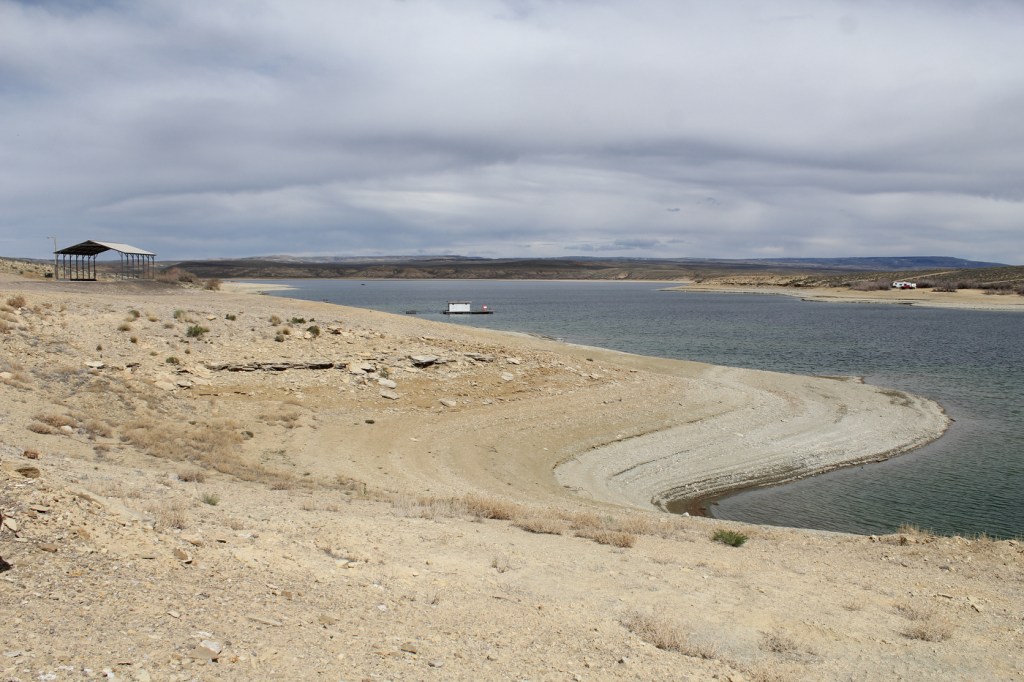
If there is no grace period for the reservoir to replenish and officials want to take even more in the near future, starting from such a low elevation point, it will be “devastating,” Valdez said.
“The water going down is not the end of the world, it’s the recovery in a timely manner that really matters,” he said. “I can’t preach recovery enough.”
Watching people come to the marina and seeing how happy they are still motivates Valdez to keep going. Despite the drawdown, there’s nowhere else he’d rather be.
“We’re not going to run away. We’re not going to give up,” he said. “We’re going to fight.”


At what point do we realize that we live in an arid high desert environment and “drought” is actually the normal weather pattern for the western US not the exception. Blaming our lack of water on “drought” and un proven “human caused climate change” just delays important decisions on how water is allocated and how we continue to blindly over develop / grow in the west.
I attended a Town meeting in Cheyenne several weeks ago on a 12 month moratorium to evaluate the effects of large data centers. Although good arguments were made to pause development, the Board voted 8 to 1 in favor of going forward with no evaluation of the consequences. The demands on water and electricity are considerable and I believe this is being overlooked in the demand for water. In addition, it was mentioned that AI is an existential threat to civilization. I agree.
Just like our federal ‘reps’, our state reps don’t represent the people. Instead they goose-step to the billionaires
If “using water like there is no tomorrow” is alarming, knowing that it is not the only critical finite resource we are “using like there is no tomorrow” should be even scarier. The world lives in an envelope of atmosphere. There is only so much of it. Yet we elect leaders that tell us there is no need to worry about it! Hell, we even pay them to pass legislation to rescind protections already in place so we can pollute at a more accelerated rate! We need to look more closely at those who could lead us off of this dead end road we’re on and quit selling our grandchildren’s future for todays dollars.
The marina will lose access to drinking water at 6,010 feet, below their floating pump that supplies potable water. It’s only 7 feet away from the current level.
“That’s scary to me,” Valdez said.
Most folks would lower their intake hose.
I have been exceedingly fascinated in the ability for the Beast called capitalism to extract every life giving or civilization creating resource to its ultimate limit while the populace is convinced by economists that we will find a replacement for these essential materials as long as we “print” enough money.
The alarm bells are ringing everywhere but the only “bell” that seems too matter to people is the closing bell as the stock market going up is the only indication that things are right with the world. Economist should be awarded degrees from the Divinity School and not from the Sciences as there is no science in a degree that relies on Faith. Unlimited growth cannot occur on a planet with finite resources.
Living by using the water like there’s no tomorrow is a fool’s errand. While I sympathize with Mr. Valdez and others who expect the water to be there forever, the reality is that now we have to pay the piper for our shortsighted policies.