
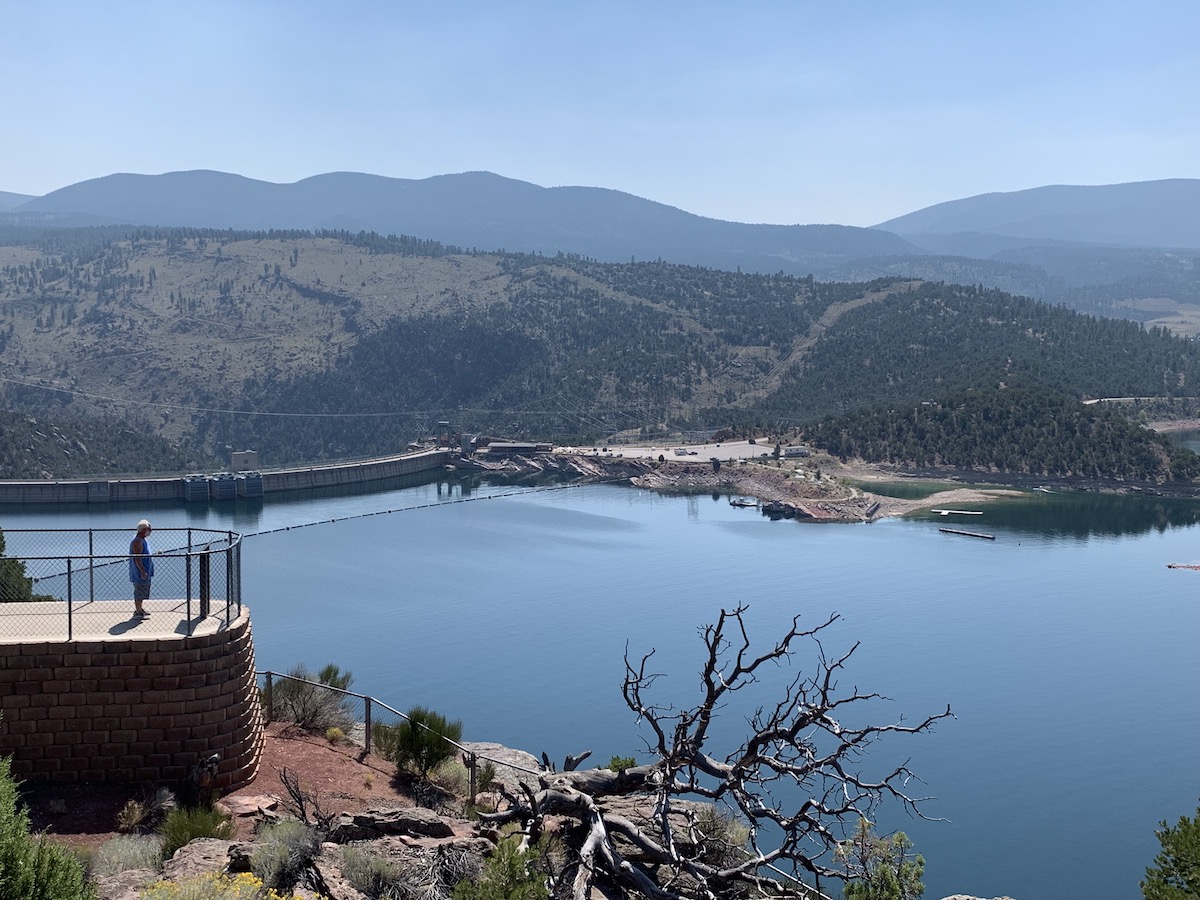

The outlook for the Colorado River, and Lake Powell in particular, continues to worsen due to an historically warm winter and dismal snowpack.
Projections show that Lake Powell on the Utah-Arizona border could drop low enough this year that it stops producing hydroelectric power at the Glen Canyon Dam. If it drops even lower, the dam is in danger of structural failure.
Wyoming relies on some of that hydroelectric power, according to state officials. The state will also play a major, legally obligated role in trying to help prevent such a catastrophe. Primarily, the Bureau of Reclamation will release extra water from Flaming Gorge Reservoir — potentially 1 million acre feet, which is more than a quarter of its storage capacity of about 3.8 million acre-feet.
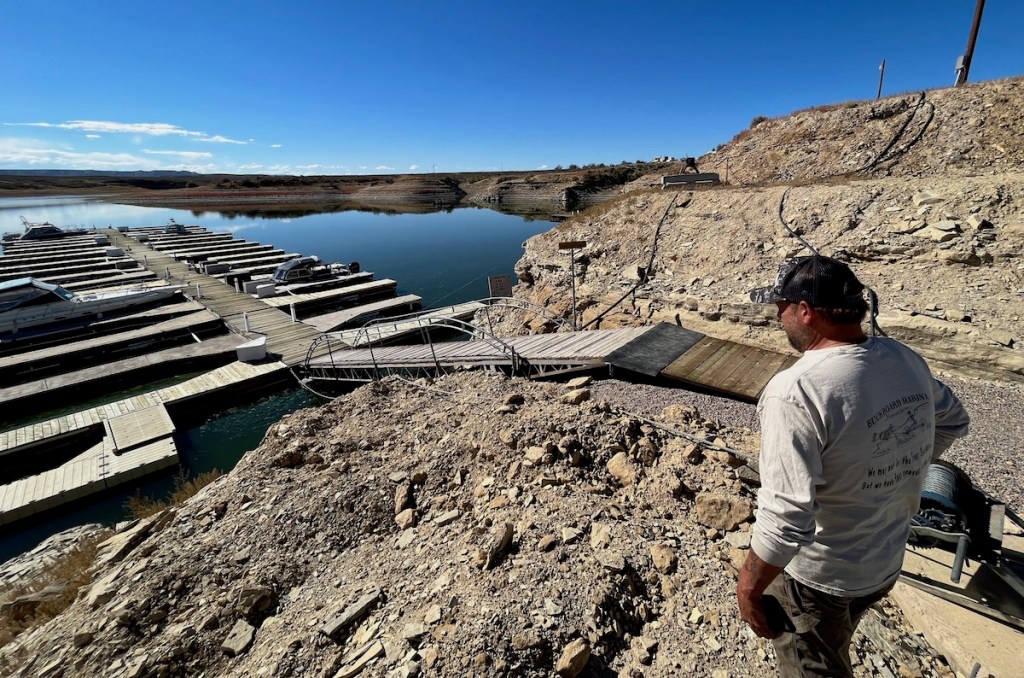
In addition to recreation and economic impacts at Flaming Gorge on the Wyoming-Utah border — boat ramps may be rendered inoperable — Wyoming officials worry about potential mandatory water use reductions in the southwest corner of the state, as well as potential legal entanglements over a seven-state negotiation that has so far failed to resolve how stakeholders will share the pain of a declining Colorado River.
Adding to frustrations and fears, the water crisis is so severe and crashing so rapidly that stakeholders can’t even track — with confidence — its extent.
“Even though these projections are painting an incredibly dire picture for us, we need to be mindful that runoff might even be worse than what’s being projected,” Wyoming Senior Assistant Attorney General Chris Brown said Friday, adding that dry soil throughout the region is a wildcard in water calculations. “It’s bad. It’s incredibly bad what we’re seeing in the Upper [Colorado River] Basin right now.”
Brown joined Wyoming State Engineer Brandon Gebhart Friday at a Wyoming Colorado River Advisory Committee meeting to provide an update on the crisis (click here to see a slidedeck presented at the meeting).
“The information we’re getting is evolving just about as quickly as the hydrology is declining, so we’re trying to react to what we’re seeing in almost real time,” Brown said. “We don’t know what’s actually going to happen.”
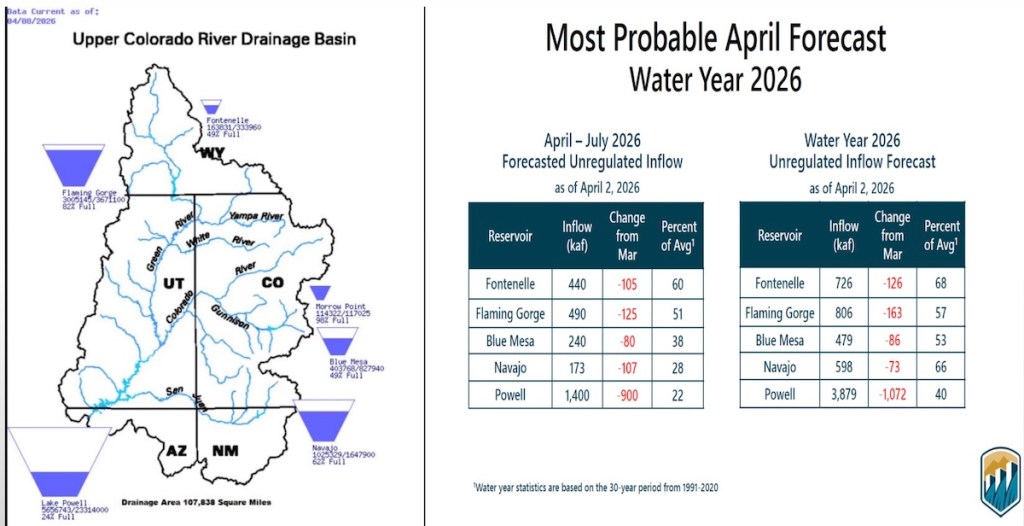
An extra release from Flaming Gorge, which will begin on or before May 1, is a certainty, according to Wyoming water officials. That’s because the reservoir was specifically built to serve as a sort of water bank to ensure legally obliged deliveries to downstream states Nevada, Arizona and California. Among four storage reservoirs in the upper basin, Flaming Gorge has the most — and the most legally unrestricted – water to send downstream to Lake Powell.
“It’s the low-hanging fruit,” Brown said. “It’s the biggest, by far, and it’s got the most available water.”
The reservoir also played a vital backup role for Lake Powell a few years ago. Colorado River authorities released an extra volume of about 465,000 acre-feet of water from Flaming Gorge in 2023.
But this year, even considering decreased releases from Lake Powell to help maintain Glen Canyon dam’s functionality, “anything we do as far as upstream [extra water] releases is not going to be enough,” Brown said.
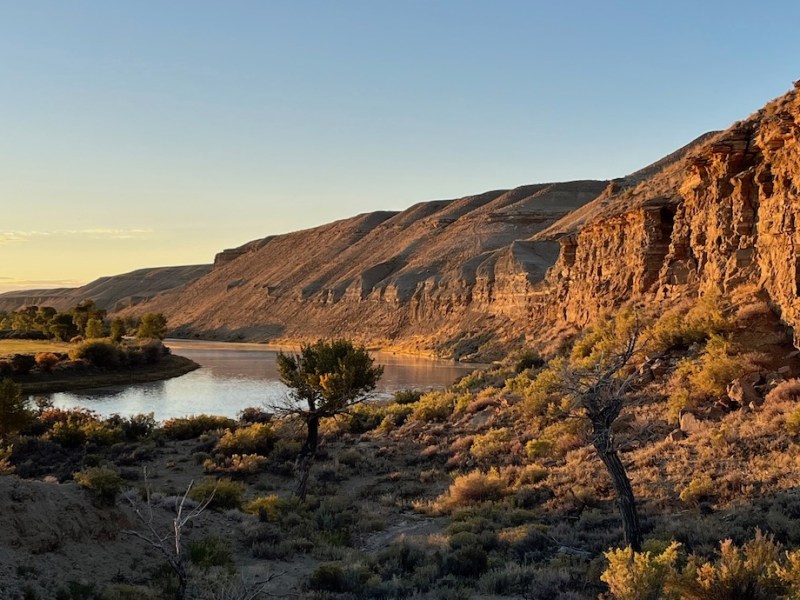
If the climate and hydrology crisis in the Colorado River Basin persist, how many times can water authorities go back to the well, so to speak, before it runs dry? After extra releases this year, it will take time to replenish Flaming Gorge. What if 2027 is another bad year, and beyond that?
“That’s something that we’re certainly incredibly mindful of,” Brown said, adding that those are questions still unanswered in failed negotiations to update the drought management plan.
Asked about a potential legal strategy regarding continual demands for extra releases from Flaming Gorge, Brown said, “That would require going into executive session.”

It appears the threat of moving water out of other river systems such as the Snake to address decades of mismanagement and bad development decisions in the Colorado River Basin is an old one.
https://cowboystatedaily.com/2026/04/13/teton-commissioner-doesnt-want-water-diverted-to-make-up-for-colorado-river/
Kudos to the Teton County Commission for understanding the threat.
46% of all Colorado River water for human use goes to alfalfa and similar crops for livestock feed. This is one of the most important facts out there that rarely gets discussed. If we want to take this issue seriously, we have to look at what or who uses the most water. We also need to take climate change more seriously since climate change leads to reduced snowpack in the Rockies, more drought, more evaporation, and more heatwaves. We’re long past the time of protecting sacred cows (pun intended).
I was a rafting guide on The Mighty Upper C (the Colorado River in Grand and Eagle counties, Colorado) for eighteen seasons, starting in 1986. Scrape, crunch, stop and silence, “We’re on sandbar folks. Let me explain …..” All this is nothing new. It should be noted here that the term “watershed” is not, strictly speaking, completely accurate or useful here, “usage area” would be more so. Recall that owing to transmountain diversions, many places that receive water from the watershed are not even in the watershed! This includes, incidentally, Denver and all of northwestern Colorado, at what I call “The top of the watershed (usage area), and of course California’s Imperial Valley and L.A., at the bottom of the watershed (usage area). We are too many, and we waste water extravagantly even for non-essential uses. Water conservation is only water conservation if there is water in the streams and rivers.
Thank you for bringing attention to this most important of issues. Here in California we barely had a winter this year. We have to all work together to conserve what we have and heal the environment we depend on to live so it gets better not worse which is where we are currently headed.
When will people wake up and realize that there are no NEW sources of water to date. Where I live, the last three snow seasons have been below average and this year was the worst at 59%. Think about it folks, what do you do when one day you go to your kitchen faucet, turn the tap and nothing comes out?
How many years has this problem
been addressed by those dependent
upon this water to take corrective action? Why must it be true that leading the horse to water does not force the horse to drink? Historically, since its creation, water has been foundational for life. Those who for profit and/or greed should not have the power to refuse to reduce consumption.
There has to be a clause written in, that protects the surrounding area, if there isn’t enough to let go of. If not it needs to be amended to include this. It does no one any good if there isn’t ant left to sustain the area that collected it in the first place. It was only intended to be shared if enough is available. Not at the detriment of the surrounding area/people/fish/animals.
The unfortunate thing is we don’t see any comments or analysis of watershed or stream condition. Our watersheds should be our natural storage systems allowing water to infiltrate, recharge our aquifers and then be released to our streams during summer. What actions in our watersheds affect this water storage and streams, and what are we doing to restore full function to those that are impaired?
What about letting beavers return to streams and do their job of water storage in their ponds and recharging the groundwater near streams? Are we destroying wetlands by filling, development and other uses?
What about soil condition in our watersheds? Are soils compacted? Are they eroding? Have they lost the ability to absorb water? If so, what are the causes and what are we doing to restore their function?
I agree with you, especially about beaver reintroduction and protection. Are golf courses and grass lawns really necessary?
Maybe start restrictions based on the forcast, not wait until it’s too late.
Sooner or later Phoenix is going to have to stop growing and everybody else along the C.A.P.. drive through the wealthier burbs and you see grass medians and water ponds and lakes for recreation/asthetics only. As I longterm resident of Az (moved into the state in 1961) it really offends me to see such wastefull use of scarce water in a dry arid desert. I don’t know when, but it’s going to lead towards a ecological and economic collapse of the state. Land is already dropping as the groundwater is pumped dry. Totally unsustainable.
Given the likely future of even less water going into the Colorado River System, I can see an effort to try and bring water from other systems into the doomed Colorado. Systems such as the Snake and Wind River. If we think water politics are vicious now, just wait.
Could be a prelude to water restrictions for human consumption only.
” human consumption ” — like the 266 golf courses in Phoenix, Maricopa County , AZ ?
Their time is short.
Lake Powell at historic lows, Lake mead 20 feet from record low.
Not only water, but electricity will be cut off when those reservoirs reach dead pool level.
In regards to “human consumption only,” what does that mean, exactly? Clearly it means no water to lawns or golf courses, but all agricultural uses do lead to humanly consumable food. Maybe (horrrors) human consumption means fruits and vegatables, but no alfalfa or corn for cattle?
Good points. Agriculture, such as cotton growing in southern Arizona? Alfalfa for export to the Middle East? Cows and sheep on public lands only benefiting welfare ranchers …. These are issues and the desert southwest. Do read Cadilac Desert, still very relevant; also, Beyond the Hundredth Meridian; Two good books that ought not be collecting dust ….