


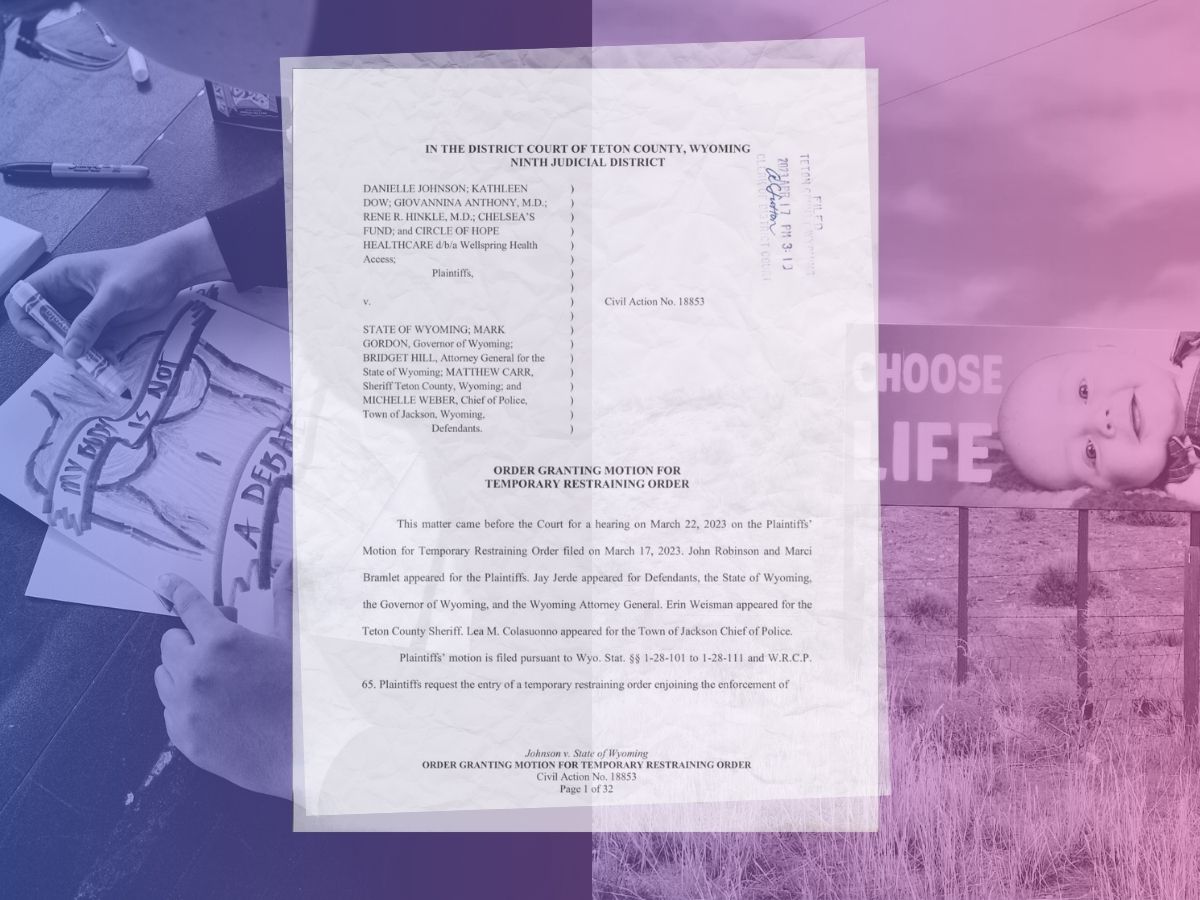
With major abortion decisions looming, 9th District Court Judge Melissa Owens has issued some timely orders.
The latest allows plaintiffs who are challenging Wyoming’s abortion bans — including women, health care providers and an aid group — to use eight expert witnesses to support their case.
The expert witnesses’ testimony was scientifically valid, relevant and necessary to address key claims in the case, according to Owens’ Thursday order.
“Expert testimony may be admissible even if shaky,” wrote the Teton County-based judge. “It may provide only a ‘scintilla’ of support for a claim or defense.”
Her findings align with arguments plaintiffs made earlier this year.
Those witnesses include four of the plaintiffs, two religion experts, an OB-GYN medical expert and well-known Wyoming prosecutor Michael Blonigen.
The state challenged the use of such witnesses for several reasons, including that it felt the experts were making opinions on “ultimate issues of law,” which isn’t allowed.
Owens disagreed, finding the testimonies “necessary” to understanding the plaintiffs’ facts and claims that the abortion bans are unconstitutional.
“The trier of fact in this case [Judge Owens] has no medical training, no theological training, nor is the trier of fact permitted to rely on her knowledge as a former prosecutor,” she wrote.
Judges aren’t allowed to research these things themselves, relying instead on the facts presented by both parties.
“The trier of fact in this case has no medical training, no theological training, nor is the trier of fact permitted to rely on her knowledge as a former prosecutor.”
Judge Melissa Owens
Amicus briefs
Late last month, Owens also accepted an amended amicus brief from a group of current and former medical practitioners who argued in favor of abortion bans.
That group included retired doctor and former lawmaker Timothy Hallinan, retired doctor David Lind, practicing OB-GYNs Samantha Michelena and Michael R. Nelson.
A main tenet of their argument was that allowing abortion overthrows a “two-patient paradigm” of obstetricians caring for both mother and the unborn.
“Under this one-patient paradigm, the wellbeing of the unborn baby is irrelevant, every abortion is medically indicated, and every obstetrician would have a legal and ethical duty to provide (or at least facilitate) abortion on demand, regardless of the circumstances,” they wrote.
In response, plaintiffs called the one- and two-patient paradigms “ideological tropes,” and argued the amicus brief doesn’t address health facts related to abortion and doesn’t acknowledge vague medical terminology that could keep doctors from helping patients.
“Forcing a physician to risk criminal liability in order to provide necessary medical treatment is unconscionable and unconstitutional,” plaintiffs wrote. “Of course, Amici themselves will not have to confront this impossible dilemma because two are retired and the others presumably choose not to perform abortions.”
Wyoming law protects physicians’ right to not offer an abortion.
The plaintiffs also claimed the brief didn’t offer any evidence that the abortion ban is constitutional.
Coming up
On Tuesday, anti-abortion lawmakers and Right to Life of Wyoming will argue before the Wyoming Supreme Court why they should be allowed to join the suit against the state’s bans.
Reps. Rachel Rodriguez-Williams (R-Cody), Chip Neiman (R-Hulett), Right to Life of Wyoming and Secretary of State Chuck Gray requested to intervene in the case to defend the bans, but Owens denied their request in district court. The group, sans Gray, appealed that decision to the state’s highest court.
On Thursday, Owens will hear arguments over whether she should skip trial and side with the state or the plaintiffs — either finding that the abortion bans are legal or that they’re unconstitutional.
For a review of the two sides’ initial, overarching arguments, go here and here.
It’s expected that however Owens rules, her decision will be appealed to the Wyoming Supreme Court.


Why do “religious experts” have any input in this issue?
Good point!
Roger Sinden, good question! If someone’s religious beliefs forbid abortion, fine. Just don’t force those beliefs on the rest of society, thereby relegating women to second class status.