

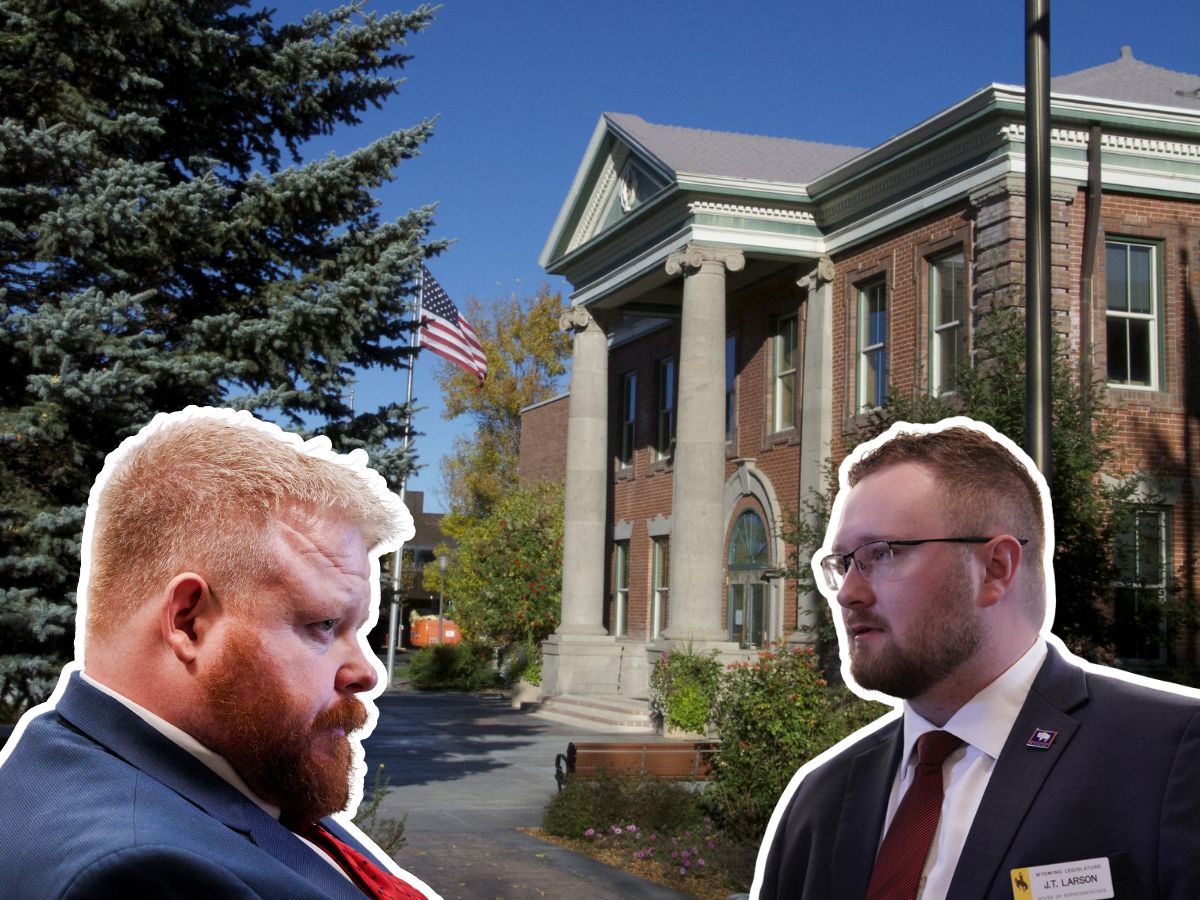
A district court judge dismissed a defamation case Thursday against a political action committee linked to the Wyoming Freedom Caucus, ruling that there was insufficient evidence to indicate the PAC had made statements against two lawmakers with actual malice — a hefty legal standard in libel cases involving public officials.
After launching in 2023 to support the hard-line Wyoming Freedom Caucus, the PAC took aim at Republican incumbents in the Legislature, including Rock Springs Reps. J.T. Larson and Cody Wylie.
The two filed a lawsuit in 2024 after the PAC sent text messages and mailers to voters indicating the two lawmakers voted to remove former President Donald Trump from the presidential ballot. No such vote occurred in the Wyoming Legislature.
In their complaint, the two lawmakers argued that the PAC knew its statements were false and, therefore, made them with actual malice — a legal standard in defamation cases involving public figures or officials.
Attorneys for the PAC, meanwhile, accused Wylie and Larson of “seeking to punish and censor criticism of their records as legislators and to profit from their public services.” The PAC also argued that the mailers and text messages did not constitute defamation and “were made in the court of political campaigning, where imaginative expressions and hyperbole are at their zenith.”
The case was scheduled for a five-day jury trial in June, but Uinta County District Judge James Kaste ruled Thursday that there was insufficient evidence to move forward and granted a motion by the PAC for summary judgment.

“There is no doubt the messages were purposely crafted to exaggerate the effect of the legislators’ votes and to more efficiently criticize them,” Kaste wrote in his decision. “In short, the messages were pretty standard political attack ads. Similar ads plague Americans every day, but they are indisputably protected speech under the First Amendment.”
Kaste also pointed to the high bar a public official must clear in a defamation case.
“They must produce evidence demonstrating that the criticism was published with actual malice, meaning the publisher either knew the statement was false or they made the statement with reckless disregard for the truth,” Kaste wrote. “And they must make this demonstration by clear and convincing evidence.”
“The bar is high because the right to criticize our government and our public officials is so fundamental to our democracy,” he wrote.
The plaintiffs, however, did not clear that high bar, the judge ruled.
“That is not an endorsement of the message or the pervasive use of negative misleading political attack ads,” Kaste wrote. “It is an endorsement of the fundamental right to freedom of speech established in the First Amendment.”
How we got here
The Wyoming Legislature has never considered, debated or voted on any proposal to remove President Donald Trump from the ballot in any election, in any state.
Campaign mailers and text messages stating otherwise referred to a vote on a budget bill footnote, WY Freedom PAC Chairman Kari Drost previously told WyoFile.
Lawmakers have regularly clashed over which elected officials should have the authority to represent the state’s interests in litigation, including in a debate during the 2024 budget session. At the time, Secretary of State Chuck Gray had recently joined Ohio and Missouri’s Republican officials in filing an amicus brief that advocated overturning a Colorado court’s decision to remove Trump from that state’s ballot because of his role in inciting the Jan. 6, 2021 riots at the U.S. Capitol.
The Joint Appropriations Committee responded by adding a footnote to the budget limiting the secretary of state’s ability to sue on Wyoming’s behalf.
“No funds shall be appropriated under this section shall be expended without specific legislative authorization for the secretary of state or the office of the secretary of state to initiate any litigation or participate in any litigation initiated in a court outside of Wyoming in which the state, the secretary of state or the office of the secretary of state is not a named party,” the proposed language read.
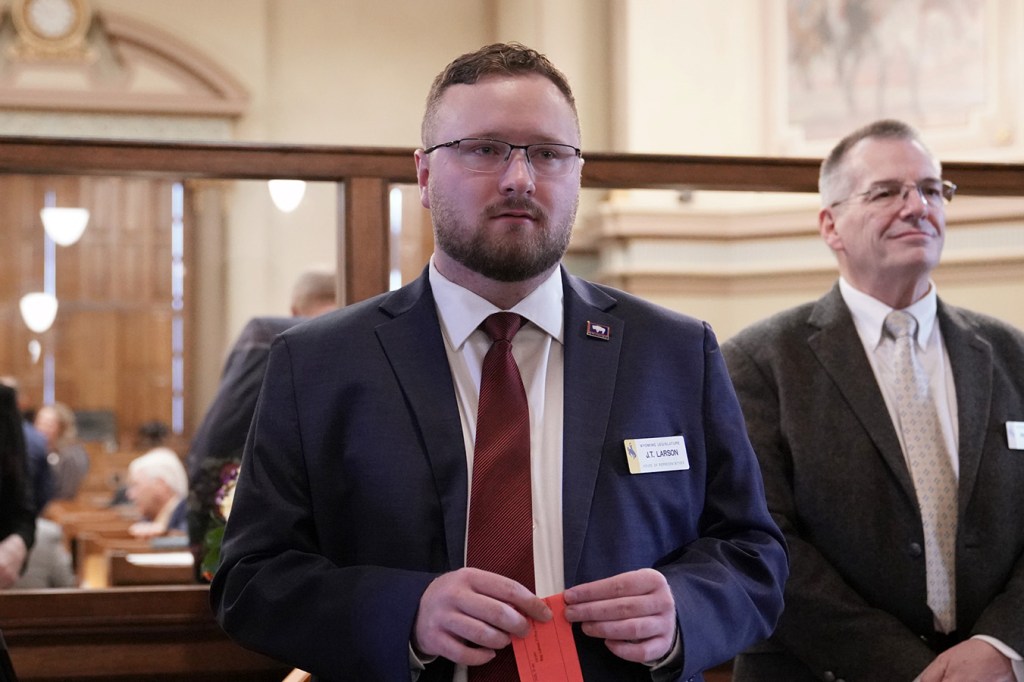
The footnote was motivated by protecting the separation of powers and ensuring the governor — the state’s chief executive — remained the one office with the authority to speak on behalf of Wyoming in a courtroom, some lawmakers argued.
Freedom Caucus members, however, argued that Gray’s office needed the ability to act quickly. The footnote was ultimately left out of the final budget bill passed by both chambers, but was described by the PAC’s mailers as a vote for or against Trump being on the ballot.
“[He] voted with the RADICAL LEFT to remove President Trump from the ballot,” a postcard targeting Wylie stated. A similar mailer aimed at Larson accused him of voting “NO to KEEP President Trump on the ballot this fall.”
The Freedom Caucus celebrated the ruling Thursday, calling the case a “meritless lawfare defamation lawsuit.”
“The First Amendment is clear. Politicians don’t get to silence speech that points out their unpopular voting records,” the caucus said in a statement. “Lawfare is a favorite tactic of the left, and it won’t go away after this case. That’s why Wyoming needs strong anti-SLAPP protections.”


Wyoming is one of 10 states without a law to prevent lawsuits intended to silence free speech, also known as an anti-SLAPP statute.
An attorney for Reps. Wylie and Larsen did not respond to WyoFile’s request for comment by publication time.

Exercising MY right to free speech, here is my take on this ruling. The Free dumb caucus are not out right liars, they are just good at twisting the truth to appeal to the dumb MAGA crowd. Hopefully, by August the Wyoming voters will come to their senses and give this crowd some sea shells.
Ok, fine, but believe me, all of us know now what a bunch of unhinged scuzzy liars these nonFreedumb carcass people are. Another media outlet reported that Gillette’s finest, the unhonorable rep. John Bear was the brainchild aka author of these hideous fliers. Just wait, John, til the flyers get sent out exposing you and your whackjob cohorts as the pond scum that you are. Guess what, you won’t be able to sue for defamation either!