


Power struggles between lawmakers reverted at least a quarter of Wyoming’s legislative redistricting map back to square one during a contentious meeting Wednesday in Casper.
With time ticking down before the 2022 budget session convenes in Cheyenne in February, members of the Legislature’s Joint Corporations, Elections, and Political Subdivisions Committee narrowly voted to adopt a plan involving significant changes for communities along the Interstate 80 corridor in southern Wyoming. While some lawmakers called it a compromise, others called it chaos.
The 2020 Census tallied Wyoming’s population at 576,851. Divide that figure by 60 (for 60 House seats) and the math shows that a Wyoming House district should comprise 9,614 people. Federal court decisions maintain that a district’s population should not deviate more than 5% from that figure to minimize the difference between the largest and smallest districts. The I-80 compromise plan’s proponents — led by Sen. Brian Boner (R-Douglas) and Sen. Larry Hicks (R-Baggs) — pitched the plan as a way to bring districts along the corridor within the acceptable range of population deviation.
“The time for posturing is over,” Boner told the committee. “It’s time to sit down and discuss something that’s middle-of-the-road and something that we can all maybe not like, but can live with.”
But committee Chairman Rep. Dan Zwonitzer (R-Cheyenne) and others said the plan throws Laramie and Albany county districts into upheaval.
“Stakeholders from those two counties are going to be scrambling to come up with a plan,” Zwonitzer told WyoFile. “It throws out four months of work.”
“I don’t want to look at any more regional plans. I want to look at statewide plans and see how they fit together.”
Sen. Cale Case (R-Lander)
Wyoming’s redistricting process has been contentious from the get-go, mostly due to an urban-rural divide. Some believe maps need to be redrawn to reflect growth in populous areas and declines in smaller, more rural communities, and others favor sticking closer to current lines.
The I-80 compromise is no compromise at all, Zwonitzer said, as it’s a win for rural interests at the expense of more populous districts.
“This is really more of a rural legislative plan for Sweetwater, Carbon, Goshen and Converse [counties],” Zwonitzer said.
Calling the adopted plan “chaos” for Laramie County, Sen. Tara Nethercott (R-Cheyenne) appealed to the committee’s chairmen, Zwonitzer and Sen. Ogden Driskill (R-Devil’s Tower), to unify committee members around a comprehensive proposal. It’s critical for the committee to agree on a plan before the session and defend it when it comes to the House and Senate, she said.
“I would encourage my chairmen to take the lead on that and the committee to come together,” Nethercott said.
The plan adopted Wednesday also leaves significant questions unanswered regarding the state’s northeast corner. It would split up Weston County — a fate stakeholders from that community tried to avoid — and leaves Campbell County stakeholders needing to redraw maps based on the compromise.
House Speaker Eric Barlow (R-Gillette) said the newly adopted plan does not satisfy stakeholders in Campbell County; he assured a bill pushing back will be brought to the floor during the session.
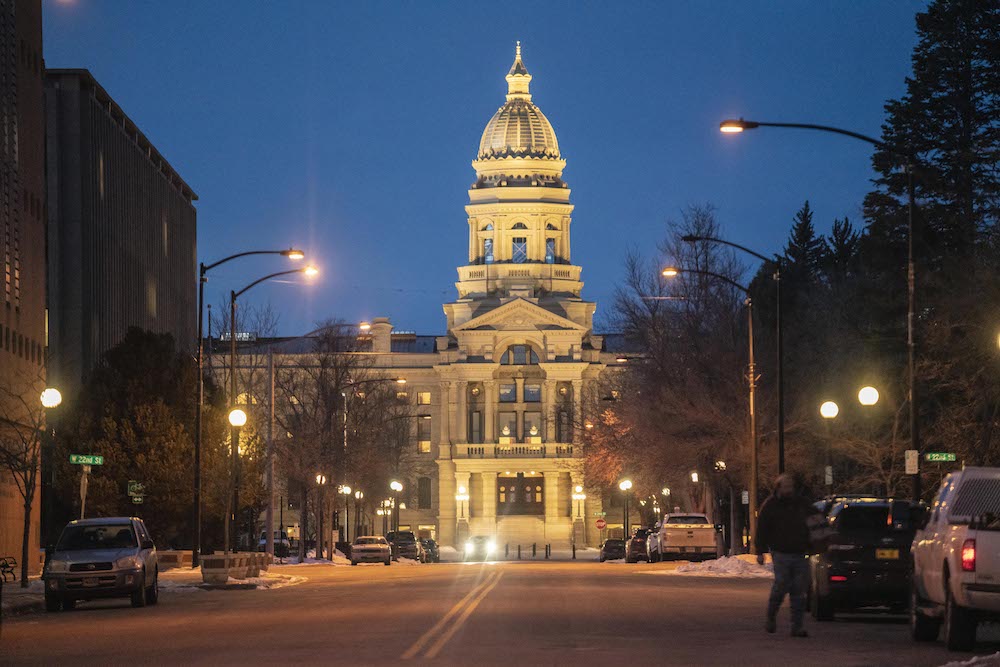
Many committee members expressed frustration with Wednesday’s meeting.
“I think we are really playing Whack a Mole but on a larger scale because we keep doing these regional plans,” Sen. Cale Case (R-Lander) said. “I don’t want to look at any more regional plans. I want to look at statewide plans and see how they fit together.”
The committee scheduled an all-day meeting in Cheyenne for Jan. 27 to continue discussions on redistricting. The 2022 budget session convenes Feb. 14.

How fine a point do you really need to put on each and every stick in a box of 60 red crayons anyway? Hurry it up already and no running with the scissors………
Phil; how about “complete disorder and confusion” created when a party turns on itself?
What about chopping the state into 60 vertical rectangles no wider than an area that contains 9,614 people? Or, into horizontal rectangles? Sixty diagonal polygons?
Ditto Phil.
Explain chaos please.
Phil (or Dan, apparently), please address why you need “chaos,” within the context of this article, explained. Your question or concern is unclear.