

Angus M. Thuermer Jr. is a WyoFile reporter and the former editor of the Jackson Hole News. He is a decades-long Jackson Hole resident and a graduate of Sandlin’s Write Your Novel class. This column was published in cooperation with Writers on the Range, an independent nonprofit dedicated to spurring lively conversation about the West.
Before Wyoming’s Jackson Hole valley became the province of the ultra-rich, it drew mountain athletes and outdoor enthusiasts enthralled by the Teton Mountains and the wild forests around them. Starting in the 1960s, legions of young people settled in the cowboy community, found ways to make a living and helped it grow into an international ski resort.
In this period between buckskin and billionaires, novelist Tim Sandlin, who died March 29, spun decades of living into 11 novels. He plucked his characters’ eccentricities from the skiers, carpenters, cowboys, waitresses, motel maids and climbing and river guides he lived among. He worked more than 40 entry-level and service jobs, including elk skinner, dishwasher, cook at the Lame Duck cafe, and copy editor and columnist at the Jackson Hole News.
The New York Times called his last novel, “Lit,” “slightly unhinged.” It’s about book burning, a coffee shop and a dead preacher. Readers shouldn’t be too bent on solving a murder, Sarah Weinman wrote. “Spending time with the quirky, unforgettable characters is a lot more important.”
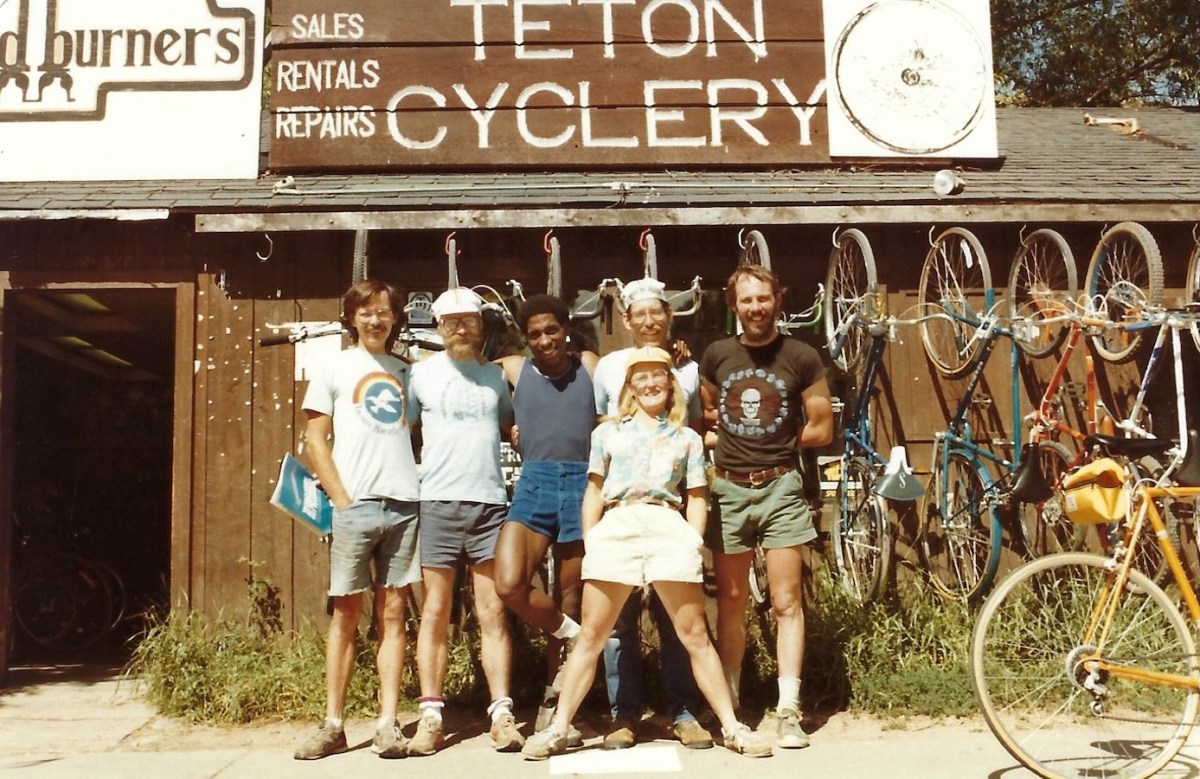
Sandlin fashioned many of his dramatis personae from real souls of the ’60s, ’70s and ’80s West. He lived in the Glenwood Arms, an ageing warren of nine apartments originally built for nurses at St. John’s Hospital. The Arms morphed into a compound contained by the back wall of the Jackson Hole Guide and encompassing Teton Cyclery, plus the headquarters of Jackson Hole Mountain Guides.
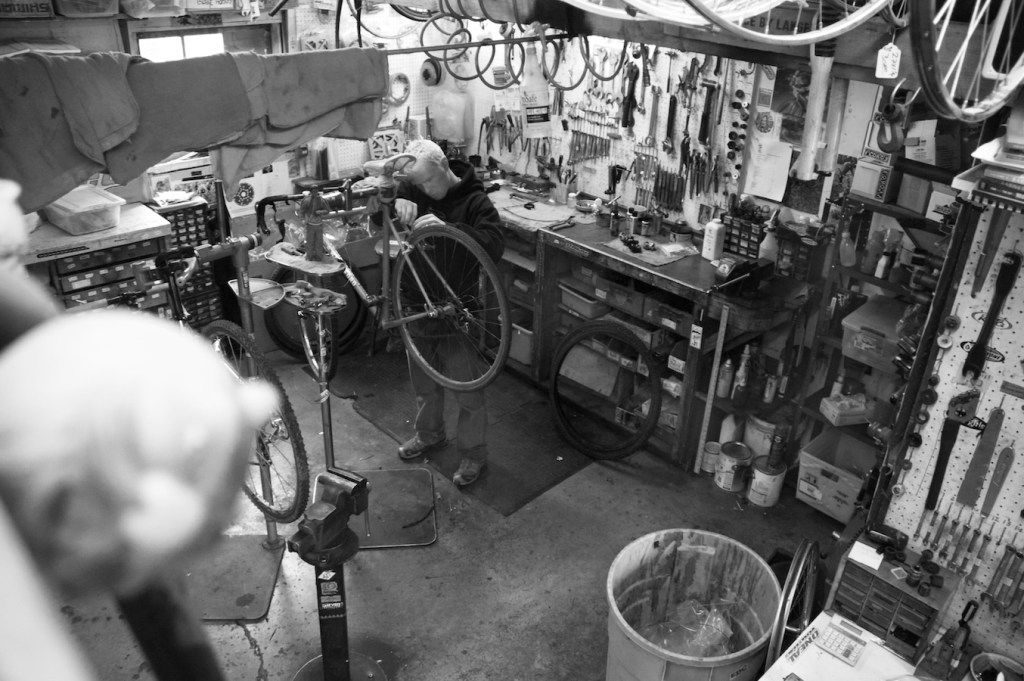
Sandlin adopted the slopeside patois of linguistic shortcuts and nicknames that became kind of a local code. “Every idea Sandlin had, he saw from his window at the Glenwood Arms,” K.B., former co-owner of the Cyclery, told me. Arms’ residents included a master glassblower, a virtuoso luthier, artists, musicians, resort workers and the astrologer and gemologist Janet Planet, whose window flower box fed the neighborhood moose.
Sandlin could witness the annual departure of the editor of the Jackson Hole Guide, which had a sack-happy publisher at the time. He might have seen the two police actions at the compound, one with guns trained on a knife-wielding resident, who was perhaps the third part of a love triangle. The other raid responded to reports of illicit smoke.
Cyclery mechanic Marty lived nearby in a single-wide with walls covered by sarcastic artwork. Three bike riders — Hajji, the Emir and Peter — left through one door of the Cyclery in 1980, then came back through the other door six and a half years later — having ridden around the world.
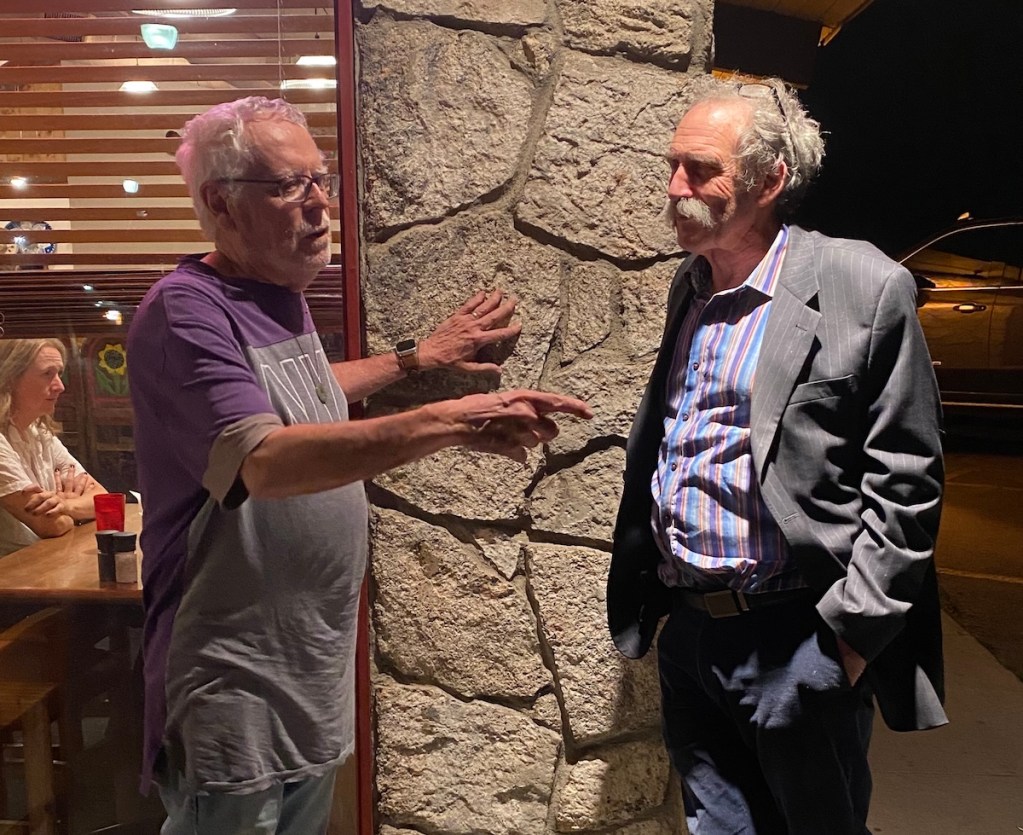
Jim Stiles, then editor and publisher of Moab’s Canyon Country Zephyr, spent the desert’s summer interregnum at The Arms. Moseying to the Town Square one day, he caught sight of “the ugliest man I’d ever seen.” It was the villain of the nightly shootout melodrama, one-eyed Clover the Killer, who never wore a patch.
Other compound characters left their mark. Dr. Liu built the first machine to mass-produce Croakies, the neoprene strap that saves your Vuarnet sunglasses when rolling your kayak. Cyclery co-owner Wendell’s special quesadilla is still on the Merry Piglets menu. Cyclery mechanic Flat Ed got his name after his ’69 split-windshield VW bus slipped off its jack while he worked underneath.
Today, “The Glenwood” stands at the site of the razed Glenwood Arms. It offers three-bedroom townhomes for $6.5 million. Just across the street there’s the Browse ’n Buy thrift store. Second-hand Ralph Lauren button-downs are now up to $8.
Born in Oklahoma in 1950, Sandlin moved to Jackson Hole to build a life, and once there, he established a writers’ coalition and conference, raised a family and wrote regularly at the back table of Pearl Street Bagels on Pearl Avenue.Sandlin’s career tells of a just-gone era, reminding me that imagination and literature enrich us as we learn that there’s humanity just outside our windows. There’s more about him in the Jackson Hole News&Guide, where they drop the paywall for obituaries to allow the living to keep up with the dead. You can find a collection of his newspaper columns that reflect the valley’s weekly dramas in his book “The Pyms.”

This story pleasantly captures the spirit of the 1960s — 1980s in Jackson where I worked during my summer breaks from college {1974-1976) and like the other working class young people such as Tim Sandlin found housing in a tent, a hotel windowless attic, the ski patrol building at the top of the tram, a condo, and a cabin. I returned in 1978-1979 to work as a bookkeeper at the Jackson Hole Guide. My sole mode of transportation was purchased from Teton Cyclery where I observed the comings and goings of the business from my desk at The Guide. My husband of 44 years arrived in Jackson in 1967. This past January I spent a night in Jackson and realized it’s the people who make the place.
Thanks Angus. A great article; a great guy; and interesting times in a place with a plentitude of interesting characters back then.
Thanks, Angus. Yes, Tim stands as a cultural and literary icon, and many antics spun around his axis. I especially remember the early days of the JH Writers Conference, with his lineups of boisterious, iconoclastic authors and publishing personalities — as well as the One Book Club, which we hope continues in his spirit.
“Wendell” is mentioned once in the story and once in the caption. Though his last name is not included in the version I am looking at, I assume Angus is referring to the legendary Wendell Brown of Jackson. I was an avid bicycle racer in the early 1980s and heard that Wendell was quite the athlete, though we never were in a race together. I also heard a story that some rednecks in a truck lassoed the bicycle of Wendell, a Black man, and drug him down the highway while he was out on a ride one summer day. I was horrified when I heard that and always hoped the story was not true. When I was reading this column (thanks Angus!) I started thinking: was Wendell really roped and drug down the highway like I heard back in the early 1980s? I just did an online search and discovered the story indeed was true, that Forest Stearns of Jackson and three other men in a big green truck rode up alongside Wendell, threw a loop around his bike, and drug him 220 yards down the highway near Gros Ventre Junction. Stearns, who now has a long rap sheet, and at least one of the other men were sentenced for assault with a deadly weapon. What a truly horrific, racist crime that was on July 17, 1980, but unfortunately crimes like this continue to happen. Oh so sad!
Thanks, Angus. I’ll miss Tim. We first met in 1981. I was the Sous Chef at The Silver Spur. Tim was the dishwasher. In more recent years, I was a KHOL DJ, and he worked at The Center. I always wondered what was going on in his head:)
I was a frequent visitor to JH during the 70s, 80s, and 90s, and I remember with fondness the collection of one-off shops that catered to any outdoor need. I almost sprang for a job as a bike tech at one of the “larger” ski shops somewhere back it that time period. It had been years since I visited JH until the eclipse came to town, and I probably wouldn’t have made it there if the eclipse had not, but…what a change!!
I liked the old town better, the one where the best skier in town was the guy who first skied Grand Teton.
Sometimes “success” just isn’t worth it.
The Cocktail Hour in Jackson Hole by Donald Hough is a great novel that depicts what the Boomers parents did there in the 1950s.
Good one, Angus. I’m going into a memory coma. Only 45 years ago I had hair and no belly. Many adventures rolled out of Teton ( third world ) Cyclery, home of Abuse Tours International. Some even returned. Cheers to the living and the lost.
Is that then-Tetonia residents Bill Scott (second from right) pictured with his then-wife Vini Norris (now deceased) leaning back against him?
Those were another couple super-smart, accomplished characters from the Lander-Jackson-Driggs axis back in the day.
Thanks for this column, Angus! I will go find some of his books. I loved your description of the changes in Jackson Hole, in the time “between buckskins and billionaires” and the comment about every idea he had he saw out his window…” thanks for the good read.
Nice, Angus. I didn’t know him, but you evoked both Tim Sandlin and an era beautifully.
In 1981, I was 18 years old and riding my ten speed road bike from Dubios to Jackson, then a loop through Yellowstone and back to my families dude ranch NW of Dubois. Just south of the Shoshone Lake I broke a spoke, which set off a chain reaction, and before I could get to the south entrance several were busted and my rear wheel wouldn’t spin. I had to abandon my comrades and hitch to Jackson. My ride took me to Teton Cycles who fixed my bike and tuned it up, took me around Jackson to enjoy the nightlife, and let me throw my sleeping bag on the grass near their house. I’ll never forget those guys, and I’ve been able pay back their hospitality several times by have travelers, both cyclists and hitchers at my house for a night or two. Thanks for the article Angus, brought back forgotten memories.
An excellent article Angus. Thank you for sharing.