


Wyoming lawmakers are considering several ways to ease the burden of soaring property taxes on residents.
The Joint Revenue Committee moved forward with five proposals during its meeting last week in Casper. These include a measure that would change the qualifications for a property tax refund program and another to give the Legislature greater flexibility to provide exemptions to residential properties.
Teton County saw the state’s biggest jump in property taxes in 2021 with a 36% increase, according to Department of Revenue data. Wyoming’s 22 other counties also experienced increases at an average of 16.17%. Such spikes are especially difficult for those living on a fixed income, such as retirees and disabled residents. Renters are also vulnerable to property tax hikes since some landlords will pass the increased cost onto them through the price of rent.
County officials, however, cautioned lawmakers against unintended financial consequences — property taxes fund local governments and education in the state.
Long-term solutions
There are more than a dozen approaches to property tax relief on the table for the Joint Revenue Committee’s consideration, each with a different fiscal outcome and potential legal challenge. Timelines also vary; some proposals, for example, would not bring material change for several years.
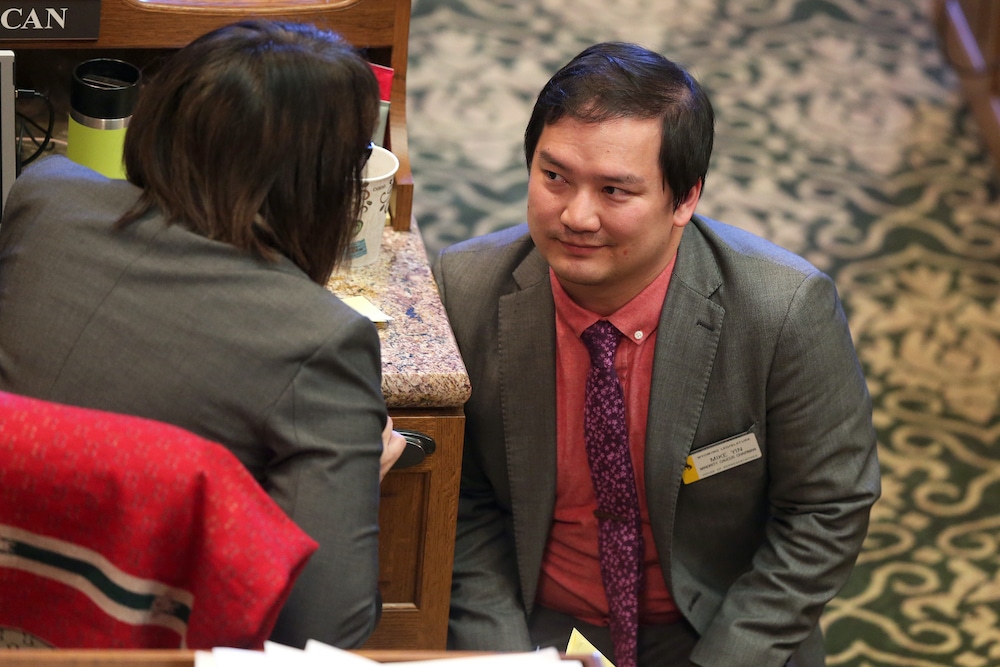
The committee began its discussion last week with a bill that would begin the lengthy process of amending Wyoming’s Constitution. There are three classes of property currently outlined in the state’s constitution — minerals, industrial and “all other property,” which is a catch-all for residential, agricultural and commercial properties. Originally sponsored by Mike Yin (D-Jackson), the bill would create a new property class for residential. This would allow lawmakers to create exemptions for residential property without losing critical revenue from agricultural or commercial properties.
“My goal, ultimately, is to ensure that people who have lived in Wyoming their entire life or for a long period of time, don’t end up getting kicked out of their homes because of property tax increases,” Yin said of the bill.
The bill would give the Legislature greater flexibility to pursue measures such as lowering residential assessment levels. Park County Assessor Pat Meyer cautioned lawmakers against tinkering with assessment levels.
“You’re going to hurt poor counties,” Meyer said, adding that it will be difficult for those counties to come up with other revenue.
As with any constitutional amendment, the decision would ultimately be left up to voters. If the bill succeeds in the Legislature, the soonest it would be on the ballot is 2024. The committee voted to move forward with the bill, and a tentative plan to amend it to clear other constitutional hurdles.
In a separate effort, the committee discussed commissioning a study to look into moving the state’s property tax system to one based on acquisition value, i.e. purchase price. Right now, property taxes for homes in Wyoming are based on current market value, regardless of what the current owner paid for the property, potentially decades earlier.
Department of Revenue Director Brenda Henson urged the committee to clearly outline the scope of the study, including a definition for “purchase price.” Henson asked the committee whether that would include realtor fees, for example. A Department of Revenue memo included about 30 other questions for the committee’s consideration.
The bill to commission the study mirrors failed legislation from the 2022 budget session sponsored by committee member Reps. Chuck Gray (R-Casper) and Mark Jennings (R-Sheridan).
Teton County Assessor Melissa Shinkle spoke in favor of the bill, saying it would be especially helpful if paired with some kind of rate cap.
“It may not seem like a relief program, but it will have an effect on those people who are on fixed incomes and have owned their homes for a long time in Wyoming,” Shinkle said.
The committee voted to review and incorporate suggestions from the DOR as well as the Wyoming County Assessors Association into the bill. The bill will be discussed once more in November.
Quicker fixes
Lawmakers also moved forward with three pieces of legislation that would bring about more expedient relief for homeowners. One bill would change state statute to allow for optional monthly payments, instead of having residents pay twice a year.
Another bill would amend the state’s property tax refund program, which saw its highest demand yet in 2022, according to Henson. The previous record was in 2015, when about 2,300 residents qualified for the program, costing the state a little less than $1 million. So far this year, the department has refunded 3,075 applicants totaling more than $1.8 million.
The program’s budget for the biennium was $3 million, so “to make the program available to property owners in full for next year, we’re going to need additional money when it comes supplemental budget time,” Henson said.
Sweetwater County Assessor Dave Divis encouraged lawmakers to continue funding the program and increasing the income requirements instead of other pursuits, like the acquisition-based study.
“That’s not property tax relief. That’s a different way to value property for taxation,” Divis said. “If the Legislature truly does want to help people who need property tax relief, I think [the refund program] is the best method because it’s already in statute. There is no constitutional amendment that has to be passed. It can be handled now and there’s no loss of revenue to anyone.”
About 1,300 applicants were rejected this year, mostly because their income exceeded the limit. The drafted bill would raise those income caps. The committee also amended the bill to require applicants to live in their homes at least six months of the year.
The committee also voted to sponsor a bill that would exempt up to $50,000 of a home’s value from property taxes — at least for homes worth more than $200,000. Lower-priced homes, on the other hand, would get a 25% exemption under the bill. The legislation outlines other requirements for such an exemption, including limiting it to owner-occupied homes that are lived in at least six months of the year. One must also have been a resident of the state for at least five years to qualify.
To address concerns with local-government budget impacts, committee co-chairman Rep. Steve Harshman (R-Casper) brought a successful amendment to use state funds to reimburse counties for lost revenue due to the exemption.
“We want to solve this problem, but in the meantime, not create other problems and that’s all I’m trying to do with this backfill,” Harshman said.
The committee’s next meeting will be Nov. 21 in Cheyenne.

Base property tax on last acquisition price or current valuation, whichever is lower.
no “or” there……acquisition value (going backwards–and how far???) will almost always yield a lower basis for taxation–given the inflationary housing mkt currently….
We already have a tenuous stream of tax revenues in this state dependent on minerals. Stick with the system we have, ultimately it is a fair system, everybody has skin in the game and for those on the lowest level of income scale, give them the tax break as currently outlined in statute. Let’s not tinker with or make the system any more complex that it is.
Thanks Rob, what I was thnking too. In a state with no income tax, falling funds from fossil fuel extraction, and underfunded education – where do they expect to get the money to pay the bills and provide the services?
Theyll figure out a way to continue to leech off of the more successful (blue) states but claim to be self secure.
nows the time to really practice that proud adage of fierce independence, pull yourself up by bootstraps, etc. You just voted (about 66%) for congress personage who shares your “standing ground” for states rights of self-determination and actually declined federal program monies over the last couple
years. Show me your cowboy pride: saddleup, pony up and keep on paying the load. It’s the cowboy way, no?