

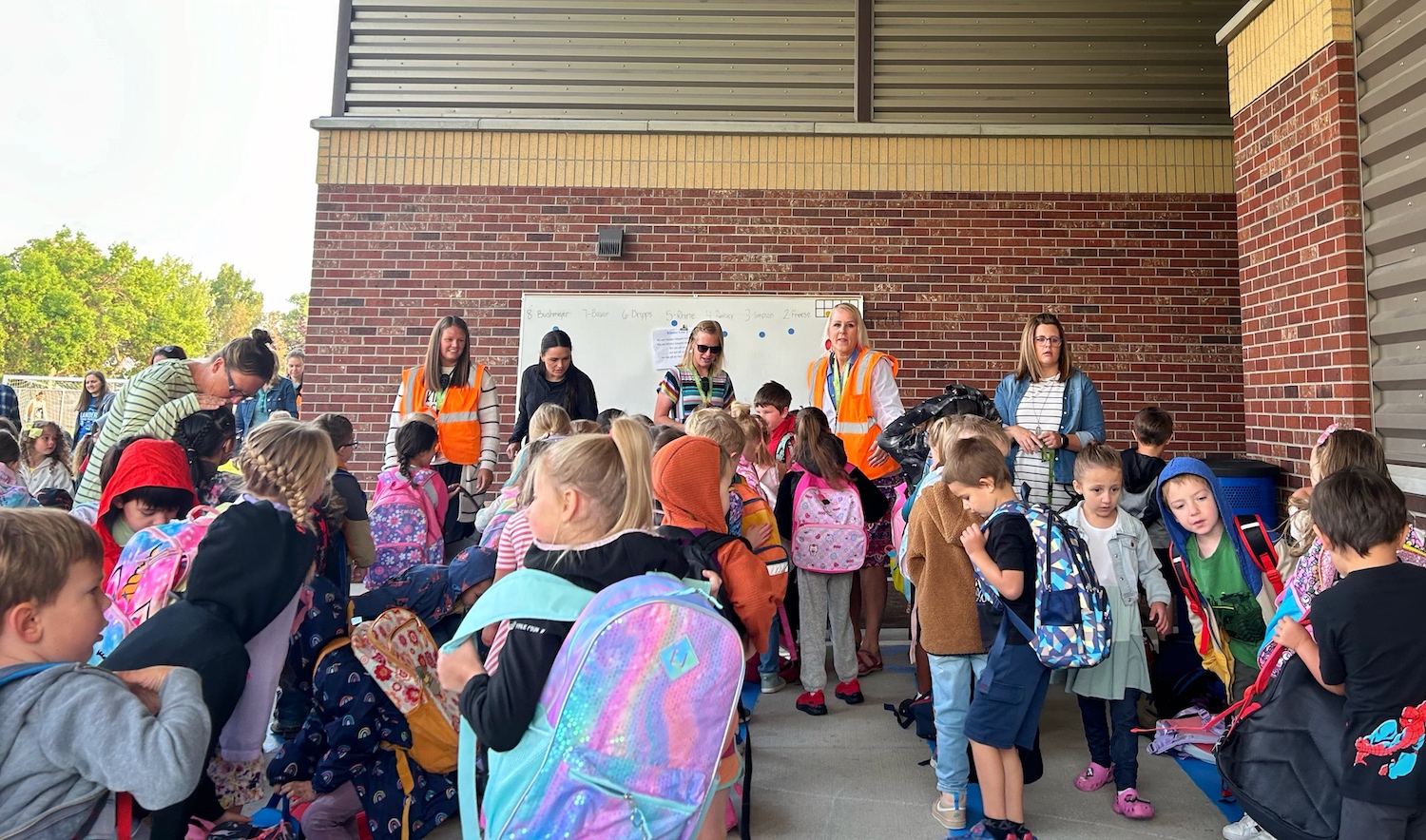
As the brother of a recent graduate from the University of Wyoming’s College of Education, Rep. Landon Brown (R-Cheyenne) has seen firsthand how lagging teacher salaries in Wyoming affect the state’s pool of educators.
“The offer that he received from Arizona was $22,000 more a year than what he was offered for any school district here in the state of Wyoming, including Cheyenne, where his home was,” Brown told his colleagues on the Joint Education Committee Thursday.
“He picked up and moved to the state of Arizona, where he’s going to pay income tax, because he can make $22,000 more a year,” he continued.
In the face of such anecdotes, as well as empirical evidence that Wyoming is struggling to attract and retain quality educators, the Joint Education Committee recommended an 8.5% “external cost adjustment,” or temporary increase in funding, for teacher and other school staff salaries for the 2025-26 school year. The body voted 11-1 to recommend the increase.
The recommendation, which also includes shifts in funding for school materials and utilities, would increase funding by approximately $66.4 million in total. That would bring the funding in alignment with Wyoming’s “evidence-based model.” That funding model was implemented after the Wyoming Supreme Court in 1995 declared the state’s K-12 school finance system unconstitutional for failing to “provide for the establishment and maintenance of a complete and uniform system of public instruction.” The new formula relies on consultants using complex economic data to periodically define appropriate funding levels instead of elected officials.
The pay bump still has hurdles to clear. The Appropriations Committee will make its own recommendation on the matter to Gov. Mark Gordon by Nov. 1.
But the Education Committee’s decision could represent a response to critics who say Wyoming has lost its ability to recruit and retain quality educators because it hasn’t kept up with the high relative pay it once offered.
Background
Wyoming periodically “recalibrates” how much the state is willing to spend on education and how the funds should be split — a complicated undertaking done with the help of consultants. The next recalibration is scheduled for 2025.
During the non-recalibration years, lawmakers decide whether inflation and cost models demand an external cost adjustment to appropriately fund staff, supplies and utilities. Any changes are then reflected in Wyoming’s Educational Block Grant Funding, a spending measure approved by the Legislature.

The committee’s discussion last week honed in on pay for teachers and other school staff.
In 2010, teaching salaries in Wyoming were about 25% higher than salaries in adjacent states, according to a 2022 report by economics researcher Christiana Stoddard. But over the next decade, the state’s average teacher wage didn’t increase much, going from $59,268 in 2012 to $60,650 in 2020, the report states.
Today, Wyoming still exceeds many Western states for teacher pay, but its edge has slipped. It’s ranked No. 26 in the nation for its average teacher salary of $61,979, according to the National Education Association.
Teacher pay in surrounding states is creeping up, Stoddard told the committee Thursday, including in Utah, which now surpasses Wyoming. Teaching wages have also fallen relative to salaries in other comparable occupations in the state, she said.
“Cost pressures matter because they affect the quality of teachers, and we know that teacher quality makes an enormous difference in terms of student outcomes,” Stoddard said. Many Wyoming school districts, she said, have opted to hire fewer personnel at a higher pay to remain competitive.
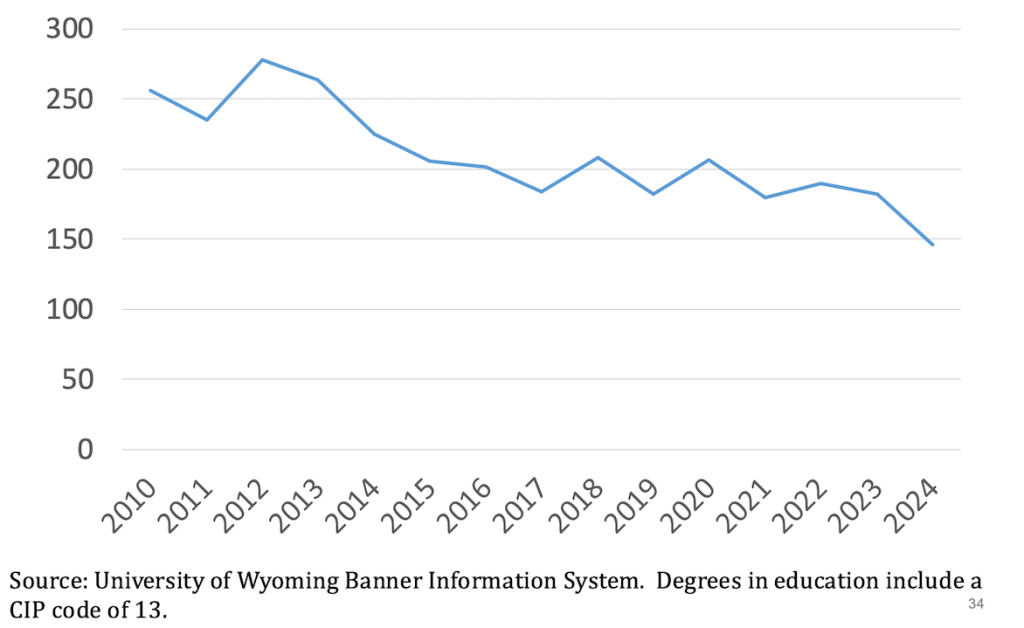
Stoddard noted another concerning trend: “a pretty sharp drop in the number of bachelor’s degrees from the University of Wyoming who are graduating in teaching.” UW has been a major source of new teachers to Wyoming schools.
In an effort to sustain teaching levels, districts are coming up with creative solutions. Wyoming reported 190 teachers using emergency or provisional credentials and four teachers working outside their licensed subject area for the 2021-22 school year, according to a Learning Policy Institute report on the state of the teacher workforce.
Keeping constitutional
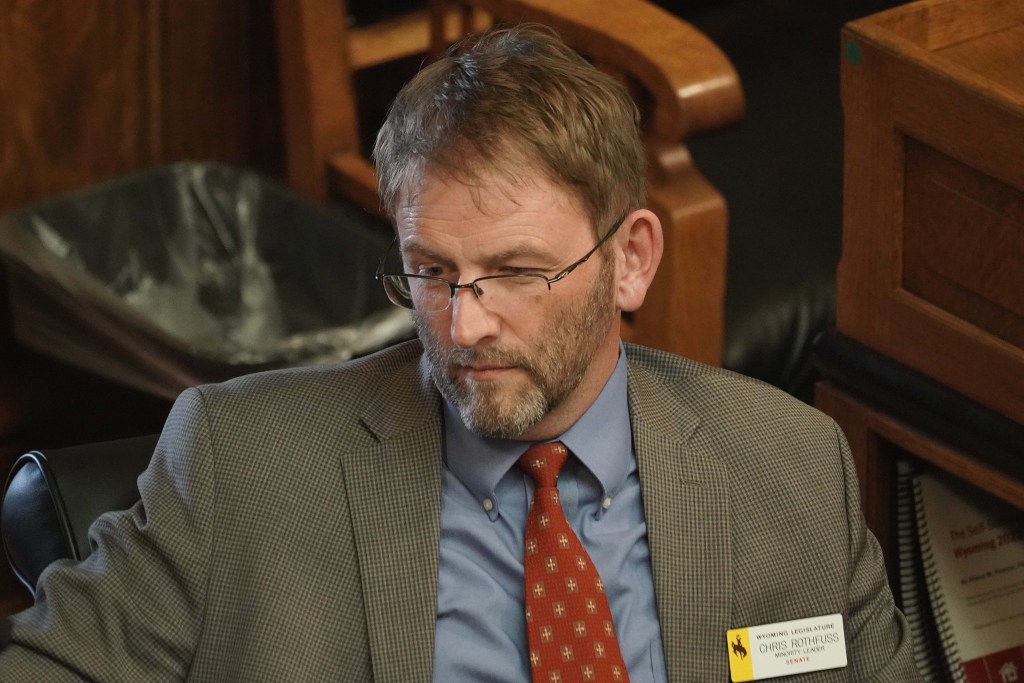
After listening to reports on the state of school funding Thursday, Sen. Chris Rothfuss (D-Laramie) made a motion to recommend an external cost adjustment that includes the 8.5% increase for both professional and non-professional staff.
The total $66.4-million difference in the funding that adjustment would represent is “not an arbitrary number,” Rothfuss said.
Instead, it’s the figure legislative staff identified to ensure Wyoming follows its constitutional mandates, he said. “It is the amount that it takes to make a constitutional, statutory model equivalent to the evidence-based model.”
Sheridan County School District 1 Business Manager Jeremy Smith encouraged the 8.5% recommendation. The conversation leading to it, he said, had a consistent theme: high teaching salaries can attract quality candidates even when they have alternate employment opportunities.
One only has to look at the University of Wyoming graduation data to see that Wyomingites are being dissuaded from the profession, Smith said. He also pointed to a 2022 survey conducted by the University of Wyoming’s College of Education and the Wyoming Education Association that found 65% of Wyoming’s teachers would quit if they could.
“Teachers aren’t very satisfied in their profession right now for a whole host of reasons, but one is certainly salary,” Smith said. “You’ve got to give the ECA, it’s got to be substantial and substantive in order to turn the ship around.”
Sen. Charles Scott (R-Casper) was the sole lawmaker to protest, calling the adjustment “out of line.”
Rep. Brown of Cheyenne, meanwhile, spoke in support of it, saying that failing to sustain external cost adjustments has already proven to be unwise.
“We’re not funding our school districts with the valuable resources they need to teach these kids,” he said before the committee passed the recommendation.


I have teacher friends looking for jobs in other markets and looking to get away from teaching. In part due to the political climate that is out there and in part due to the wages. They need to find the wages competitive. Get it done. We all have favorite teachers that impacted our lives.
While most people have received little in pay raises, somehow the education system is exempt from the hardship we all face.
Working for 36 years in Wyoming as an educator, and seeing minimal raises in the past 20 years, it is about time for a pay raise for staff. I have been retired 8 years, and would still be making the same salary if I were working. The pay seems so low to me. AZ has always been a poorly funded state. Wyoming can do better!