

The Legislature’s Management Council voted Thursday not to take up “critical infrastructure” protection as a topic for committee study in the months before the next legislative session.
The Management Council, which is made up of leading lawmakers from both parties, voted 7-6 against ordering the Joint Judiciary Committee to examine stricter laws to protect infrastructure from sabotage and protestor interference.
The topic had been requested by Senate Judiciary Chairman Leland Christensen (R-Alta), who sponsored Senate File 74, the controversial “critical infrastructure” bill during the last legislative session. That bill would have punished protesters with felony charges, and organizations supporting them with large fines for “impeding” oil and gas, agriculture, water development and communications infrastructure, among many other categories. It died following Gov. Matt Mead’s veto. Mead called it poorly crafted but said he hoped the topic could receive study during the interregnum between sessions.
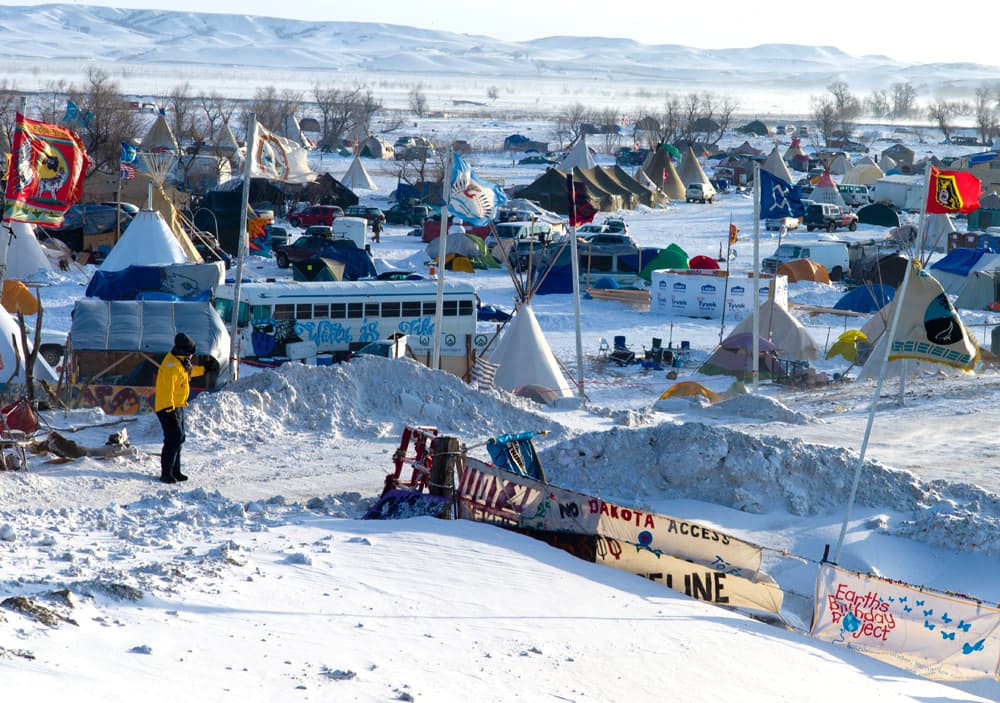
Opponents of the bill said it would have violated protected rights of protest and free speech in order to protect business interests concerned by the Standing Rock pipeline protests in North Dakota.
Support unparalleled legislative coverage with a tax deductible donation today
The no vote on interim study is a blow for supporters of the bill, which included Wyoming energy, business and law-enforcement groups. While lawmakers can continue to push the topic on their own, having the focus of a legislative committee over months allows a bill to reach the next session with an appearance of thorough vetting, giving it weight with lawmakers.
Following the split vote on Thursday, Senate President Eli Bebout (R-Riverton) encouraged Christensen or any other lawmakers listening to advance legislation independently.
“[It’s] really important and it was a very close vote here,” Bebout said, “so I would certainly encourage individual members to carry that vote forward.”
The Joint Judiciary chairmen submitted their priorities for the interim period before SF-74’s demise on the last day of an extended legislative session. The committee’s three priorities are continued evaluation of parole and probation programs to further reform Wyoming’s crowded criminal justice system, receipt of reports from the judiciary branch and examination of child custody laws.
Christensen proposed the critical infrastructure study topic separately, in a letter to the Management Council. “This is a topic that warrants interim study so that all points of view can be addressed in a carefully considered and precisely crafted piece of legislation for the 2019 session,” he wrote.
There was almost no discussion before the voice vote and names were not recorded by the Legislative Service Office. Democrats, who voted en masse against last session’s critical infrastructure bill, hold five seats on the committee. The initial vote was 6-6. However, Senate Vice President Michael Von Flatern (R-Gillette) was participating in the meeting by phone and his votes had not been counted. Later in the meeting, Bebout asked him to vote.
“You have the swing vote,” Bebout said. Von Flatern’s vote had been “no,” the senate vice president said. The topic had been added to the committee’s study topics list too late, he told WyoFile on Friday.
Fight moves on outside Wyoming
The 2018 critical infrastructure bill drew swift condemnation from environmental, civil rights and Native American advocacy groups who said it was designed to chill dissent against the energy industry in the wake of the Standing Rock pipeline protests in North Dakota. Bill opponents criticized the measure as rushed, and as a product of outside business interests, particularly the American Legislative Exchange Council.
Before significant amendments were made in the House of Representatives, the bill brought by Christensen, Bebout and 15 other lawmakers closely mimicked the language of a model bill posted to ALEC’s website.
Other bills related to protecting infrastructure or enhancing sanctions against protesters failed in Colorado, Illinois and Pennsylvania in 2017, in Alabama in 2016 and in Maine and Louisiana in 2015, according to WyoFile research and an analysis by the International Center for Not-for-Profit Law. The ICNL tracks anti-protest legislation in various states. The organization includes SF-74 on its list.
A similar bill to protect “critical infrastructure” has recently been introduced in Minnesota.
Legislators in Louisiana again introduced a “critical infrastructure” bill. That state has recently seen escalating protests over pipeline construction by Energy Transfer Partners, the company whose Dakota Access Pipeline drew controversy, protesters and international attention in North Dakota.
Lawmakers in Pennsylvania (again) and Ohio have also proposed bills to levy large fines and felony charges to dissuade environmental protest interfering with “critical infrastructure.”
It appears that fascism has taken a blow in Wyoming–at least for the time being.
Your story reflects the continuing confusion over the purpose of “critical infrastructure” bills. Legislators supporting SF 74 kept stating that the purpose was not to block protests, but to prevent damage to existing infrastructure. However, the bill clearly had provisions intended to criminalize protests. An interim study might have been useful for defining whatever problem the bill is supposed to address and to linking the “solution” to a defined problem. As far as I know, there have not been any attacks on infrastructure in Wyoming, nor have there been any pipeline protests or any major pipelines. Under those circumstances, the primary purpose of the bill seems to be to support ALEC, an organization largely funded by the Koch brothers who are heavily invested in fossil fuels. If existing property damage penalties are not severe enough to be viewed as preventative of damage, then it would be very easy to increase those penalties. The only reason for trying to create a new class of crime and a new, very vague, basis for lawsuits against protestors, seems to be to stop protests. Why would anyone in Wyoming, other than energy companies, want to do that? And why would we sacrifice Wyoming freedoms for that purpose? And why would we design a law that elevates the rights of energy companies above those of the agriculture industry, the recreation industry, and the individual citizen? Without the interim study, the likelihood of struggling with those issues is dim. The ideal outcome is for the whole idea to go away as meritless. Another introduction of the ALEC bill is the worst outcome. We need a legislature that pursues Wyoming issues, not one that wastes time and resources on national interest group issues.