


This story is part of WyoFile’s collaborative legislative initiative — a coordinated effort by partner newsrooms to deliver comprehensive coverage of Wyoming’s 2025 general session.
Wyoming senators: No transgender athletes in intercollegiate athletics
CHEYENNE—State lawmakers took a step Friday toward banning transgender athletes at the University of Wyoming and the state’s community colleges from playing in intercollegiate athletics divisions that match their gender identity.
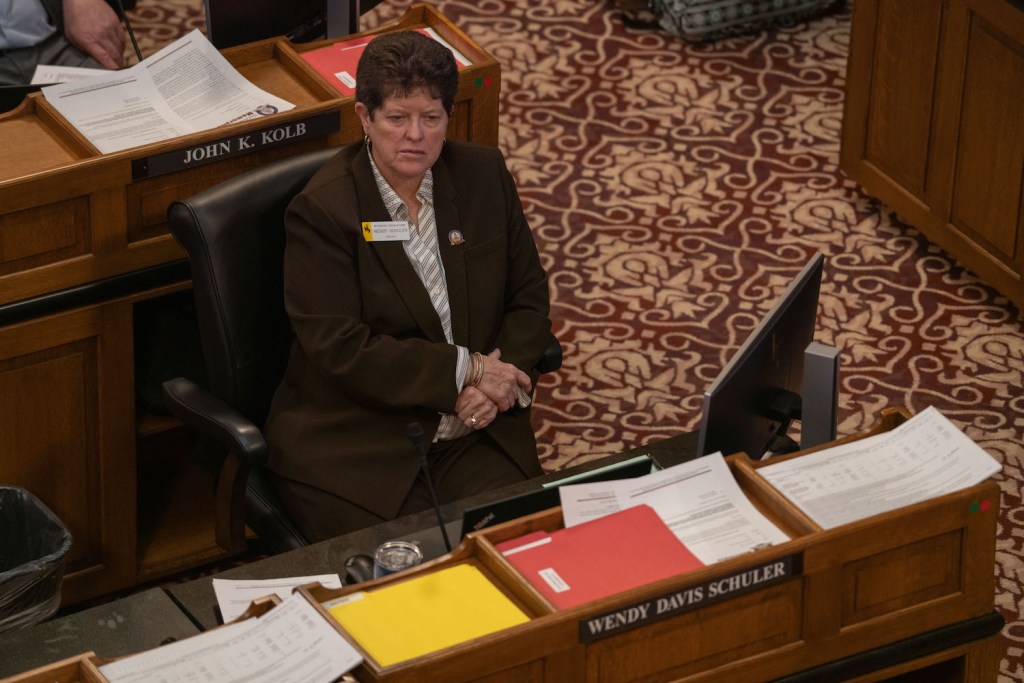
The Senate Education Committee passed Senate File 44, “Fairness in sports-intercollegiate athletics,” by a 4-1 vote, with the sole Democrat on the panel, Sen. Chris Rothfuss of Laramie, voting against the measure. Sen. Wendy Schuler, R-Evanston, brought the bill, following a successful effort in 2023 to ban transgender athletes from competing on teams that match gender identity in grades seven through 12.
“The bill … is fairly simple. It requires students at the University of Wyoming and Wyoming community colleges to compete in intercollegiate athletic competitions based on their biological sex,” Schuler said. “What this does, it just protects those female – biological female athletes – not only with the safety issues, but the fairness issues.”
Dickey Shanor, chief of staff for State Superintendent of Public Instruction Megan Degenfelder, said Degenfelder fully supports SF 44. Kirk Young, president of Western Wyoming Community College, said that although community colleges have been disappointed the NCAA has been silent on the issue and has not offered guidance, he supports the bill and the direction it provides.
Nyoka Erikson, a Laramie woman who said she plays roller derby and has played on both male and female hockey teams, urged lawmakers to vote against the bill. She said she has competed with both cisgender and transgender women.
“I don’t think it is appropriate for the state to tell sporting organizations what their policy should be,” Erikson said. “I additionally do believe, because of my experiences, that trans women do belong in sports.”
University of Wyoming volleyball player Macey Boggs spoke in favor of the legislation.
“During my last season at UW, my team was punished with two losses for refusing to play against a male athlete on an opposing team,” Boggs said, saying that ultimately kept the team out of the Mountain West Conference championship.
“I was (denied) the chance to play my final collegiate matches because we faced a situation no woman should have to face: either compete against a team rostering a male athlete on a woman’s scholarship, robbing us of fair and safe competition, or forfeit the rest of our season,” Boggs said.
Boggs said she has joined a lawsuit against the Mountain West Conference over the incident.
Sen. Charles Scott, R-Casper, asked Schuler if the bill would authorize UW to ban other teams from bringing transgender athletes playing for teams that match their gender identity to Wyoming to compete. Schuler said the bill does not do that.
‘We have not been taking care of our buildings’: Wyoming school funding model may increase
CHEYENNE—Wyoming has underfunded school facilities maintenance for about a decade, as the state’s formula for calculating routine and major maintenance has been pushed lower and lower, according to testimony Friday in a state Senate committee.
To address crumbling school buildings, the Senate Education Committee voted unanimously in favor of Senate File 34, “School finance-routine and major maintenance calculations,” which would increase the formula for paying for school building repairs.
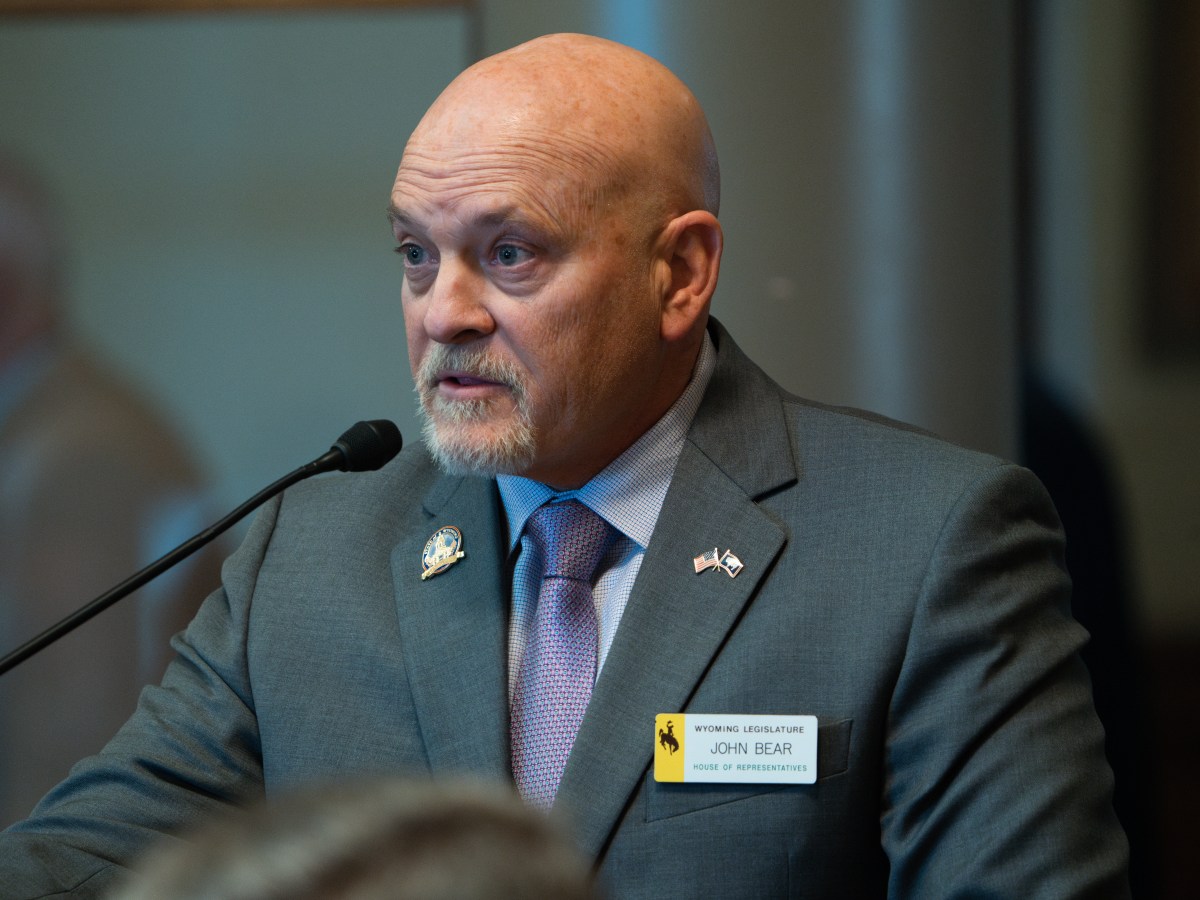
“Frankly, we have not been taking care of our buildings out there,” Sen. Bill Landen, R-Casper, told the committee. “We have over 25 million square feet of school facilities buildings across our state, and we need to maintain them. … You either pay now, or you are going to pay a lot later.”
Nearly every session, the Select Committee on School Facilities has warned lawmakers that school maintenance is underfunded, Landen said.
SF 34 would increase the allowable square footage utilized to calculate routine and major maintenance for school districts, and increase the percentage utilized to calculate major maintenance payments to school districts.

Currently, the formula considers 115% of educational space capacity for the prescribed per-student gross square footage, and the bill would increase that to 135% for the 2025-26 school year. It would also increase the multiplier for the amount of adjusted square footage from 2% to 2.5%.
“We stopped spending very much money on school buildings” in about 2015 due to an economic downturn, Landen said. “We ratcheted down on what we paid on routine maintenance and major maintenance. This ratchets it back up.”
Some people question whether school districts are appropriately using the existing maintenance funding they receive. Landen said he is confident they are.
“Where you come into question marks is when you have very old buildings, and sometimes our districts are criticized for not taking care of old buildings,” Landen said. “Sometimes that is a building that is targeted to be replaced. At that point in time, there are decisions to be made regarding how much more you want to put into a building like that.”
Del McOmie, director of the Wyoming State Construction Department, said that if the state continues to defer maintenance using the 2% multiplier in current law, the life expectancy of school buildings will be cut by about 20 years.
“On top of that, that lifespan shortening increases the capital construction budget, because you are going to be building more schools sooner,” McOmie said, adding the state could face an increased cost of $3 billion over 50 years.

SF 34 contains an appropriation of $38.1 million from the public School Foundation Program account to the State Construction Department, as well as an additional $5.5 million from that same account to the Wyoming Department of Education. That appropriation would cover only the first year of increased funding, and an additional appropriation would be required in a future state budget cycle.
Sen. Chris Rothfuss, D-Laramie, said that the increase to 135% is not a “magical” number and probably won’t cover all major and routine maintenance needs across the state. During the interim, lawmakers considered an increase as high as 200%.
“(We’ve) picked a point of compromise,” Rothfuss said.

I agree with maintaining school buildings as outlined in this legislation. However, if lawmakers insist on passing universal vouchers (aka Education Savings Accounts), many schools in Wyoming will be closed. That is what is happening in Arizona, according to Beth Lewis of Save our Schools Arizona. Can we learn from their mistake, or will our lawmakers pass House Bill 199 (the Wyoming “freedom” Scholarship Act)?
With all of the economic issues facing this state the legislature has do devote a disproportionately large amount of time to an issue that few even care about? And these particular legislators refer to themselves as the Freedom Caucus? Let the participants decide whether to compete or not. Religion and politics have no place here.