

When I was working with a Kenyan outdoor instructor in Wyoming’s Wind River Range a couple of decades ago, he surprised me one day by saying, “Hiking here feels like a walk in the park.”
Opinion
With armed guards, he was used to moving through wild places in Africa full of dangerous animals. He said he always felt vigilant on those trips, but in Wyoming’s Winds? We weren’t going to be threatened by anything larger than a GORP-seeking squirrel.
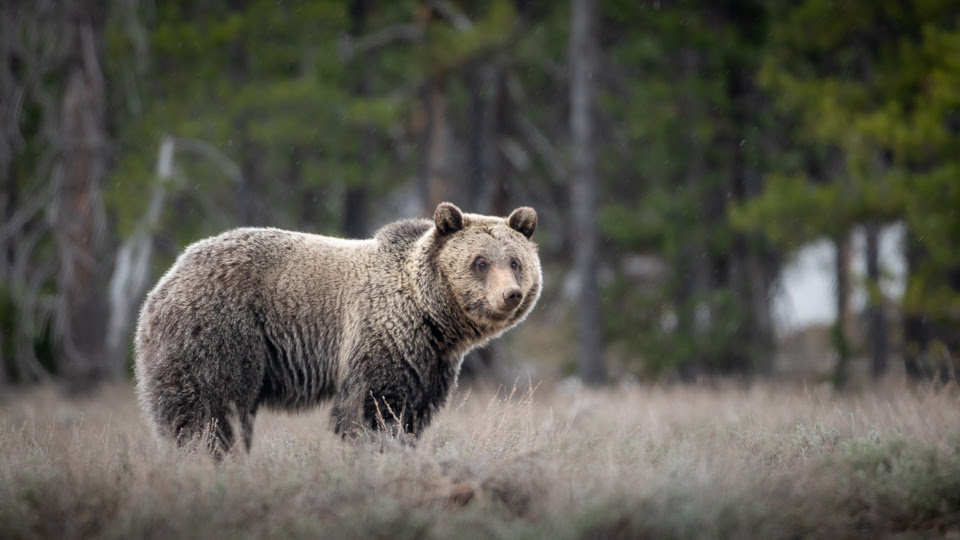
But now, grizzlies have returned to the Wind River Range, a 100-mile string of craggy peaks southeast of Yellowstone National Park. The big bears once owned the West, and now they are reclaiming some of their traditional turf.
At their peak, as many as 50,000 grizzly bears roamed the western United States. By the time the Endangered Species Act passed in 1975, however, their numbers had dwindled to fewer than 1,000 in the Lower 48, and they inhabited a mere 2% of their former range there. Only 220 to 320 grizzlies were believed to live in the Greater Yellowstone Ecosystem at the time of listing.
Once protected, grizzlies expanded out of the park and are now found throughout the region. For me, that makes a difference. It’s not just that I carry bear spray and store my food in bear-proof containers, or that I make noise when I’m hiking through areas of low visibility. It’s subtle: I’ve become hyper-aware.
Sudden noises make me start. I don’t like to be alone unless I have an unobstructed view of my surroundings. I never wander off in the dark by myself. Yet being in bear country feels invigorating.
“Grizzly bears are what makes a place wild for me,” says Barb Cestero, who directs The Wilderness Society’s Greater Yellowstone and High Divide Landscape Program in Bozeman, Montana. “It’s about being present, in the moment, alive, and aware that you have to avoid surprising a bear and getting into trouble. That’s a lot of words to describe the indescribable.”
Indescribable or not, most people feel a mixture of fear and awe in bear country. Whether you like those feelings depends on your perspective.
As most of us know, development and climate change have squeezed the grizzlies’ habitat. These days, people in the Northern Rockies encounter grizzly bears on backpacking trips but may also run into them in their neighborhoods. The bears are getting into food sources like garbage, livestock, bird feeders, chicken coops, apple trees and beehives.
It’s not easy living with grizzlies. But we can choose whether to embrace the awe and fear that their presence brings, or we can begrudge them.
That means people pay attention when they leave their houses because stumbling outside in darkness can be dangerous — as Tim Henderson learned in 2007.
Henderson lived in a cabin in the western foothills of the Teton Range near Tetonia, Idaho. One evening, after hearing his dog barking, he went outside to check. She barreled toward him with a grizzly bear in pursuit, and the bear turned on Henderson.
“I like to refer to the encounter with the bear as just that, an encounter,” Henderson says. “Unfortunately, what makes splashy headlines is ‘an attack,’” which hospitalized him with injuries to his head and elsewhere. Yet he says he thinks of himself as the intruder.
“Keeping that in mind lets me enjoy the reason I moved here — for the mountains.” But these days, Henderson carries bear spray even in places where most people think it’s unnecessary.
Encounters between grizzlies and humans usually go badly for the bears. By August, wildlife managers had killed 11 grizzly bears in 2022 because of conflicts with people. Statistics aren’t available for human fatalities from bear attacks for 2022, but 2021 was a particularly deadly year with five deaths. Still, you can’t call that a trend.
Frank van Manen, a research biologist for the Interagency Grizzly Bear Study Team, told Backpacker Magazine that in the Greater Yellowstone Ecosystem, human fatalities from bear attacks are rare. “There was a fatality in 1986,” he said, “Followed by a 25-year period with no fatal incidents, and then several years with multiple incidents.”
As grizzly bear territory merges with human territory, the potential for conflicts will surely increase. Many communities are trying to cope by passing ordinances to help minimize the risk of dangerous encounters.
It’s not easy living with grizzlies. But we can choose whether to embrace the awe and fear that their presence brings, or we can begrudge them. For me, those emotions make me feel more alive.
This piece was originally published by Writers on the Range, a nonprofit dedicated to spurring lively conversation about Western issues, and reprinted here with permission.

Back in the 80s I can remember Len Carlman say the same thing. Then and now I have mixed feelings about living with wolves and bears in my backyard. Bearspray and keeping my dog on a leash certainly changes my walks around my cabin or my mushroom hunting forays. It is called living on the edge. I love the wild and the critters that keep it that way, BUT
Anyone who says that the increase in bear attacks isn’t a trend is just refusing to admit the obvious. I don’t think anyone wants Grizzly’s gone. But most folks don’t necessarily want to see a half dozen every time they go out for a hike or hunt. Bears are more than fully recovered in Wyoming, and management should be done by G&F. Not by some federal judge in some cozy big city courtroom.
A wonderful evaluation of our “Grizz” problems. The city of Evanston had a resident Bear. A city Policeman shot the animal. The rules are foggy??
Very good, sentient article. I hope many people read this.