

A found-object sculpture resembling sideways lampshades hangs on one wall. Voices from the sculpture’s audio track fill the air with a poem. Rocks, landscapes, a pair of shoes and old photographs fill the other walls. This eclectic exhibition is “Material Connections,” on display at the Wyoming Women’s History House.
What do the artworks have in common? They offer commentary from women artists on what it means to be a woman in both the past and present. Going back centuries, women have been and are still underappreciated in the visual arts. “Material Connections” seeks to change that.
Wyoming Women’s History House is a free museum highlighting women instrumental to the suffrage movement in Wyoming. The museum celebrates female firsts and seeks to inspire the next generation of women to be leaders in their fields.
“Material Connections” features seven artists working across a range of media, offering a glimpse into the breadth of work Wyoming women artists produce.

Wyoming artists
Rocio Gomez Sandoval, born in Michoacán, Mexico, is a mixed media artist who now lives in Laramie. She uses techniques and materials often associated with women and crafting that aren’t considered fine art.
“I use embroidery because I like using traditional [women’s] techniques to make art,” Gomez Sandoval said. “I want to say just by choosing this media, we are here, we were here, and we were always making art.”
Gomez Sandoval’s pieces in the show focus on the life and death of women. One piece uses a fancy photo of a long-dead woman that ended up in a thrift shop, discarded by her loved ones, to explore abandonment. Another piece focuses on death and a mother’s milk. Gomez Sandoval dislikes when people categorize her work as women’s art. Instead, she sees art as a universal thing that doesn’t need divisions or separations based on her gender or ethnicity.

Sadie Winter is a multidisciplinary artist. She has three landscape prints in the show. Winter made the ink for two of the prints from foraged earth materials from Pilot Hill. For Winter, process is important in her work to help ground it in a place, material or tradition. Many of Winter’s mentors in the arts have been women, from her ceramics mentor to people who didn’t consider themselves artists like her grandmother.
“A lot of times what I see is, like, what have been understood as like traditionally marginalized crafts,” Winter said, like textile arts and collage, “are not elevated to the level of fine arts until a man does it,” Winter said.
“I wonder how much of it is internalized, like with my grandmother,” Winter said. “She’s an incredible fiber artist, quilter, embroidery artist, but doesn’t really consider herself to be an artist. So some of that I think is internalized and then some of it is also like societal pressures.”
Katie Christensen, an artist and self-described feminist, currently works in mental-health care. She helped organize “Material Connections,” by reaching out to the artists and curating the show. One of her works is a caustic print of bleeding-heart flowers, which her grandmother grew. The flowers are also tied to her great-grandmother’s homestead.
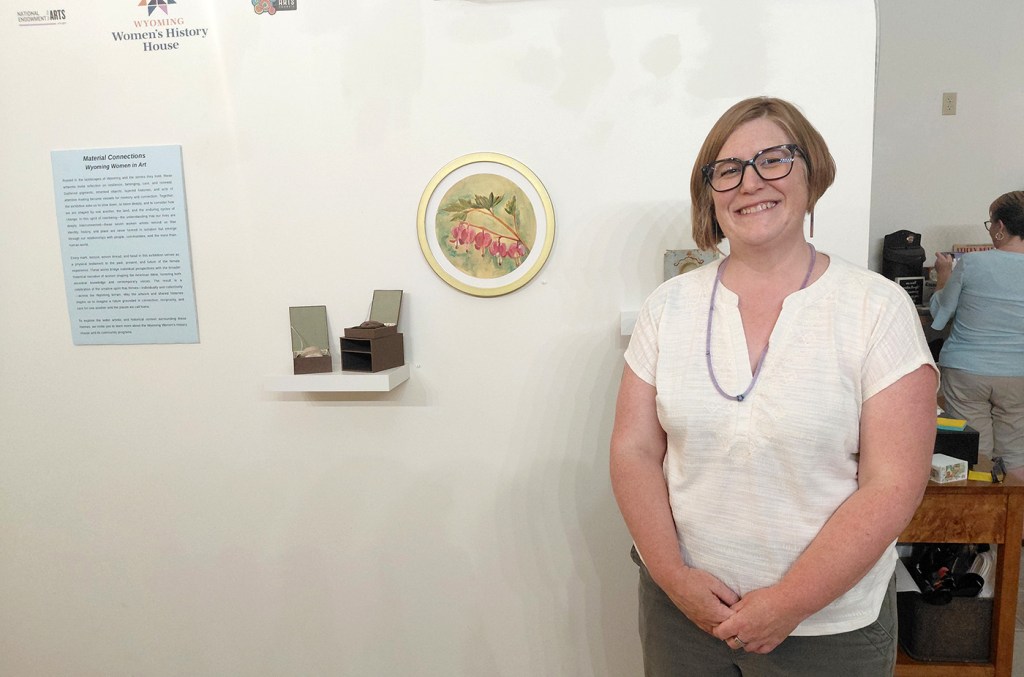
“It’s kind of an homage to all the really strong women in my life,” Christensen said.
Her other piece features two rocks in boxes. The first rock was the last gift given to Christensen by her father before he died. The other is a rock from her husband. Together, the three pieces are titled Mother’s Sons.
Christensen recognizes that women have lacked visibility in the arts. However, solving this problem can’t be done with just women alone.
“Men are just as important in this story as women” Christensen said. “We’re at the Women’s History House, and I think it’s very women-forward, but we need men just as much as we do need women and women’s equality.
“And I think that’s kind of an important piece as to why I also named the collection of work I did Mother’s Sons.”
Connect with the artists
The Wyoming Women’s History House will host five workshops over the next few months, providing the public with an opportunity to make art alongside the artists, while learning their processes and techniques.
Joanne Mai, director of the Wyoming Women’s History House, hopes the workshops and exhibit will build a sense of community. “One of the things that we really notice about the women that we feature here is that they were really instrumental in building community in Wyoming,” Mai said.
“So that sense of community is really important to us. And so we really want to bring people in to connect with each other, to learn from one another and to start to build new communities.”
Wyoming Women’s History House hopes to host future exhibits highlighting Wyoming women in other fields, including music and writing.

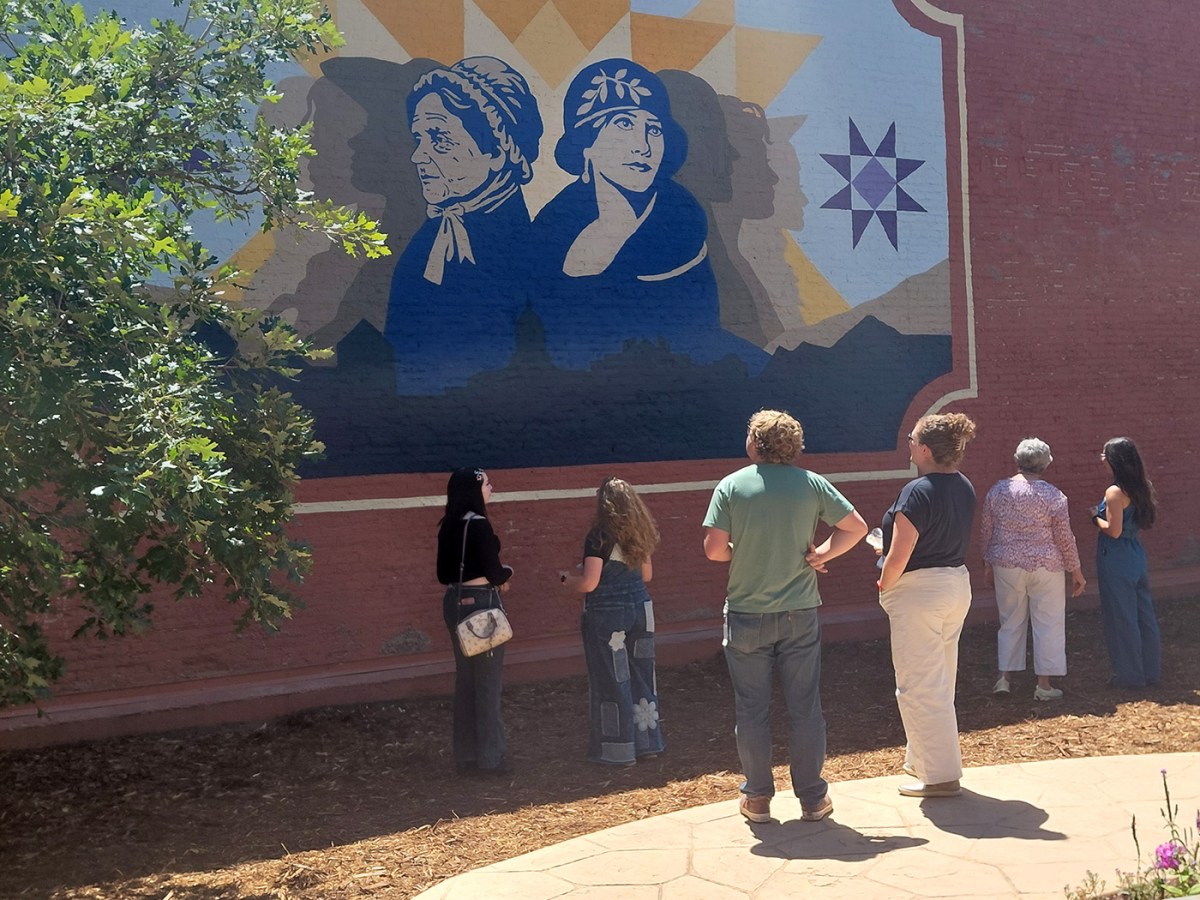
Alongside the exhibit is a new mural by artist Cassidy Post. Painted on a building next to the Wyoming Women’s History House, it depicts Louisa Swain and Nellie Tayloe Ross, two historic Wyoming women. Swain was the first woman to vote and Ross was the first female governor.
The mural is a permanent fixture and was coincidentally finished the day before the “Material Connections” opening exhibit.
“Material Connections” is open through Labor Day weekend, at 317 S. 2nd Street in downtown Laramie.

I live in Oklahoma. I am an artist. Mostly painting abstracts. I hope to attend this museum in Laramie one day. Women’s art is important and needs more recognition.