

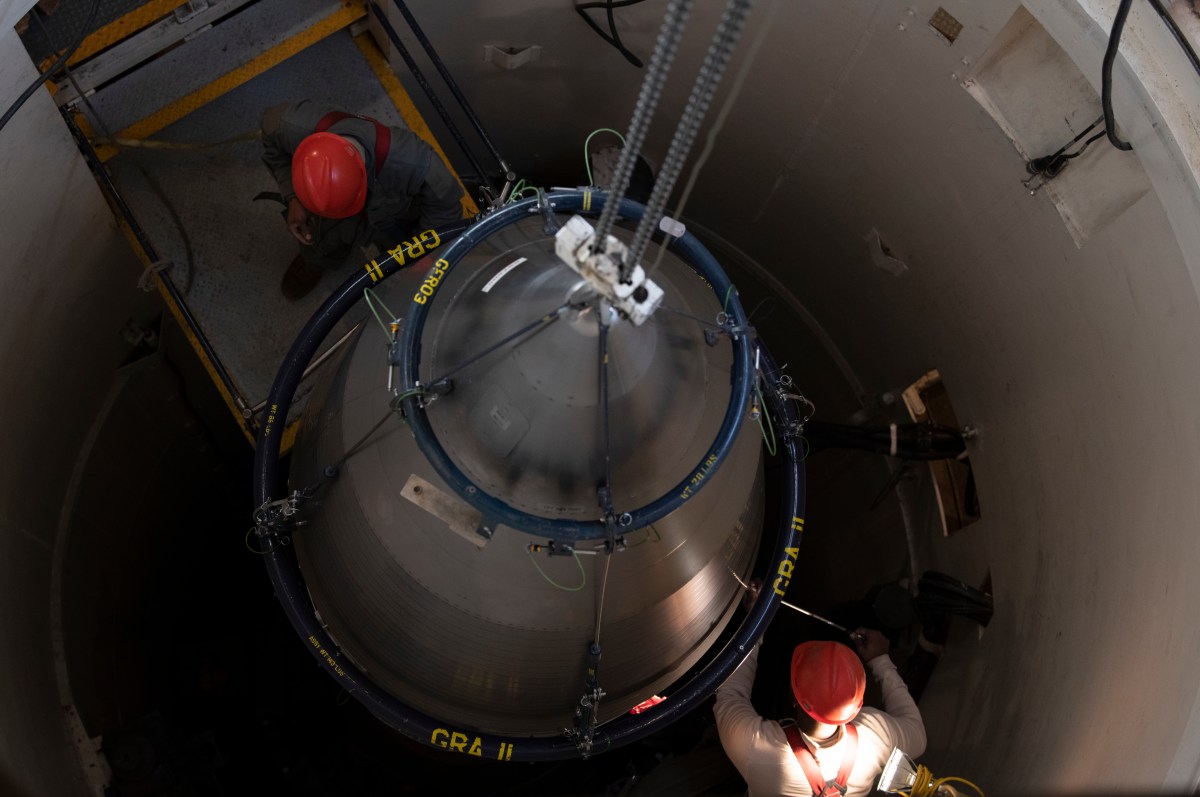
CHEYENNE—The nation’s aging Minuteman III intercontinental ballistic missile system is nearing the end of its service life, but an in-progress replacement will soon bring major changes to the missile field.
At a Greater Cheyenne Chamber of Commerce luncheon last week, retired Col. Stephen Kravitsky, Sentinel Task Force Detachment 10 director and former F.E. Warren Air Force Base commander of the 90th Missile Wing, gave a presentation to attendees about the new Sentinel ICBM program.
The Sentinel program is designed to completely replace the Minuteman III system, including the missiles, launch facilities, communications systems and other infrastructure. Kravitsky said another reason for the switch is to maintain the country’s nuclear deterrent against threats from other countries.
“There are countries out there who want to do us harm,” Kravitsky said. “Those countries are absolutely building up their forces. We have a threat.”

F.E. Warren currently oversees the operation of 150 Minuteman III missiles in silos spread across 15 launch control centers throughout Wyoming, Nebraska and Colorado. F.E. Warren is one of the three Air Force missile wings involved in the Sentinel conversion, along with Malmstrom Air Force Base in Montana and Minot Air Force Base in North Dakota.
With Sentinel, the U.S. Air Force plans to maintain the 150 missile silos but reduce the number of launch centers to eight.
The new system will also replace the existing communication network with fiber-optic cable. Around 2,000 miles of fiber will eventually be installed throughout missile fields, Kravitsky said.
Constructing a new system
Under the Sentinel program, the Air Force will construct new launch facilities while continuing to operate the current system, rather than simply upgrading the Minuteman III infrastructure.
The existing silos will eventually be decommissioned. The Air Force will dismantle and dispose of the current infrastructure after Sentinel becomes operational.
Some new missile sites could also be located in areas different from the existing sites.
Officials have evaluated the missile field for issues including water intrusion, security response times and other challenges, Kravitsky said. The relocation could require the Air Force to acquire additional land from private landowners.

Kravitsky said he has already met with some landowners who could be affected by the changes.
“So in all three wings, we’re moving the missile field around,” he said. “We’re going to acquire new land, and we’re going to move sites around. I will tell you, any piece of land that never had a silo on it before, I would personally reach out either via phone or sitting around somebody’s farmhouse at their kitchen table, or a rancher in their field walking the ground with them, showing them exactly what we want to do.”
Construction has already begun
Work on infrastructure for Sentinel has already begun in portions of the missile field.
Air Force officials are installing conduit that will eventually hold the new fiber-optic network. A 24-mile pilot project in Kimball and Banner counties in Nebraska is currently being used to test construction methods before the work expands.
Kravitsky said the construction crews are using horizontal directional drilling, vibratory plowing and trenching to install the conduit. Construction in the pilot program is expected to be completed by the end of September. The fiber will be installed at a later time.
Several major construction projects are also in progress at F.E. Warren.
A new command and operations center is expected to be completed late next year. The facility is designed to support the new system’s command- and-control requirements and includes electromagnetic pulse protection, Kravitsky said.
“This is a one-of-a-kind, very complicated building,” he said. “It’s a building within a building within a building.”
The base is also building facilities for missile handling and storage, maintenance and training.
Dismantling Minuteman III
Although Sentinel construction is ongoing, the Air Force has already begun dismantling portions of the existing Minuteman III system.
Launch Facility Echo-10 at F.E. Warren has been removed from the current missile network and is now being used to test the decommissioning process.
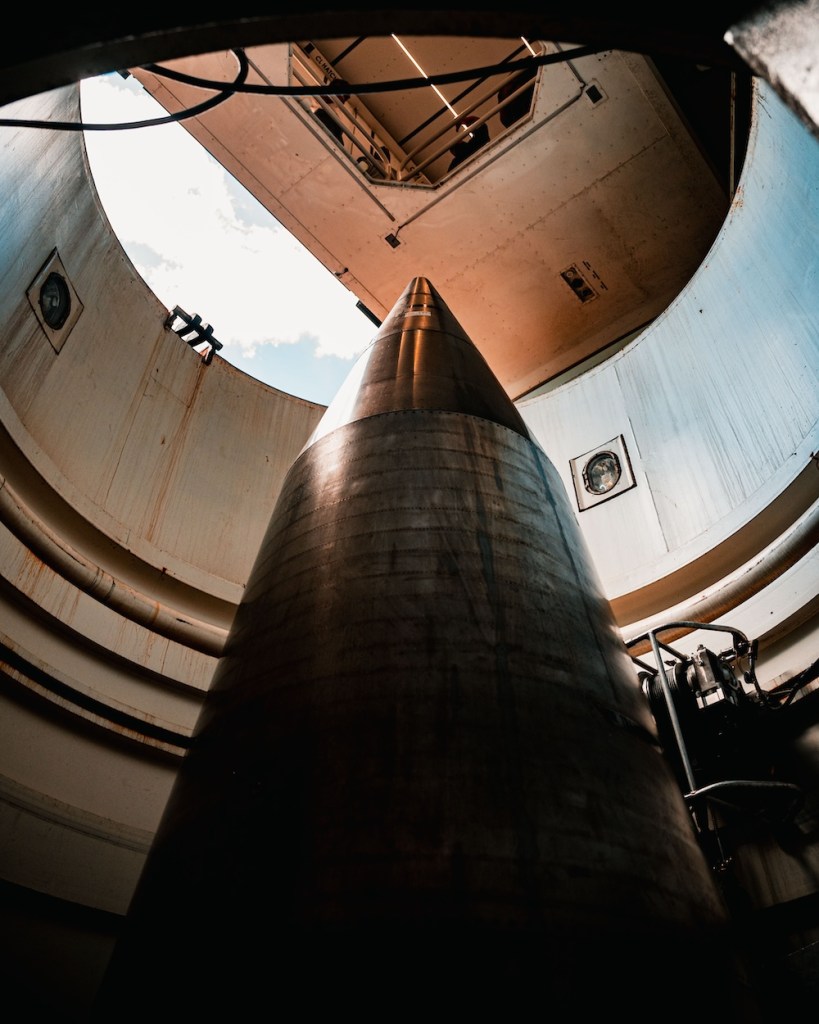
Equipment and explosives have been removed from the site, along with a diesel storage tank, Kravitsky said. Environmental testing was conducted after the tank was removed to ensure the site was remediated.
“We got our test results back, and it was good to go,” Kravitsky said. “So we’re going to have to do that 449 more times in five states. … I’m not going to give you years, but we’re going to be at this for a while.”
Many years before completion
Kravitsky said Sentinel remains years away from becoming fully operational. The Air Force hopes to have the first Sentinel missile completed in the early 2030s.
Several components of the new missile are already being prototyped and tested. Some of the testing has to be done in a special vacuum chamber facility at Arnold Air Force Base in Tennessee, Kravitsky said.
“I’m not sure how long it’s going to take, but it’s like anything else, right? There’s a thing called a learning curve when you’re doing a mass production,” Kravitsky said. “Theoretically, (in the) automotive industry, any industry, the more you produce, your learning curve increases.”
For Kravitsky, the project is an opportunity to be part of a historic transition in the nation’s nuclear deterrent.
“I have the best job because I feel like I’m part of history right now,” he said. “This is probably the most needed weapon system, in my estimation, that we will need in a long time.”

I just wonder who those missiles are going to be pointed at now that President Trump is butt buddies with that gargoyle midget dictator Vlady Putin. I clearly remember when the original Minute Man missiles were first installed in Montana. My first grade class had 45 kids in it due to the influx of workers from Boeing. The good old USSR was the threat. Work crews were transported by Huey helicopters over the little ranch we lived on. That’s how immediate the threat was. The Cuban Missile Crisis? Forget it, me and my third grade buddies were willing to sign up and fight the Rooskies. Now the Rooskies are financing our President’s son’s wedding.
The National Security Journal reports that the new missile system will cost $141 billion:
“Lost in the shuffle of constant news of negotiations to finally end the U.S-Iranian war and the rise of fuel prices with a global oil shortage is the status of the American nuclear weapons program. Minuteman III ICBMs are aging and need to be replaced, but the expense is monumental. The newfangled Sentinel ICBM system is slated to cost $141 billion. That’s 81 percent higher than originally estimated.”
That is a lot of money. The wisdom of continuing the program has been a matter of debate for years. China now has more missile silos than the U.S., accdording to the Center for Security Policy. Others worry that the high-alert status that missileers work under increases the possibility of inadvertantly starting a nuclear war.
I’d say give Peace a chance, but who in the international world believes they can trust the leader of the current U.S. administration, let alone Russia’s Putin or the Great Leader of North Korea?
It’s time for serious arms limitations talks that involve all the world’s nuclear powers, including North Korea, Pakistan, India, and the rest.