

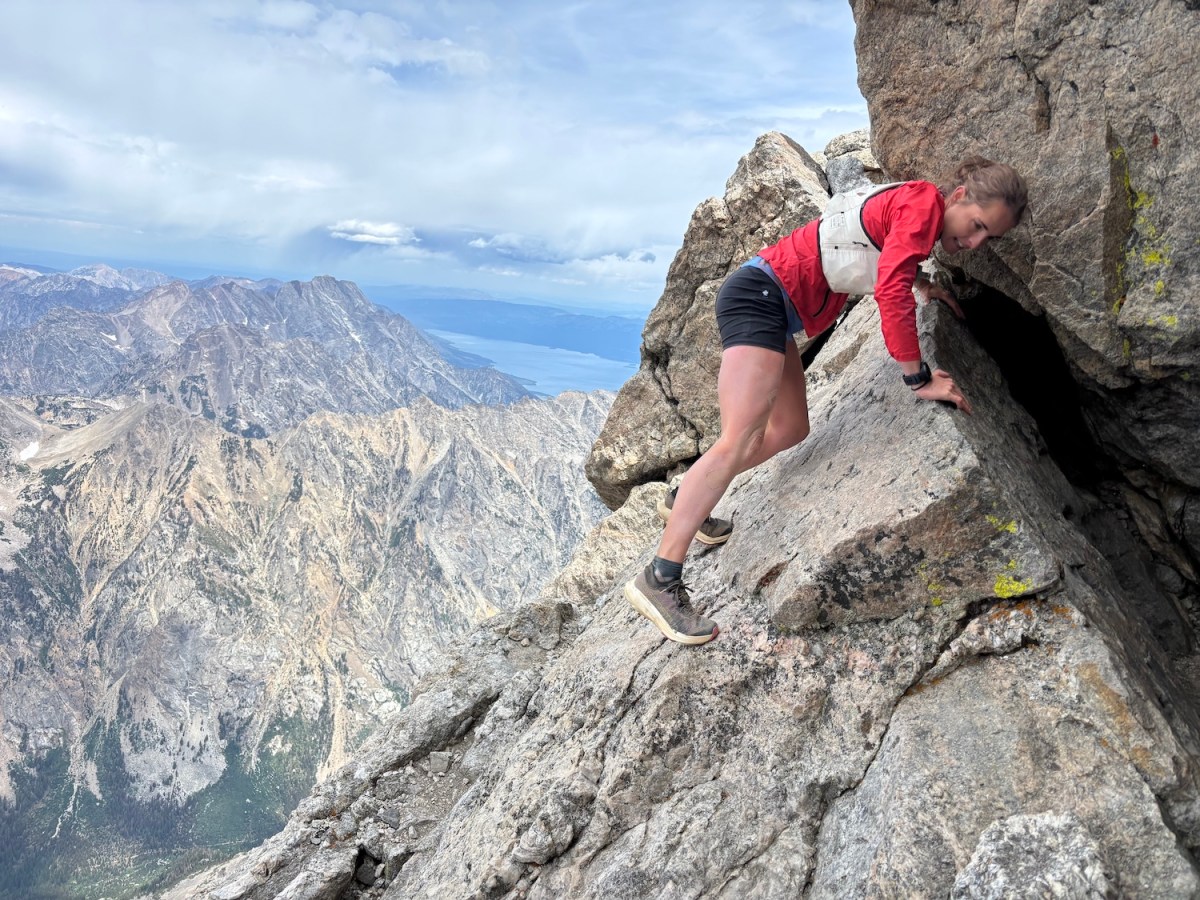
There’s been a lot of hubbub over the last year surrounding the Grand Teton speed attempt. Runner Michelino Sunseri’s now-infamous 2024 shortcut set off a national debate and courtroom saga over outdoor ethics, the responsibilities of professional athletes with thousands of followers and hefty penalties for trail transgressions.
Amid all of this, a professional runner from Boulder, Colorado, quietly set her sights on the vaunted peak. Jane Maus temporarily relocated to the Tetons in August, scouted the Grand and began her own journey toward breaking the female speed record.
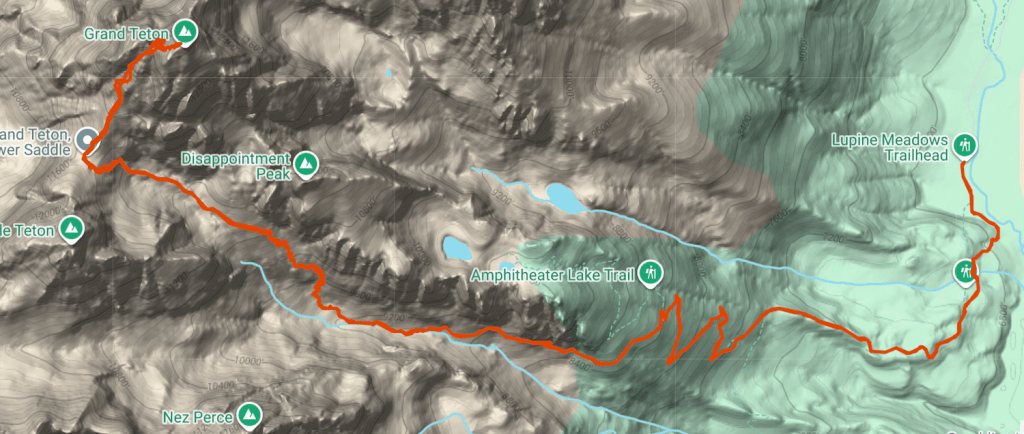
With very little fanfare and zero shortcuts, Maus did just that on Aug. 22. She ran the 13.2-miles out-and-back route — with its sections of technical scrambling and some 7,000 feet of elevation gain — in a blistering 3:45:34. That put her more than 20 minutes faster than the previous fastest known time, or FKT, which was set just three days earlier by Canadian runner Jazmine Lowther.
It was by all accounts a stunning physical accomplishment. Maus had gone into the Aug. 22 attempt thinking more that it was another chance to hone her route than to set the record. She was unaccompanied. There was no cameraman to photograph her, no social media buzz to build excitement. But it all fell into place.
When she ran back into the parking lot and realized what she had done, she said, there wasn’t even anyone to high five. She was so early that her partner hadn’t arrived yet to pick her up.
“It still feels kind of surreal,” she told WyoFile weeks later.
Along with setting new benchmarks, Maus and Lowther’s feats also signify a new fidelity to what are considered authorized routes in the niche world of high-alpine speed records. Both women followed what is known as the “Modern Route.”
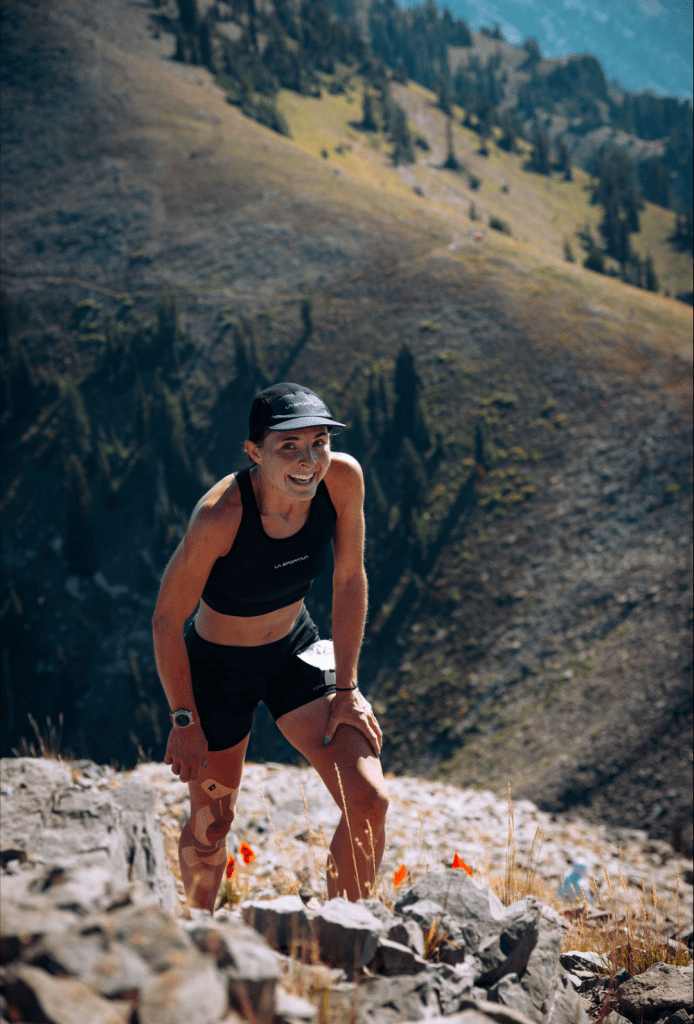
Fastest Known Time, the organization that tracks these records, recently updated the language in its Grand Teton entry page to note that the Modern Route differs from the Historical Route. That latter includes the shortcut that landed Sunseri in hot water. Previous record holders including Killian Jornet and Jen Day Denton also used the Historical Route. The current male record holder, Andy Anderson, took the Modern Route.
“The [Grand Teton National park] Jenny Lake Rangers now prefer that runners stick to designated and maintained trails (where available), which aligns with this Modern Route,” the page reads. “FastestKnownTime indicated it will not accept future submissions using the Historical Route, though it remains an integral part of the mountain’s history and lore.”
For Maus, the old route with the shortcut was never an option.
“With everything that had happened, and now moving forward, it’s not acceptable to cut the switchback,” she said. “That never crossed my mind.”
Super daunting
Before this season, Maus wasn’t a household name. The 30-year-old dietician grew up in the Salt Lake Valley, where she gained comfort with scrambling through the mountains. She played college-level soccer, and a passion for trail running and rock climbing eventually led to endurance runs and a La Sportiva sponsorship.
Maus’ coach first urged her to try the Grand Teton FKT this spring, saying it would fit in well with her skillset of climbing and running.
“I was like, ‘that’s absolutely crazy,’” she said.
But after a couple more people brought it up to her, she started considering it. Since she works remotely, she had the flexibility. She decided to at least spend some time on the mountain, though she didn’t presume she was going to break the record, she said.
“I just kind of committed to trying it out,” she said. “I really had no idea what to expect. But I was like, ‘I have the time. It seems like a really cool objective. I’m just gonna go for it.’”
Maus first climbed the mountain on Aug. 2, alongside her partner, who had climbed it before. They took their time figuring out the route. The technical section was actually not as difficult as she expected, but still. The whole thing took nearly seven hours.

Even seven hours is beyond the realm of most people when it comes to the Grand. The out-and-back climb entails many trail miles along with complex route finding through boulders and technical scrambling. Jackson-area guiding companies typically hike clients up to a saddle, camp overnight, then summit the following morning using ropes and climbing gear for the technical sections before descending to the valley.
The notion of cutting the entire ordeal to under Denton’s time of 4:15, Maus said, was “super daunting.”
“When it took us almost seven hours, I was like, ‘absolutely not. That’s so much time to cut off,’” she said.
Training
Maus climbed the Grand four more times over the next three weeks, each time learning more of the route’s nuances and how to better move through it, she said. But every summit also brought more doubt that she could run up and down in four hours.
At the same time, there was another athlete gunning for the Grand speed record. Lowther, a runner who has been notching FKTs and top race results in recent years, was in the area with Sunseri, her coach and partner, with her eyes on the Grand.
Maus bumped into Lowther on that first climb up the mountain. On Aug. 11, Lowther notched the fastest known time in the supported category, which basically means a crew or person is there to help with things like route finding and water carrying. In this case, Sunseri ran with her through the technical terrain, and she finished with a time of 3:51:12.
“It was a full circle moment for the duo, setting the first GPX-verified FKT on the modern route,” according to an Instagram post from Lowther’s sponsor, Arcteryx.
Eight days later, Lowther returned to run the mountain alone for the first time. She claimed the unsupported FKT with a time of 4:06:58.
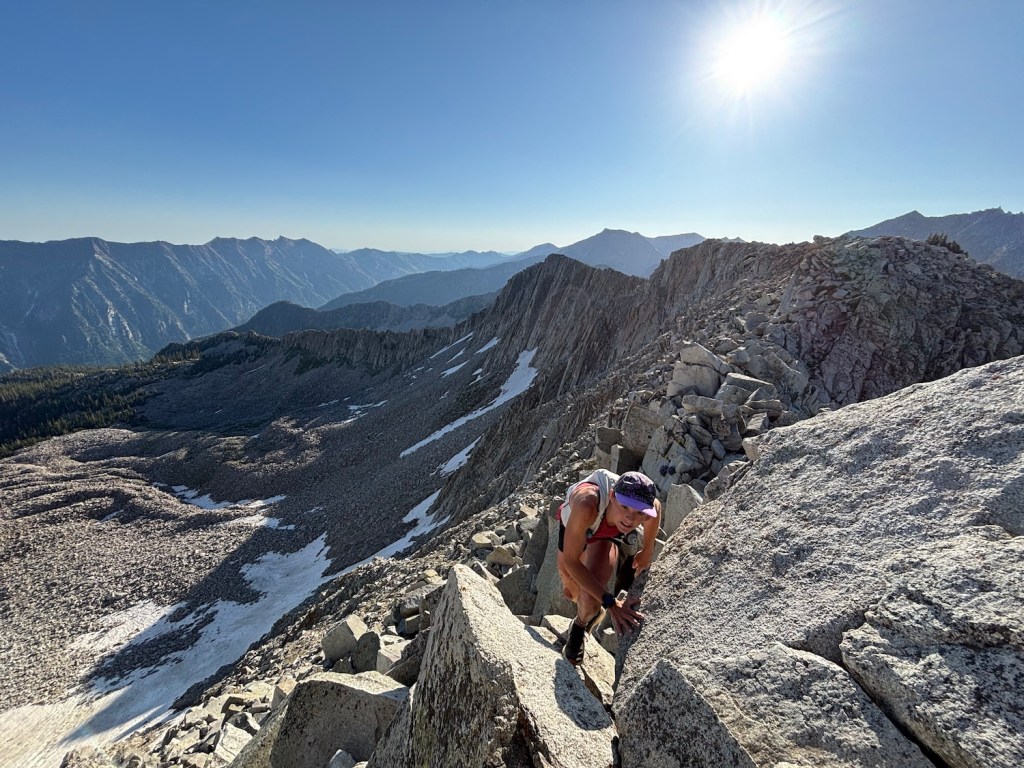
Lowther’s achievements unnerved Maus, she said. Maus had by then done the Grand four times and began doubting that she could nab a speed record in the rapidly closing weather window. On Friday, Aug. 22, she got dropped off in the Lupine Meadows parking lot a little before 8 a.m. to do her fifth climb.
“But I did not feel ready to go for the FKT, by any means,” she said. Instead, her main goal of the day was to better figure out the technical section up top.
The morning
She had Lowther’s unsupported time of 4:06 in her mind, however, and felt nervous like she does on race mornings. She decided to just try her hardest, no expectations.
She shot out of the parking lot. The weather was perfect. Getting up to the boulder field, she realized she was ahead of her previous pace. But in the boulders, her legs felt trashed, and she worried that she would bonk. Despite that, she moved efficiently. She began to pick up steam in the fourth-class scrambling between the lower and upper saddle.
When she hit the summit, she was surprised to find she climbed it 10 minutes faster than ever before, she said.
“That’s really when I turned it on,” Maus said. “I’m not the strongest descender … but I kind of shut off my brain and went into race mode, and the descent is where I gained most of my time.”
In an attempt like this, the smallest setback can make or break it. But Maus’ descent, like her climb, was smooth. She sprinted into the parking lot that marked the end point. No one was there.
She looked at her watch, saw that she was 20 minutes faster than the record, and had a moment of disbelief, she said. She wondered briefly if she unwittingly cut a section. She checked her route again, and texted her coach.
It took a moment for reality to set in, she said, but when her partner arrived, they spent about an hour at the trailhead, celebrating her achievement and reflecting.
Maus’ accomplishment sets a new standard in mountain running. She still seems a little surprised by it all.
“I had so many people around me that believed I could do this, but I truly did not believe in myself,” she wrote in an Instagram post. “Now I believe them a little bit more.”
She was also humble about the mantle, saying she doesn’t expect to hold onto it.
“I am confident the strong women in this sport will bring this time way down, and I am so excited that I get to be a part of the story of the Grand Teton,” she wrote. “I truly feel so, so lucky right now.”


Good Job Lady! Show them how it’s done. With integrity!
Awesome! Is the route basically the upper Exum?