

Wyoming’s Occupational Safety and Health Administration has cited an outfitter in the death of a kayak guide on Yellowstone Lake last summer, seeking $38,672 in fines for eight safety violations.
OSHA cited OARS West Inc. for violations associated with the June 14, 2017, death of Timothy Hayden Ryan Conant, 23, of Salt Lake City. Conant died of hypothermia while guiding an OARS kayak trip from Grant Village to the West Thumb Geyser Basin and back, OSHA reported. He was helping rescue a client who had fallen in the water when he, too, went into the lake.
Neither OARS nor OSHA personnel would comment to WyoFile, citing ongoing negotiations over the proposed fine and any abatement the company is undertaking.
In an undated “fatal alert” OSHA provided WyoFile, the agency cited “significant factors” in Conant’s death. (See the alert below.)
Three OARS guides were on the water the day of the incident and all were first-year guides, the alert said. Conant was the longest-tenured guide at 45 days.

“The guides were not trained in self or buddy rescue techniques for kayaks,” the alert said. “The guides were using everyday clothing for extremity protection.”
Also, the guides “were not familiar with the [company’s] emergency response procedures,” OSHA wrote.
Those descriptions of shortcomings translated into eight “violation items,” six of which OSHA classified as serious. Three carried fines of $11,224 each and one a fine of $5,000. OSHA says all the violations have been abated, meaning the company has addressed the shortcomings.
According to a list of OSHA safety regulations, two of the citations for serious violations were for infractions regarding the issuance of personal protective equipment to guard against hazards. Conant was wearing a life vest, or personal flotation device, at the time of the incident. But, as the alert stated, he was paddling in “everyday clothing.” He had a kit containing a wool blanket and cell phone “to call for emergency services,” OSHA said.
Employers are required to analyze hazards that employees face, equip them with protective gear at no cost to the worker, and ensure employees use the gear.
In its alert, OSHA recommended that OARS evaluate guide rescue training and the training used to familiarize new guides with their duties in the company’s emergency response plan. The agency said OARS also should reevaluate its policy regarding personal protective gear specific to Yellowstone Lake.
Once it issues citations and sees that safety shortcomings are addressed by an employer, OSHA typically negotiates for potential reductions in the fines. That negotiation is ongoing, according to an OSHA spokeswoman and OARS.
The tragedy unfolded on the return to Grant Village from the geyser basin when a client’s kayak capsized, OSHA’s wrote. The three guides got the client back into his kayak but were struggling to get him to shore when Conant’s kayak also capsized.
Never miss a story — subscribe to WyoFile’s free weekly newsletter
One guide took the client to shore and eventually the third guide, and two clients, helped get Conant to shore. National Park Service water rangers rescued the group and transported them to the marina at Grant Village where Conant was pronounced dead from exposure and hypothermia.
A Salt Lake City native, Conant grew up there and in Anchorage, Alaska. He graduated from the University of Utah in 2017 with degrees in history and anthropology.
He was a ski instructor, an enthusiastic skier, and loved outdoor adventures and clean mountain air, according to an obituary posted on Facebook. The son of Steve Ryan and Molly [Ryan] James, “he taught others through example, of the selfless life, ultimately giving his to save another,” the obituary read.
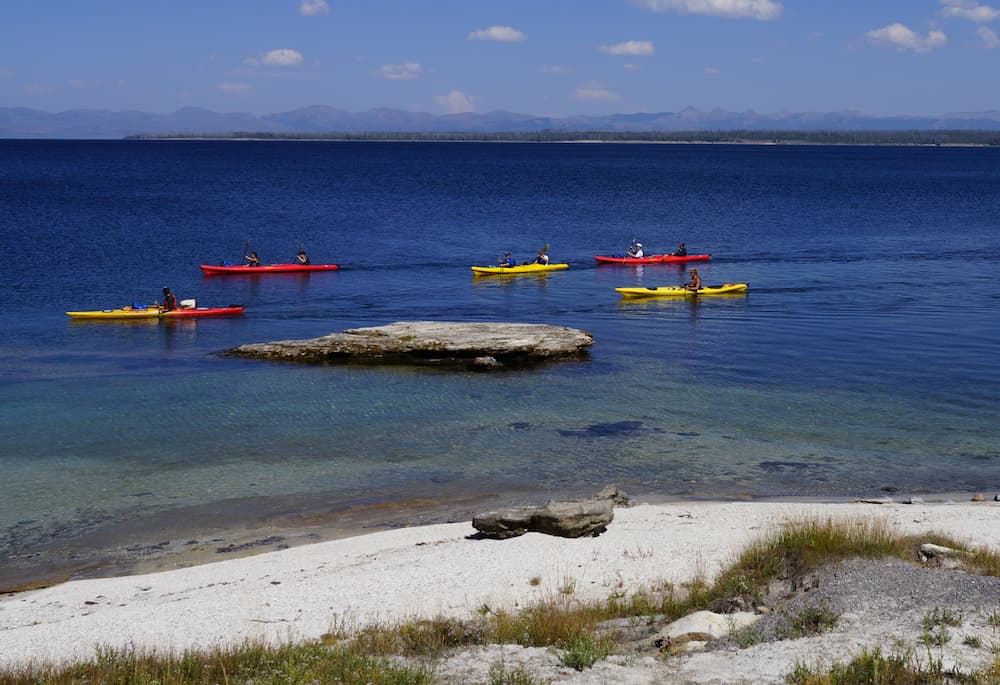
Flickr creative commons photo by Jeremy Reding some rights reserved.
This article was updated Jan. 10 to add OSHA’s “fatal alert” document — Ed.

Thanks Angus for this coverage. I forwarded it to a couple of other outfitters who regularly ply the waters of Yellowstone Lake. They were grateful for your account of the event and its circumstances. They said the story caused them to have better company discussions about safety and accident prevention, including, for one company, keeping up the practice of full-immersion swimming by the guides at the end of every day, no matter what the weather is, including during snow storms, to drive home the reality of that lake’s powerfully cold water. One also said his company requires what feels like “over-dressing” for travel on that lake because of the drastic contrast between what is often amiable paddling along the surface and the harsh and instantaneous contrast of dealing with the water as a swimmer. That dialogue taught me some new things too, so I’m personally grateful to you as well.