

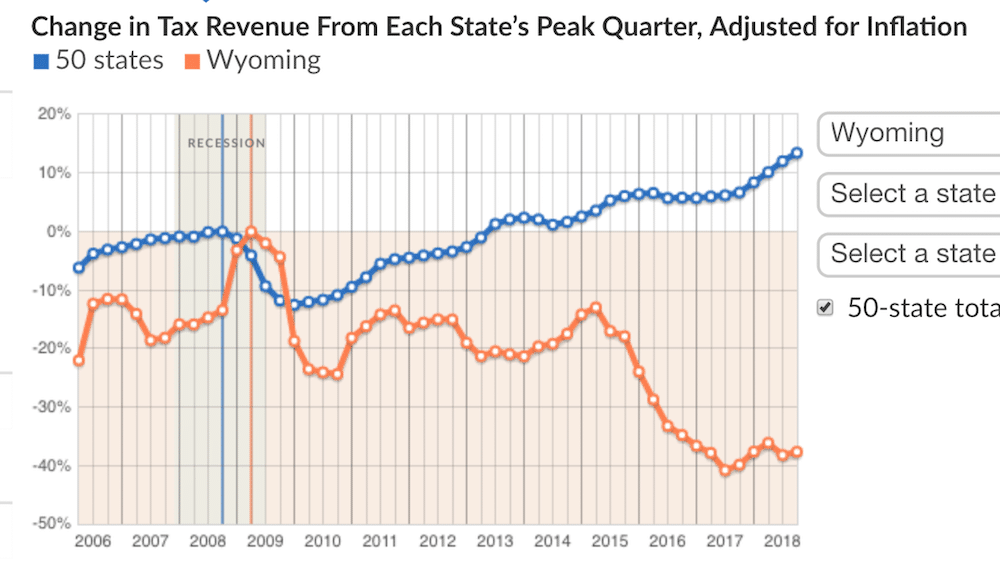
Wyoming’s tax revenue collection has fallen farther since the 2008 recession than every state in the union except Alaska, while 41 other states have increased tax revenues, according to a study by The Pew Charitable Trust.
The Cowboy State collected 37.7 percent less money in the last quarter of 2018 than it did at its high point in 2009, according to the study. The drop comes amid a rise in the average tax collection of all 50 states, which is now 13.4 percent higher than it was in 2008.
The 50-state-average for tax collection has risen steadily since a low in 2009. Wyoming’s always volatile tax revenues swung up and down from 2009 to 2015, then plunged in 2016 and has yet to rebound close to previous levels.
The Pew study did not analyze the reasons for each state’s performance.
Wyoming’s heavy reliance on the energy industry to fill state coffers, lack of personal and corporate income taxes and low individual property and sales tax rates have left state government funding unable to benefit from the national economy’s recovery.
The Pew researchers studied tax revenue collections from 2006 to 2018 to see how they’d changed since the 2008 recession. Researchers compared revenue for each quarter to a peak period around the 2008 recession. While the “peak” for the 50-state average came in 2008, Wyoming’s came in 2009, as energy markets helped insulate the state from the 2008 financial crisis.
But Wyoming’s tax collection dropped in the fourth quarter of the same year, according to Pew, and since 2009 has lagged well behind the steady rebound of the 50-state average. The gap between Wyoming and the nation as a whole widened significantly from 2015-2016, as coal, oil and gas revenues all plunged together.
Neighbors outstrip us
By the second quarter of 2017, Wyoming was collecting 40 percent less tax revenue than at its 2009 peak.
A rise in oil leasing and an improved economy nationally has helped the state stop the decline and raise its revenue collection slightly — in the third quarter of 2018 tax collection was 37 percent off its 2009 peak.
Nearby North Dakota, which like Wyoming draws a lion’s share of its tax revenue from severance taxes — particularly from oil production — has outpaced other states in its rebound. Though it has also seen volatility, at the end of 2018 tax collection in that state was 58.7 percent above its pre-recession peak.
Support in-depth reporting during WyoFile’s spring fund drive
Neighboring Colorado and South Dakota also saw large rebounds from their tax-collection peaks. Colorado’s tax collection has risen 34.5 percent, a near inverse of Wyoming’s drop.
South Dakota’s tax collection in 2018 was 21.6 percent higher than its pre-recession peak. Like Wyoming, South Dakota has no corporate or personal income tax. But its property tax rate is much higher than Wyoming’s — the 17th highest in the nation in 2014, according to a study by the Wyoming Legislative Service Office. Wyoming has the 46th lowest property tax rate in the nation, the LSO found.
South Dakota’s sales tax also brought in a significant portion of its revenue.
Wyoming’s policy makers continue to grapple with how and to what extent the state needs to shift its revenue structure away from the energy industry. Government spending was slashed by Gov. Matt Mead in 2016, and the Legislature has sought to reduce it further since then but this year did not make any significant cuts.
While some conservatives say the Legislature needs to keep cutting, others worry the state’s revenue picture remains vulnerable to further drops down the road.
CORRECTION: This article was corrected to indicate the study was conducted by the Pew Charitable Trust, not Pew Research Center as originally reported. —Ed.

The way you listed the statistics – 17th highest and 46th lowest makes it very unclear to me how the two compare really. When I read those kind of things, 46th lowest is approximately the 7th highest.
Great coverage, dude! Just an FYI: This study is by Pew Charitable Trusts, which is not the same as Pew Research Center. Pew Research Center receives funding from Pew Charitable Trusts, but are a totally different organization.