
An early spring snowstorm dumped more than 3 feet of snow on Casper this week, closing schools and businesses while burying neighborhoods and vehicles and creating a chore of opening roads.

A record-breaking 26.7 inches of snow fell in the city on Monday. It was the single snowiest day for the city since records began tracking snowfall in 1937, according to the National Weather Service in Riverton. The previous single-day record was 24.3 inches on Dec. 24, 1982.

Total snowfall from the event also set a record — 37.4 inches — breaking the previous snowstorm record of 31.3 inches, also from December 1982.
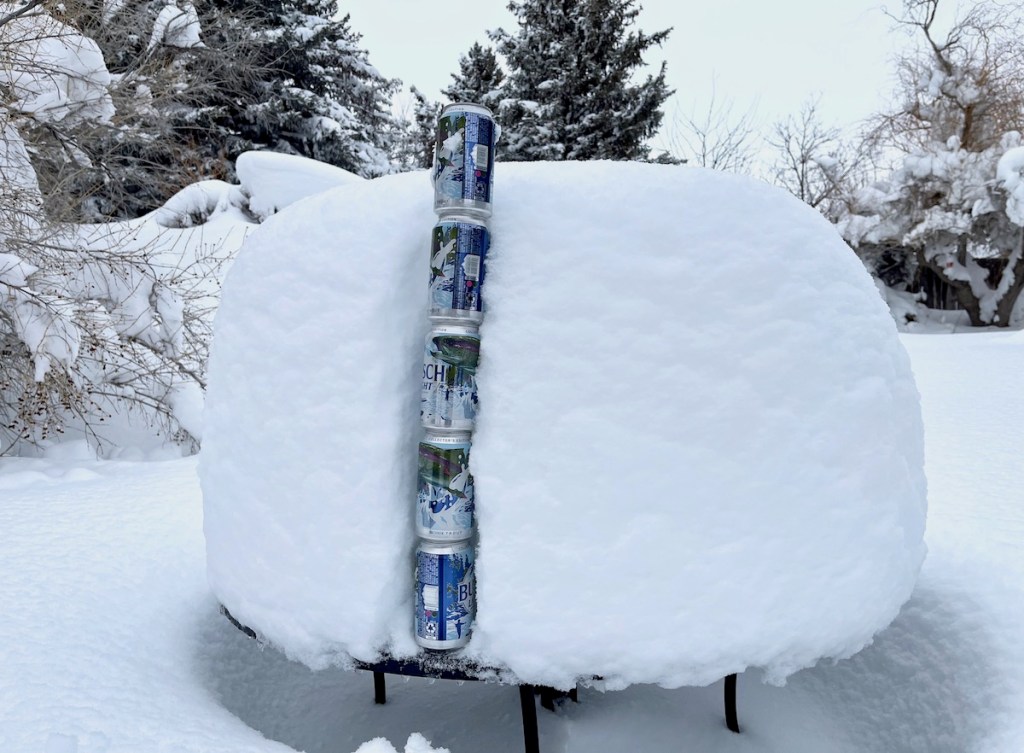
A tower of frosty refreshments gives scale to the deep blanket of snow in Casper April 4, 2023. (Dustin Bleizeffer/WyoFile)

Casper may set another record for seasonal snowfall. As of Thursday, seasonal snowfall was at 132.7 inches — just about 20 inches shy of the record 151.6 inches set in the 1982-83 snow season.

“The snow season’s not over,” NWS Riverton meteorologist Celia Hensley said. “We’re only 20 inches away, and you could get that in a single snowstorm.”

But, Hensley said, it’s too early to know what spring might still have in store. So far, the forecast calls for cooler than usual temperatures overall in April. However, a period of warmer temperatures will push Casper into the 50-65 degrees Fahrenheit range early next week, bringing a lot of snowmelt.

“We’re watching for the potential for flooding in some lowland areas,” Hensley said.

Dustin Bleizeffer covers energy and climate at WyoFile. He has worked as a coal miner, an oilfield mechanic, and for more than 25 years as a statewide reporter and editor primarily covering the energy...

Join the Conversation

3 Comments

WyoFile's goal is to provide readers with information and ideas that foster constructive conversations about the issues and opportunities our communities face. One small piece of how we do that is by offering a space below each story for readers to share perspectives, experiences and insights. For this to work, we need your help.

What we're looking for: 

  • Your real name — first and last. 
  • Direct responses to the article. Tell us how your experience relates to the story.
  • The truth. Share factual information that adds context to the reporting.
  • Thoughtful answers to questions raised by the reporting or other commenters.
  • Tips that could advance our reporting on the topic.
  • No more than three comments per story, including replies. 

What we block from our comments section, when we see it:

  • Pseudonyms. WyoFile stands behind everything we publish, and we expect commenters to do the same by using their real name.
  • Comments that are not directly relevant to the article. 
  • Demonstrably false claims, what-about-isms, references to debunked lines of rhetoric, professional political talking points or links to sites trafficking in misinformation.
  • Personal attacks, profanity, discriminatory language or threats.
  • Arguments with other commenters.

Other important things to know: 

  • Appearing in WyoFile’s comments section is a privilege, not a right or entitlement. 
  • We’re a small team and our first priority is reporting. Depending on what’s going on, comments may be moderated 24 to 48 hours from when they’re submitted — or even later. If you comment in the evening or on the weekend, please be patient. We’ll get to it when we’re back in the office.
  • We’re not interested in managing squeaky wheels, and even if we wanted to, we don't have time to address every single commenter’s grievance. 
  • Try as we might, we will make mistakes. We’ll fail to catch aliases, mistakenly allow folks to exceed the comment limit and occasionally miss false statements. If that’s going to upset you, it’s probably best to just stick with our journalism and avoid the comments section.
  • We don’t mediate disputes between commenters. If you have concerns about another commenter, please don’t bring them to us.

The bottom line:

If you repeatedly push the boundaries, make unreasonable demands, get caught lying or generally cause trouble, we will stop approving your comments — maybe forever. Such moderation decisions are not negotiable or subject to explanation. If civil and constructive conversation is not your goal, then our comments section is not for you. 

Your email address will not be published. Required fields are marked *

  1. With that image of a tower of beer cans used to gauge snow depth , you have created a new standard of measurement , Dustin. It is good you did not use politically sensitive Bud Light beer cans for the quantification. While Busch beer is marked ‘ Safe’ for calibrating , it lacks luster and the company is now owned by a Belgium- Brazil consortium. We can do better

    I suggest we honor one of America’s domestic brews from the glory days. Blatz. The unbiquitous brand was brewed and sold for 150 years but did not survive into the 21st century. The last bottle and cans of Blatz left the loading dock in Milwaukee in 1996. We should revive the name by adopting the ” Blatz” as the new standard gauge for snow depth , 1 blatz being the height of the can equivalent to 4.8 inches / 12.2 cm . But the letter are awkward units on their best day.

    It appears that Casper recieved 4.5 blatzes of snow. Coincidentally , that is very close to 1 bleizeffer…