

Author's note:
WyoFile now provides audio versions of all articles. Feel free to send feedback to casey@wyofile.com
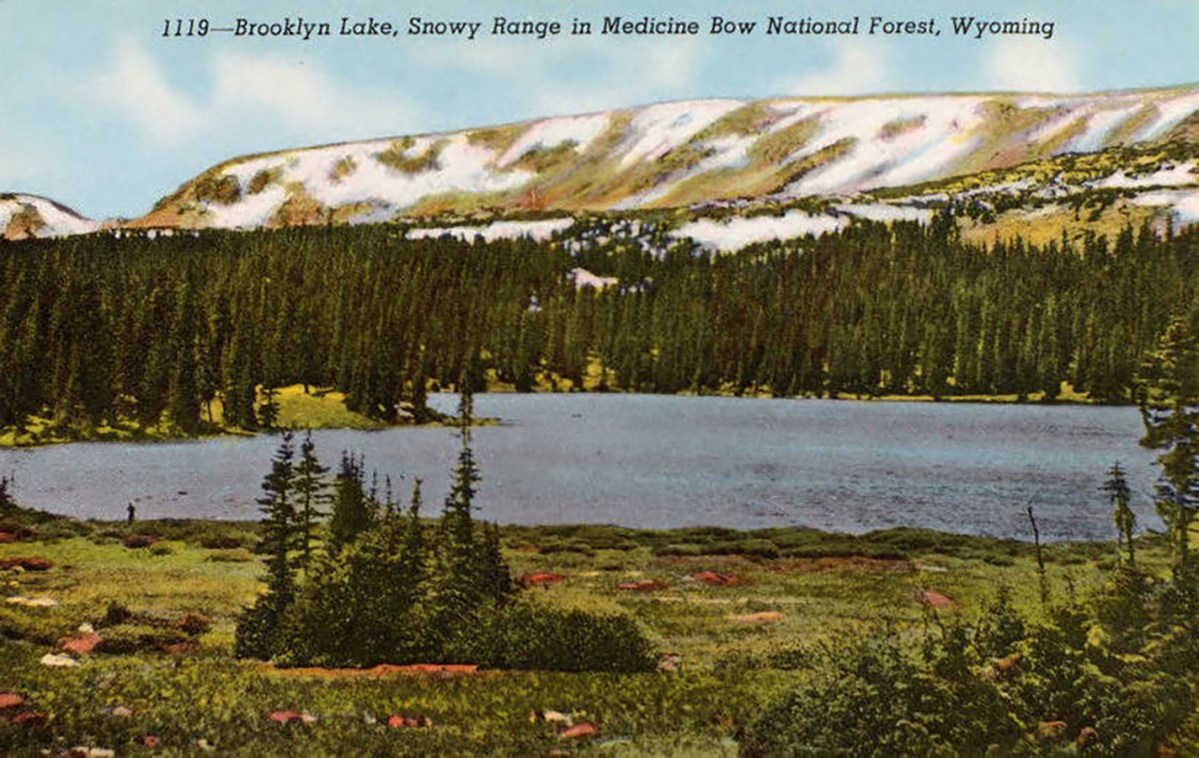
We are spending the summer again at Brooklyn Lake. The lake sits at 10,500 feet above sea level, just below Brown’s Peak, in the heart of the Medicine Bow National Forest. Formerly called Trout Lake, it was re-christened by Harry “Hoot” Jones, former rodeo star and owner of the nearby Brooklyn Lake Lodge, a century ago. Old Hoot knew a tourist draw when he saw one. It remains one today.
Kim and I are camp hosts here — U.S. Forest Service volunteers in charge of the 19-space campground. We welcome folks to the campground, help them register for a campsite, let them know about the area and the rules for camping here. Most importantly, we try to create a welcoming atmosphere. It’s a great job. And it provides an opportunity to experience public lands camping and, perhaps more importantly, some quiet time to process what we’re seeing.
The Medicine Bow Mountains and the Sierra Madre Mountains bracket the upper North Platte River Valley like a set of parentheses. The Medicine Bows — known far and wide as the Snowy Range — are bigger and more heavily used than the Sierra Madres. Most of both ranges are administered by the U.S. Forest Service. Both have some privately owned inholdings, artifacts of the hardrock mining that took place a century ago. Both are stunningly beautiful.
Opinion
My first experiences in the Snowies came in the 1950’s when I was a preschooler. Somewhere in the basement are photos of me in my ever-present cowboy hat, taken by my dad’s friend, Ferd Stone. We came to visit Ferd once a summer at his cabin on Brooklyn Lake. I still remember holding his hand as we walked the dark spruce woods, hunting wild mushrooms and talking about whatever 5-year-old cowboys and 40-year-old bachelor law professors talk about. I know now that he was a Rhodes scholar and had a doctorate from Yale. All I knew then was that he was my friend and he was the first man I ever saw wearing hiking shorts. I asked my mom what happened to the rest of his pants. Abbreviated pants notwithstanding, he shared his place with us and taught me not to be afraid of afternoon thunderstorms.
The high mountain country was largely the domain of locals back then. People drove the highway over Snowy Range Pass and gawked at the great wall of granite and ice that was (and is) Medicine Bow Peak, but they didn’t get far from a paved road. Kim’s dad skied there in the 1940s and drank with his buddies in Centennial when the day was done. But very few people came to the Snowy Range with the express purpose of camping, hiking or climbing.
It’s different now. The backpacking and cross-country skiing fads of the 1970s changed everything. Young people (including college students like us) flocked to the Snowies year-round. People came from all over the U.S. to experience those same dark spruce woods that my friend Ferd loved so dearly. They brought their kids, and those kids brought their kids and soon it seemed the woods were a lot more crowded than they’d ever been. There began to be talk about loving the place to death.
But we hadn’t seen anything yet. The explosive growth of the Colorado Front Range and the development of social media created a human tsunami here. The Front Range Urban Corridor (think Cheyenne to Pueblo) is home to about 5.5 million residents — almost exactly 10 times as many people as live in the entire state of Wyoming. And we’re right next door. The public lands of the Snowy Range and the Sierra Madres belong to us all. People come all year long, and they share their experiences on TikTok and Instagram and X and a host of other social media platforms. You can’t blame them for wanting to escape the crush of humanity, the heat and the frenetic pace of the 21st century.
We meet them every day here at Brooklyn Lake. Our campsites are pretty much permanently occupied all summer long. We split the campground between first-come-first-served sites that anyone can occupy when they become vacant, and reserved sites that can be booked at recreation.gov. It’s $20 a night, unless you have an America the Beautiful pass, which cuts it to $10 a night. Stays are limited to 14 days. Most guests come from Colorado. That’s been especially true this year, with the wildfires on the Western Slope driving folks north to Wyoming to escape the smoke.
They camp in everything from the back seat of their car or a Walmart tent to Class A motor homes that cost more than I want to know about. They come in all ages — from high school kids to elderly folks. They bring a variety of life experiences and attitudes, but one thing unites them all: They love being here. And that creates the opportunity that makes it better for us all. Our experience has taught us that it’s up to us to create a community, a feeling of connection with the land and with the other campers in the campground. That community, that connection, is what makes a great experience for all of us.
Honestly, it’s not that hard. No matter where they come from, they’re here to have fun. They want to breathe some fresh air, hear some birds and maybe see a moose. They want to hike the high mountain trails, maybe climb Medicine Bow Peak or take the paddleboard out on the lake. They’d like to have a campfire, but they understand that this year we’re in a tinderbox and they’re willing to keep it small and keep it in the fire ring, not because we say so, but because it’s the right thing to do.
At the end of the day (both literally and figuratively), that’s the public lands camping experience here. It’s about sharing the commons we all love with people we may meet, share a day or two together and never see each other again. It’s about being kind to your neighbor and taking care of the land.
If there’s anything more quintessentially American than that, I don’t know what it is.

Pushing eighty I remember when the snowy range was truly lonesome. In high school we would camp on Jim Creek for days and not see a soul. You could drive over the range seeing maybe a car or two. Before we went into the Marines we spent the summer of 1966 at a base camp we set up on the Sand Lake road where we climbed and hiked all over that country and could count on two hands the number of people we saw.
I understand times have changed and I truly believe in public lands being in public hands and that they belong to all of us. But at the same time I can’t help but long for those less crowed times. It brings to mind the phrase that Peter Arnett quoted a Major as saying after a battle in Vietnam. “We had to destroy the town to save it”.
Dave Gustafson
Dear Walt,
I am so grateful that you are taking care of the Brooklyn Lake CG with an acute awareness of how important it is…many hosts have preceded you with so much dedication and service…(I hope the towner Lake Road is still not overwhelmed and driven on). Thank you so much for understanding that all of us need this space and helping to preserve it for all of us…the pressure is real and immense…it seems that you understand how valuable the Snowies are to EVERYONE! As Rec staff for the Med Bow, once upon a time, I have had the privilege of being friends with many campground hosts…you are honoring all those before you…
I am in awe of your big job…and the attitude with which you and you wife seem to master for the greater good…
Thank You!!! Keeping that beautiful place accessible for so many is a gregarious task…a very generous task…
I notice and appreciate…
Thank you!
Thank you, Walt.