

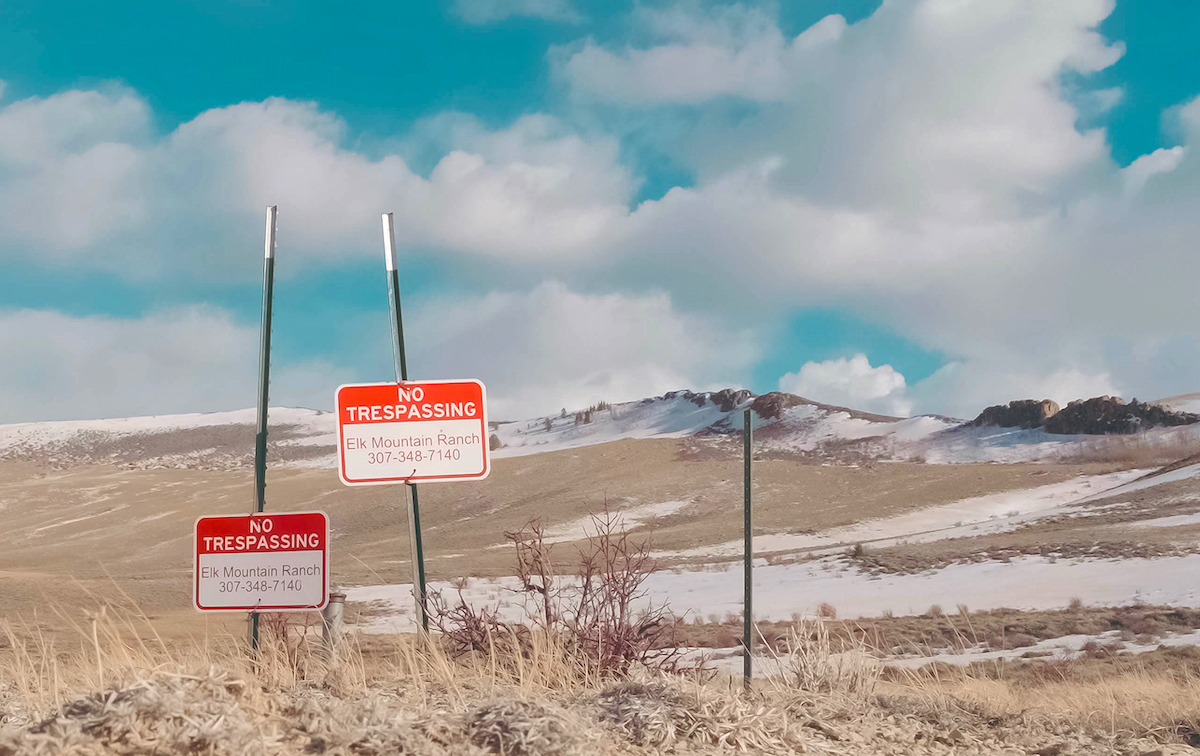
Five groups are supporting Elk Mountain Ranch owner Fred Eshelman’s petition for the U.S. Supreme Court to review a 10th Circuit Court of Appeals ruling that he cannot block the public from corner crossing to reach public land surrounded by his ranch.
The groups filed briefs Monday urging the Supreme Court to take up the matter. The 10th Circuit ruled earlier this year that four Missouri hunters did not trespass when they corner crossed to hunt on public land on Elk Mountain in Carbon County.
Eshelman wants that ruling overturned, claiming that the hunters trespassed. They did not touch his land but passed through the airspace above his property.
United Property Owners of Montana, The Claremont Institute’s Center for Constitutional Jurisprudence, Wyoming Stock Growers Association, Wyoming Wool Growers Association and Montana Stockgrowers Association joined Eshelman on Monday in seeking a high-court review.
Corner crossers step from one piece of public land to another where they meet at the common corner with two pieces of private property. Corner crossers do not set foot on private land, but they pass above it.
“There is a need for a nationwide rule addressing corner crossing.”
John Gabel Connors
At issue is public access to 2.4 million acres of public land in Wyoming and 8.3 million acres across the West that would be “corner locked” and inaccessible to the public if the Supreme Court sides with Eshelman. By controlling access at common corners, a landowner can essentially have exclusive use of public property, the Missouri hunters have said.
The 10th Circuit decision applies to Wyoming, Colorado, Utah, New Mexico, Oklahoma and Kansas. But it leaves a gray area elsewhere in the West, Eshelman’s supporters say.
“The outcome of this case affects 150 million acres of public and private land,” John Gabel Connors wrote in a brief for Montana landowners. “There is a need for a nationwide rule addressing corner crossing, and this case may be the only opportunity for the Court to consider the issue.”
Unconstitutional?
The groups suggested numerous reasons for the Supreme Court to take up the issue. The three ranching associations also urged justices to reverse the lower-court decision.
Attorneys argued that the 10th Circuit decision was an unconstitutional taking of property without compensation. The appeals court, however, said the 1885 Unlawful Inclosures Act prevented Eshelman from blocking public access to public land in the checkerboard area of Wyoming.
Eshelman never had a right to exclude others and so there was no taking, according to the ruling.
That rubs Montana landowners the wrong way.
“The fundamental flaw in the decision … is the Tenth Circuit’s belief that the UIA ‘permit[s] limited trespass’ and ‘functionally operates like a limited easement’” the brief states. The lower court concluded that corner crossing was legal and Eshelman “was not entitled to compensation for the property right that had been taken.” That “taking” is unconstitutional, the group said.

The 10th Circuit ruling also opens “previously inaccessible property” to the public, creating headaches for federal and state governments and even limiting the federal government’s power to purchase public access easements, the brief says.
In another brief, the Claremont Institute’s Center for Constitutional Jurisprudence reached back to English common law in its arguments. “[T]he ‘poorest man’ in the meanest hovel can deny entry to the King,” John Eastman wrote of the foundation of the United States’ legal framework.
“The natural right to own and use property … is a foundation of individual liberty,” Eastman’s brief states. “One of the core principles of the American Founding is that individual rights are not granted by majorities or governments but are God-given and inalienable.”
The 10th Circuit decision allows corner crossing in the checkerboard area of southern Wyoming where the government granted land to enable railroad construction. That created the pattern of alternating square-mile sections of public and private land and the ongoing embroglio.
“Congress created the patchwork mess,” Eastman wrote, “it can fix it as well.” That would be by purchasing easements, he argues.
Ranchers see disruption
Stock growers leaned on potential damage to ranchers and cases known as Leo Sheep and Camfield.
In the Leo Sheep conflict, courts concluded the federal government did not have a right to construct a road across a common corner because the road was partly on private property. In Camfield, fences constructed on private land wrongly prevented access to public grazing pasture, courts decided.
The Camfield decision essentially abated a nuisance and is centered on laws preventing such things, attorney Brandon Jensen wrote for the stock and wool growers. But Leo Sheep addresses implied easements.
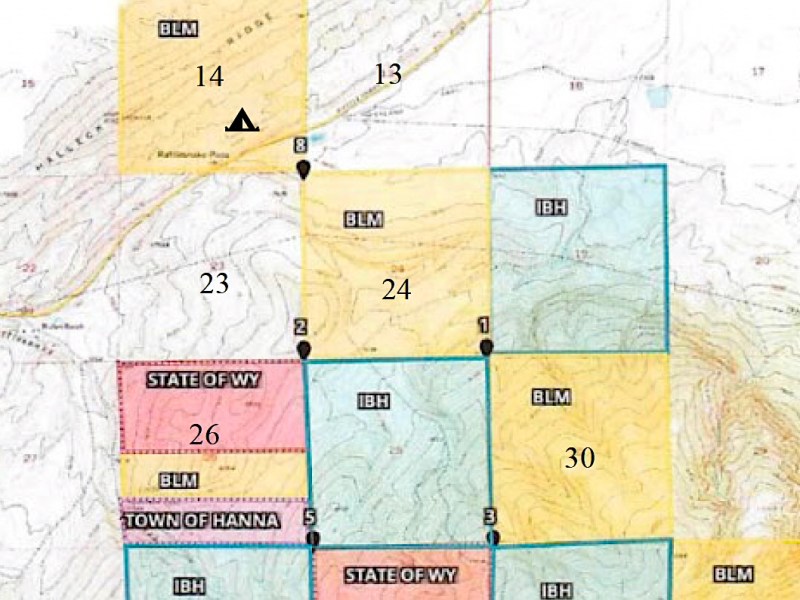
The Leo Sheep precedent rejected an implied easement at common corners, albeit for a road. “Certiorari must be granted to provide necessary clarity on the application of existing legal reasoning and Leo Sheep’s effect on precedent under the UIA,” the brief states.
“The [Montana Stock Growers Association] believes corner-crossing is a serious threat to the integrity of private landownership, undermines long-standing property boundaries, and may set a harmful precedent that erodes the ability of landowners to manage and protect their property,” Jensen’s brief states.
The 10th circuit unleashed chaos, the brief suggests.
“Without a systemic and strategic method to acquire access to corner locked federal lands, the public will have access to lands that the state and federal government may not regulate or maintain,” the filing states.
Public access to public lands “can cause great stress to livestock,” stock growers said. Ranchers will be shouldered with “the burden to absorb the costs to their livestock operation if livestock are disturbed or livestock is lost to an errant hunter’s shot (which certainly happens); the burden to clean up the public lands intermingled with their private lands from trash, empty cartridges, plastic water bottles, gut piles and waste which can attract predators that may also choose to prey on livestock.”
The 10th Circuit decision also creates a gray area with respect to liability, the filing states.

“The natural right to own and use property … is a foundation of individual liberty,” Eastman’s brief states. What about publicly-owned property? The public has a right to an easement of necessity. An easement by necessity is a legal right that allows a person to use a part of another’s land to access their own property, created when a property is “landlocked” after a division of land and there is no other reasonable means of entry or exit to a public road or utility line. It arises out of the practical necessity of the situation, not necessarily out of a specific written agreement, and requires demonstrating that the easement is essential for the practical use and enjoyment of the landlocked parcel.
Great article on a complex issue
Attaboy Angus
As a stockman I am somewhat disappointed by the associations position. Those of us involved in agriculture are a small, decreasing minority. For our system of public land to continue we need a broad base of support.
There is no such thing as a “grazing right.” Ranchers with leases have a privileges’ to use the grass. That’s it. No property rights pertain, period. U.S. Supreme Court decision.
The federal Taylor Grazing Act, passed in 1934, says, “Nothing in this Act shall be construed as in any way altering or restricting the right to hunt or fish within a grazing district in accordance with the laws of the United States or of any State, or as vesting in any permittee any right whatsoever to interfere with hunting or fishing within a grazing district.”
Blocking hunters from entering at a corner is restricting rights of citizens. It would be helpful to do research in old Congressional files to see what testimony and discussion went in to the unlawful enclosures act. My bet is that the intent was to allow access for horses, wagons and livestock. Maybe there are already implied easements included in the Congressional Records.
Just some fun facts regarding Public Lands grazing fees: the fee is currently $1.35 per cow/calf pair PER Month ($00.045 a day). In comparison the going monthly rate to graze a cow/calf pair on Private lands is $20.00. The average cost for the USFS and BLM to “manage” or administrate the Public Land grazing is around $8.00 per month. This is a net loss of $6.65 per Month for each cow/calf pair you come across while recreating on Public Lands. Add inflation over the years and that $1.35 a month “Fee” is nearly a freebie for the Public Lands grazers. To top it off, these welfare cowboys not only want to graze their livestock for nearly free, with the cows and sheep denuding the land and cow patties floating down once pristine streams, no food or cover left for wildlife and stand by to watch the Government loses big money administering this subsidized program , they also want YOU to get off what they think is THEIR Public Lands! Oh, the irony and probably the best solution, since the Public Land user is such a burden, let’s remove the livestock. Problem solved for all parties concerned. This isn’t a Green issue, this isn’t a Conservative issue, this is a FREELOADER issue. People who don’t pay their fair share shouldn’t be dictating who can or can’t access Public Lands
As a frequent public lands user in Colorado, I have encountered ranchers and employees of ranchers that attempted to intimidate me and pressure me to go away. In a couple of those instances I visited the Pawnee Grasslands local office and discussed with the Rangers. Their response was these incidents would be raised when grazing permits were discussed with the lease holders. Grazing leases are not “ownership by proxy,” but are agreement to allow the grazing entity to pasture livestock. Ranchers are not law officers or rangers. I have friends that are ranchers and graze cattle on USFS lands in Pawnee Grasslands. They treat other public lands users graciously, and don’t consider themselves as victims beleaguered by hunters or hikers. What a concept!
Public Land for the public.
This is a good article. The lawyer Eastman has been recommended for disbarment in June– he supported an insurrection and takeover of the US Government, he is not trustworthy. This fact that billionaire land owners and ranchers (really disappointing) want to lock up our public land is very concerning. Most of these ranchers use OUR public land to graze their sheep and cattle, but they don’t want to give access to outdoor groups because they say it would cause stress to their cattle and sheep — give me a break. Here is the sad part, this push for the SCOTUS to hear this case is because this court is bought and paid for by billionaires and will rule against corner crossing preto vent us from accessing our public land. I hope I’m wrong.
I know A LOT of “conservatives” that are against this going to the Supreme court and in favor of public access to these lands.
Agreed
[Public access to public lands “can cause great stress to livestock,” stock growers said.]
Thanks for the chuckle with my morning coffee.
If the ranchers are stressed about their livestock’s mental health, then I would suggest they remove their privately owned livestock from our public lands.
The free ride is over boys.
What will the treasury department do without the tens of dollars they receive from public lands grazing fees
How many of you feeling ranchers should be mandated to allow you access across your yards to save time for someone? I grew up on a sheep ranch, but we had milk cows and my Dad butchered every year. The inside of the hide had many pellets and healed holes. The bad thing about the passion of this situation is damage done to ranchers in retaliation for their concerns and attempts to protect their animals.
If they’re on public land, they are in MY backyard.
Marion, many, many times you’ve mentioned that pretty much all of the animals on your farm while growing were shot. I find that hard to believe, just like hunters never close gates, throw trash out on the BLM, etc. You’re over your head
grazing leases on public land are not “owned” by the welfare rancher. throughout the dozens of articles on this topic, you keep repeating the same false example.
If Eshelman and the right-wing peasants that do his bidding prevail in this case, it will be a disaster for all who use public lands. The radical right longs for the day when democracy is no more and feudalism returns.
The brush you paint with is so broad that you have paint on your face.
We are screwed if the supreme court decides to hear this. They don’t care about the majority. Screw the few, support the many in this situation. Hunters and all outdoor enjoying people deserve to access OUR land!
The super welfare recipients want to keep you off of PUBLIC LAND. These people couldn’t make it without their hand in our pocket. Then there’s the ‘conservatives’. What a laugh.
Public access to public lands “can cause great stress to livestock,” stock growers said. HUH?!?!? Ok, I have a solution, get those 4 1/2 cents Per day grazing fee cow calf pairs off OUR Public lands. Problem solved and you’re welcome, stockgrowers
I can name 5 states where corner crossing and section line walking are legal. The SCOTUS needs to deal with this quickly. I am all for property rights but I am also for public right. It’s our land and I’m tired of being locked out of it.
“Surprise, Surprise, Surprise,”