


The “catastrophic” municipal water system failure in March that prompted a temporary boil advisory in Rawlins was the result of poor engineering and aging infrastructure, exacerbated by drought conditions driven by climate change.
Even as crews scramble to repair and upgrade water facilities, some residents are not complying with lawn watering restrictions, according to city officials. So they’ve stepped up enforcement efforts.
“This is getting really bad, and if we don’t stop [rogue water users] we won’t have any water at all,” Rawlins City Engineer Austin Gilbert told city council members during a recent meeting.
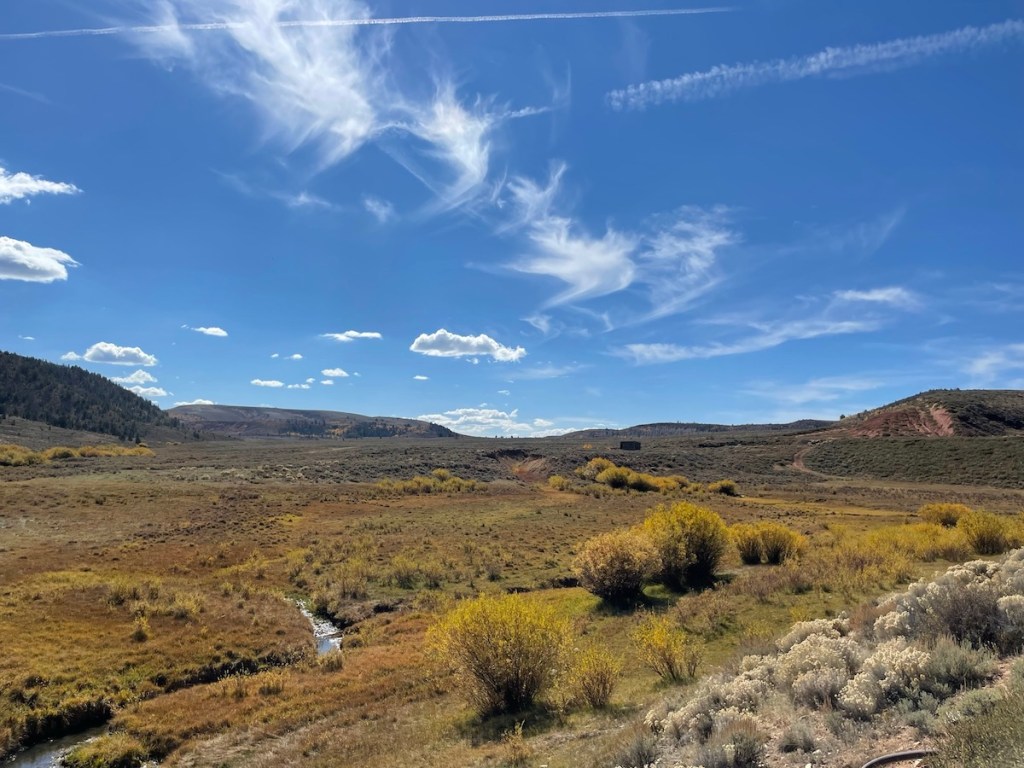
Water delivery volumes for Rawlins are down by about half this summer — a situation that, without major infrastructure upgrades, could get worse for a community that relies on wintertime snowpack to feed the natural springs that provide the bulk of the city’s water. The springs are flowing at about one-third the usual rate this water season, according to the city.
The south-central Wyoming region is experiencing moderate drought conditions and a longer-term climate trend of warmer temperatures and more erratic precipitation. The annual mean springtime temperature in the Upper North Platte Valley has increased by 3.6 degrees Fahrenheit since 1920, according to National Oceanic and Atmospheric Administration data.
That’s twice the global average.
“We are sensitive to drought in this area because the aquifers that we have for our springs are fairly shallow,” Gilbert told WyoFile. “It has put a real strain on our ability to deliver water for [lawn] irrigation.”
As the city restricts use and contemplates how to build a more sustainable water system in the face of a changing climate, it is also trying to figure out how to pay for it. Critical water and sewer upgrades rank among the most expensive priorities for Wyoming’s cities and towns, according to Wyoming Association of Municipalities Member Services Manager Justin Schilling. Yet they find themselves with shrinking budgets and shrinking help from the state.
For some small towns in Wyoming, it’s not entirely hyperbolic to suggest they are one catastrophe away from not meeting basic water and sewer needs and, potentially, financial insolvency, Schilling said.
“It’s a little dramatic, but so many of our communities kind of live hand-to-mouth,” Schilling said. “They see the [infrastructure] problem slowly moving towards them, you know, but they just don’t have the resources to address it on their own.”
System failure
The deteriorating municipal water system had been known to Rawlins officials for a long time. Several miles of the spring water collection system consist of 108-year-old wood-stave piping. A closer examination of the total municipal water network in the summer of 2021 revealed a system “riddled with multiple leaks, miles of corroded pipeline, faulty blow-off valves” and antiquated controls, according to the town’s website.
The city immediately formed a new maintenance and repair plan and began searching for funds to implement a systemwide overhaul.

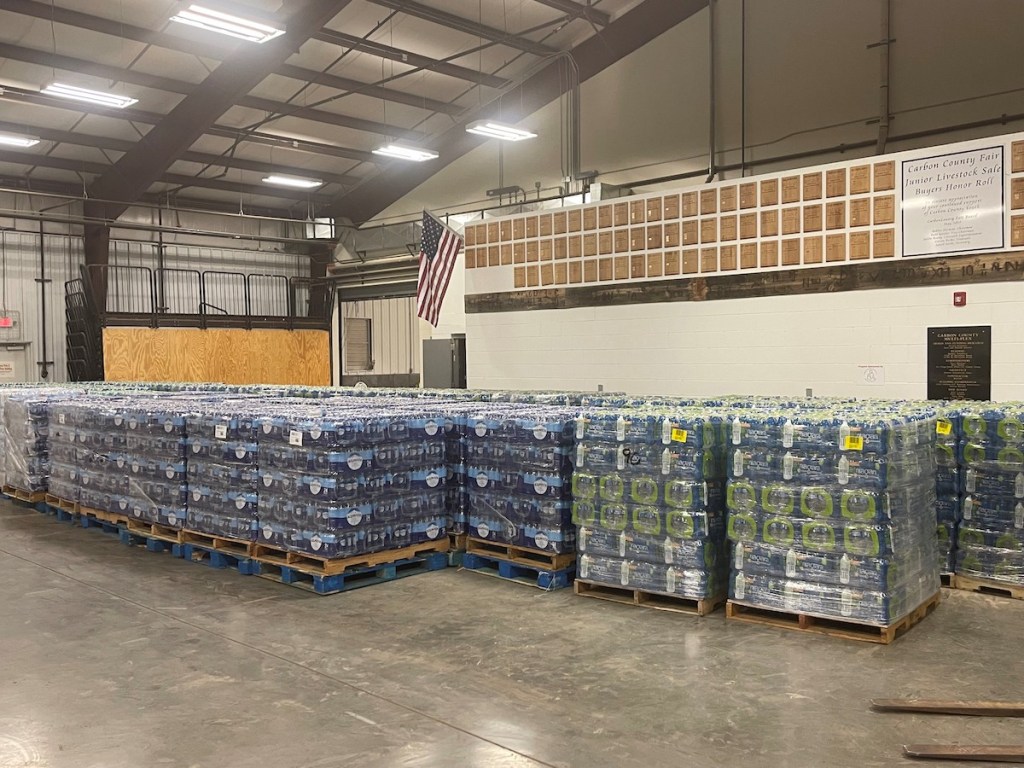
The work required shutting off flows from the springs this past winter, leaving the city to rely on drilled water wells and reservoir water that supplement the town’s supply. But the reduced water flows couldn’t keep up with demand. An “extensive” water line break occurred in town on March 3 as crews attempted to resume flows from the natural springs.
“Between the limited water from the wells, a precoat line crack and the draining of tanks, our water system emptied causing a negative pressure in the water system,” according to the city. “This ultimately required the boil advisory to be placed per [U.S. Environmental Protection Agency] guidelines.”
The boil advisory lasted five days. And while officials fixed the cause of the emergency, water users in both Rawlins (population 8,298) and the neighboring town of Sinclair (population 418), which also relies on the Rawlins system, remain under summertime restrictive use.
Wintertime water demand averages about 1.5 million gallons per day, according to city officials. Demand jumps to about 5 million gallons per day during summer months.
“That’s when the strain starts to happen, depending on how much [water] the springs provide,” Gilbert said. “If it’s not a drought year, we can actually provide a substantial amount of water — 5 to 6 million gallons a day.”
Compliance with this season’s water restrictions is generally good, Rawlins Community Relations Coordinator Mira Miller said. But there’s little room in the system this summer for nonrestrictive water use.
“It can be really difficult for people who really love their yard,” Miller said. “One thing we did differently this year is we’re allowing people to water their gardens and flowers when they feel necessary. But I think, generally, because of what happened in March, people understand that this isn’t something that the city is doing just to be mean. This is something we need to take seriously.”
Repairs and upgrades
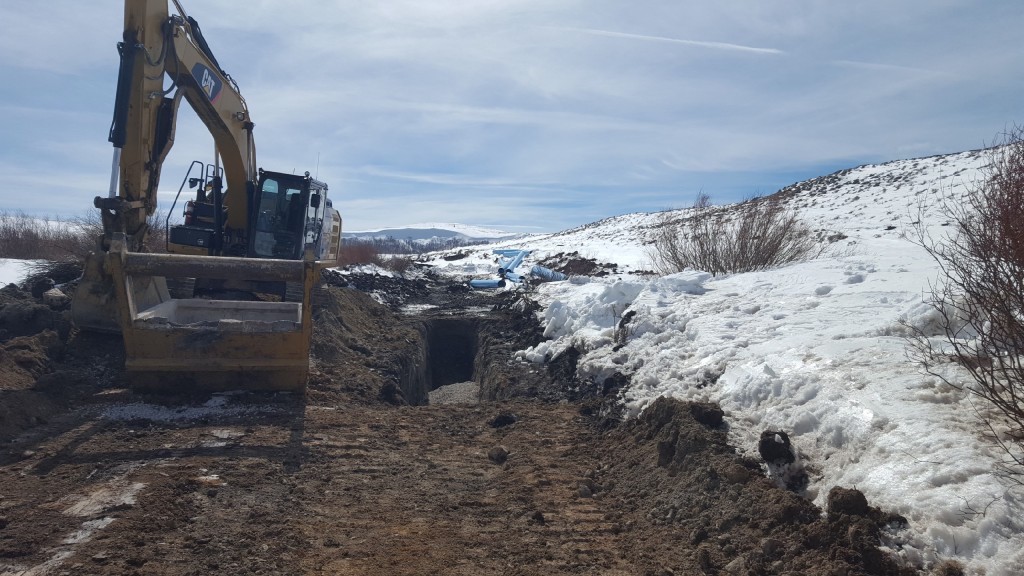
Crews have replaced sections of both wood-stave piping and a main pipeline that delivers the artesian spring water 32 miles to the city’s water treatment plant.
Work is also underway to update a “pretreatment” plant that will allow the city to use more water from the North Platte River. Rawlins officials note that the city’s water rights extend far beyond its historic use, so it has the legal right to use more water from the river. Another project will siphon water from the river to irrigate the local cemetery and other green spaces in town with untreated water.
“When it’s all said and done, it could easily be two, maybe three times the volume of water the city had before,” Rawlins City Manager Shawn Metcalf said.
City officials estimate the repairs and upgrades could exceed $20 million. The city set aside about $2 million a couple of years ago anticipating repairs and upgrades, Miller said. The city received a $675,000 Mineral Royalty Grant from the Office of State Lands and Investments in June and will use $738,000 in America Rescue Plan Act funds.
The city is also using about $1.25 million in “impact assistance payments” administered by the Wyoming Industrial Siting Council to go toward the municipal water system improvements. The payments are distributed to communities to help them deal with impacts from large industrial developments. Rawlins and other communities in Carbon County have received impact assistance payments for wind energy construction projects.
The city will also apply for a U.S. Department of Agriculture loan. So far, the city has more than $4.6 million on hand to fix and upgrade the system, with an estimated $15 million to go.
“We really are taking this seriously and throwing all of our resources at it,” Miller said.
Infrastructure funding
There are many pots of money available to help cities and towns upgrade sewer and water systems, such as federal ARPA funds and funds from the pending Infrastructure Investment and Jobs Act, but it doesn’t automatically flow to communities like Rawlins.
State law restricts how counties and towns can tax themselves and otherwise raise funds — a particular challenge for communities with small populations, the Wyoming Association of Municipalities’ Schilling said. That leaves cities and towns — especially small towns with limited staff — scrambling to find the resources and expertise necessary to fulfill federal grant writing and compliance requirements.
“We are sensitive to drought in this area because the aquifers that we have for our springs are fairly shallow. It has put a real strain on our ability to deliver water for irrigation.”
Austin Gilbert, Rawlins City Engineer
“There’s a lot of [federal] money out there,” Schilling said. “But for a town of, say, 100 people where there’s two full-time employees, you don’t have the bandwidth to go chase a bunch of these federal grants.”
Meantime, the Wyoming Legislature reduced appropriations to the Office of State Lands and Investments’ Mineral Royalty Grant program — one source that Rawlins tapped into — in anticipation of federal programs stepping in to fill the need.
The U.S. Department of Agriculture also has a lot of money to disperse to communities for infrastructure needs, Schilling added, but that money usually comes in the form of loans that can take decades to pay off.
“A small community will have to shift the burden to their children to pay that off over time,” Schilling said.

If it lasted 108 years, it must have been incredible engineering! Most systems only have a 50-year life if they are maintained. After that, It’s probably time to start over with new materials, which are much better than what was available 100 years ago. Think about lining the old pipe with new fused HDPE pipe – no digging, quick replacement & long life – no corrosion or hard water buildup. It also sounds like it’s time to get serious about more desert landscaping or working on a new raw water system like some Wyoming towns have.
Kemmerer ran out of water, maybe 20 years ago. Can’t remember the date. They got by with water owned by the power plant if I remember correctly.
Wyoming really is poorly managed on a local level. Even Teton County can’t keep its water clean.
Why aren’t they considering either a capital facilities tax or the optional sales tax to fund the needed infrastructure? If my Google search was correct, a $25m capital facilities tax was passed in 2019 to fund courthouse renovations, so it should be close to being completed. Pass a new capital facilities tax to take effect as soon as the current one is finished, so local officials know they have a revenue source and they can get to work planning the needed improvements.
Bud will fix it!
It would be interesting to conduct a poll in Rawlins asking:
> Do you prefer politicians who promise No More Taxes! ?
or
> Do you prefer politicians who promise federal and local taxes will result in your home being supplied with drinking water?