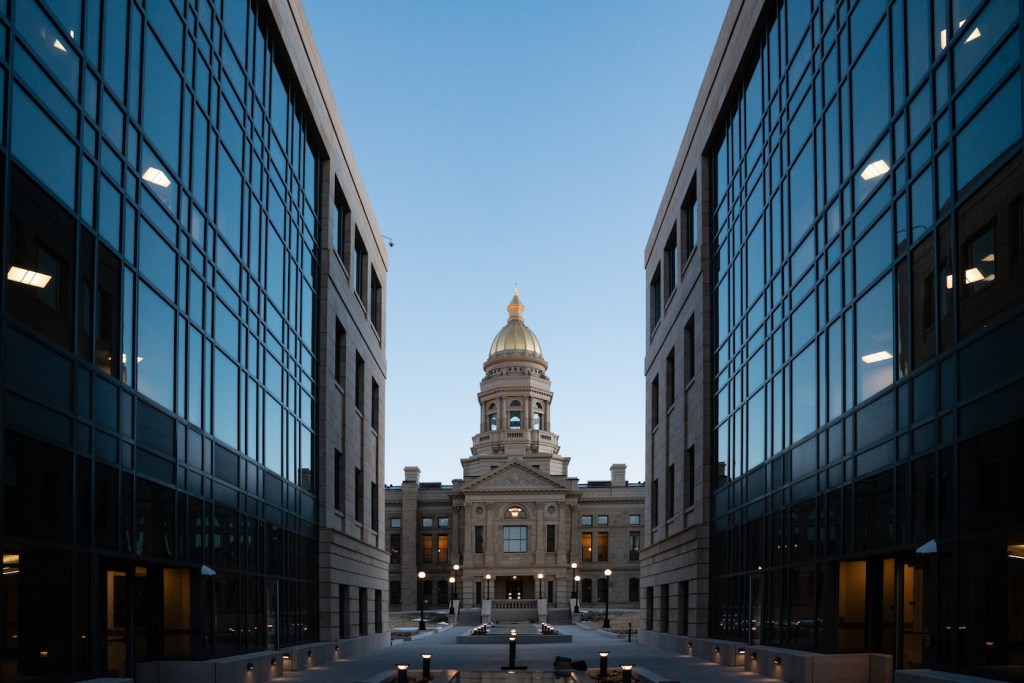


University of Wyoming President Ed Seidel has historically avoided wading into the day-to-day affairs of the Legislature. Even as lawmakers have turned an increasingly relentless eye to the state’s lone four-year public university, taking aim at its diversity, equity and inclusion programming and any curricula that smell remotely of “wokeness,” Seidel has publicly stayed mum.
That’s in part, he has said, because of the fluid nature of the Legislature and the whims of its lawmakers — a proposal born one day could be dead the next. And though many conversations don’t reach the public spotlight, university representatives often speak with lawmakers behind the scenes.
But the Legislature’s opening bid last week to slash the University of Wyoming’s block grant by $40 million pushed Seidel to break from his usual silence and publicly address the proposed cut point-blank:
“Please be assured that UW leaders are following and participating in this process very closely,” Seidel wrote in a campus-wide email sent Jan. 15, two days after the Legislature’s chief budgeting arm voted for the cuts.
“We’re advocating for the interests of the state’s university and informing legislators about the potential impacts of a reduction of this magnitude,” he continued. “We have hope that the decision-makers will recognize, as did the governor, that such a cut — almost 11 percent of UW’s state block grant for the biennium — would be both harmful and unnecessary, especially considering the lack of a financial crisis for state government.”
The proposed block grant cut — championed by hard-line Republican members of the Wyoming Freedom Caucus, which won control of the House in 2024 — adds to lawmakers’ rejection of a $12.5 million request for matching funds and a $6 million ask for the school’s athletics department, as well as their vote to defund Wyoming Public Media, which is housed at the university. The committee also denied Gov. Mark Gordon’s recommendation to give salary bumps for state workers, including almost $28 million for University of Wyoming employees who last saw a raise in 2023.
What came out of the Legislature’s Joint Appropriations Committee last week was a far cry from Gordon’s recommendation of about $374 million in block grant funds for 2027 and 2028, or roughly $187 million per year (Gordon recommended other state funding as well for the university, but that money would be earmarked for specific purposes, whereas the school can use block grant funding however it sees fit). The committee reduced Gordon’s suggestion to about $334 million. They also added a number of footnotes that specify how some of this money can be used, bringing the total unrestricted funding to roughly $322 million or around $161 million per year.

To give those numbers context, the university’s 2026 unrestricted operating budget totaled almost $410 million, the school’s spokesperson, Chad Baldwin, told WyoFile. The school’s unrestricted state aid comprised more than $164 million of that.
Put simply, the university is staring down the barrel of a cut that could alter the school in dramatic ways, Seidel explained — including the potential loss of jobs.
“This was such a major proposal that I thought we should make sure that our community understood what was at stake,” Seidel told WyoFile in a phone call on Tuesday.
The proposed cut to the school’s recommended block grant comes amid an already difficult time for the university. Enrollment has declined following national trends. The school has lost some key faculty and leaders. And Seidel himself has not only faced discontent from lawmakers, but also from the campus community — in April, the school’s faculty senate overwhelmingly delivered a vote of no confidence against his leadership.
If the Legislature’s proposed cuts come to pass, they would likely result in layoffs, given that a big chunk of the school’s budget is reserved for paying people — according to Baldwin, 77% of the 2026 unrestricted operating budget is earmarked for salaries, wages and benefits.
“Most of that funding does go for people, so that would mean we’d have to have fewer people in order to accommodate the cuts,” Seidel told WyoFile. (He noted that this is speculation, and he would need to see the Legislature’s finalized language to know for certain how the budget would impact personnel.)
Then there’s the matter of university sports, which flood Laramie’s streets with fans on game days. Seidel told WyoFile that losing the university’s Division I status would be “a serious concern” if the proposed funding cut for athletics came to pass. The $6 million request that lawmakers axed stems from a landmark NCAA settlement that allows colleges to compensate student-athletes for their name, image and likeness. Even Wheatland Republican Rep. Jeremy Haroldson, a Freedom Caucus member, spoke against this cut.
What’s more, another two-year budget cycle without raises could compromise the school’s ability to retain faculty, Seidel said. “We will certainly lose faculty through people finding better opportunities if we aren’t able to keep up.”

Laramie Democrat Rep. Ken Chestek, a professor emeritus of the university, fears that such losses would render Wyoming’s sole four-year university into “a feeder school” — an institution where students start their education but transfer elsewhere to finish it.
It wouldn’t be the first time that UW has seen budget cuts of such magnitude. The school took hits during the tenures of former Govs. Dave Freudenthal and Matt Mead, when plummeting state revenue pushed the Legislature to pinch pennies. The university also faced a $30 million cut to its block grant during the pandemic-spurred economic downturn in 2020, when Seidel came in as president.
But in those instances, the Legislature slashed budgets across state government. This time, as Seidel noted in his email last week, there is no revenue crisis.
“We worked hard to pivot to make sure we provided the best value possible even in the face of budget cuts,” Seidel told WyoFile. “This time, I don’t see how we can do that. We’ve already gone through the pruning exercises — I mean the deep ones — and so we’re just really going to have to damage the university if we have to implement such cuts.”
The proposed budget restrictions are meant to curb “an increase in administration” and “woke education” at the university, Gillette Republican Rep. John Bear, chairman of the House Appropriations Committee and the Wyoming Freedom Caucus’ former leader, told WyoFile. He said he feels that the university has turned against a “Wyoming way of life.” (Cody Republican Rep. Rachel Rodriguez-Williams, who now chairs the caucus, didn’t respond to WyoFile’s call.)
Rather than funnel more money toward the university, Bear said he would prefer to see a bump in funding for Wyoming’s community colleges. At the same time, he noted that, for those who do attend the University of Wyoming, it’s important to him that their tuition stays low. (Bear pointed out that the Joint Appropriations Committee voted to increase the Hathaway Scholarship.)
“Reorganizing the university is a much larger task than we can tackle now, but we expect trustees to start paying attention to the people of Wyoming,” Bear said.

This continues a battle that the Freedom Caucus has been fighting from its genesis. Last budget session, caucus members and allies passed a footnote specifying that the school couldn’t use state funds for its Office of Diversity, Equity and Inclusion or on any other diversity, equity and inclusion programming. The University of Wyoming’s Board of Trustees subsequently backed Seidel’s recommendation to close the office and reassign staff. And for years, lawmakers have also targeted — so far without success — the school’s gender studies curricula.
It’s not surprising that the Freedom Caucus is pushing aggressively on the university’s budget. Caucus members and sympathizers ran on a platform of “cutting the hell” out of budgets, Laramie Democrat Sen. Chris Rothfuss, who is also a University of Wyoming professor, said. “They didn’t hide that from anyone.”
What’s more, it’s an election year, and there’s no telling what the House and Senate will look like when the next session comes around, or if the caucus will maintain the leverage that it has now. “The Freedom Caucus is trying to flex its muscles,” Chestek, the Laramie Democrat, told WyoFile. “They’re trying to leverage their power to get what they can while they can.”
While Seidel primarily addressed worries about the impact of the proposed budget cuts in his campus-wide email last week, he also wrote that “there are legitimate concerns expressed by lawmakers that we have been addressing and will continue to address.” Those concerns, Seidel told WyoFile, include questions about “whether or not universities across the country have liberal environments, and therefore conservative voices are suppressed.”
UW, Seidel added, is “one of the first universities in the country to commit to institutional neutrality.” The school had also begun scrutinizing its diversity, equity and inclusion programming even before it was “faced with pressure from the Legislature,” he said.
What’s been proposed is not the end of the story. The Legislature’s budget process has only begun, and it’s likely these numbers will change by the end of the session, particularly given that the Freedom Caucus doesn’t have as strong a grip over the Senate as it does in the House.

At the same time, it’s entirely possible that the university also hasn’t seen the end of potential budget restrictions. Lawmakers can specify in footnotes how UW is allowed to use its money. They’ve already added some, for example, to exempt the College of Education and the College of Agriculture, Life Sciences and Natural Resources from the cuts. The College of Education’s 2026 budget is almost $8 million, and the School of Agriculture’s budget is almost $33 million. The exclusion of these two colleges would mean the university would need to cut deeper elsewhere.
Much of the budget debate will likely stem from these footnotes, and it’s all but guaranteed that lawmakers will be proposing more of them on the House and Senate floors once the session starts. Bear told WyoFile that he plans to work on crafting potential budget footnotes over the next few weeks, targeting the use of state funds for particular curricula. (He noted, for example, an ecofeminism course that was once taught at the university. Baldwin, the school’s spokesperson, said the course is no longer offered.) The Freedom Caucus will likely hold a press conference on this topic at the beginning of the session, Bear said.
Ultimately, whatever comes to pass won’t be Seidel’s problem for long — the president plans to leave his post in June. “I’ve stated publicly many times that I think my main goal right now is to put the university in the best possible position for the next president,” Seidel told WyoFile. “Budgets are an important part of that, but not the only part of that.”
Who will take the helm after Seidel departs remains to be seen. It’s uncertain whether the uproar over potential budget cuts might discourage some candidates from applying for the job. But there’s little doubt that whoever inherits this responsibility will be navigating rough waters.
Excellent writing Maya. Clear and concise and easy to understand which I don’t always find true of all articles. That being said, it is also clear that this was something the freedom caucus told us they would do. The level of stupidity and closed mindedness never ceases to amaze me. We are truly working on dumbing down the masses so some knuckle draggers can maintain power. A story older than the evolution of man (which of course most of them don’t even believe in!!!!).
Let’s make some comparisons. Colorado State University versus University of Wyoming… State funding. For the year ended 2024,
State Appropriations to CSU…..$22,355,000
State Appropriations to UW…..$230,341000
That is 10.3 times the appropriations of Colorado to CSU.
It is worthwhile to read the financial statements to understand how much state funding UW is addicted to and Why the president is complaining. State appropriations are considered non-operating funds for a university.
CSU Total Non Operating funds are $204,617,000 and the percent of the appropriation to total no operating funds is 10.9%.
UW Total Non Operating funds are $338,404,000 and the appropriation part of non operating funds is 68%.
UW appears to be heavily funded by the state as compared to other universities in the region according to the Audited Financial statements.
CSU also does not have massive state funding of Tuition through the Hathaway program. And on top of all that the University often receives grants from state agencies.
UW also has a unique subsidy called the Hathaway program that subsidizes tuition somewhere between $12 and $14 million dollars.
President Seidel probably should not even be in this discussion after he announced he is leaving following the scandal with demoting the Engineering Dean in a sordid tale well played out in WyoFile. wyofile.com/university-of-wyoming-announces-president-seidels-departure-3-months-after-no-confidence-vote/
Why the board of trustees continued to retain him is beyond comprehension. A lame duck president in that situation results in a rudderless university and has probably done more damage than an appropriations cut.
Your STATS don’t tell the whole story.
What is the tuition at CSU vs. UW? UW: $8000 in state. $25,000 out of state.
CSU:$13000 and 34000.
Do you want WYO kids paying a higher tuition?
Do you know that in many first world countries tuition is free?
Maybe WYO should work towards that. Wouldn’t you think that is the smart way to go.
Ha ha ha ha ha! UW kowtowed to WY’s lawmakers (ending diversity efforts, proclaiming the school politically neutral, etc,) and they STILL punished UW for merely existing! You can’t placate wolves, Seidel!
It might appear to some that these proposed cuts to UW funding are an indirect financial attack, by the politicians, on Laramie itself.
How do I get one of those $40 million Carte Blanche debit cards? I promise I’ll only use it in the best interest of what I decide to use it for!
The JAC, now dominated by the Freedom Caucus, proposes dismantling the Wyoming Business Council. It claimed the WBC picked winners and losers. If they are trying to rid state government of any group that picks winners and losers, they have stopped far short of the mark. They themselves pick winners and losers. What about the Office of State Lands and Investments? They pick who gets a $20/aum state subsidy, why are they allowing this welfare to continue? They should be demanding that every acre of state land be leased at fair market value, not only are they allowing the state to pick winners and losers, but they are also allowing the OSLM and the five elected officials to ignore their fiduciary obligation to the beneficiaries of trust lands. Why is the brave freedumb caucus not attacking these give aways? Could it be because they directly or indirectly benefit from them?
The regressive policies of the so-called “Freedom Caucus” continue to destroy this state. Voters, please be more discerning in your choices!
Seems like an appropriate moment for the Freedom Caucus to carve out of its proposed cuts, and fund, a “Lloyd Eaton” tolerance award.
Woke means giving preference to a less qualified person based solely on their skin color, sexual preference and gender. The single most discrimination practice against qualified people ever. Hope this helps.
Not any more, it now means anything they don’t agree with.
UW’s acceptance is over 90%. The student population is 87% white. A lot of favoritism going on at UW. NOT.
Rep John Bear doesn’t know the Wyoming way of life- he’s from Missouri. Go back home MAGA.
Neither does Rachel Rodriguez-Williams; she’s from California.
Note the irony. The JAC, now dominated by the Freedom Caucus, proposes dismantling the Wyoming Business Council. It claimed the WBC picked winners and losers. The same JAC proposes winners and losers among colleges at UW. In truth, the proposal to exempt two colleges from cuts (Education; Agriculture, Life Sciences and Natural Resources) does not make them winners. Both would be diminished by layoffs and disruptions of sister colleges.
Note also Bear’s comment that he will work on budget footnotes so that specific curricula can be targeted. Historically, the JAC tended to have Wyoming’s more pragmatic, rational and informed legislators. These are not descriptors that characterize JAC members Bear, French, Allemand, Angelos, Haroldson or Prendergraft
I wish those Freedom Caucus clowns would define woke for us and explain what is wrong with having diversity, equality and inclusion at the University. It sounds like they want the student body of the University to be all white sons and daughters of wealthy parents.
The daughters will only be there to find husbands, they don’t want educated women.