


Conservative politicians across the country have taken up arms against the specter of “wokeness” in recent years.
Wyoming lawmakers are no exception. Republican legislators in the Equality State rode the wave of this pushback during the recent budget session, bringing bills and budget amendments that aimed to bar the use of state funds for gender-affirming care, define gender based on chromosomes and what a person’s “reproductive system was developed to produce,” criminalize gender-affirming care for minors and defund the University of Wyoming’s gender studies programming.
Most of these measures failed. But lawmakers managed to pass a budget item that targets, in the eyes of the far right, a particularly irksome movement: diversity, equity and inclusion programming that some Republicans say is responsible for the leftward drift of college campuses.
The University of Wyoming board of trustees will mull the uncertain future of the school’s DEI programming at its meeting Thursday. Lawmakers’ recent passage of a budget item targeting funds for these resources stirred the uncertainty, although nothing is set in stone until Gov. Mark Gordon signs off. The topic is on the agenda for 1 p.m.
Trustees aren’t the only ones interested in the future of DEI measures at UW. An email obtained by WyoFile and distributed among faculty highlighted the DEI agenda item and shared information on how to attend or listen to the meeting.
As the state’s sole four-year university, UW often finds itself under the Legislature’s microscope. That’s become even more so the case in recent years as conservative lawmakers and politicians in Wyoming and nationally have increasingly scrutinized a variety of social issues, particularly surrounding race, gender identity and sexual orientation.
UW’s Office of DEI has become Wyoming lawmakers’ most recent target.
The office, established in 2017, aims to make UW a place where people of various backgrounds can “encounter a welcoming environment where inclusivity, multiplicity, fairness, and parity are steadfast values,” the office’s 2017-2022 strategic plan says. To this end, it provides “educational opportunities and diversity workshops,” supports “the recruitment and retention of diverse students, faculty, and staff” and facilitates “an inclusive campus community” through partnerships within and around campus.
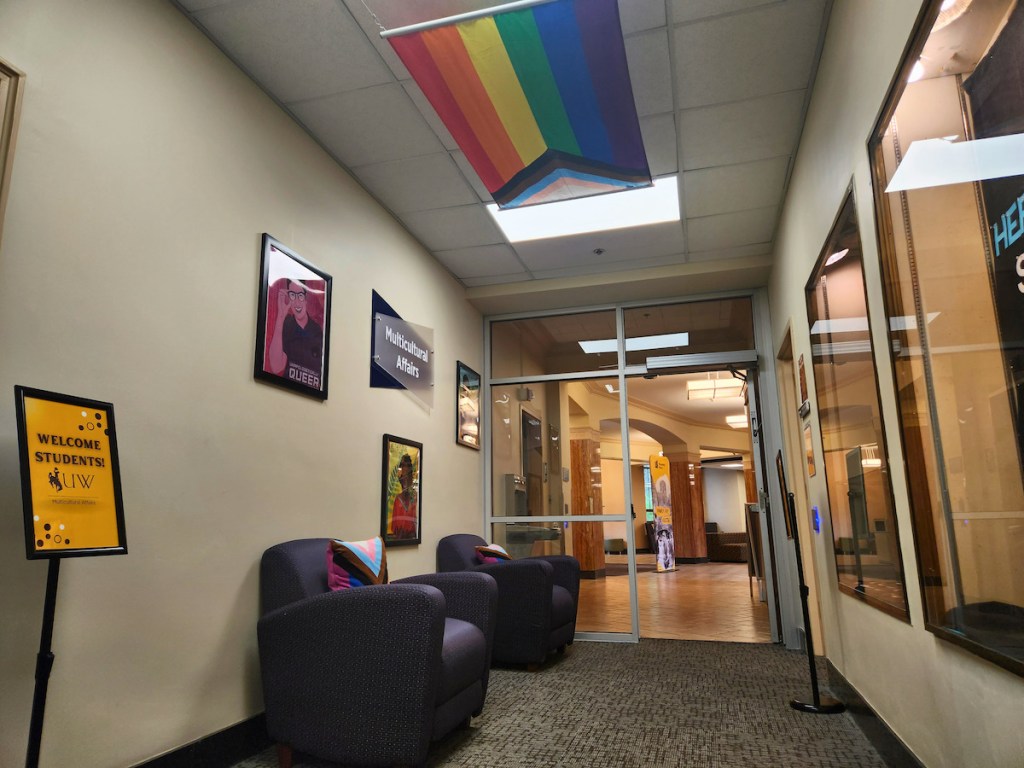
Legislators in both the House and Senate brought budget amendments this year to bar the school from using state aid or endowments and matching funds for “the office of diversity, equity and inclusion … or on any diversity, equity and inclusion program, activity or function.”
Lawmakers defending the DEI office argued that it provides important resources to, for example, first-generation students and others who are adjusting to life at the university. Meanwhile, those who supported the budget amendment said the school’s DEI programming, contrary to its labeling, promotes “division, exclusion and intolerance,” as Senate Majority Floor Leader Larry Hicks (R-Baggs) described it.
In addition to the budget amendment targeting the DEI office’s funding, lawmakers in the House and Senate brought forward proposals to defund the school’s gender and women’s studies programming. The Senate adopted both amendments while the House ultimately tossed them. But in final negotiations, a group of lawmakers agreed to kill the proposal to defund the school’s gender studies programming while retaining the other restricting funds for the Office of DEI and DEI resources. The House and Senate approved the final budget — narrowly in the upper chamber — on the last day of the session.
The Office of DEI currently has two full-time employees, five part-time student employees and two graduate student assistants, UW spokesperson Chad Baldwin said in an email to WyoFile. Baldwin didn’t specify if any of these positions would be at risk of being eliminated under the provisions of the budget footnote.
“Regarding the positions, that determination has not been made,” he said. “The university will prioritize retaining our talented and dedicated staff.”
The office’s 2024 fiscal year budget is $865,000, according to Baldwin. A chunk of that budget — $139,000 — pays for the Office of the Ombuds, which provides a setting where the UW community can “share dilemmas, ideas [and] questions, without fear of exposure, retaliation, or recrimination.” This office “has no DEI mission,” Baldwin said. It also moved under the Office of the President in January, according to a university announcement.
The DEI office’s budget comes from a variety of sources, including state aid, student tuition and private support. The budget amendment specifically targets state aid and endowments and matching funds. Baldwin said he didn’t have an answer to WyoFile’s question regarding how much of the office’s budget is paid for by these sources.
During the legislative session, Don Richards, the budget and fiscal administrator for the Legislative Service Office, told lawmakers that the budget amendment could jeopardize roughly $120 million of UW’s federal research funds annually. That’s because many federal grants have DEI requirements.
Baldwin said that while the budget footnote will likely create challenges to receiving federal dollars, it won’t necessarily bar the university from obtaining those funds altogether.
“We anticipate the footnote would complicate, but not preclude, UW’s ability to obtain and administer funds from federal agencies,” he wrote. “Most federal grants include some DEI requirements, and UW would not be able to spend state appropriations to fulfill them.”
Gov. Mark Gordon has until midnight Saturday to veto items in the budget, meaning he has the power to nix the footnote barring funding for DEI programming at UW. Because the Legislature is no longer in session, lawmakers have no recourse to override any of Gordon’s potential vetoes, short of convening what’s called a “special session” — an additional time for legislators to come together outside of a regular session that would cost the state extra money.
The UW Board of Trustees meeting can be attended in person at UW’s Gateway Center or online via WyoCast.
WyoFile engagement editor Anna Rader contributed to this story.


I sure hope he restores the funding.
Veto, veto, VETO! Either that or change the state’s motto to something more authentic. This certainly isn’t equality.