

In 1950, the pioneering ornithologist Robert Patterson documented 73 strutting male greater sage grouse at a Jackson Hole breeding ground he called the Western Airlines Strip lek.
Later that year, President Harry Truman incorporated the lek site — and the rudimentary Western Airlines strip — into Grand Teton National Park. Over subsequent years, the airport has paved, fenced and mowed the landscape, developed it with landing strips, taxiways, de-icing pads and buildings. Grouse numbers declined.
During grouse mating season last spring, only three of the dandy cocks spread their tailfeathers to strut, puff and cluck in front of the finely feathered femmes at the renamed Jackson Hole Airport lek.
Grouse are loyal to their breeding grounds. Hence, their motivation to return to the airport lek — once the largest of eight leks in Jackson Hole — even as jet and other air traffic increased to a combined average of 98 dailytakeoffs and landings. In a 19-year span ending in 2013, aircraft struck 32 grouse, each collision a danger to air travelers and invariably deadly for the birds.
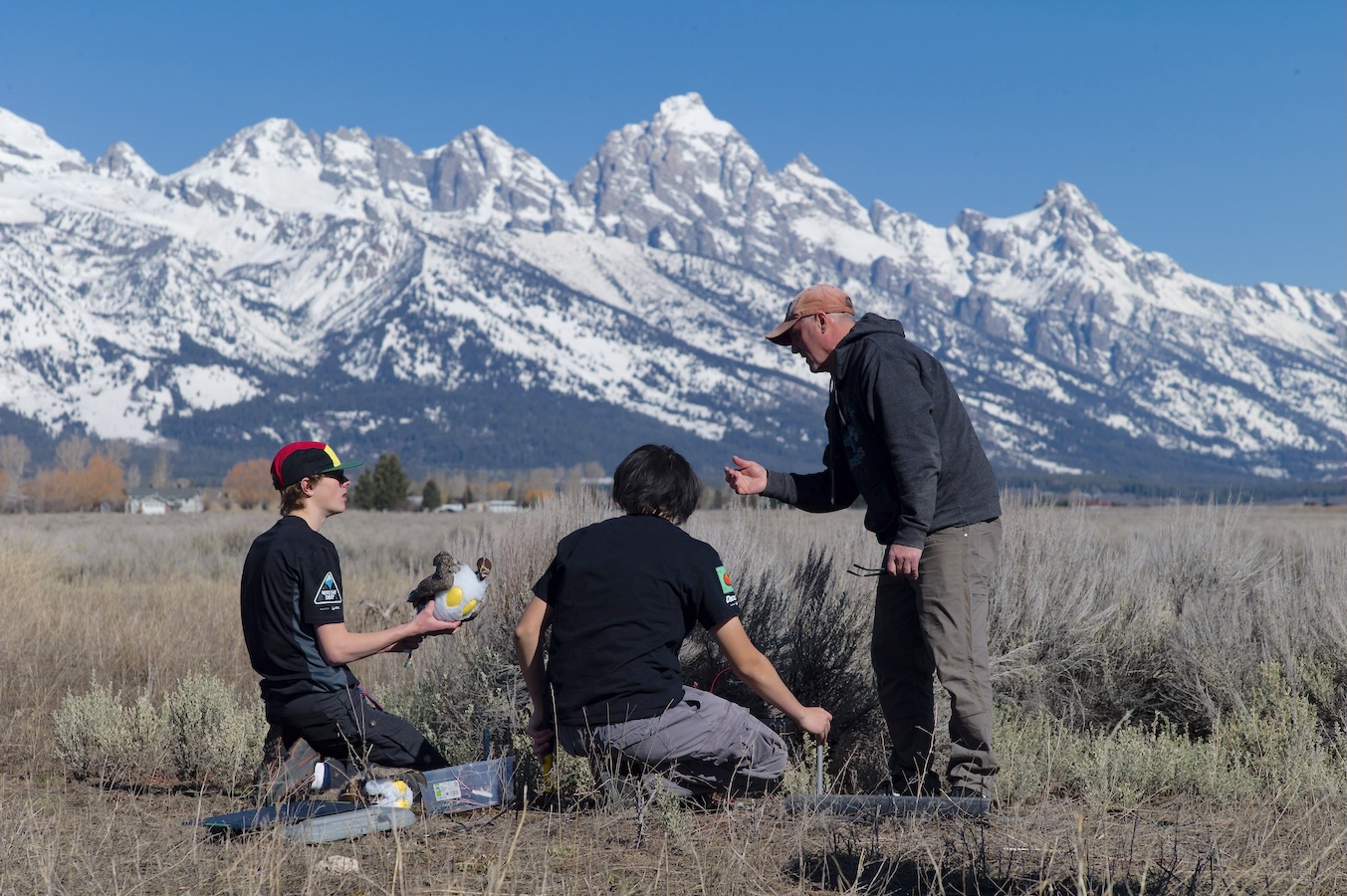
To reduce strikes and preserve the dwindling colony of greater sage grouse in the valley, a consortium of biologists, ecologists, students and others is trying to establish a new breeding ground south of the Jackson Hole Airport. To draw birds there, a team of high school students manufactured several alluring mechanical avian Chippendales and put them in the field last week.
Robo-grouse.
“It’s kind of a Frankenbird,” said Gary Duquette, former engineering teacher at the Jackson Hole High School, who now mentors robotics students through the nonprofit Wonder Institute. Powered by car batteries and programmed to gyrate to a sultry sage-grouse soundtrack, the robo-grouse “kind of do a turn, turn, turn, then do their wing, wing, wing,” Duquette said.
Turn, turn, turn
The hope is that the moving decoys and some additional static ones will encourage other grouse to congregate at a restored meadow about 3 miles south of the airport lek. “It’s a better alternative than the de-icing pads,” said Bryan Bedrosian, conservation director at the Teton Raptor Center and one of the involved biologists.
If young male grouse — typically on the fringes of the dating scene — find the faux lek, they could establish themselves as dominant breeders and the site as a bird-like pick-up bar.
“Everything gets turned on at five in the morning,” Bedrosian said of the mechanical menagerie. The robo-grouse turn, turn, turn and wing, wing, wing to their mating soundtrack until 9 a.m. A trail camera records the scene at five-minute intervals throughout weeks of potential breeding.
“I didn’t even know grouse were a thing,” said Connor McCarter, a sophomore who worked for a year and a half with Duquette’s team of 10 other students to make the robo-grouse. “I learned a lot about them.”
Working after school, the team stumbled at times. School projects are designed for students to succeed, Duquette said; “they don’t really get to experience real-world problems” where failures lurk.
“There was a bunch that went wrong,” McCarter said, “kind of frustrating.”
Spikes in the electric currents burned out servo motors as the season of sagebrush serenades loomed, Duquette said. “The kids had to learn the difference between voltage and amperage.”
“We kinda set a deadline,” McCarter said. To resolve the problem, the team wired a voltage converter in line with the Arduino controller and other elements on an electronic breadboard. “We pulled through and got it done in time,” he said.
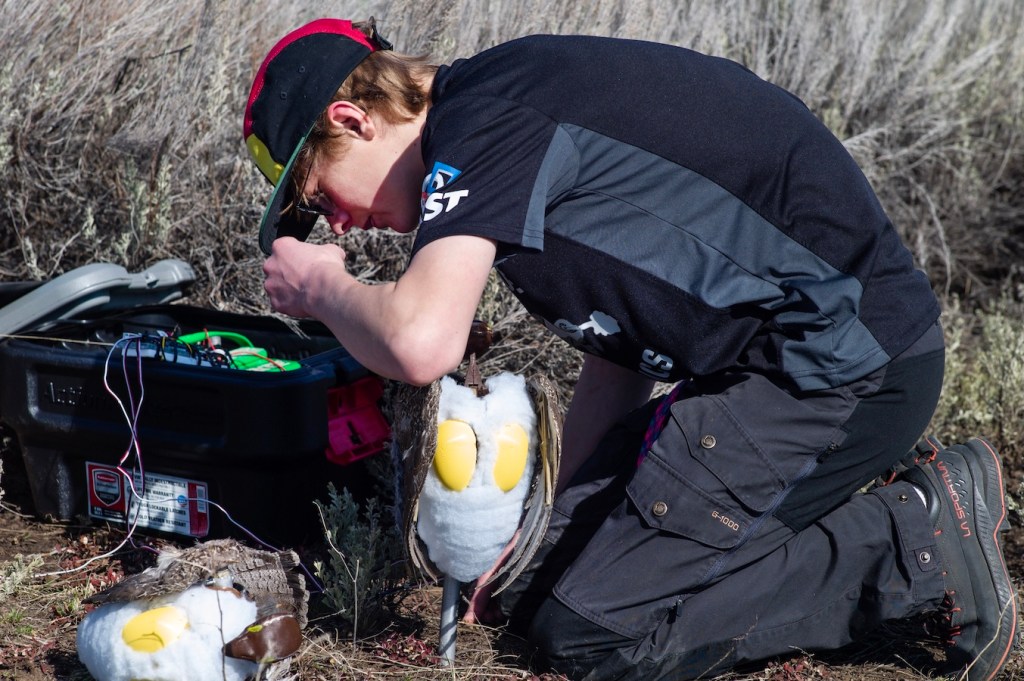
The team created shells — modeled on a taxidermist’s form — at a Riverton plastics lab to house the mechanics. A noggin fabricated by a 3D printer tops the robo-grouse. Wyoming Game and Fish staffers in Pinedale supplied grouse wings from hunter surveys, and body feathers came from fly-tying supplies at an angling store. Packaging foam from a Hello Fresh meal kit replicates white breast feathers, accented by yellow air sacs.
Deeply troubled
The effort drew considerable inspiration from a study south of Jackson Hole at the Jonah oil and gas field in Sublette County, where a pair of schoolgirls fabricated papier-mache grouse to lure strutting birds away from drilling sites. Papier-mache grouse couldn’t weather the elements and elk hooves in Jackson Hole, so the more durable robo species evolved.
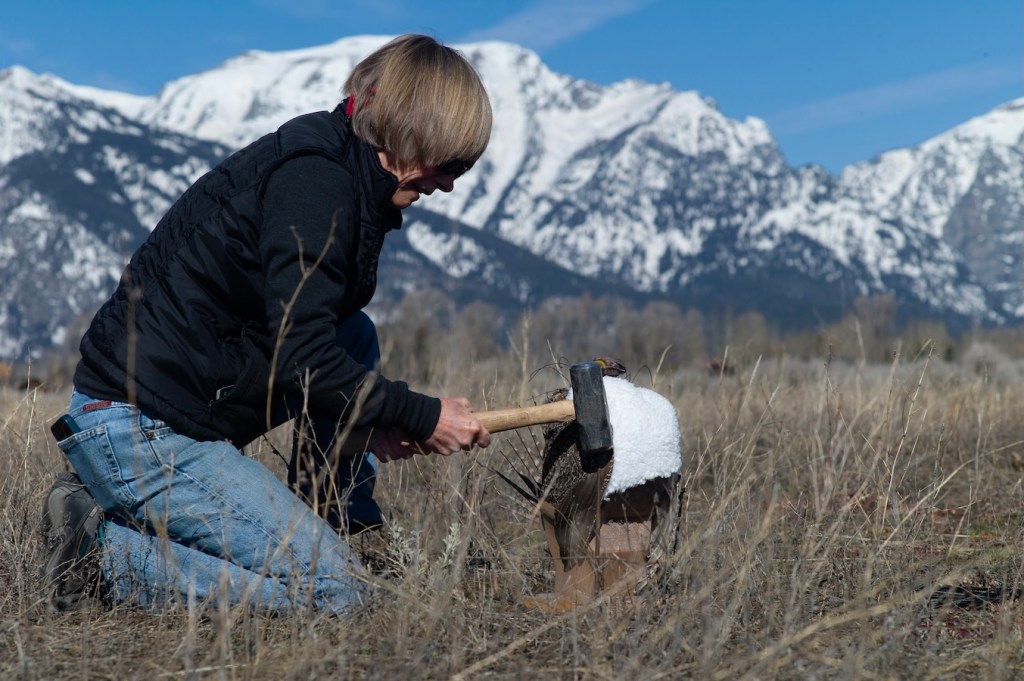
In Grand Teton National Park, biologists sited the robo-lek on an abandoned brome grass field once fed by an irrigation ditch, where pioneers tried to make a go of it decades ago. The Jackson Hole Airport, which has spent at least $680,000 in the last seven years through a wildlife mitigation program to improve grouse habitat in Grand Teton, aided the effort. Funds enabled spraying every blade of exotic grass for five years across an 80-acre pasture at the robo-lek, park officials said.
With another $150,000 budgeted for the next two years, the airport will help improve a total of two historic leks and a satellite one, all in concert with FAA regulations and coordinated with the National Park Service.
Jackson Hole sage grouse are deeply troubled. Wyoming’s Sage Grouse Implementation Team rejected a plan several years ago to transplant birds in the valley. The same state group also recently abruptly disbanded an array of local sage grouse working groups, including one in Jackson Hole, that collected and disseminated information, including annual lek counts.
“We know we have some of the lowest genetic diversity of any grouse population,” Bedrosian said.
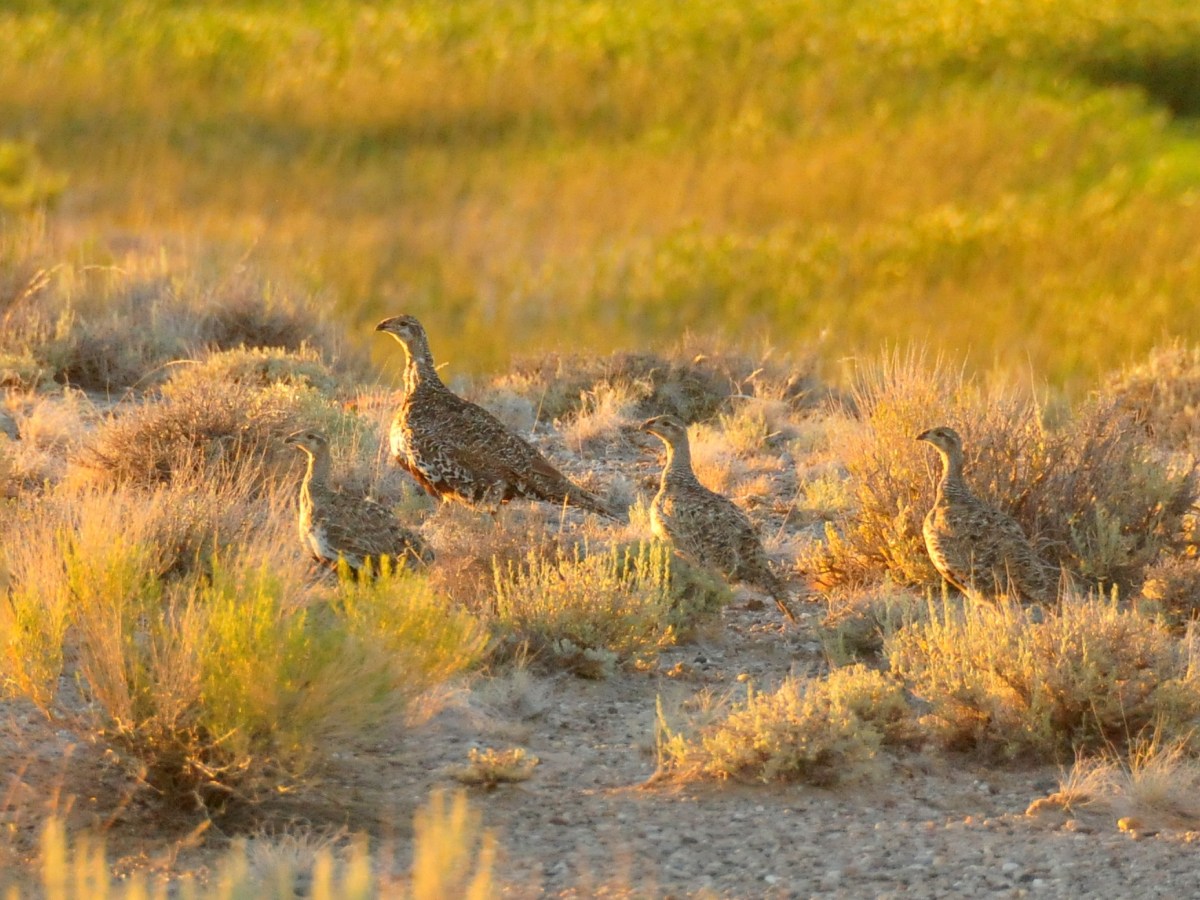

Jackson Hole grouse, on the other hand, could contribute significantly to the species’ survival. That they have persisted at the periphery of grouse habitat may indicate a trait that could contribute to survival in a changing climate.
“The genes in the sage grouse population in Jackson may be unique and hold a reservoir for the species in the changing environment we are in,” Bedrosian said. “We need to make sure we don’t lose the diversity of genetics of any grouse population.”
The robo-grouse may cost $150 in parts, Duquette said. But the experience the students get, “it’s priceless.”