

It’s time to take it out of the closet.
Actually, from behind my office door, our Wyoming art acquired almost three decades ago now seems eerily timely.
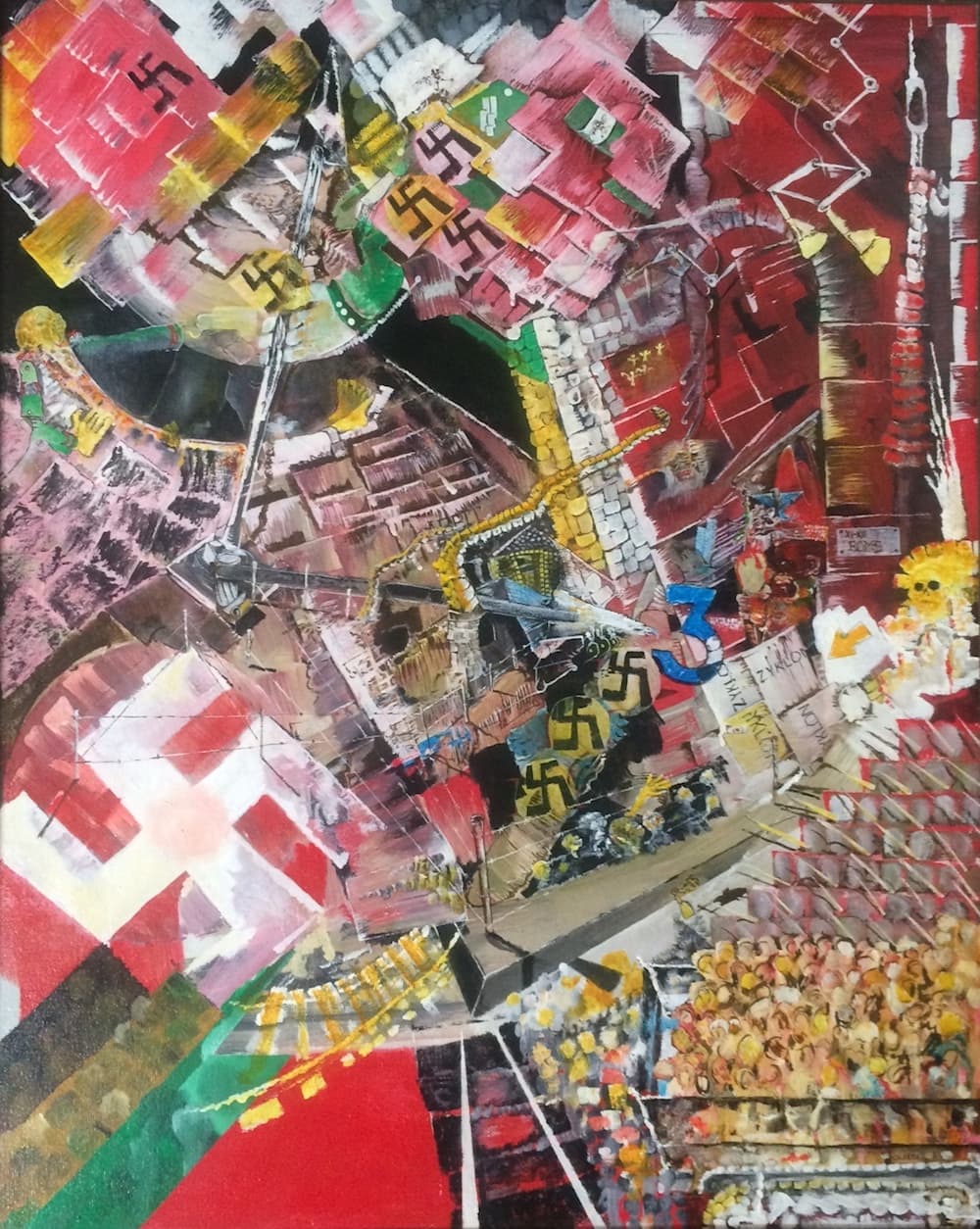
We’ve hauled it on multiple moves, the latest to Albuquerque, always wary of displaying it lest we inadvertently offend. Needless to say, a two-foot by three-foot, multi-colored oil painting splashed with unsettling images draws attention, sometimes of the wrong sort, so we’ve been careful sharing this powerful creation. And, yes, once we actually kept it in the closet.
No, not images of the Tetons or bucking broncs. Rather, a provocative, even shocking, political portrait, improbably painted by a Mexican-American living in the Bighorn Basin, coincidentally also home to a robust version of Wyoming’s trademark right-tilted politics. Even now: If Donald Trump carries only one state, it will be Wyoming, a Rock Springs friend told me on a recent visit.
You can see “Tar Baby,” title character of the artwork, tucked over at the far center right edge, a smallish, half-palm-sized yellow skull, eyeing a yellow arrow pointed ominously downward, almost obscured in a mass of symbols and smashing colors.
Though often understood as a racial slur, the meaning of “tar baby” in many cultures is a “sticky situation” that becomes worse, or, alternatively, how something awful starts innocuously, grows over time and soon overwhelms.
We bought Tar Baby from the artist, Fermin “Richard” Olveda, on a trip to Powell, where sugar beets are an economic mainstay. Mexicans, Mexican-Americans and Spanish-Americans came to pick the beets, most from south Texas and New Mexico, first relegated to a separate colony outside Powell and later subjected to routine discrimination. The Bighorn Basin is a prime Wyoming agricultural area, Riverton, just south of the basin, Worland in the middle and Cody and Powell to the north.
When Sen. Joe McCarthy spoke in October 1952 near Riverton, he called Democrats “commie-crats” and likened killing communists to killing skunks. The crowd of several thousand who turned out cheered. McCarthy also stopped for lunch in Cody, a short drive from Powell. In the late 1960s when I lived in Cody, local radio featured programs that echoed the extremist John Birch Society agenda, augmented with the station owner’s own right-tilted commentary.
From dreams to canvas
Olveda was more than happy to show us his huge selection of works, all, he said, inspired by a flood of dreams, so many he even painted over pieces. Another painting we selected was being used as a studio door because he had run out of space.
Tar Baby immediately caught our eye, a surreal splash of images, most prominent being large and small swastikas. It was about the rise of Hitler, Olveda said, pointing to the barrels marked “Zyklon,” the gas used to exterminate Jews in his concentration camps. The Catholic Church’s alleged complicity with the Nazis is noted in an inscription that an eye sees as either “Rome” or “Bomb.” Even though it’s an abstract, there’s no mistaking the overall visual horror: Truckloads of humans, barbed wire, an ominous ticking clock and dangling horse hooves.
When we returned to our then-home in Casper, the artwork presented a display dilemma. One neighbor who stopped by became visibly nervous, almost fleeing when she saw the swastikas, leaving us no time to explain that no, we aren’t Nazis, quite the opposite.
We later saw Olveda’s name in his frequent letters to the Casper Star-Tribune where he periodically assailed Wyoming Republican Sen. Alan Simpson, his Cody neighbor. In the 1990s, he put domestic violence on display in an exhibit at the Nicolaysen Museum in Casper. At his request, we also photographed Tar Baby and sent prints for a political art anthology. Olveda served a stint on the Wyoming Arts Council, and later moved to Glenrock, where he died in 2013.
We didn’t ask Olveda what might have motivated his Tar Baby dream. Perhaps he was channeling the ghost of another abstract artist, Jackson Pollack, who was born in Cody. But it’s likely his outsider status and the pervading politics of the Basin influenced in his prolific, intense and edgy art.
The last time I went public with Tar Baby was June 1995 in a column about ethnic killing in Bosnia, the outgrowth of the rise of Serbian political opportunist Slobodan Milosevic, who demonized Slavic Muslims and promised followers he would restore “Greater Serbia.” A friend in Slovenia called Milosevic’s politics “a most unfortunate blending of communism and nationalism into some weird Balkan brand of Nazism.”
Don’t miss a WyoFile story — sign up for our free weekly newsletter
Now two decades later, Tar Baby is suddenly, and sadly, relevant again. Trump employs similar strategies, bashing Mexicans and Muslims, demeaning opponents and promising to “make America great again.” Prominent folks express alarm, and he’s been branded a fascist.
Recall this started small last fall, when opponents laughed off Trump, dismissing him as a big-mouthed, reality-show star. Nobody gave him much of a chance, and most predicted he would crash and burn. Now, he’s the tar-baby nominee, stirring turmoil as the campaign unfolds, even mainstream Republicans “sticking” with him.
I worry another sad chapter looms, Olveda’s tar-baby dreams again becoming reality, venom and excess soon to haunt our world. I hope I’m wrong. But Hitler was elected to office, and Milosevic likewise enjoyed popular support.
See you at the ballot box.
Paul Krza is a former longtime reporter, editor and columnist with the Casper Star-Tribune who subsequently wrote and edited at several New Mexico publications. His travel interests and writing also prompted him to recently apply for and be granted citizenship in Slovenia, the home of his grandparents. He now resides in Albuquerque with spouse and travel companion Kate Padilla and does occasional freelance writing — Ed.

Richard Olveda, my father, actually passed away on July 11, 2011 in Denver, CO. He was living in Lusk, Wyoming at the time of his passing and never lived in Glenrock. Just wanted to clarify.
Thank you for the great article. Trump doesn’t need to build a big wall, he needs to build a big boat so him and the rest of illegal immigrants go back to Europe.
Great story, Paul–you described the Big Horn Basin perfectly!
What utter nonsense…Trump bashing Mexicans and Muslims. His views on danger presented by illegal immigration and immigration of person who cannot be vetted is not racist or any other phobia. I guess you count people like me in the basket of “Deplorables”. Shows your true nature.
Paul,
Great article!
Sweetwater County used to be a Democratic stronghold when we were kids.
From an original Mass. St. gang to your Penn. St. gang, I bid you well.
Why oh why , did we ever leave Wyoming?
Paul Kis
Thank you for this wonderful article.