


As a newcomer to Wyoming in the 1980s, I earned my living — if you can call how little I earned a living — as a freelance writer and teacher. One of the most satisfying jobs I held was as a book discussion moderator for the Wyoming Humanities Council.
Opinion
Each year, council staff designed thematic reading lists — sports, mysteries, western American literature, science fiction, history, biographies. Any not-for-profit group could go through the nearly 40 different book lists to find one it wanted to use. The Humanities Council mailed out the books as loans to be returned when the series ended, so they could be read by another group. There were six books in a series. We read and discussed one book per month. There was no charge to the local group and if there was no series that appealed to a group, people could design their own list and request funding for it.
The honorarium, travel expenses and lodging for the book discussion leader were also paid for by the council. It wasn’t a lot, but it helped me to both pay the bills and get to know my new home. I met groups in Buffalo, Newcastle, Sundance, Casper, Cheyenne and Jackson. All the driving gave me a physical sense of Wyoming, along with the time to think about why and how books help us make sense of our lives, how they help us to understand each other and our history.
Back then — the 1980s and 90s — the Humanities Council received no funding from the state. Rather, the budget came almost entirely from the National Endowment for the Humanities. With NEH support, we were given the opportunity to know ourselves and others more deeply, and to examine our society in ways that were both serious and pleasurable while building communities of mutual respect.
I worked with a group in Newcastle for five years running. At our first meeting, there were 25 participants, all women. “Where are the men?” I asked.
“Are you kidding?” one woman said, “Our husbands? Read books?”
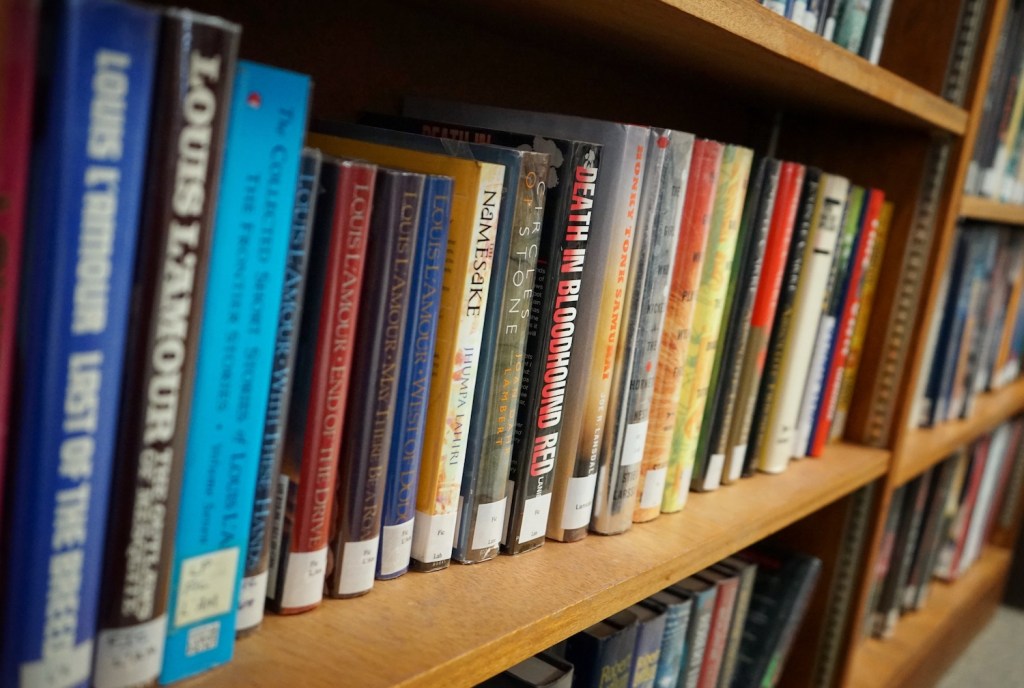
This was pretty ironic as I was a reader, a man, and the only person in the room being paid to be there.
That first Newcastle series focused on women’s autobiographies — another irony. One of the books told the story of a woman who disguised herself as a man in order to travel throughout Iran after the 1979 fundamentalist revolution that led to severe restrictions on the rights and activities of women. Many of the Newcastle women spoke of their own experience of disguise — pretending to be someone you’re not in order to get by in society. The woman in disguise story resonated powerfully with the women in our group.
In Jackson, we read books on water and land use issues in the West, including Marc Reisner’s Cadillac Desert, which briefly mentions James Watt, who served from 1981-83 in the Reagan administration as the Secretary of the Interior. Reisner described Watt as “the environmentalists’ anti-Christ,” and as, at age 30, “a fire-breathing evangelical Christian from Wyoming.” While Watt was said to be a central figure in conservationists’ “annals of villainy,” he was also dismissed as having “hopped around so much with his foot in his mouth that he didn’t really have a chance to do much that the environmental movement regarded as awful.”
At the time of the book discussion series, Watt lived in Jackson and, wanting to defend himself, signed up to participate. I was surprised that he would feel a need to do this and at first thought it self-centered and small. But as he talked in the group, it hit me that he felt vulnerable, that he’d been hurt by Reisner’s book. I’ve felt that way, too, and saw that prior to our discussion, Watt had been for me only a distant — not quite real — figure, I believed had done a disservice to the country through policies and actions that endangered our land, air and water. As a result of the book discussion, Watt was transformed into a person for me. I felt a little ashamed at how I had dismissed him from afar.
The Newcastle and Jackson book discussion series, indeed all of the Wyoming Humanities Council book discussion series, were eye-opening experiences for me and, as far as I could tell, for nearly everyone who took part in them. I’m grateful that public officials supported this use of public funds. It helped us to know one another more fully so that even when we disagreed, we were able to feel kindly toward each other, almost as if we were friends.

Thank you David. I really enjoyed reading this.
This is a great opinion piece and refreshing after all the political nonsense. A lot of men read, but we typically don’t wander far from our favorite topics. I prefer history and literature about my craft. I would have read the biographies because of their historical nature. but I am picky, if by the end of the first chapter it hasn’t tickled my mind, I put it down. The other thing that is true for me is that I don’t have a set reading schedule. I may read several books one year and none the next.
Would Cadillac Desert make it past the screeners these days?
Thanks for the comments, David. We in Big Horn County where the Commissioners often low-ball their support for Libraries, really appreciated and enjoyed the book discussion set up, with the teacher, and accompanying the book-packet, and the topics. Sometimes the series was something we would Never have read on our own. We have really missed this outreach and support to rural areas.
Not only did the Humanities Council sponsor book discussions ,it sponsored lectures in various venues all over Wyoming.As a writing professor at the U, fresh out of NYC,I was engaged to do a presentation with slides, based on a book I was writing, titled,”What’s Happening in Western Ghost Towns.” I did more than thirty lectures” which meant traveling to towns all over the state, which I got to visit because of this gig. I met many interesting people I wouldn’t have otherwise gotten to know in the process.Later after Matthew Shepherd was murdered I organized gay literature discussions in several libraries. Before the wide use of the Internet these cultural events , like those David mentions, were terrific both for me and the small town audience and well attended .
I’ve led similar book discussion groups for the Teton County Library and I, too, found them revelatory about people in my community and myself. It’s too bad we can’t meet all the time in such settings, reading books we might not have and talking about that. In my experience women get involved in these discussions way more than men. Why is this, I wonder.