


Despite Wyoming’s crude oil production, a handful of refineries and its local taxing authority, there’s little that state officials can do to influence prices at the pump.
After two public meetings this month, members of Gov. Mark Gordon’s Gas and Diesel Price Working Group concluded that Wyoming consumers are largely at the mercy of global oil and national fuel markets — at least for the near term. However, avoiding fuel price spikes that hit all individuals and sectors of the state’s economy is an energy security issue worth pursuing, group members said.
The group held its second and final public meeting July 22. Specific recommendations are forthcoming and may include a “flexible” gasoline tax mechanism and policies to boost the “supply side” of the equation, such as streamlining policies to encourage more oil production and refining.
“It’s a tough situation just given the fact that prices are really set globally,” Petroleum Association of Wyoming Director of Communications Ryan McConnaughey said.
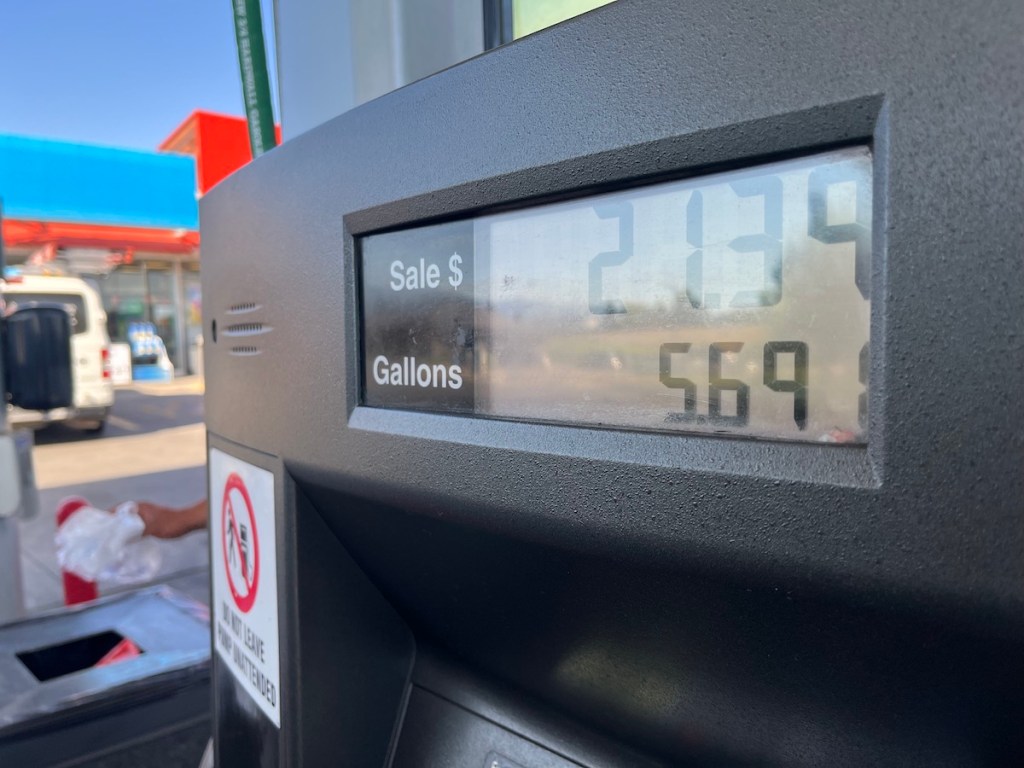
Enabling more oil production and refining capacity in Wyoming and throughout the country is only part of a potential solution, but could be critical, he added. “It’s going to be tough until we see a shift on the supply side in drilling, production and refining, and allow companies the flexibility to invest capital with assurances that it’s not going to be done in vain.”
Foregoing all or a portion of the state’s gasoline tax of 24 cents per gallon during price spikes may also be a tough sell given uncertainties around the state’s budget, according to group members.
Providing some sort of tax relief might not add up to much for individual consumers, and it would likely result in the loss of millions of dollars that go to fixing and maintaining Wyoming highways — funds that are necessary to gain federal matching dollars, according to the Wyoming Department of Transportation.
Regional market realities
The average price for unleaded gasoline at the pump in Wyoming on Tuesday was about $4.55 per gallon, higher than the national average of $4.33 per gallon, according to the American Automobile Association. Regular grade unleaded gasoline in Wyoming peaked at $4.90 per gallon on July 1 while diesel peaked at $5.71 June 29.

Wyoming has typically enjoyed among the lowest gasoline prices in the nation. The recent higher-than-the-national-average fuel price is partly a function of stagnant refining capacity combined with increasing demand within the Rocky Mountain region — particularly with population growth in Colorado, Montana and Idaho, according to Colorado-Wyoming Petroleum Marketers Association Executive Director Grier Bailey.
“That logistical [refining] capacity has been under strain for several years now as we’re trying to service the growing amount of people with exactly the same distribution capacity that we had six or seven years ago,” Bailey said, adding that the scenario makes the region especially prone to volatile world oil and national fuel market disruptions.
Refiners across the nation responded to the COVID-19 pandemic economic slowdown by temporarily curtailing production. Although production has mostly recovered, some refiners — particularly small ones in rural areas — are slow to make capital investments as they gauge new economic realities and policies regarding climate change, according to industry officials.
Wyo oil refining in decline
The state has no authority to compel companies that refine oil and other commodities into fuel products to favor Wyoming consumers. But having more regional and in-state refining capacity would likely help buffer petrol price spikes in Wyoming, Bailey said. Wyoming’s capacity to refine oil into fuels, however, has slipped in recent years and isn’t likely to rebound anytime soon.
Despite an uptick in regional demand, the outlook for fuel demand nationwide isn’t likely to inspire major new refining investments. “Demand nationwide has generally decreased as cars get more efficient,” Grier said, adding that the trend is likely to gain momentum.

On the supply side, Wyoming produces much more oil than it has capacity to refine. The state produced an average 244,000 barrels of oil per day in April — the most recent month of complete data available — ranking seventh in the nation, according to the U.S. Energy Information Administration. Yet the state’s overall oil refining capacity shrunk by 27% from 177,500 barrels per day in 2017 to 125,850 in 2022, according to the EIA.
Wyoming went from five oil refineries to four in 2021 when HollyFrontier Sinclair took its Cheyenne oil refinery offline to retrofit the facility to produce “renewable diesel,” which uses agricultural products — not oil — to produce the fuel. Renewable diesel is mostly marketed to states other than Wyoming that are ratcheting up vehicle emissions standards.
HollyFrontier Sinclair completed the makeover of its Cheyenne refinery in December 2021 and began selling its new renewable diesel product in January, according to the Dallas, Texas-based corporation.

Thank you for giving some insight on the oil and fuel industry.All I’ve ever herd is that it’s Biden’s fault.