
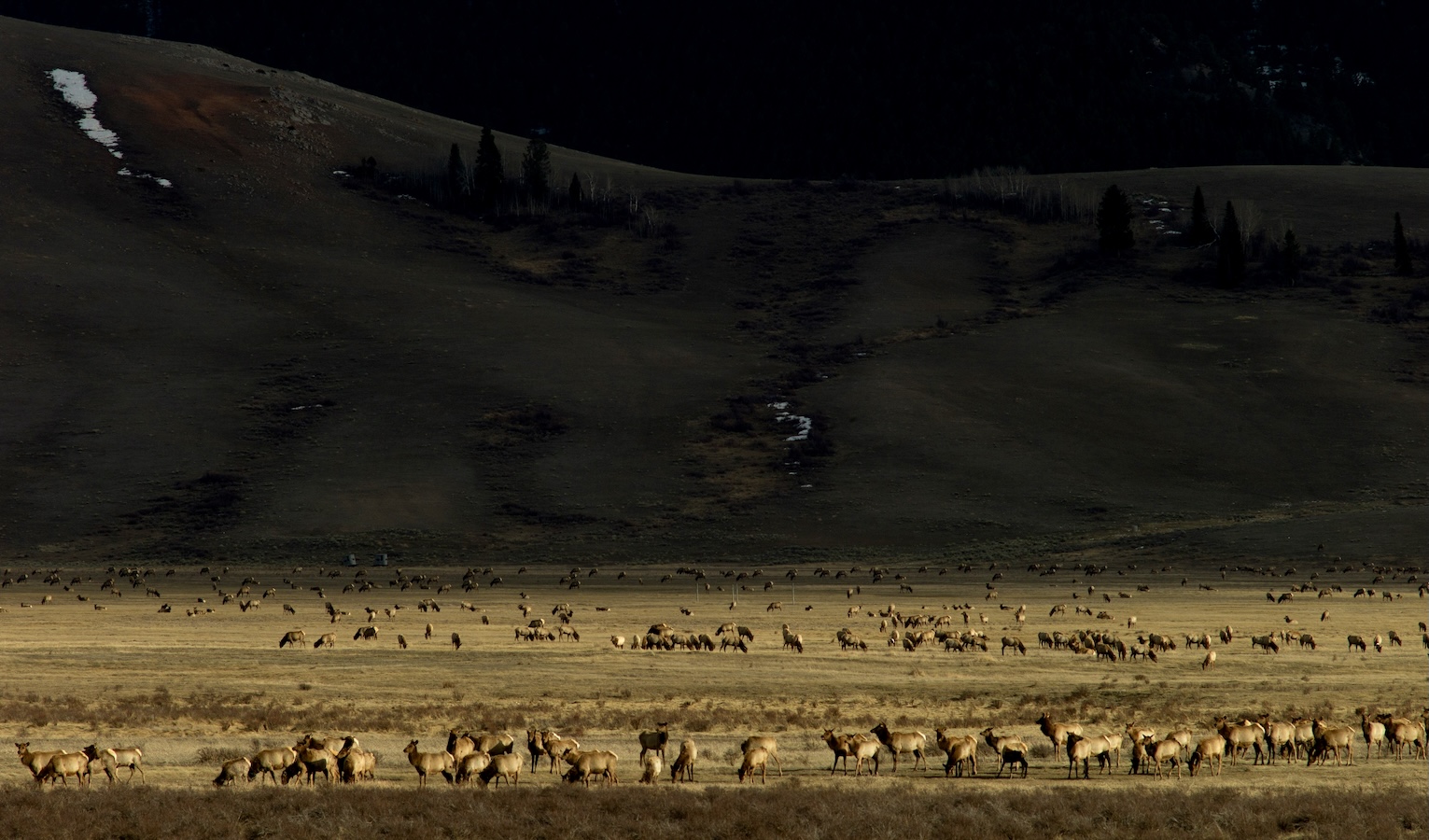

Thousands of wapiti on the National Elk Refuge near Jackson are ready to leave the reserve for their summer ranges.
Following a winter with meager snowpack on the Jackson Hole lowlands, the lanes are open for an early exit. Elk will disperse north into Grand Teton National Park and some farther afield from there.
Biologists will be tracking their various courses using GPS collars fitted on more than 100 female elk. The work aims to refine wildlife managers’ understanding of which elk go where as they split into four principal groups that migrate to Grand Teton, Yellowstone, the Gros Ventre and private land on the valley floor.
The information will be used to determine how hunting seasons can help better manage the refuge’s winter population, which is increasingly made up of elk that summer on private property where they are largely protected from hunting and predators.
As usual, many elk fans debate what’s proper and improper with supplemental winter feeding, hunting seasons based on GPS data, the effect of wolves on elk reproductive success, disease and so on.
The debate recalls a story about a newly appointed National Elk Refuge manager who called the person he was replacing — this was some decades ago — to get a sense of his new challenge. The retiring director summed up the town of Jackson as a friendly hamlet of 2,000 residents, 1,999 of whom were elk biologists.
Science, hunting, wolves and disease don’t have to be forefront this spring when observing thousands of elk lining up to make their short and long journeys. Largely sedentary during the day, the elk rise in the evening to browse, stretch their legs and amble north.
Wildlife watchers can see them — mostly in the morning — when they cross the Gros Ventre River and strike out for lands beyond.
How does an elk on private land prevent predators?
And who pays the all knowing biolegest pay. Those elk hunters
“The migration to summer ranges is a peaceful one during which elk lollygag along, unmolested by hunters.”
This statement, like the rest of the article seems to be a fictitious fairytale.
Every year elk are migrating less and less due to wolves. The elk NEVER stopped migrating before the invasive canis lupus occidentalis was transplanted into the GYE.
The elk will endure “molestation” on a daily basis.
Cow elk in the coming months will have unborn calves torn out of them by packs of wolves or devoured by grizzlies shortly after birth at their annual calving grounds.
Calf survival rates will continue to be at rates so low that rare elk sightings will only be on private lands that will essentially be wolf free zoos.
So you would prefer we just give up on the natural world with predators that evolved with elk and have the equivalent of an elk ranch where we raise elk for human consumption? Sounds boring, no wonder most people don’t agree with you.
Mark, Canis Lupus Occidentalis did not evolve with the elk of the GYE and Rocky Mtn West.
They were transplanted from the northern reaches of Alberta and BC. They evolved to have an unnatural advantage over ungulates that the NATIVE Canis Lupus Nubilus didnt have in size and physiology.
No one seems to realize or care what the transplanted sub species has done to calf survival rates and overall elk herd health.
Elk calf survival rate “in the teens” (10-19%) is generally considered very poor and unsustainable for maintaining stable herd numbers, especially when compared to typical benchmarks.
Moose suffer worse, I challenge anyone to find and photograph a moose in YNP. The moose in GTNP (Kelly, Mormon Row, Teton Science School, Airport) have the benefit of proximity to human activity which the wolves so far have steered clear of. Once the elk have been reduced to a fraction of their number a dozen or more years ago in the Gros Ventre, the wolves will probably start being an issue closer and closer to Jackson.
How will they be wolf free zones? If an elk can get there, so can a wolf or a bear.
Proximity to humans.
Elk gravitate towards human inhabited areas when wolf/predator pressure is high.
Banff and Canmore Alberta are perfect examples where elk are essentially only seen in town and nowhere in the backcountry of Banff National park.
This sounds just like an Elk hunter.
Elk have natural predators, such as wolves and Grizzly, but hunters do not want to share with the natural order. The greedy sports of hunting and fishing now drive governmental
Programs in support of their interests, not necessarily intended to benefit the ecosphere.
Not true at all, Wolf molestation is nothing new. If not wolves, lions, Bears, even Coyotes or the push of the hurd naturally moving on. Except Moose all of the Deer Family are Migratory. Evident by the movement of Bull Elk to High Country, only coming down to lowland pastures during the Rut. We followed this for years, even decades in Rocky Mountain National Park. From May to November, the High Tundra were filled with Bull Elk, 3 by 3 to 7 by 7, Monarch, Grand and Royal sized Bulls. Following the same migratory trails over and over again.