

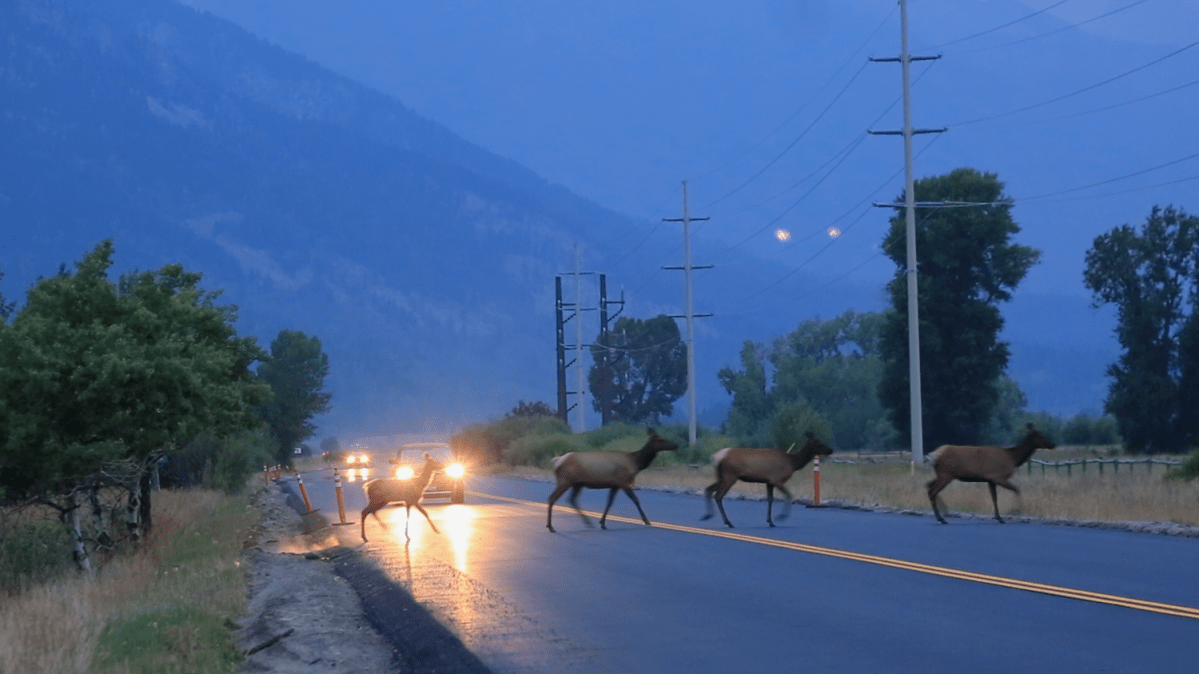
In the coming months, thousands of elk will migrate onto the National Elk Refuge, just outside the town of Jackson, where the Jackson Elk Herd winters.
Historically, they’ve traveled long distances from summer range in places like southern Yellowstone National Park, but so-called “suburban elk” that stick nearer to Jackson to feed off hayfields and in residential subdivisions are increasing. It’s a headache for ranchers and wildlife managers that also reduces hunting opportunities and threatens the herd’s natural biodiversity. To best conserve long-range migration, wildlife managers would ideally concentrate hunting pressure on the refuge on the “suburban elk” — a task that has been nearly impossible until now.
“When they’re on the refuge and there’s thousands of elk milling around, you can’t tell just by looking at them whether they migrated eight kilometers or 80 kilometers,” said Gavin Cotterill, a quantitative disease ecologist with the U.S. Geological Survey.
New research Cotterill headed changes the equation.
“Based on this work,” he said, “we can predict where conflict-prone suburban elk [that get into livestock feed] are going to be.”
Cotterill’s study, “Elk personality and anthropogenic food subsidy: Managing conflict and migration loss,” assists wildlife managers with tools to decipher which of the 10,000 elk in the herd are migrating from where. Specifically, the research could help concentrate hunting pressure on the lowland elk that summer on ranchland and amid the trophy homes of the wealthiest Americans once they reach the National Elk Refuge. Doing so could help efforts to preserve struggling migratory elk that now take the brunt of the gunfire.

How does it work? With location data from 101 GPS-collared female elk, Cotterill used modeling to discover that the conflict-prone elk that generally live south of Grand Teton National Park were four times more likely to use the southernmost feeding areas on the refuge nearer to the town of Jackson.
“The single strongest predictor of which feeding area they’re going to use was whether they ate livestock feed in suburban areas,” Cotterill said.
That’s a finding the Wyoming Game and Fish Department has a keen interest in, and it has potential to help reverse an undesirable trend that’s long been afoot in the Jackson Elk Herd. Historically, virtually all animals that winter on the National Elk Refuge were considered “long-distance migrants” that spent summer in places like Yellowstone National Park, the Teton Wilderness, the Gros Ventre drainage and northern Grand Teton National Park. By 2012, however, the proportion was less than 60% — and the suburban elk are potentially still in the process of taking over.
“We may actually be seeing a slight increase in those short-distance migrants,” Game and Fish Disease Biologist Ben Wise said.
The growing imbalance, he said, is related to big differences in reproductive success and calf survival. Lowland elk that live in housing subdivisions and on ranches are adding 40 or 50 calves to their ranks for every 100 cows, but the calf ratio is only about 20 per 100 for migrating elk.
Wise, who’s a co-author of the study, explained that come fall of 2026, the bolder elk that dwell in the refuge’s southernmost feeding areas will have more of a target on their back. And it’ll be because of their own kind. He’s using the term “Judas elk” to describe GPS-collared animals that will assist Game and Fish in pointing hunters toward the problematic suburban elk. The tracked animals, in essence, will be attracting a source of danger — human hunters — to their herdmates.
“It’s something that’s really kind of novel for this area,” Wise said. “We have so many different elk coming from so many different summer ranges into this winter range [on the refuge]. And we’re definitely trying to manage for certain segments and bolster those populations where we can, while still getting harvest on the segments that we don’t have a lot of access to anywhere else.”
Easing hunting pressure on the long-distance migratory elk has historically proven a great challenge because the herds cut through other late-season hunt areas, like Grand Teton National Park. Then they’re the first to arrive at the federal wildlife refuge, where hunters are waiting for them.
Jackson Hole’s pesky suburban elk, meanwhile, spend most of the fall in a much trickier landscape where they’re hard to hunt. Then they’re typically the last cohort to show up on the refuge.
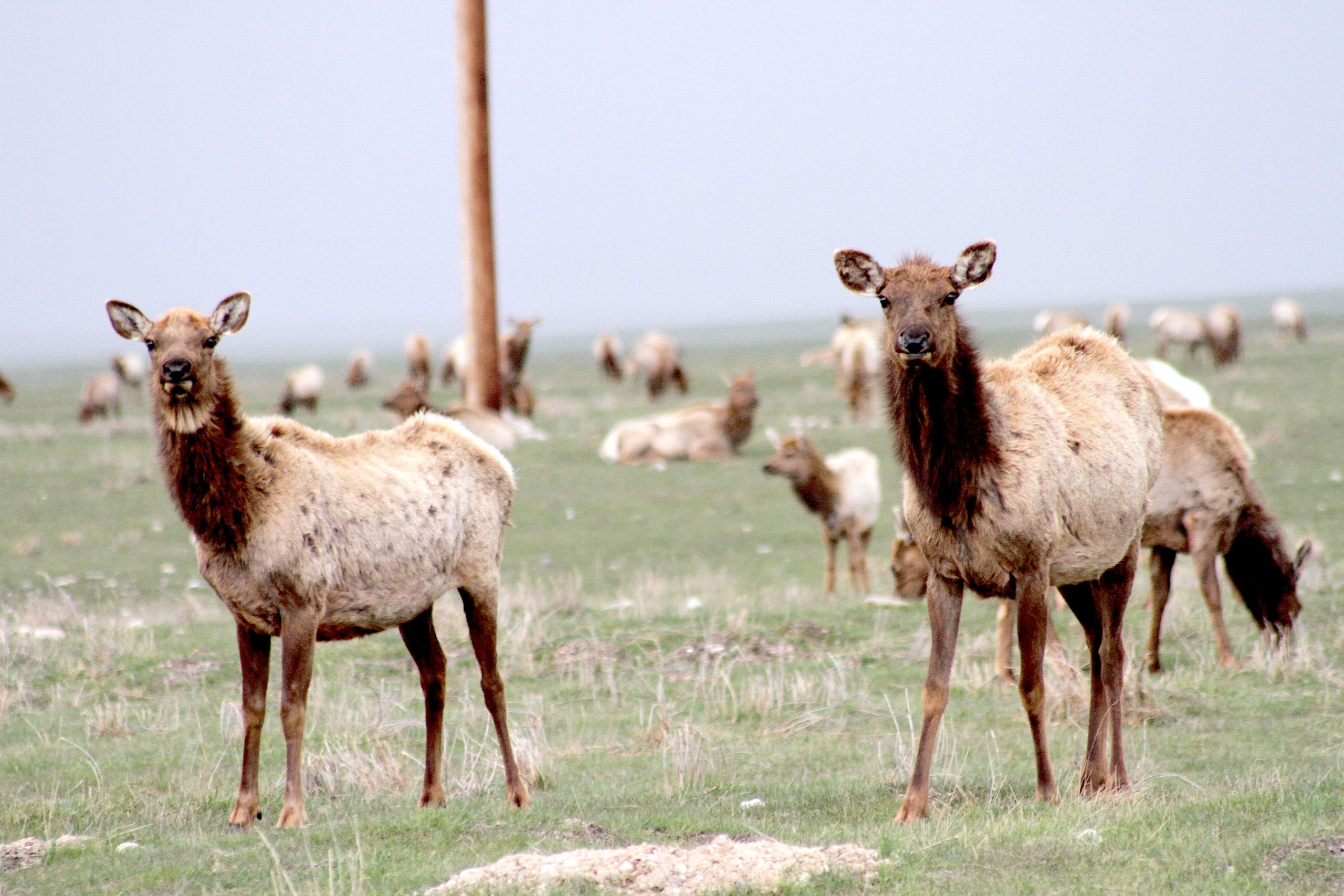
The “Judas elk” will help wildlife managers point hunters toward the so-called suburban elk when they do arrive.
“When they cross the line, how do we get hunters to go out there?” Wise said.
The elk will be tracked this winter as part of a broader effort to equip 150 members of the Jackson Elk Herd with GPS collars. They’ll be programmed to transmit “finite, fine-scale information” about their location several times a day from November through early January, Wise said.
In wildlife management, the concept of a “Judas” animal — a nod to the Christian Bible’s apostle who betrayed Jesus— is well established. “Judas wolves” were used during the mid-1990s to capture packmates of Canadian wolves reintroduced into the Northern Rockies, and “Judas lake trout” have also been used to map out the nonnative species’ spawning beds in Yellowstone Lake with the intent of choking out the next generation before it begins.
Using “Judas elk” to help hunters go after Jackson Hole’s conflict-prone suburban elk comes after years of effort to rebalance the herd by conserving the long-distance migrants.
“Elk are pretty, pretty savvy to anything that we’ve done,” Wise said. “How do we outsmart this herd of elk for more than just one year?”
Cotterill’s study also reflected on the complex task of conserving the Jackson Elk Herd’s migrations. Movement corridors in Jackson Hole cut through protected landscapes like the Bridger-Teton National Forest and are “pretty well preserved” as open spaces, he said.
“What we’re saying is that might not be enough,” Cotterill said.

Adaptable species like elk readily capitalize on human-related food sources, like hay meant for cattle. They also take “anthropogenic refuge” from predation, and have less risk of being eaten by grizzly bears or wolves in the suburbs than they do in wilder places.
“That’s working against long-distance migration,” Cotterill said, “in the favor of these short-distance migrants.”
Cotterill’s study was supported by the USGS’ Ecosystems Mission Area. It’s a division of the federal agency that the Trump administration is seeking to almost completely eliminate.

Follow up on this story.
I spoke to Colten Galambas with WY Game and Fish. There is currently ZERO private land access for the 84/85-7 tags. And he doesnt foresee much opening up either.
A private land owner with over 800 acres south of Jackson along the Snake 20 years ago, didnt let hunters access his land and was touted as a conservationist. That land is now divided into dozens of pieces, years later. But Harrison Ford still has a small piece of what he used to claim to “conserve”.
This article talking about “hunting opportunities” missed the mark.
Nice stab with that last sentence. You did a great job on a great story but just couldn’t hold your tongue.
Sensitive to truth?
Good morning, to some Americans, the “wild” outdoors is called “outdoor shopping” and the “shelves” are managed by American “folks” we trust with watching over the stocking of the “shelves” and “close by”.
So neighbors why don’t our trusted managers stock “other” shelves across our store fronts with the appropriate “elk/animal(s)? PLEASE begin with Southern Wyoming and if I can be so bold “CARBON COUNTY”.
I’M pretty confident those “hunters/shoppers” of Carbon County will be overjoyed and be there for the culling. Of course the funds are available to stock the shelves with some adjusted logistics because I’m pretty confident that these funds aka monies are not appropriated and can be adjusted for logistical reasons and ESPECIALLY if the impact is affecting the ROI because that’s the goal of great management!
Because it’s obvious through the research that this particular “animal” will adjust to its surroundings and environment in our great state of Wyoming and in particular CARBON COUNTY…
BECAUSE we as the American frontier folks would be terribly upset to just have such a beautiful natural nature animal be conditioned, trained for visitation and scheduled culling to any high/highest bidder aka “licensed hunter” of convenience and of course we are not seeing this type of logistics, conditioning and training because of SECOND AMENDMENT feelings/action(s)/activity(ies)/issues unrelated to our “American hunting” tradition?
With true wildlife still in the “wild” the bait animals if were to unfortunately be subjected to some foreign health condition(s) the shopping will be strictly available if there were an unexpected hazard to befall this Republic in the near or far future.
Excellent article and exercise of the FIRST AMENDMENT about the condition(s)of America’s outdoor shopping center aka “wildlife” and the management skills being performed and utilized to focus on these non-domesticated animals BUT seriously with the “price” of beef/raw meat/protein I am pretty confident that planning on domestication of this/these animals is in progress and who will be the shopper for this would more than likely be in a certain percentage of our American society as a whole, hmmmmmmm would their be a consideration for the “flatulence tax” as an issue or sanitization? SEMPER FI!
There are virtually no more Yellowstone migrants, the graph on the 8 year old JHNG article showed the descent. Continue that red trend line to the current near zero level.
The wolves have essentially removed Yellowstone migratory elk from the equation. The local “suburban” elk like the safety that comes from living near humans vs. wolves and ranchers haystacks have ZERO to do with it.
The hay stacks and ranchers pastures have been there the whole time, they aren’t the factor in elk choosing not to run a gauntlet of unchecked wolf packs in all directions of the GYE.
Would love to see a story documenting the loss of hunter opportunities in areas 79 and 75 where 1500+ tags were once allocated now a grand total of 20 are now handed out.
This is a fascinating development for elk management and hunting and I look forward to the ongoing studies. However, I would drop the term “Judas elk” because of its unsavory associations, such as using “Judas” wolves to help target and destroy entire wolf packs.
We also need to recognize that this can only be one tool for conserving migratory elk and wildlife migrations overall in the Yellowstone Country. Of course, the main obstacle to conserving migrations is economic development of land, particularly the suburban areas that support unwanted “suburban elk.”
Framing elk as “suburban” versus “migratory” misses the point: elk adapt to the landscapes people create. Punishing them with “Judas collars” so hunters can target them isn’t fair chase and won’t fix the real problem.
Migration loss is driven by habitat fragmentation, subdivisions, and artificial feeding on the Refuge—not by elk choosing hayfields. A better solution is protecting corridors through easements, phasing down artificial feeding, and supporting wildlife-friendly ranching.
Conservation should mean stewardship and coexistence, not scapegoating elk for adapting to human-altered land.