


A multistate power outage Thursday left as many as 95,000 customers in Wyoming without electricity, according to some reports, and may have caused a fire at the Dave Johnston coal-fired power plant near Glenrock.
The outages affected more than 10% of Wyoming customers and extended into portions of western South Dakota, according to reports.
“We believe the outage, which began around 12:45 p.m., was triggered by two tripped 500-kilovolt lines near Medicine Bow, Wyoming,” Western Area Power Administration Public Affairs Specialist Stephen J. Collier said in a statement. “This incident resulted in an abnormal voltage event that subsequently tripped a number of surrounding lines, including WAPA transmission, resulting in further power outages to communities across the area.”
By 4:30 p.m., electricity was restored to about half of the affected customers, according to PowerOutage.us. But officials warned that power delivery could remain unstable.
Authorities were searching for correlations between the events, according to Wyoming Department of Homeland Security Director Lynn Budd, while utility workers were gradually restoring power to impacted communities around the state.
The widespread outage was highly unusual, because it affected several different electrical utility providers, including Rocky Mountain Power, Black Hills Energy and Montana-Dakota Utilities customers. The affected utilities share an interconnected grid.
The fire at Dave Johnston started after the power outage, Budd said. The agency reiterated that because the Dave Johnston power plant fire happened after the power outage, the fire was a “possible consequence of the power outage, not the cause.”
WyoFile was waiting on more information from the Converse County Emergency Management office — though an official in that office reached at 3:30 p.m. said the fire had been put out. There were no emergency vehicles visible just outside the entry gate to the Dave Johnston coal-fired power plant shortly after 2 p.m.

Outages were reported in Gillette, Casper, Douglas, Newcastle and Sheridan, among other communities in Wyoming. Natrona County took the biggest hit, according to PowerOutage.us, which tracks electricity disruptions.
Rocky Mountain Power reported 55 outages in Wyoming affecting 56,776 customers around 2 p.m.
Powder River Energy Corporation, which serves Campbell, Crook, Johnson, Sheridan and Weston counties, reported 26,544 customers experiencing outages.
Intermittent outages persisted in some Wyoming communities throughout Thursday afternoon.
“Bottom line, members should be prepared for an extended outage through the night. The voltages coming into our system are unstable and are tripping off power,” Powder River Energy Corporation wrote on its Facebook page shortly after 3:30 p.m. Thursday. “That’s why some are seeing ‘lights on, lights off’. We have crews staged at almost every substation to begin safe restoration of power once the voltages stabilize. However, we do not want to flip the switches unsafely. We do not want to blow up transformers or arrestors and cause more problems.”
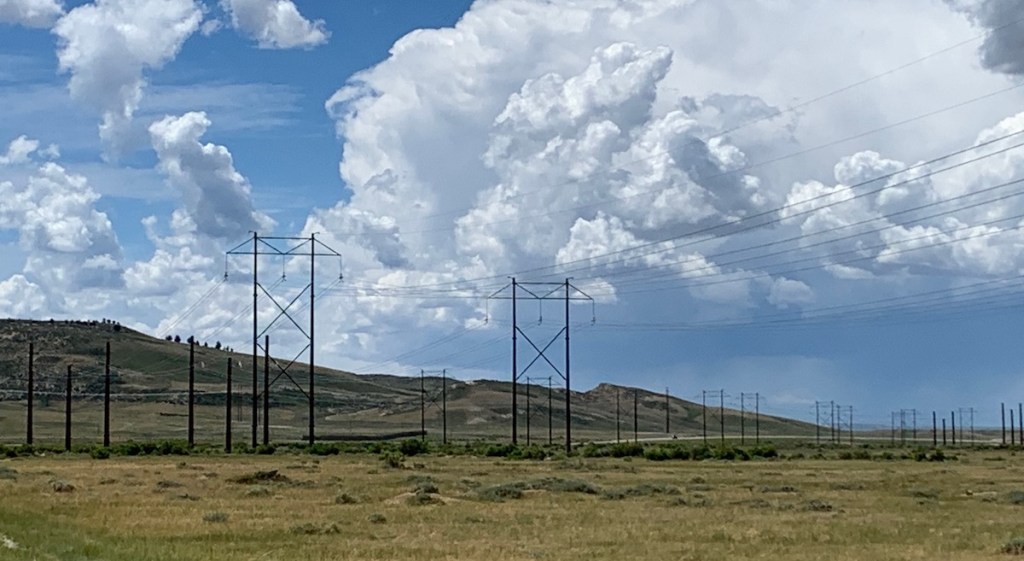
In Gillette, the city government reported a community-wide outage at 12:40 p.m. An hour later, the city posted on its Facebook page that power had been restored. Things changed again 40 minutes later.
“As of approximately 2:20 p.m., all of the City is out of service again,” an updated post read. “We are being affected by a widespread regional outage and do not have an expected return to service at this time.”
The outage in Casper appeared city-wide, the police department there reported. The agency directed people who were dependent on oxygen and in need of electricity to two locations in the city.
Natrona County’s library and YMCA closed early due to the outages, and several local businesses reported the same. The Natrona County School District canceled all after-school activities, according to a text sent to parents.
Some businesses, including a liquor store, in Glenrock — just a few miles from the Dave Johnston plant — posted written signs that they were temporarily closed due to the power outages. Non-essential Natrona County offices closed for the remainder of the business day. The city of Casper announced that a number of its facilities — including City Hall, Casper Recreation Center, Casper Ice Arena, Casper Family Aquatic Center, and Fort Casper — closed early and would not reopen until Friday due to the unstable electricity.
Suggested safety precautions
Treat all downed power lines as live and extremely dangerous. Stay away and report them immediately to 911 and your local utility provider.
- Conserve cell phone battery: Limit non-essential calls and use text messaging where possible. Utilize cell phone carriers or public safety radio for emergency communication.
- Use generators safely: If operating a portable generator, NEVER run it inside a home, garage, or any enclosed space. Ensure proper ventilation to prevent carbon monoxide poisoning.
- Check on neighbors: Check on vulnerable family members, neighbors, and friends, particularly the elderly or those dependent on electricity for medical equipment.
- Use alternate facilities: Residents who are oxygen-dependent or require power for life-sustaining medical equipment and do not have backup power are encouraged to contact their local emergency management office or visit designated facilities.
- Avoid overloading circuits: Once power is restored, gradually turn on appliances to prevent overloading the local circuits.




Couldn’t have asked for a more perfect day for a practice drill to prepare for the end of the world. Middle of the day— middle of the week— temps in the middle 50s… I sincerely hope we each take a few moments in the coming days to get ourselves ready for the day that this gets real.
Apparently, Buffalo/Johnson County residents are not part of the NE of Wyoming….
After all the nonsense I read on fakebook I can’t wait to see what happens when it’s more than a couple hours. Go buy a weber, bag of charcoal and keep it tucked away.
It seems I’ve heard this song before… circa 1965. Courtesy of Wikipedia…
The Great Northeast Blackout of 1965 was caused by a chain reaction that began when a faulty protective relay at a Canadian hydroelectric plant shut down a major power line. This caused power to automatically divert to other lines, which then became overloaded and shut down as well. This effect cascaded throughout the interconnected power grid, leading to a widespread failure in the Northeastern United States and parts of Canada.
Initial failure: At the Sir Adam Beck station in Ontario, a protective relay was misconfigured and tripped, shutting down a 230-kilovolt transmission line.
Power diversion: When the line went down, the electricity that had been flowing through it was automatically diverted to other transmission lines.
Overloading and cascading failure: These other lines, already heavily loaded, became overloaded and shut down in succession.
System-wide collapse: The power surge then traveled south, overloading lines in New York and the rest of the Northeast, causing the entire system to collapse in a cascading failure.
Duration: The blackout lasted up to 13 hours for some areas, affecting over 30 million people.
On July 25, 2000, KN Energy was testing its gas lines and an employee forgot to re-open a valve after the test. Fortunately this occurred in the middle of summer because gas service to all of Laramie was cut off. KN had to call in servicers from all over the area to first, go to every house and turn the gas valves off, then after the valve was opened they had to return and light the pilots in all of those locations. It was a huge undertaking. Losing electricity in summer for too long would cause the loss of thousands of dollars of frozen food. The pressure from too many humans in the richer countries making increasing demands on diminishing fossil fuels (flying anywhere for any reason at any time, for example-An industry almost totally dependent on petroleum) is the reason everywhere across the world things are coming apart at the seams and edges.
Customers. 10% of costumers. A house is a customer, a lot houses have multiple meters. A business is a customer, and a lot of businesses have numerous meters. An irrigation pivot is a customer. Where does it say 10% of residents in the article ?
So 95,000 Wyoming residents lost power. And that was 10% of the population. So Wyoming has 950,000 residents????
Apparently a communications degree doesn’t involve basic math.
Apparently neither of you have any ability to comprehend what you are reading. Nowhere in this article is it written how many residents lost power. Customers. A customer is a business, a house. A meter for an individual oil well or a center pivot is a customer. Troll somewhere else, try to understand how this stuff works.