

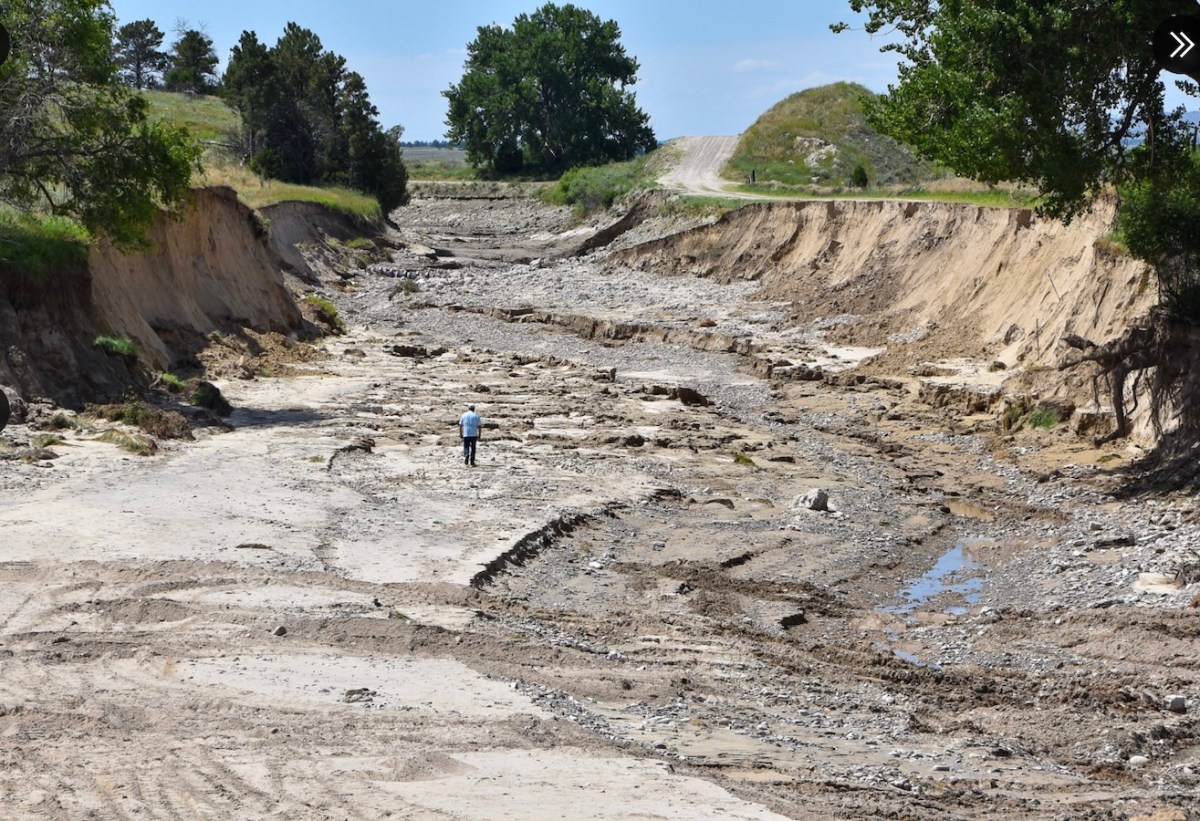
As Wyoming plans to spend $250 million on two new dams, primarily for agricultural use, the state’s water office warned lawmakers that it will also cost hundreds of millions of dollars to restore existing irrigation canals and infrastructure.
Jason Mead, director of the Wyoming Water Development Office, outlined the state’s challenges in remarks Jan. 7 to the Legislature’s Joint Appropriations Committee.
“The real theme is just aging infrastructure,” Mead said. He reached that assessment after a survey of 10,000 irrigation structures revealed about 20% “in poor or failing condition.”
“When we put numbers to the top 30 most critical structures,” Mead said, “that dollar amount to rehabilitate or replace those structures [was] somewhere in the range of $200 [million] to $300 million.”
Municipal water infrastructure across the state is in “pretty good shape,” he said. But many plants are “original” — the first ever constructed by cities and towns — and are “getting to their end of life.”
“I feel we have a train wreck coming down the line.”
Tim French
Mead didn’t estimate those future municipal costs, but outlined other expenses the state is facing for proposed water development and maintenance projects.
The proposed West Fork or “Battle Lake” dam on Battle Creek above Baggs is expected to cost $150 million. An additional $100 million is estimated for the Alkali Creek reservoir proposed near Hyattville, Mead said.
The state has set aside $90 million to reconstruct the LaPrele Dam and about $42 million to rehabilitate the Goshen irrigation tunnels. The Goshen set-aside isn’t expected to cover Wyoming’s share, prompting questions from one legislator
Meantime, Gov. Mark Gordon wants $30 million to launch new small water development projects. Mead’s office itself is seeking $9.4 million to operate over the next biennium, a budget that doesn’t cover most planning and construction costs, which are funded by annual omnibus bills.
All that adds up to more than $700 million.
How or when the work would be undertaken is uncertain. Funding also is an issue. Water projects have been paid for by the state, by irrigation and municipal entities, and with federal funds.
Train wreck?
“I feel we have a train wreck coming down the line,” Sen. Tim French, a Republican from Ralston, said of the aging infrastructure. Another critic, Tim Gardiner, whose land neighbors the Alkali project, asked why Wyoming is taking on more when it’s facing existing challenges.
“Why would you bite off more than you can already chew?” he said in an interview.
Wyoming will apply for federal grants, Mead told lawmakers, but few leads are firm. Meantime, the state will push forward with its own money, starting when the Legislature considers water works funding at its budget session that begins Feb. 9. Lawmakers will debate appropriations for several accounts.
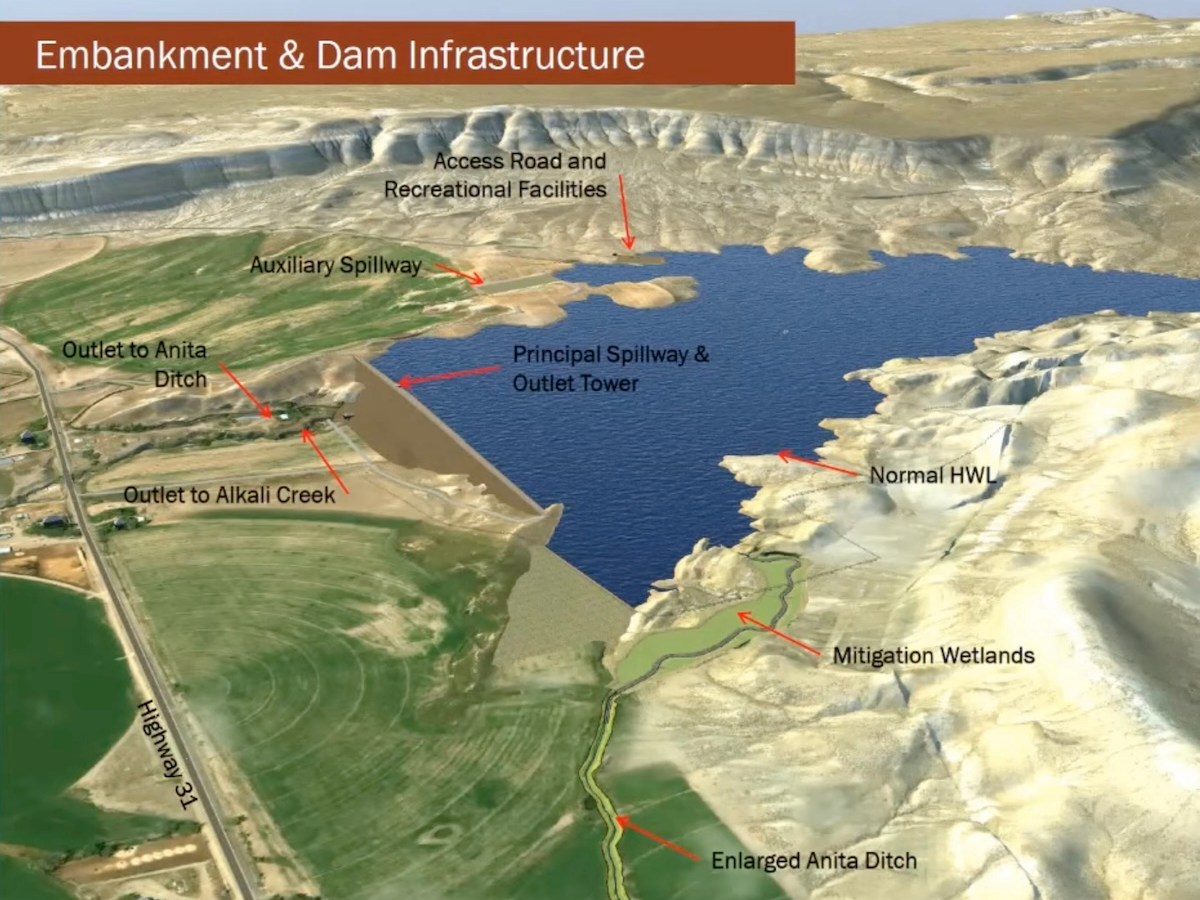
The $9.4 million for the Water Development Office biennium budget covers 21 staffers and their work. In addition, lawmakers seek $22.5 million for grants and $7.2 million for loans in the “Omnibus water Bill-construction” endorsed by the Select Water Committee on Jan. 21. That would fund numerous municipal and irrigation projects, including adding $1.1 million for more work on the proposed $150 million West Fork Dam on Battle Creek in Carbon County.
The committee also seeks more than $4.4 million in the “Omnibus Water Bill-planning.”
“I think our office has been as efficient as we can be,” Mead told the Appropriations Committee. “We’re really focusing on needs and trying to identify when sponsors want something, but it’s really not critical, and make sure we’re only paying for needs.
“We understand funding is limited,” he said, so the office has reduced many of its grants from 67% to 50% of a project’s cost. Now, sponsoring entities like towns and irrigation districts will pay half the cost of many projects, often backed by Water Office loans.
Holding the bag
Major projects, like the $250-plus million for the proposed dams at Alkali Creek and the West Fork of Battle Creek Dam, are sought to be funded almost entirely by the state. Federal funds for those remain elusive, Mead told lawmakers.

“There’s been a billion dollars set aside for Bureau of Reclamation infrastructure,” he said, “but all the rules and regs and how that’s going to operate, nobody knows yet. None of that’s been provided.”
Nevertheless, rehabilitation is ongoing at the Goshen tunnels without a firm federal financial commitment, Sen. Ogden Driskill, a Republican from Devils Tower, said.
“When you get to the end, if we’re short $60 million, somebody’s got to pay,” Driskill said. Who is “going to get left holding the bag?” he asked.
“We’re on limited budgets here,” Driskill said. Parts of the state could be shortchanged because “we’ve drained our accounts out to do one district.”
His comments mark Driskill’s continued dissatisfaction with water office operations, including ballooning estimates at Alkali Creek. There, the office gave $1.6 million to the Nowood Watershed Improvement District, which bought only some of the property and easements necessary for development.
Several landowners have not granted easements for the proposed dam and reservoir, stalling the project as inflation exacerbates the situation.
Driskill called for changes, asking for lawmakers to investigate water office procedures as an interim topic after the budget session. He wants things changed to prevent Alkali-like delays.
“When a sponsor comes and they’re going to irrigate a bunch of ground, easements should be in place with the application,” he said at the Select Water Commission meeting. “It should be the responsibility of the sponsor to come with a complete package that says, ‘here’s a map, here’s all the easements.’
“I want every water dollar we spend to get on the ground,” Driskill said, “not to be spent waiting for somebody to get their ducks in a row.”

The farmers will be waiting for ‘free money’ for maintenance. You know, the public money.
If anything, WWDC is understating the maintenance and rehabilitation needs of Wyoming’s water infrastructure. Their historical focus has been on building storage projects while largely ignoring efficiency and improving infrastructure. They do nothing until it’s an emergency or if someone “important” or “politcally connected” wants it. The Water Development office is in desperate need of reform and needs to refocus it’s efforts toward updating infrastructure and emphasizing efficiency and water conservation. The three big WWDC reservoir projects are all hyper-expensive and benefit only a very few agricultural irrigators. Why should the State of Wyoming invest so much for so few? Water is Wyoming’s most critical resource, by far. Yet, it’s the most mismanaged. Wyoming deserves better, and the legislature should demand it. Sadly, it’s unlikely that anything will change.
Wyoming is a giver in the Colorado river compact.
Even though Wyoming DOES NOT HAVE enough WATER ?
The takers in the Colorado river water compact,have golf courses,swimming pools & illegal aliens.
Time for Wyoming to make water that is in Wyoming great again !
Show me on the doll were all those water-stealing “illegal aliens” touched you so badly. I ask because I don’t see how an “illegal Alien” can steal water. Maybe the white farmer they work can, but that’s another issue.
The people of Hyattville above the alkali reservoir project have been threatened and harassed and you want and need are easements something has to change Martin Mercer is the problem
I believe that the alkali dam is a farce you need my easement to go forward and as of right now I am not giving it due to some circumstances that Martin Mercer has continually been doing
Mr. Shirran, please expand on what Mr. Mercer is doing/not doing!? A lot of eyes are watching this “project”
Having served on a number of Boards, I expect Board members to operate at the highest standard of care, insuring no conflicts of interest in performing their duties. Yet, the operation of the NOWID Board (the sponsors of the Alkalai Dam) are not consistent with the highest standards of business ethics. Where else in America do you find two board officers executing a multi-million dollar contract, whereby the Seller of goods and services under the contract (the “Contract”), is an officer of the Board, and the purchaser of those goods and services is another officer of the Board?
• Further clouding the breach of ethics is the fact that Board President denied executing the “Contract” in a public forum, despite the fact that he signed the Contract and recorded it at the County Recorder’s Office 3 years prior to the public meeting!
Considering the dollar amounts involved, the conflict of interest is epic… (The Contract authorizes payments approximating $4,000,000 of taxpayer money to another officer of the NOWID board!) In my opinion, any board member, who expects to enter into contract negotiations for personal gain…. with an organization which he is supposed to represent impartially, should resign from the Board due to the blatant conflict of interest.
Furthermore, the proposed Alkalai Dam makes no sense economically. As Dave Haire commented, the proposed dam is“ Typical ag welfare in the west…Paid for by all and only benefitting a few.” The project is to be 100% financed by the state of Wyoming at a subsidy of $3,424,242 per irrigator. The project is of marginal benefit to the state as a whole because it only benefits only a handful of irrigators (33!).
The project also puts downstream owners at risk. (The State’s engineers have classified the proposed dam as a “high hazard” dam….A “high hazard” dam is defined as a dam whose failure is likely to result in loss of life, or negatively impact property.) Do we not remember the Teton Dam disaster, which left 11 people dead, 16,000 livestock killed and scoured the land for 90 miles downstream? Damages topped $2 billion!
From my perspective, (as the owner of the ranch ½ mile below the proposed dam), I should not be asked to put myself at risk for my neighbors’ financial gain. A taxpayer subsidy of of $3,424,242 per irrigator is a misappropriation of the public purse. (And that does not include the payments to our Board officer!) Why should subsidies for 33 irrigators take precedence over the 8,000 residents of Rawlins who suffer from a city water system that only functions intermittently? Why should downstream property owners be asked to put themselves at risk for neighbors’ financial gain and marginal public benefit?
$113 million is better spent repairing our state’s aging infrastructure and funding schools. On a stand-alone business basis, the dam is not an economically sound or viable business venture. The return on investment is negligible. At a time when Wyoming is looking to cut expenses, I am surprised that this venture is even in the public forum. The dam is emblematic of what average citizens hate about politics. Taxes should fund essential functions of government, and not make a handful of people rich. After 9 years of planning, and millions of tax payer money wasted, this project needs to end. I ask our legislators to do their job. Be wise stewards of the public purse. This pork barrel project needs to be euthanized.
Wyoming and the federal government have a long history of socializing the costs and privatizing the benefits of water projects. Good deal if you are one of those who receive the benefits without having to incur the costs.
Water projects can be complicated with some people benefiting while others are harmed. In our system benefits and harms are most often addressed in the planning process which include environmental assessments.
Funding can also be complicated. For instance, my water system includes fees to cover maintenance and eventual replacement. The State does assist with low-cost loans. These loan subsidies reflect the benefit that accrues to the general public from having safe and reliable water for our communities. Even then, the community pays the lions share.
Some current projects have the water users pay less than half. I am no expert but this just doesn’t seem right. Maybe a third federal, a third state and a third users is a better place to start. If a project doesn’t qualify for federal or state funding, maybe it shouldn’t be done. If locals think it still is of benefit, let them pay for it. We want to give people a hand but not necessarily a handout.
It would seem to me that if taxpayers are paying for these projects, the public should have access to the reservoirs for recreational purposes.
“I feel we have a train wreck coming down the line.”
Tim French
When the Republican primaries are only about “culture wars” instead of issues that really impact the State and it’s citizens, you might be culpable in building that train.
There was a focus on infrastructure during the previous administration and instead embracing what is really needed in America, Republicans decided the brown people, that did a lion’s share of this critical work, should be violently exported with no due process.
To be fair, Wyoming has proven that socialism does not work as the Bureau of Reclamation handed the Goshen irrigation district a tunnel that could have lasted a lifetime if they had only taken care of what they had been given the first time.
Aww yes, the Madam Chairman himself, Tim French. A dude who’s stuffed 100’s of thousands of ag Subsidy welfare dollars in his pocket shouldn’t be in a position of decision making.
Must run in the family. A few years back, his brother approached the Park County Commissioners wanting them to build him a $900,000 grain bin. Fiercely independent on the outside but closet socialists
I believe that tunnel lasted a lifetime and then some. It was built in 1917. And nobody is exporting people that are in this country legally. It’s all those illegal folks that the previous administration let into the country, unvetted, unchecked that are being sent back over the border.
Every word you wrote is incorrect, bravo. Plenty of evidence the irrigation district did not maintain the irrigation tunnel leading to its collapse. That’s a fact. Weird how I still see Roman aqueducts and when I explored how many irrigation tunnels are in existence, most are, and in fact the only ones that have collapsed seem to be the Goshen ones.
Summary
Canals: Over 8,000 miles of Reclamation canals remain operational today.
Irrigation tunnels: No official total count exists, but the majority of historic Reclamation tunnels are still in use, including all three Fort Laramie Canal tunnels (with ongoing rehabilitation).
It is also a fact that immigration and inflation were also up during the pandemic years and that Obama deported more illegal immigrants than Trump, but you really do not want to address those salient facts. In fact Tom Homan led these efforts for Obama. Biden was trying to do the same but Trump and his racist sidekick Stephan Miller wanted to make a spectacle of dehumanizing people. Unfortunately, people like you bought into that brand of hate and now Republicans are celebrating the defunding of Health Care, PBS, Science while tripling the budget for Trump/Miller to operate right wing death squads in the USA. Pathetic.
“I feel we have a train wreck coming down the line.” – Tim French. Hey Tim, then why didn’t you invest YOUR OWN MONEY all these years into the irrigation system, instead of relying on that evil big ole’ bad Gub’Mint to do it for you? It’s funny how the supposedly rugged individualists will be the first to whine for having the rest of us subsidize your ‘independent’ operations