

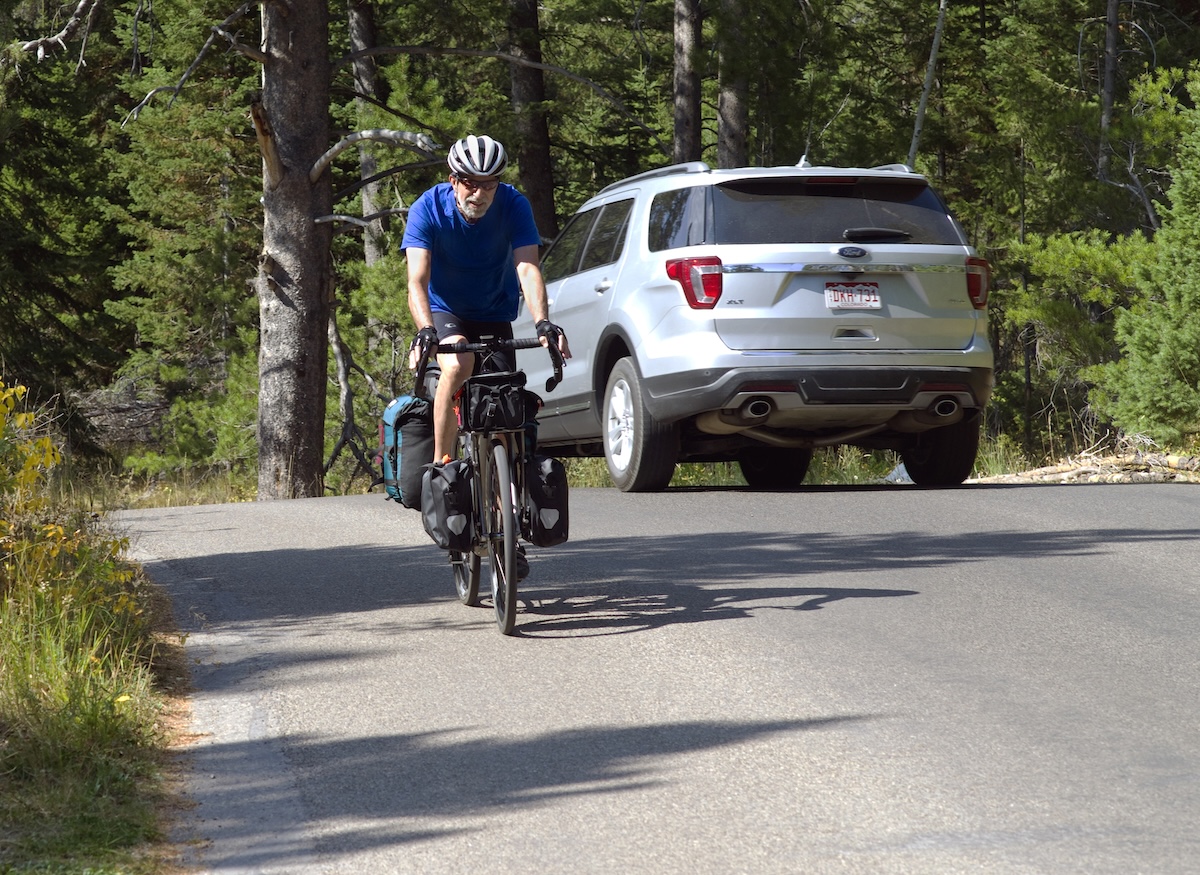
Winding through dense forests and wetlands in the southwest corner of Grand Teton National Park, the 7.1-mile Moose-Wilson Road offers incredible wildlife viewing opportunities as moose, bears and other critters forage nearby.
The road is narrow and heavily trafficked, which prompted the National Park Service to launch a management plan last decade. What ensued was a multi-year process with heavy public engagement that identified four alternatives to shape the corridor’s management.
In 2016, the park service identified an option that generally restricted development within the corridor to the existing footprint. Notably left out of that preferred alternative was a proposal to build a multi-use pathway, separated from the road, for bicycles and pedestrians.
Now, the park service is revisiting the pathway proposal. Last week, the agency released a draft “programmatic agreement” that identifies additional scoping work related to construction of a multi-use pathway, realignment of a 1.8-mile segment of the Moose-Wilson Road and restoration of that segment. The park service is accepting public comment on the proposal through July 9 — 15 days from the draft’s release.
The pivot is the result of a 2025 executive order signed by President Donald Trump that emphasizes recreation, according to the park service. “This aligns with implementation of the [executive order], which calls for improving visitor services, enhancing access, and reviewing policies that may unnecessarily restrict recreation in national parks,” the agency stated this spring when it announced plans to revisit the pathway decision.
According to the new draft document, recreational opportunities, newly stipulated by Trump’s executive order, were not considered during the previous scoping process.
Conservation groups are skeptical, however, saying the process did what it was designed to the first time around.
The order opens “the door to future development, a disrupted visitor experience, and habitat fragmentation” in the corridor, the National Parks Conservation Association said in a statement. “Given the comprehensive environmental, scientific, and community inputs that support the selected action, the National Parks Conservation Association is deeply disappointed by a new Department of Interior-led directive to re-open and reevaluate the 2016” decision.
Years in the making
Like neighbor Yellowstone, Grand Teton National Park has grappled with managing increasing crowds in recent years. The park’s annual recreation visits surpassed 3 million in 2015, and between 2015 and 2021, that count grew by 23%. The park has embarked on several initiatives aimed at understanding and addressing the impacts of growing visitation.
The National Park Service kicked off the Moose-Wilson planning process in 2013 by soliciting public comments in a year-long scoping period. In outreach materials, the agency said it sought to ascertain everything from the road’s purpose for visitors to the desired conditions of the corridor’s fundamental resources.
The road is the main artery running through what’s known as the Moose-Wilson corridor — a swath of roughly 10,300 acres with exceptional wildlife habitat that also provides access to destinations like the Death Canyon trailhead, Laurance S. Rockefeller Preserve and Murie Ranch historic district.
A mix of aspens, chokecherries, willows and conifers in forests and pristine riparian zones draw many species — which can create “wildlife jams” as slowing or stopping vehicles clog the road. Along with growing visitation, some local residents rely on the road as a shortcut between Teton Village and Jackson Hole Airport or Wyoming Route 390 and destinations in the park and beyond.
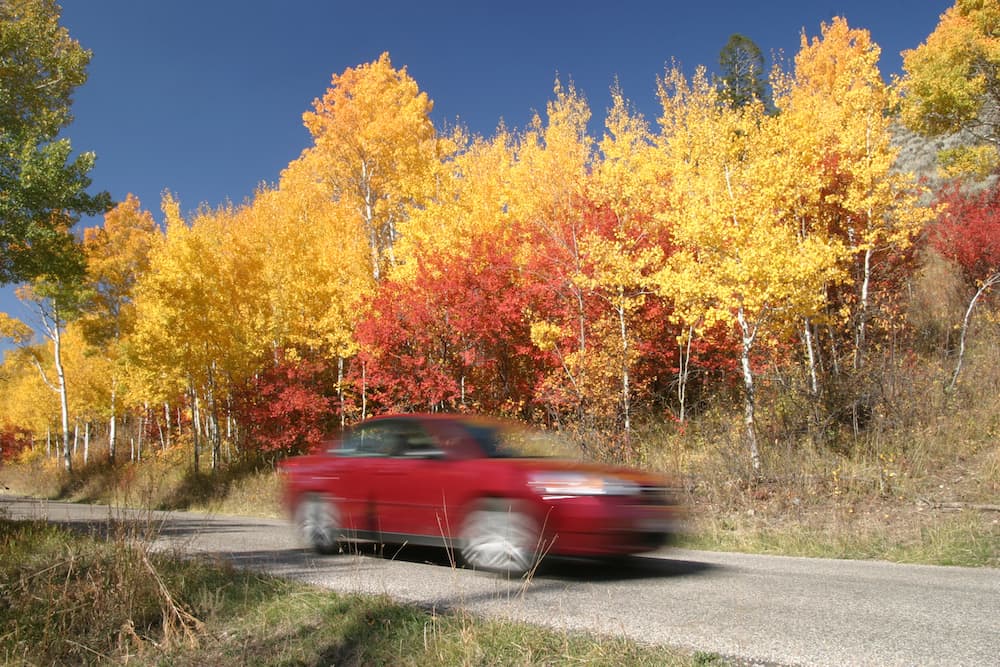
In 2016, the park service estimated that roughly 400,000 visitors traveled the corridor annually.
“The volume of traffic on the road, combined with the various purposes for which people travel the road, is resulting in congestion and conflicts among users,” the park service stated in a planning document.
Given those realities, a great deal of management plan discussion and comment focused on traffic management strategies. Ideas ranging from seasonal closures to reservation systems and one-way road traffic were contemplated. Another was construction of a multi-use pathway separate from the road. According to park service reports, public comment ran the gamut.
Those in support said it would be safer for users and result in fewer vehicles overall and a more serene experience. “A pathway will encourage users to park and use non-motorized transportation, thus, decreasing congestion on the roadway,” one commenter said. “Currently, pedestrians or cyclist (sic) must traverse the existing narrow road which is very dangerous. In addition, a pathway segment would tie Moose and [Teton] Village together. This would complete a world class pathway system loop.”
Others, however, called it an inappropriate project that would unduly affect sensitive wildlife habitat and increase the potential for human-wildlife conflict.
“Those of us who enjoy bicycling have recently benefitted by the addition of dozens of miles of pathways in Teton County, many in the Park, and in areas that have superb vistas and which are much safer and less disruptive to animals than a path would be in the Moose-Wilson corridor,” another commenter said.
The pathway was under one of four alternatives proposed for the management plan, but the park service ultimately opted for a different one, Alternative C. The alternative also directed park officials to manage traffic during peak periods, using timed entry techniques, and to lower the speed limit on the road, which isn’t open to RVs or trailers, to 20 miles per hour.
The agency released its environmental assessment on the draft management plan in 2016. A so-called record of decision, which typically represents a final step in the process, was signed in 2017 during Trump’s first term.
“The emphasis of the selected action is to balance preservation and public use and enjoyment by exemplifying conservation legacies within the corridor,” the decision states.
Why now?
In March, a page on the National Park Service’s relatively obscure Planning, Environment and Public Comment (PEPC) site was updated with an announcement.
“The National Park Service is revisiting the 2016 Environmental Impact Statement and Record of Decision for the Moose-Wilson Road project,” it read. The action, according to the announcement, stemmed from the 2025 Making America Beautiful Again executive order.
Along with increasing entry fees for foreign tourists and improving affordability for United States residents, the order’s stated goals included “expanding opportunities to enjoy America’s splendid national treasures.”

The order directed the secretary of the interior to review all of the department’s recreational access rules and “take steps to rescind any that unnecessarily restrict recreation in national parks.”
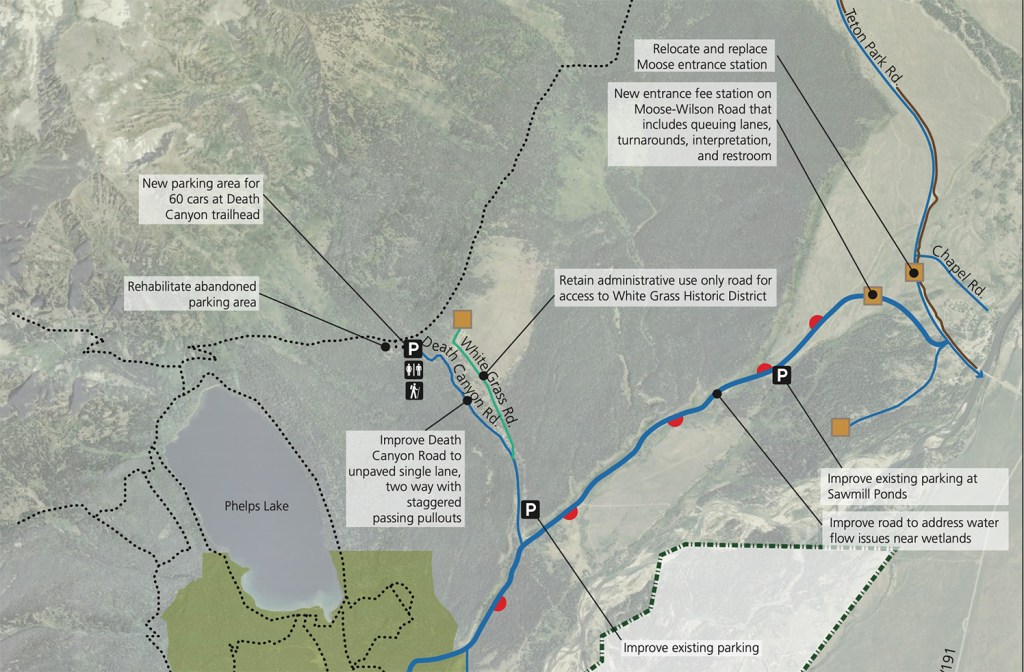
In this case, “Specifically, the NPS is re-evaluating the selected action to incorporate a separated multi-use pathway extending the length of the corridor and realign a segment of road, with a parallel pathway, between Sawmill Ponds and Death Canyon Road,” the March announcement said.
Last week, it released the draft programmatic agreement.
This type of document provides consultation procedures that streamline the standard four-step process under the National Historic Preservation Act, according to the park service. They allow federal agencies to implement a program by negotiating an agreement between the agency, appropriate state or tribal historic preservation offices and the Advisory Council on Historic Preservation.
The draft agreement, which lists Grand Teton National Park and Wyoming historic preservation officer as parties, is evidence the park has accounted for the impacts of the undertaking on historic properties, it states.
The corridor holds significance as a hub for Indigenous peoples, evidenced by recent discoveries of obsidian relics. The park has already consulted with numerous tribes, the agreement states, including Wyoming’s Eastern Shoshone and Northern Arapaho.

The bike path up to Jenny Lake is fabulous. But that doesn’t mean bike paths are approriate for everywhere in this or other parks. For this particular stretch of road, there may be no win-win solution that meets wildlife’s, and everyone’s, needs. I see a few situations, and possibilities, that I haven’t heard discussion about: (1) Could the Sawmill Ponds section be retained only for bikes, while the road is re-routed up above? (That would get people out of their cars — a destination, remote biking destination.) (2) Most road bikes, and the now-abundant e-bikes, can and do go 20mph on that section, no problem. I haven’t seen a lot of car-bike conflict, and indeed, yielding to occasional slow bikers helps slow the car traffic through there — where it should be slowed. (3) segregating bikes from cars through there is an invitation for higher car speeds, encouraging that section’s use as a racetrack between Teton Village and the airport. (4) Eventually, it appears that car traffic and parking in the Taggart-Jenny Lake area will have to be managed/restricted. Clearly, one way to achieve this is to provide incentives for people to park and use/rent bikes. If the Moose-Wilson section has a bike path, this will offer a broader day-biking experience in the park, rather than just out-and-back to Jenny Lake.
In one sense, bike paths encourage motorists and marginalize bikers. But maybe a bike path on Moose-Wilson can get people out of their cars? To do that will come down to incentives and management. But Trump’s desire to not restrict recreational opportunities does nothing to actually encourage and incentivize the use of a bike path…. It may only incentivize more car travel.
Develop and develop more. Someday nothing will be worth preserving. I see this as trump doing everything he can to make the world according to trump.
Here we go again! It has only been 6 months since the “Kelly” parcel of Wyoming state lands was sold to GTNP in order to protect the natural values on the parcel. This was a widely supported action by the community and Conservation buyers.
We now see special interest groups desiring to revisit carefully debated actions by GTNP to protect particularly wildlife values on that route. These groups have apparently asked for assistance from a Department of Interior not primarily interested in protections currently in use.
Re-opening these discussions by fiat is particularly disturbing and ironic in view of the following:
Midway along the route is the Lawrence Preserve, an interpretive Center in recognition of the natural values protected within GTNP. Ironic that the Rockefeller family was responsible for donating a large part of the previously private land now a part of GTNP – the least we should do is protect their generosity!!
Anyone interested in the fascinating history of GTNP would enjoy reading “Crucible of Conservation” by Robert Righter.
There should be a non-motor pathway next to ALL roads in ALL national parks. Teton County is 95% free of development. Get out there!
The Moose-Wilson Pathway will be an excellent addition to Grand Teton National Park, and I fully support the Department of Interior revisiting the poor decision made in 2016.
I also think WyoFile does a disservice by only telling a small part of this latest chapter.
The story of pathways in Grand Teton National Park actually began in July 1999, when 13-year old Gabriella Axelrad was struck and killed by a distracted driver near Jenny Lake while on a bike tour with her family. Gabriella’s death forced the National Park Service begin a study of transportation options for visitors to improve safety and enhance public access.
As that study started, tragedy struck again, when former park employee Jeff Pool was hit and killed on Easter Sunday while bicycling in Grand Teton near the Airport.
The public outcry to these park visitor deaths, including by U.S. Senator Craig Thomas, forced the NPS to complete the 2007 Grand Teton Transportation Plan EIS. Over 90% of public comment favored a significant pathway system, and the NPS decision approved a 42-mile pathway system in Grand Teton, including the south half of the Moose-Wilson Road.
With congressional funding support, the first 8-mile pathway from Moose to Jenny Lake was completed in 2008, and the Jackson to Moose Pathway was completed by 2011. The pathways were instantly successful, as park visitors of all ages and abilities were suddenly able to walk and bike safely in the park without being in danger along busy park highways. Studies showed that the pathway impacts were minor, and the visitor experience improvement was outstanding.
The first pathways in Grand Teton were so successful that in November 2011, President Obama and the Department of the Interior released “America’s Great Outdoors Report”, which detailed exemplary initiatives in each state. In Wyoming, the Secretary of the Department of the Interior selected the Grand Teton National Park Multi-Use Pathways Program as one of these.
Despite such success, in 2013 the National Park Service did a 180 and launched the Moose-Wilson EIS in 2013, in part to undue what had just been decided in the 2007 EIS for the Moose-Wilson pathway. Many of us involved in that EIS believe that the decision to cut the pathway was made well before the planning was completed. That’s not how things are supposed to be done, and the decision by the Trump administration to revisit this is the right thing to do.
I look forward to the day people can safely bike and walk between Teton Village to Moose on a safe pathway, and leave their car behind.
I’m all for it IF they have to leave their car behind.
Each time we build something in the wild, we take away wildlife’s habitat. Even though biking is greener than driving in certain way, it still cost wildlife certain amount of habitat. Sharing the same road with cars is best for wildlife without additional habitat loss. In the cities, bikers share with cars so you can in the wild.