
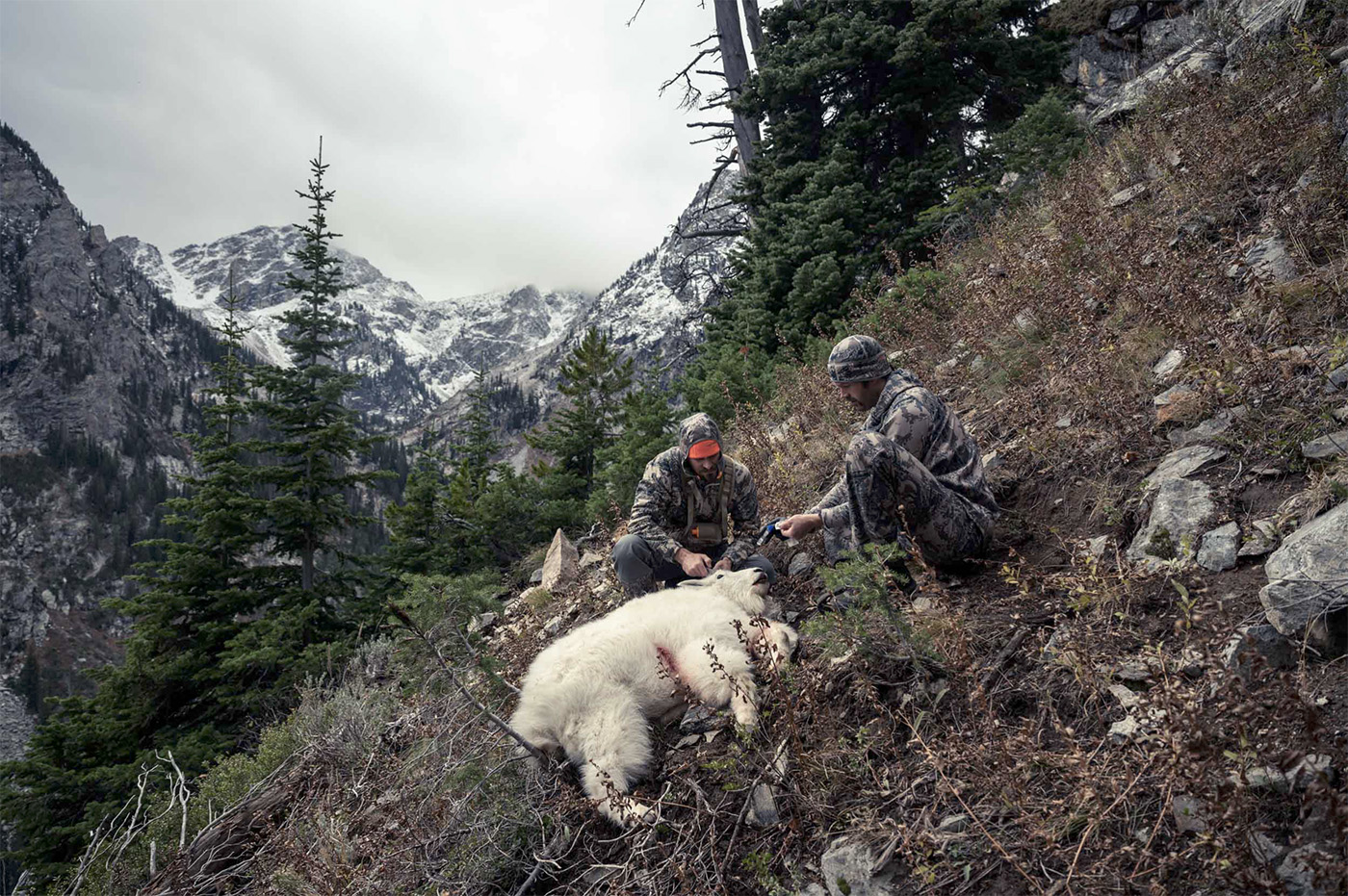

Every now and then, a hiker, climber or biologist lays eyes on a mountain goat in the nooks and crannies of the mighty Teton Range.
There’s a good likelihood that the unwanted, nonnative animal doesn’t survive long after the authorities pinpoint its presence. That’s because the National Park Service is now removing all mountain goats that survived an intensive three-year effort to rid the Tetons of the species.
A striking white alpine species, mountain goats are being targeted by gunners because they’re seen as a threat to native bighorn sheep. Mountain goats are more aggressive, overlap habitat and can also spread diseases that can be catastrophic.
“We have seen mountain goats — and we have removed those when we have found them,” Grand Teton National Park Superintendent Chip Jenkins told WyoFile in February. “We hire a private contractor who does the flying in terms of doing the survey, and we hire a private contractor who does the removal.”
Those contracted crews are “highly specialized” in dealing with wildlife, he said.
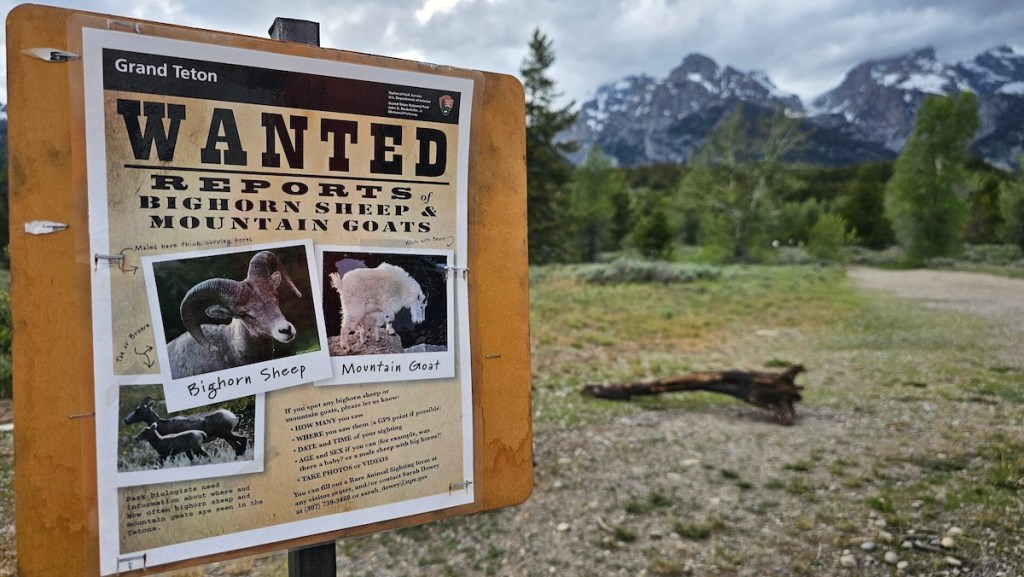
Park rangers have enlisted the public in their efforts to keep mountain goats out of the Tetons. Signs have been posted at places like the Taggart Lake trailhead, and the messaging asks recreators to report, photograph and even record GPS points of bighorn sheep and mountain goats.
Teton Range bighorns are left alone. That native species has struggled for decades after development eliminated their migration routes and backcountry skiers encroached on their winter habitat. The Wyoming Game and Fish Department found just 80 bighorn sheep during its latest survey, though DNA analyses of scat samples suggest that some animals are missed during aerial surveys and the population is somewhat larger.
Mountain goats are managed much differently. The Park Service is trying to remove the remainder to protect the bighorns.
“We’re in the perpetuity business,” Jenkins told WyoFile. “We’re working to be able to ensure that we’ve got bighorn sheep in the Tetons forevermore.”
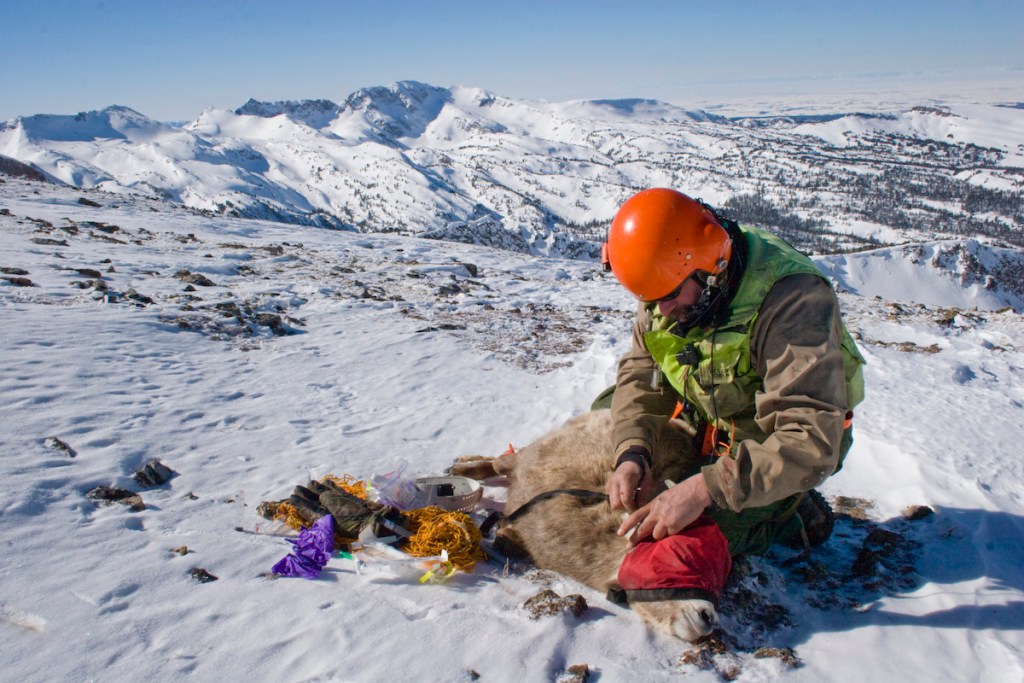
During high-profile efforts to wipe them out from 2020 to 2022, some of the nonnative goats were missed.
Mountain goats reached the Tetons in the late 1970s from the Snake River Range population introduced by the Idaho Department of Fish and Game. By 2008, they were observed reproducing, and the National Park Service first proposed eliminating the population in 2013, when an estimated “10 to 15” animals inhabited the range. It took nearly seven years to push those plans through, though, and by the time aerial gunners took flight in early 2020, the population had ballooned to about 100 animals.
Some three dozen goats were killed in that operation, which was cut short when then-U.S. Secretary of the Interior David Bernhardt intervened. Under pressure from Wyoming, the National Park Service allowed hunters on foot to cull the goats instead and they killed 63 during the fall of 2020 and 2021. The next winter, an aerial gunning operation killed another 58 goats, this time without resistance from the state.
It’s been known for years that the hunters and aerial gunners missed some mountain goats, which dwell in treacherous, complex Teton Range terrain.
“It’s extremely difficult to get every last one,” Jenkins said. “There’s always been an expectation that some would remain.”
A Jackson Hole News&Guide reporter encountered a goat while climbing in summer 2024, a year park biologists confirmed 12 sightings — up from seven sightings the two prior summers.
At that time, park wildlife biologist Sarah Dewey told the News&Guide that they weren’t actively killing remnant goats.
“We don’t have any specific actions planned at this time,” Dewey said in 2024, “but it’s very likely that we will need to take action at some point.”
By the time Jenkins briefed WyoFile on the issue in February, the lethal operations were underway.
“The big effort was five years ago, in terms of doing the removal,” the superintendent said. “Now, what we’re doing is maintenance.”
In November 2024, the Park Service’s contracted gunners killed 14 remnant mountain goats. There were 14 verified goat sightings in 2025, but no lethal operations occurred because there wasn’t the money to hire the aerial crews, said Yvette Converse, Teton Park’s division lead for science and resource management.
“We are potentially going to do it again this fall,” Converse said, “but we have to see if that makes sense at the time.”
“We’re in the perpetuity business. We’re working to be able to ensure that we’ve got bighorn sheep in the Tetons forevermore.”
Chip Jenkins
So far, park rangers have not hiked into the Tetons to pursue mountain goats, but that option is on the table.
“It’s just risky and also difficult and costly to send people out on foot,” Converse said. “If we get to a point where we have very, very few sightings … then we could potentially do that.”
In 2027 and beyond, Grand Teton’s Mountain Goat Management Plan calls for population “maintenance” that’s focused on “preventing immigration and removing any new goats that enter the park, using ground-based, tactical methods.”
In the meantime, very few mountain goats likely remain in the Tetons.
“Based on a review of 2025 observations — considering location, group composition, and timing — we estimate 7–8 goats remain in the southern portion of the park, with others possibly in the northern trailless and more remote canyons,” Converse wrote in an email.
The Wyoming Game and Fish Department shares the park’s goal of protecting Teton Range bighorns and the state agency authorized an aggressive mountain goat hunt along the west slope of the range starting in 2019 with the intent of removing the population. A few years later, however, the hunt was halted.
“We were eventually selling a license where it was really difficult to find a mountain goat,” said Brad Hovinga, Game and Fish’s Jackson Region supervisor.

Wyoming wildlife managers don’t play any role in the goat-killing operations in Grand Teton National Park, Hovinga said. Outside the park, there hasn’t been a need to kill remnant goats, he said, because none have been documented for several years.
But if mountain goats are spotted outside the park along the west slope of the Tetons, Wyoming plans to follow suit.
“We do plan to remove [animals] if we do see mountain goats reappear,” Hovinga said.


> Informative and well-written article. I appreciate the focus on wildlife conservation and the importance of protecting these remarkable mountain goats. Thanks for sharing!
I’m so glad I found this page!
Mountain goats are native to the Rocky Mountains. They have definitely expanded their range, but it’s disingenuous to call the “non-native”.
UM….no information (facts or studies)in this article from biologist that demonstrates the mountain goats are the problem. So a wild hair in someone’s …..decides ALL of the mountain goats must be killed . This sounds like other approaches in the past that are not based on science ………wild horses, mountain lions, and wolves . WyoFile has consistently been a good and dependable resource, do your job.
I know it sounds cruel but non native wildlife can reduce food sources and take over land that a native species need to survive. If no action is taken you could end up
with no Bighorn Sheep in the Teton Range with the more aggressive Mountain Goats even attacking hikers.
There used to be a bighorn ram in Sinks Canyon that was called “bam-bam” because of his penchant for ramming vehicles. I guess aggressiveness towards humans isn’t limited to Mountain Goats.
The feds welcome northern Alberta wolves, and Brown trout from Germany with open arms but heaven forbid any mountain goats from migrating in from Idaho. I guess if Lewis and Clark never saw them, they must’ve never been here and need to be slaughtered just like the buffalo. Just kill em and leave ’em to rot. Isn’t that called “wanton waste” by the Wyoming Game & Fish Dept.?!
No effort is being made to capture and relocate the goats to some other part of Wyoming.
What a joke!!!
You’re 110% on target 🎯,when will the wolves, New Yorkers and other species be dealt with?
Some times I believe you don’t want any more wildlife in your area. We love to come and visit and see ALL your wildlife. Stop killing everything. Candy Thompson
Intact and natural ecosystems can fail when invasive species flourish.
Thank you for this story. Leave the mountain goats alone. Another example of human interference. I would like to know how many big horn hunting licenses were issued. If WY is so worried about sheep numbers, stop hunting them. Problem solved.
They are hunting the non native Mountain Goats not Bighorn Sheep….please read the article
They should be hunting non native wolves as well.
Very interesting story that helped clarify the reason the mountain goats need to be removed. Question that was not answered; were the mountain goats that came into the state ever native to North America, or are they a species that was introduced as a potential exotic game animal that is displacing the native bighorn sheep?
Mountain goats are native to the Rocky Mountains. They have definitely expanded their range, but it’s disingenuous to call the “non-native”.
Be interesting for them to know in the face of this “eradication “, that there is a mountain goat head in a homesteading family’s house in Alta Wyoming that was killed in Teton Canyon in very early 1900’s. Individuals were informed of this but never pursued digging in to it because it could have thrown a hook into the already laid plans of the goat extermination and it could prove there were goats in the Tetons in the past.
This harkens back to the reintroduction of wolves to Yellowstone. My memory of all the details is a bit hazy, but as I recall, Cat Urbigkit and her husband had done a fair amount of research and insisted at the time that there was a remnant population of the original wolves still extant in the southeastern corner of the park. Proving the existence of indigenous wolves would have derailed, or at least massively complicated the USFWS and Park Service’s desire to reintroduce Canadian wolves, so they did everything in their power to suppress the Urbigkit’s claims. Again, my memory is hazy on the timeline, but it was IIRC a few years later that the rancher somewhere in I think Sublette County roped a wolf from the back of a snow machine, turned the live animal over to the authorities, whereupon it was immediately and permanently disappeared. The Feds later announced that their testing proved the animal was a wolf/dog hybred, but the carcass had been destroyed so that no independent testing could be done. Perhaps someone with a better memory could chime in and correct my memory of events.
Sorry, but under close scrutiny, Urbigkit’s claims don’t hold up.
I’m not questioning your assertion, but I would be interested to read the scrutiny you referenced. Please share your sources.