

Dug into the ground, with views as far away as the Continental Divide, rests a fiberglass tub that just may save lives. Not necessarily humans, but everything else, from buzzing bees to flitting songbirds to herds of Rocky Mountain elk.
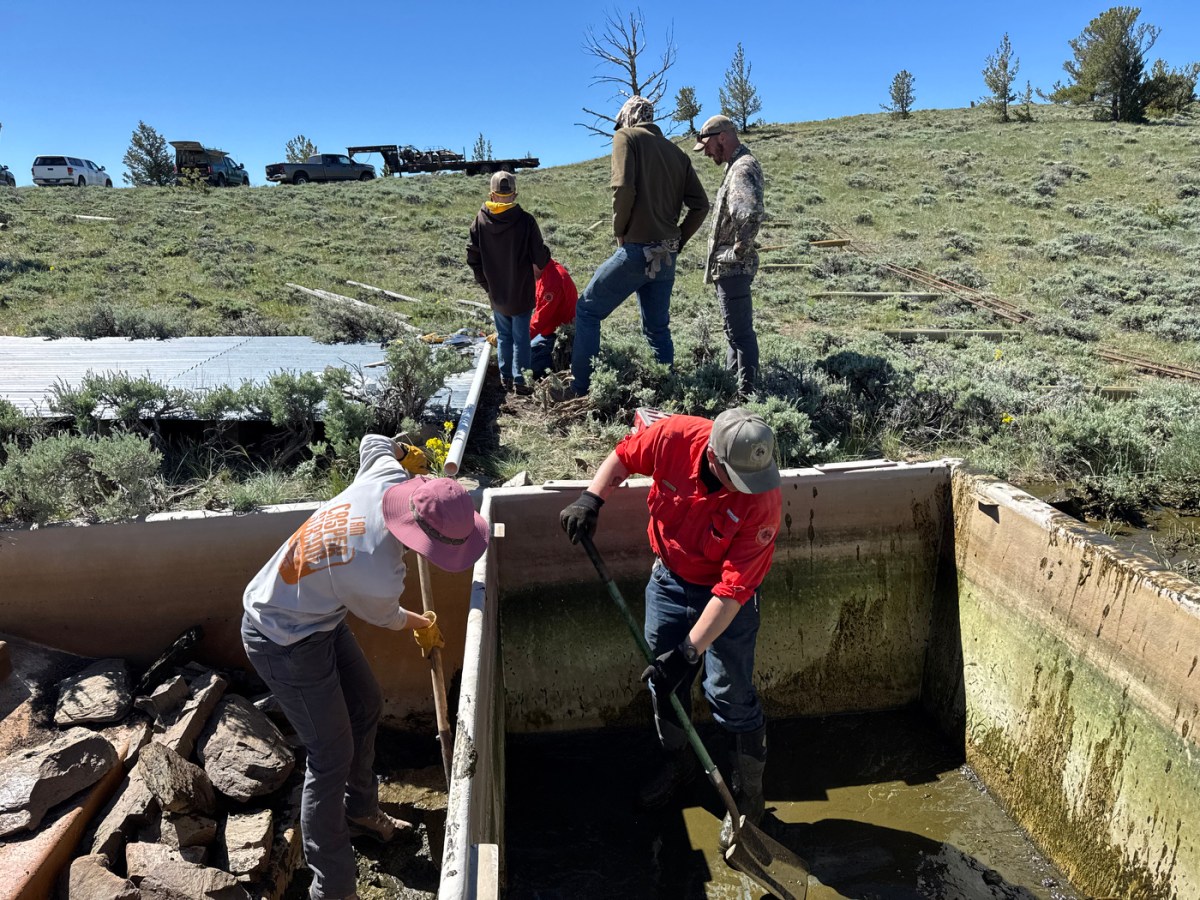
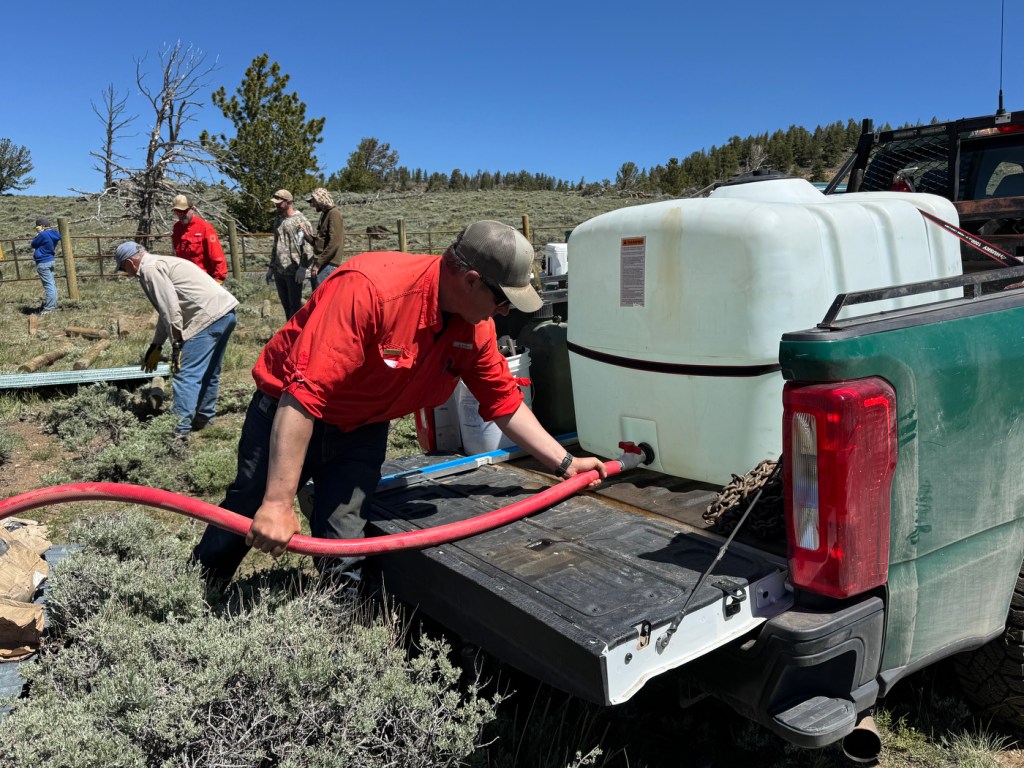
In a good year, this tub would fill with about 500 gallons of rain and snowmelt, offering the landscape’s creatures relief during dry, summer months. But this wasn’t a normal year, and this particular tank needed some help. So a group of 10 or so volunteers led by the Wyoming Game and Fish Department gathered on a Friday in mid-June for some old-fashioned repair work. At the end, they filled it with water, and the Woods Landing Volunteer Fire Department will check back later this summer to fill it up again.
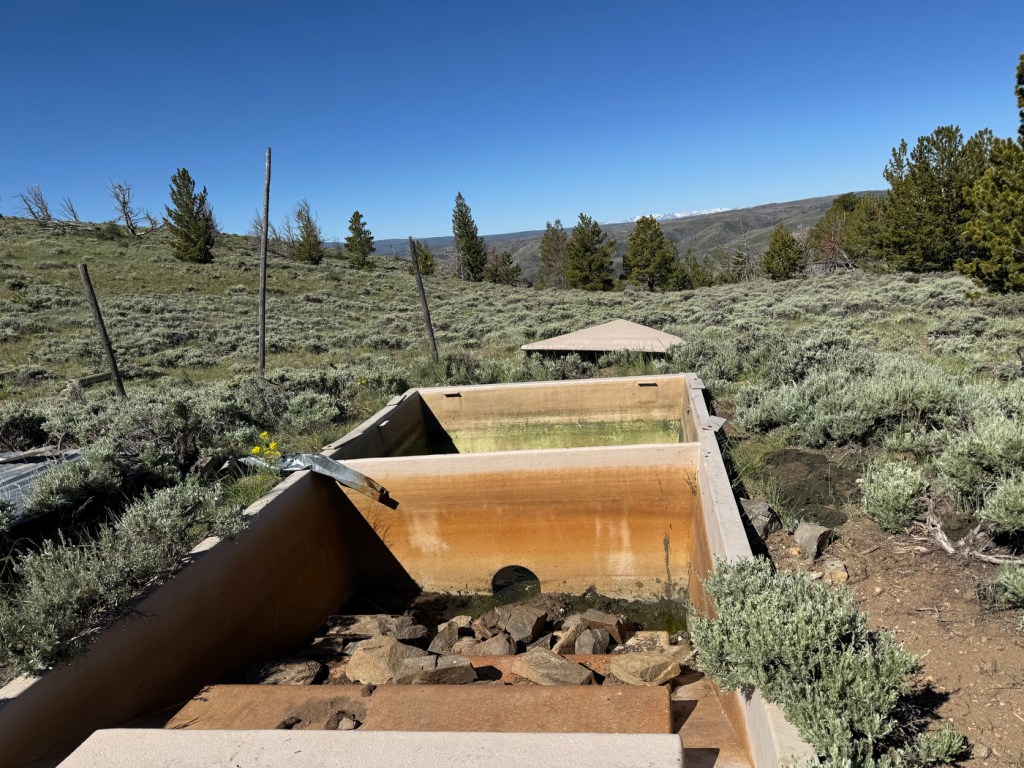
The guzzler, as the water reservoir is called, is one of a few hundred scattered around the state offering water for wildlife during hot summer months. And while some in the wildlife management community question their utility, Jerry Cowles, a Wyoming Game and Fish Department habitat biologist, said wildlife will need every bit of help they can get as they head into a hot, dry summer after the hottest, driest winter in recorded history.
“These are critical,” Cowles said. “If they don’t have water up here, animals have to go the next nearest spot, which are springs a couple miles that way and more than a mile down to the Laramie River. Guzzlers connect wildlife to the landscape, making it so they don’t have to move as far when it’s hot.”
Water for wildlife
Harsh winters can kill many big game species like pronghorn and deer. They struggle to locate food through thick, crusted snow or to find a place to rest their weary bodies.
But drought can also prove fatal to Wyoming’s ungulates. Like all of us, they need water to survive. So federal agencies like the Bureau of Land Management and U.S. Forest Service, state agencies like Game and Fish, and plenty of nonprofit groups like the Lander-based Water for Wildlife, Backcountry Hunters and Anglers and the Rocky Mountain Elk Foundation build these strategically placed puddles in particularly dry regions.
“Even in winter, free water is a big deal,” said Rich Guenzel, a retired Game and Fish biologist who volunteered to help with the guzzler repairs. “Some places, they have springs or creeks. This is on a southern exposure and gets a lot of wind, so [it] would be a little drier but because there’s less snow, so critters want to be here.”
While elk or mule deer could wander down a couple of miles from this section to drink from the Laramie River, many are reluctant. They want to avoid traffic and insects like disease-bearing mosquitoes associated with river corridors. Guzzlers are particularly popular in the southwest portion of the state, like the Red Desert, where water is even more precious, Cowley said.
Animals can smell water from miles away, and trail cameras positioned at guzzlers prove their utility. Pictures from some Wyoming guzzlers show everything from moose to mountain lions to blue grouse coming in for a drink.
Manmade relief
Volunteers moved and propped up posts while a Game and Fish technician pounded them into the ground on that day in mid-June. This particular guzzler was built in the ‘90s by the Bureau of Land Management and Game and Fish as a way to provide relief for the region’s pronghorn, mule deer and other wildlife, Cowles said.
But after decades of use, the posts holding up barbed wire intended to keep the cows away from the guzzler had begun rotting. Much of the barbed wire had fallen down, and the guzzler was filling with dirt, muck and silt.
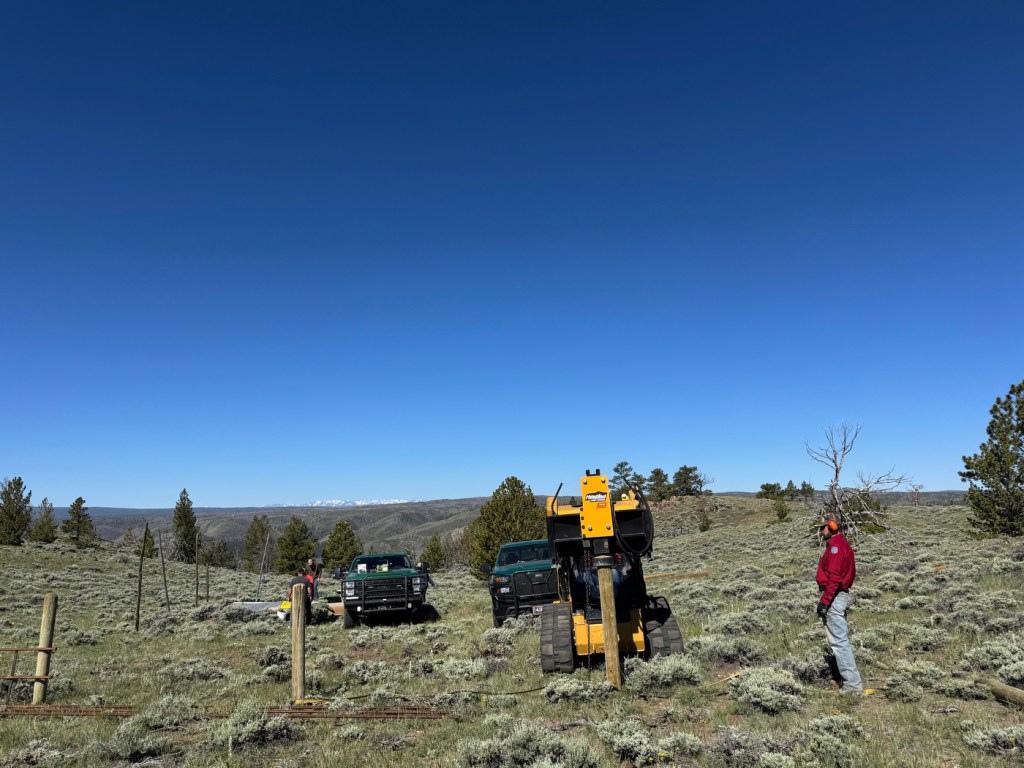
While building the new fence, volunteers created a bigger perimeter around the guzzler with continuous metal fencing firmly attached to the posts. Volunteers made sure the fence sat at least 18 inches off the ground, high enough for pronghorn and other smaller-bodied creatures to shimmy underneath but low enough that cows and horses could not get through. Elk and adult mule deer could jump over.
The rest of the volunteers scraped muck from the bottom of the tank and built a rain-and-snowmelt funnel using old barn roofing to collect and send water into PVC pipes to then dump into the guzzler. The tank also has a partial roof to limit evaporation and a set of stairs on the other side so wildlife can walk down and reach water as levels decrease.
By the beginning of last summer, the tank was full; this year, it was empty.
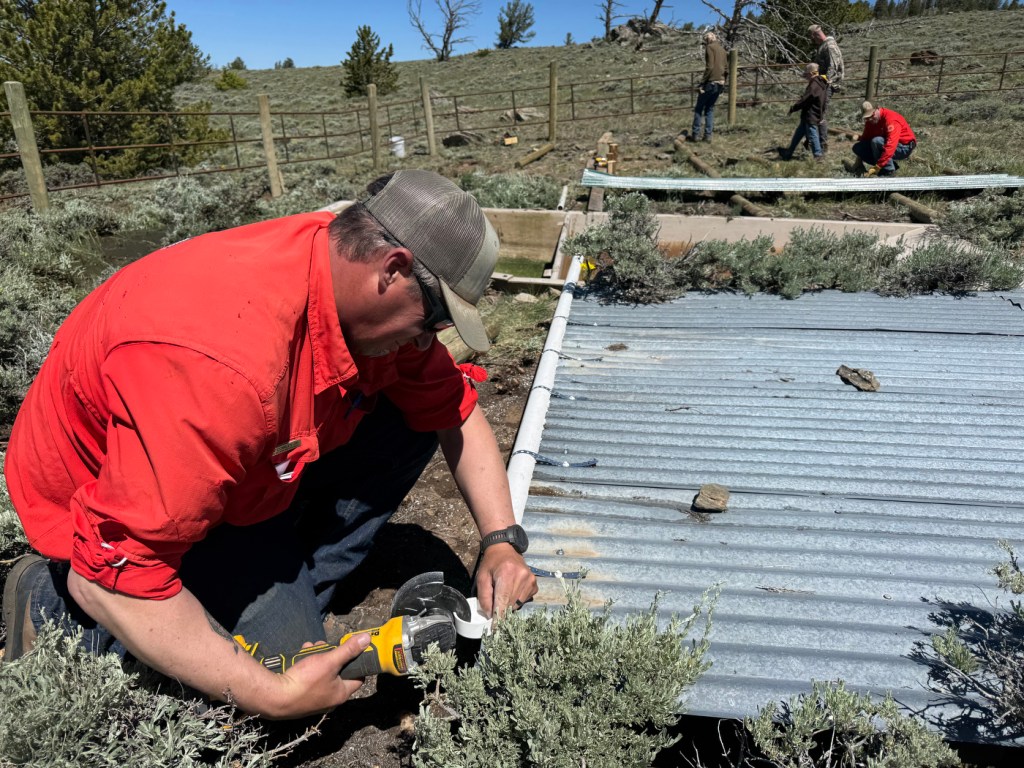
The drought is “a bad situation that’s hard on people and animals,” said Guy Litt, a volunteer and board member of the Wyoming chapter of Backcountry Hunters and Anglers. “It’s clear this one needs work, and this is the time to be doing it.”
How much, exactly, guzzlers help targeted wildlife species is still up for debate. Litt had a ewe bighorn sheep tag in a nearby area, and while he saw several guzzlers built for sheep, he only saw elk and pronghorn using them. Daryl Lutz, a Game and Fish wildlife biologist in the Lander region, worries guzzlers can artificially concentrate wildlife in certain areas on a landscape. The West’s wildlife evolved to survive extreme weather like drought, he added. But if research shows populations are becoming limited by water, then perhaps they could help.
As Cowles opened the spigot and began dumping hundreds of gallons of water into the tank, it was easy to see how wildlife, including the songbirds sitting on the newly built fence, could flock to this spot in the parched summer months.


As for moving water, check the guzzler once in awhile and put a little solar powered fountain tied down in the middle. They are made for small water features but just might work. Anything to help. Also, keep privately held “tanks” used for cattle, clean and with as much water as possible. Not only cattle and other livestock use these tanks, so do all the wildlife. And stop prosecuting ranchers from trying to make more water more available. (King family ranches) And stop the overzealous burecrats at the ground level from thinking they are the be all and end all of authority.
GREAT IDEA 💡👍. GREAT JOB 👏👍. THANKS TO ALL 🙏💝. THIS SUMMER 🌞, IS GOING TO BE VERY DIFFICULT, FOR ALL THE ANIMALS 😔. I PRAY 🙏, WE DON’T HAVE TERRIBLE FIRES 🔥. EVERYBODY STAY SAFE AND STAY FROSTY 🍻🍻. 🤠❤️😺💜 WYOMING 🏞️🏔️🌄🇺🇸🦅🔵💞
I do not possess their credentials that many of the readers here do, and I may have missed some information that was in the article. Nevertheless, I understand that standing water become stagnant and infested. But my thought is, wouldn’t it be helpful to install pumps or fountains that would keep the water in motion and hopefully bacteria and mosquito free?
An interesting story, which brings back fond memories of my many days in the field doing volunteer work with the Wyoming G&F and US Fish & Wildlife Service. One small clarification: DNA research and behavioral studies led scientists in 2006 to split the blue grouse into two distinct species: dusky grouse and sooty grouse. The dusky grouse occupies many forested areas of Wyoming and other Rocky Mountain states, whereas the sooty grouse occupies areas of Alaska, Canada, Washington, Oregon, California and Nevada. As a Wyoming native, I still find it hard not calling them blue grouse.
Here in early 21st century Wyoming , wracked with global climate change , we are starting to feel the consequences of the mistakes and greediness of Manifest Destiny back in the 19th century. Not the least was the near extermination of Beavers so the well-to-do of Europe could have fancy hats. Settlers and cattle barons had little love for the semi-aquatic rodent and not for a moment considered the long term consequences of removing them from the landscape.
Wyoming’s many and varied water issues could be well mitigated by restoring Beavers in quantity , alongside other actions. I am not the least convinced that these hydrostatic ” guzzler” vessels are all that helpful , beyond preserving critical mosquito habitat. Standing water decays. Water must move freely to work its mojo and fulfill its mission. These manmade cisterns seem more trouble than they are worth.
Wyoming needs a comprehensive effort to transplant mated Beaver pairs back into historic riparian areas and open land watersheds. Let natural engineers do it. We might be surprised at the results and how quickly living water is restored. The English and Scots have had remarkable success with Beaver translocation in recent times on the British Isles. Thankfully, they no longer feel it necessary to wear stylish hats for motivation. Climate change calls a different economic tune.
You raise some interesting points. Stagnant water in wildlife guzzlers would certainly be a good home for bacteria, parasites, and insect-borne diseases like West Nile virus. I just did a quick online search to see if there are any scientific studies examining this issue, but came up blank. Sounds like a great project for a UW graduate student.
Restoring beavers into areas they once inhabited would definitely be a step in the right direction. It could prove to be one of the more effective ways of restoring water resources to some areas now experiencing shortages. Certainly worth a try.
There is not much natural habitat for a beaver in the high desert. I am sure global climate change had nothing to do with the above fact.
I question why the BLM doesn’t require that groundwater developments such as windmills and solar powered water well pumps aren’t left in operation to benefit wildlife species when livestock are either absent or removed from a grazing allotment. These water developments were most likely paid for with taxpayer dollars. Wildlife species should have the benefit of these water developments as much as livestock. These water sources are critically important in drought years like the one we are currently experiencing.
The concept of scattered water sources for diversified “customers” has been my personal goal for many years. After 25 years as a Pipeline Construction Inspector and Environmental Inspector, I obtained Certified as a Professional, Erosion and Sediment Control (CEPESC,) with IECA, a world wide organization of like minded individuals from varying back grounds. We are in directly involved in controlling sediment AT SOURCE, and preserving water for groundwater regeneration, shaded water sources, initial attack for firefighting and in general, supporting water conservation. This helps “customers” ( bears, birds, bats, bugs )preserve energy in searching for water to survive. Trail cams are sometimes installed to support funding efforts and record usage. MINING and LOGGING Companies are happy to receive recognition for their efforts at conservation through “Habitat Restoration”
Thank you for featuring the work Water for Wildlife does across the state! We have been improving habitat and water resources for 50 years along with our partners. This year any precipitation on the landscape hasn’t refilled the guzzlers so having the WYG&F refill the tanks will make all the difference. Thank you volunteers! If you would like to donate to WFWF, we are participating in WyoGives on July 15! https://www.wyogives.org/organizations/water-for-wildlife-foundation