


Meteorologist Adam Dziewaltowski must have anticipated there’d be skepticism as he prepared his discussion of Wyoming’s weekend forecast.
“No, there does not seem to have been a technical glitch in the long term forecast models,” the National Weather Service office staffer in Riverton wrote about the forecast.
“[I]t really is looking to be that hot this weekend,” Dziewaltowski added. “Barring some miraculous shift in the weather pattern, we are likely to see a period of dangerously hot, record breaking temperatures this weekend.”
The forecast is so scorching that climate stations in several Wyoming towns could see the hottest air temperatures ever recorded — and it’s not just daily record highs that are in jeopardy.
“Looking at all-time highs, I suspect that if we don’t break them, we’ll come really darn close to it,” Wyoming State Climatologist Tony Bergantino told WyoFile. “It’s all speculative, and we’ll see how this pans out.”

The most off-the-charts temperatures are expected in western and northern Wyoming, with the Bighorn Basin most likely to flirt with or set new record highs regardless of date.
When National Weather Service meteorologist Brett McDonald queried the forecasted highs for Sunday, he was seeing up to 107 degrees in Thermopolis, 109 in Worland and 110 in Greybull.
Based on recordkeeping that goes back to 1976, the highest temperature ever recorded in Greybull was 109 degrees, he said in a Tuesday afternoon interview.
“There is a potential in Greybull of their all-time high temperature,” McDonald said, “and I wouldn’t be surprised that happened.”
Powell, where the all-time record is 104 degrees, was forecasted to reach 105 on Sunday.
And the all-time record could also be eclipsed in Lander, where the climate station record goes back to 1892.
“Lander’s all-time record is 102, and right now we have 103 [forecasted] there on Sunday,” McDonald said.
Sheridan is yet another northern Wyoming community that’s forecasted to bump up against the hottest temperatures on record. Its climate station records date to 1907. The forecasted high for Sunday as of midday Tuesday was 106 degrees, just one degree shy of the 107-degree record reached in 2002, 2005 and twice in 2021, according to National Weather Service meteorologist Luke Arends.
Even locales that aren’t forecasted to quite reach all-time record territory will still be broiling, McDonald said. Many single-day records are likely to also fall.
“Pinedale reaching 92 and Jackson reaching 95, that’s scorching,” McDonald said of Sunday’s forecasted highs.

Pinedale’s all-time high is 94 degrees, he said. Jackson’s: 101 degrees.
By Monday, the air temperature should cool off a bit and the possibility of precipitation will return, although highs will remain well above average.
In the meantime, Wyoming residents should brace for an especially warm week that peaks on Sunday. The cause of the potentially record-breaking heatwave is an “anomalously potent high pressure ridge” that’s building across the western and central United States, according to Dziewaltowski’s forecast discussion.
The record-setting temps forecast for the coming weekend are fitting for 2026.
Wyoming’s meteorological winter (December through February) was the warmest ever, surpassing Dust Bowl records. Unseasonable warmth carried into the spring, contributing to the poorest spring snowpack on record.
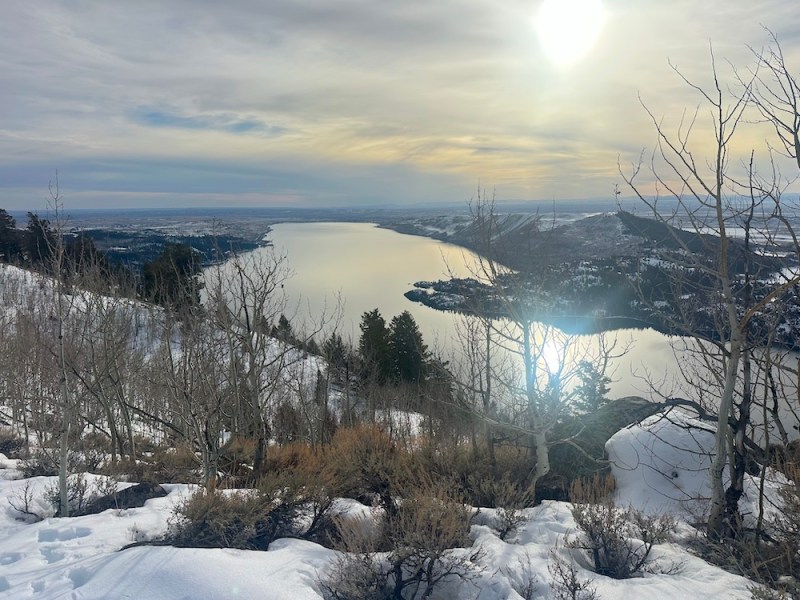

Based on temperatures at climate stations all around the state, Wyoming is on track to log its hottest year since recordkeeping began 130 years ago, according to Bergantino, the state climatologist. Currently, 2012 (44.8 degrees average) is the warmest year ever, followed by 1934 (44.5 degrees).
But the first five months of 2026 (June data isn’t finalized) are so far the warmest on record by three-tenths of a degree, Bergantino said. That edge is only likely to grow because of the looming heat wave.
“We’re going to retain the lead, I think,” Bergantino said. “I’m not sure it’s a lead we’d want to maintain, but we’ll keep it.”
Record heat is one implication of human-caused climate change that’s altering life in Wyoming.


Fortunately, human exacerbated climate change is just a Chinese hoax. Right, Free Dumb Carcass loyalists?
Please feel free to extrapolate with math on how a perforated blanket of less than .3 percent of the atmosphere has caused all of you experts to ignore basic climate cycles that have set the average temps in the various micro climates across the globe. While your at it, using that same math demonstrate the link between our orbital situation in relation to the sun and our current expected climate changes because of it.
Copy and pasted from anti-science talking points. Most likely from a Facebook post.
Depending on where you look, over 80% of climate scientists agree in humans contributing to climate change.