


Last fall, hunters put in their time pursuing Wyoming deer. They spent 12 days afield, on average, per kill. About 60% were successful.
Elk hunters had a slightly tougher go of it. Statewide, they drove, hiked and glassed an average of 19 days to successfully harvest a wapiti. Nearly 53% punched their tag.
It’s no secret that large carnivores, which occur at lower densities, are notoriously more difficult to locate, close in on and kill. Even aided by stinky bait — a common, legal tactic — Wyoming black bear hunters spent 66 days in the field per animal downed in 2023, the last year of available data. Success rates were starkly lower: Just 14%.
Then there’s the wolf.
Intelligent, relatively sparse in population, and often aided by many sets of packmate eyeballs to spot threats, wolves have proven exceptionally difficult to kill in parts of Wyoming where hunters are restricted to fair-chase tactics.

Wyoming Game and Fish Department biologist Ken Mills shared the data at a hunting season-setting meeting in Pinedale this week. During the 2023 season, the last year data was available, hunters in Wyoming’s trophy game area, where wolves are regulated, logged about 450 days per animal they managed to kill. Success rates registered at 2.7%. (Mills is still sussing out the numbers from the 2024 wolf hunt, though he expects an uptick in success.)
At least in Wyoming, those numbers are pretty typical, according to a graph the state agency’s longtime wolf biologist presented to four members of the public and a handful of colleagues. There was a time, he said, when wolves were smartening up to hunting pressure so well it was even a concern — hunter-days logged per wolf climbed from 300 to more than 500 between 2017 and 2021.

“If it continues to increase, there’s a lower probability that we’ll be able to use fair-chase hunting as a management tool,” Mills said. “If wolves are learning so much, and avoiding hunting so well, we’re going to have [a] low harvest and we’re not going to be able to attain our [target population] objectives.”
For that reason, he said, improvements in success and days spent hunting per kill from 2022 to 2024 were “actually really good” to see.
“OK, fair-chase hunting is working,” Mills explained of his thinking. “It’s still a good tool to be able to manage wolf numbers, which is certainly my preference.”
In Montana and Idaho, the only other Lower 48 states that currently hunt wolves, wildlife managers tasked by their state legislatures with killing more wolves have shifted gears, adopting tactics like trapping, snaring and night-hunting with thermal imagery that have remained prohibited in Wyoming’s wolf trophy game area. (In Wyoming’s predator zone, encompassing 85% of the state, virtually anything goes, even running over wolves with snowmobiles.)

It’s unclear based on easily accessible data how hunter success in Montana, Idaho and Wyoming’s wolf predator zone compares to the numbers Mills presented from the tightly regulated trophy game area. During the 2023-’24 wolf season in Montana, roughly 1.6% of hunting and trapping license holders killed a wolf, but the harvest report doesn’t track hunter effort. Idaho, likewise, doesn’t provide hunting effort data in its wolf harvest report, though at one point in the past, license-holder success was as low as 0.4% in the Gem State.
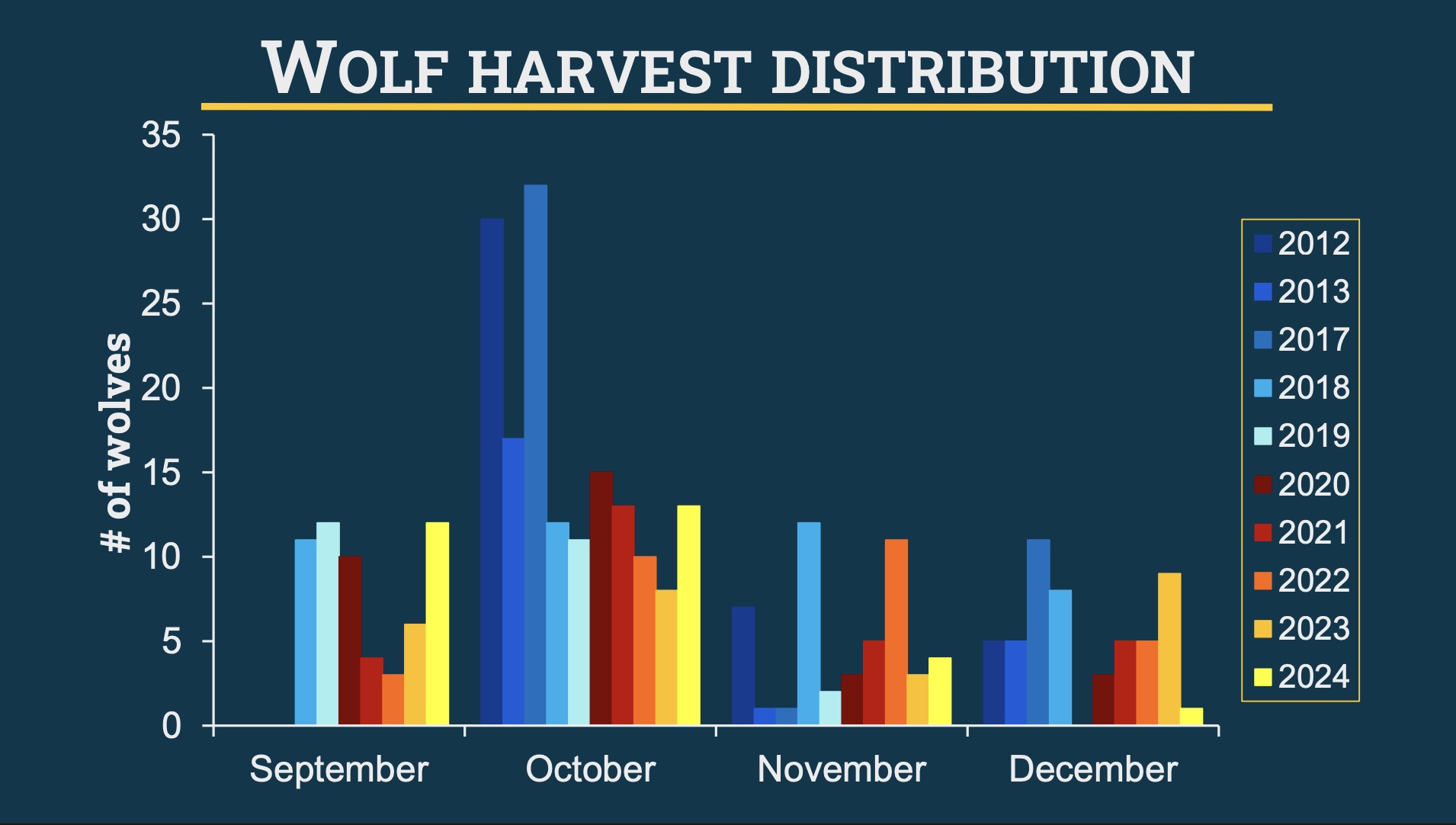
In Wyoming, the wealth of data also provides some insight into the types of animals the lucky few successful hunters are ultimately pulling the trigger on. Especially early in the season, the preponderance of animals killed are young: either that year’s pups, yearlings or 2-year-olds.
“About a third of the wolves taken in September were juveniles, and that declines through time,” Mills said.

Back in 2018, Game and Fish tacked on September to its wolf hunt. Shortly afterward, Mills recollected, officials bumped the start date back a couple of weeks to avoid killing pups on “rendezvous sites” — where the young of the year get stashed after leaving the den.
The first six or so weeks of the Wyoming hunt — Sept. 15 through October — remain the easiest time of year to kill a wolf, the data shows. That’s because success increases when hunting localized wolves, like the youngsters tied to a rendezvous site.
“Especially year to year, people figure out where wolves are hanging out,” Mills said. “They know where to go.”


Wyoming’s 2025 wolf hunting season proposal would bring mostly modest changes from the 2024 season. The maximum number of wolves that could be killed would increase from 38 to 44 animals, though that must pass muster with the Wyoming Game and Fish Commission.
Stability in Wyoming’s wolf population and regulated wolf hunt have become the norm.
The “trophy zones” do absolutely nothing to manage the wolf population. 2-1 wolves removed from each unit near Pinedale is guaranteeing the wolf population increases as it has throughout the GYE. A handful in all the other areas is insuring a continued collapse of elk numbers.
Thank you for another insightful wolf story. Hopefully Wyoming will someday value this keystone species and stop the aggressive eradication efforts….including running them over with snowmobiles and other vehicles.
Those in the Wyoming government that voted for continuing the use of snowmobiles to run over, run down the wolves will hopefully not get re-elected.
A couple dozen quota in the entire GYE isn’t aggressive eradication
After reading this story, as well as Koshmrl’s excellent earlier one from September 2024, two issues come to mind.
1. Given the intensity of Wyoming wolf management, particularly the census method that is proving so successful in sustaining the wolf population of the Greater Yellowstone under extreme, profoundly unecological and political conditions, I wonder whether this intensive approach could also add to our knowledge of how wolf predation on feedground elk contributes, or not, to disease control, particularly of chronic wasting disease. There has been some research on this question, e.g., Wild et al., “The role of predation in disease control” (2011, see below link), but clearly more needs to be done. In other words, I’m asking whether research into wolf predation and disease control can “piggyback” on the existing “intensive close contact” management regime.
2. Given current political conditions in this country, it seems more than likely that grizzly bears will be delisted and go under WG&FD management. It also seems clear that successful bear management will have to be as equally intensive as wolf management, to include hunting grizzly bears–an entirely new situation, as bears haven’t been legally hunted for decades. My question here is, can G&F afford it? Just how does G&F propose to manage bears intensively while continuing to manage wolves intensively? It will be very expensive, especially as reproductive biology and thus population dynamics are very different in the two species. In short, to a large degree bears will have to be managed differently than wolves.
https://meridian.allenpress.com/jwd/article/47/1/78/121161/THE-ROLE-OF-PREDATION-IN-DISEASE-CONTROL-A