

Anticipating about 1,000 construction workers for the Dinosaur Solar Energy Project, Natrona County and the city of Mills began investing hundreds of thousands of dollars to meet the influx; a new $268,000 ambulance, a $55,000 command vehicle and additional expenses to beef up the local fire district.
Those hefty sums would be covered via a 50-year-old state program that expedites payments to impacted communities based on a portion of the sales and use taxes the developer will, presumably, eventually pay.
But the developer of the 440-megawatt, 2,000-acre solar farm delayed the original construction date of 2024. After a change in ownership, the project was supposed to begin construction in March. The new developer, NextEra Energy Resources, recently delayed the project again — this time for another three years. It also trimmed the solar farm’s size to 240 megawatts.
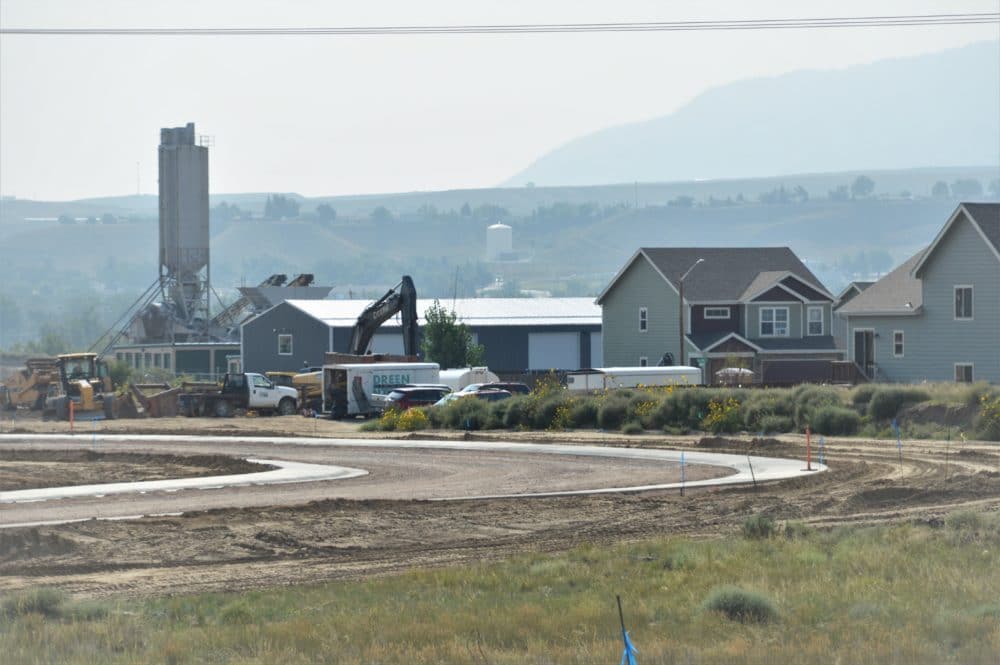
That means the “impact assistance payments” have been delayed and, possibly, will be reduced while the town and county are left holding the bag.
“We are now facing the possibility of waiting until March of 2029 to be reimbursed for our expenses, if at all,” Mills Mayor Leah Juarez told the Legislature’s Joint Minerals, Business and Economic Development Committee this week. “That structure is fundamentally backwards.”
Though community leaders generally embrace the prospect of a large industrial project for its job opportunities and additional tax revenue, such economic bonanzas come with headaches that officials are obliged to address. There’s also an increasing volume of large industrial proposals. Until recently, the Industrial Siting Council averaged about one permit application per year, according to the agency.
“We are now facing the possibility of waiting until March of 2029 to be reimbursed for our expenses, if at all.”
Mills Mayor Leah Juarez
“We have 39 projects in different stages of development right now — wind, solar and other projects. So there’s quite a bit going on in that division right now,” Wyoming Department of Environmental Quality Director Todd Parfitt said.
DEQ oversees the siting council.
It’s also difficult for community leaders to suss out which projects might be speculative.
Increasingly, developers are delaying construction, leaving communities like Mills and Natrona County to take on extra expenses for something that might never come to fruition, local officials say. Another recent example is the Settler Wind Project in Converse County. The developer in February was granted a request to change its construction start date from August 2025 to November 2027.
Developers ought to put up a big chunk of money for impacted communities soon after they receive an industrial siting permit and long before they are scheduled to begin construction, Natrona County Commissioner Dave North said. That way, if they delay a project, “those companies are on the hook for it. It’s not the state. It’s not the counties. It’s not the municipalities.”
Aside from developer delays, the program doesn’t seem to be working, Juarez said.
“We don’t receive payments for months to years and sometimes not at all, and we are required to report on funds we have not received and prove that we have not used them,” Juarez said in written testimony to the panel. “The ISC works swiftly and prematurely to approve projects with minimal solidified information. It is all a wild estimate by the company proposing the project.”
The committee directed legislative staff to draft two bills for consideration at its next meeting in June.
Rather than issue fast-track payments from the state’s general fund, one measure would require a developer to post a bond shortly after receiving an industrial siting permit. Qualifying communities would receive pre-construction payments based on a percentage of the estimated tax revenue of the project.
Another measure, based on this initial draft, would exempt projects within existing coal and trona mining districts, as well as facilities built within existing industrial parks. It’s based on the notion that communities neighboring such industrial complexes have already installed the resources necessary to handle those expansions.
Regarding the proposal to impose a bond on developers, Parfitt warned lawmakers not to make it too expensive. If the bond requirement is too steep, a developer may abandon a project, he said. However, Parfitt added, “we do agree that some money needs to come up front so that some of these impacts can be addressed before the project actually begins.”
Imposing a bond, and ensuring that communities receive impact assistance payments long before scheduled construction, is a no-brainer, North said.
“It’s not going to cost the state anything additional,” he told the panel. “All it’s doing is saying to the companies, ‘OK, you have to put this right up front.’ This just makes the companies have a little bit more skin in the game right up front, so they don’t keep kicking the can down the road.”


If you think wind developers are going to pay, lol wish in one hand and oops in the other and see which fills up first.
The U.S. federal and state governments give the fossil fuel industry over $20.5 billion in support each year through the tax code, inadequate royalty rates, and direct funding. Big fossil fuel companies claimed $8.2 billion in 2020 from the CARES Act pandemic relief bill.
It looks like WE pay them.
Yet, still less than we paid Somali daycare centers in Minnesota.