
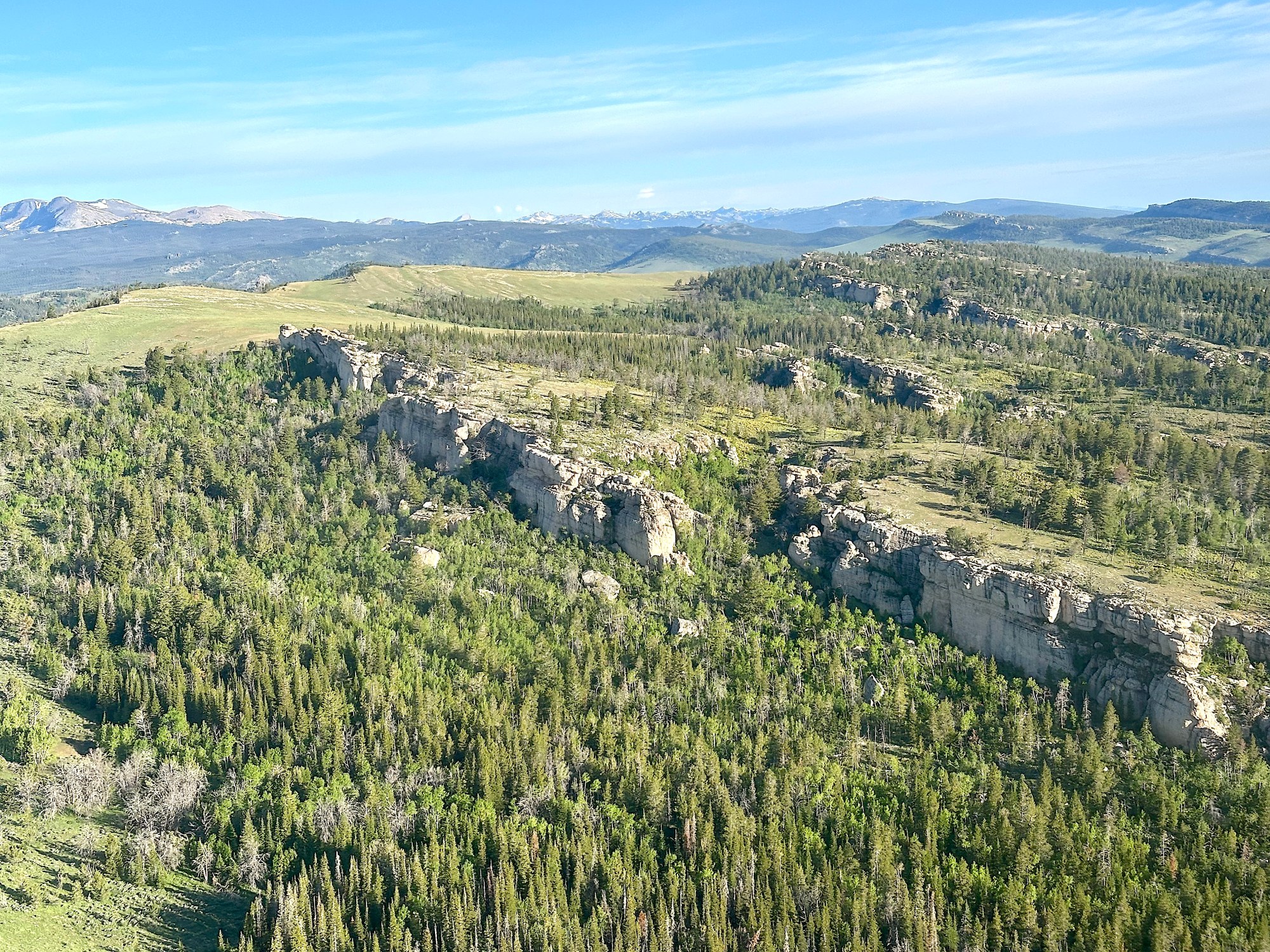

The Wyoming Game and Fish Department and other state agencies are among the relatively few parties encouraging the Trump administration to fully eliminate the 2001 Roadless Rule, which safeguards roughly 3.3 million acres of backcountry in the state — valued habitat for wildlife and hunters alike.
State wildlife officials took that position in an Oct. 6 comment letter signed by Game and Fish Deputy Director Jeff Davis. It’s a stance that’s related to a desire for more local control and dissatisfaction with a “blanket federal rule,” he told WyoFile in an emailed statement.
“Locally driven planning — focused on forest health, habitat restoration, and improving public access without increasing impacts to fish, wildlife, and natural landscapes — is best guided by the people of Wyoming,” Davis said.

Game and Fish’s comment letter asks federal officials to adequately staff the Forest Service so the federal agency can successfully administer the Roadless Rule cancellation. The memo also encourages deference to the state agency’s own expertise.
“That expertise should shape decisions from the outset and should not be overridden by national-level direction without prior consultation and a transparent, science-based explanation,” the letter reads.
Regardless of its reasoning, Game and Fish’s position puts the agency at odds with the overwhelming majority of hunters, anglers and the general public. Overall, 99.1% of the 370,238 public comments received by the U.S. Forest Service opposed eliminating roadless areas.
Yet, Game and Fish’s request also isn’t that surprising insofar as it’s coming from a Wyoming state agency. Gov. Mark Gordon has been a vocal advocate of rescinding the rule in favor of forest-level control, and he sent an Oct. 5 comment letter reiterating that view. In that letter, he let the federal government know that they’d be hearing from his Agriculture, Game and Fish, Forestry, Environmental Quality and State Parks departments.
“Unlike a broad, one-size-fits-all federal rule, local planning allows for tailored solutions that consider the unique biodiversity, wildlife, habitat, water resources, timber potential, recreational uses, grazing opportunities, and cultural heritage of each area,” Gordon wrote.
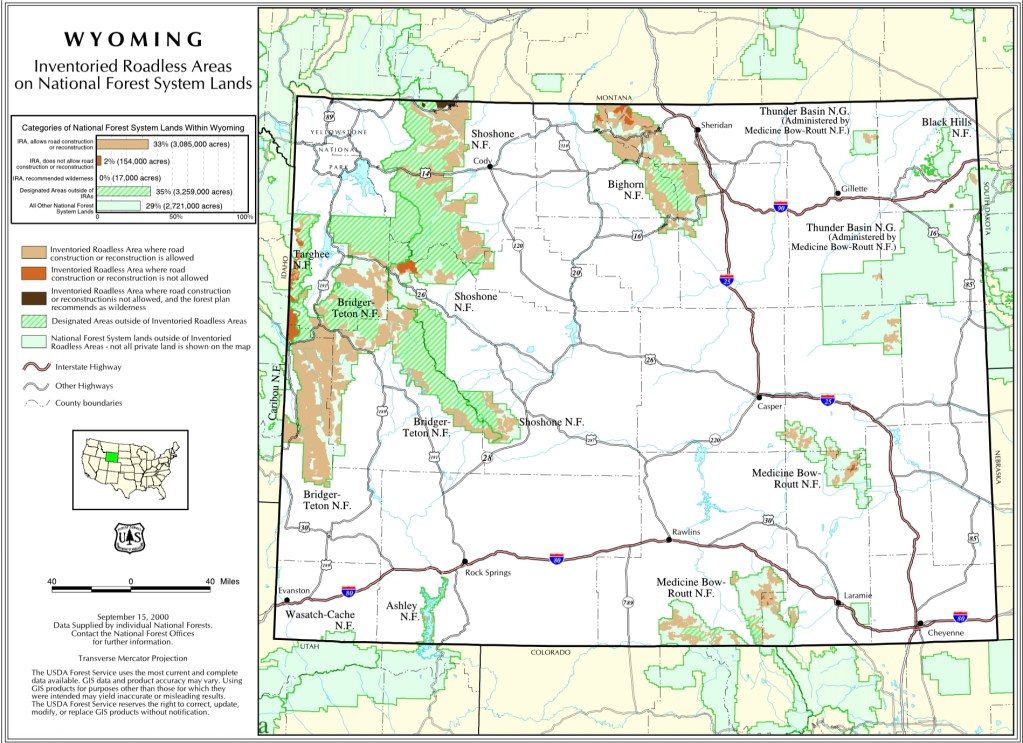
Nationally, there are 44 million acres of national forest with roadless area protections. It’s a class of land that’s often akin to backcountry, and the rule keeps it that way — future roadbuilding isn’t allowed under most circumstances. In Wyoming, there are big tracts of inventoried roadless areas in mountain ranges like the Absarokas, Tetons, Winds, Bighorns, Snowies, Laramie Mountains and the Wyoming Range.
The Trump administration has argued that the Clinton-era land protections should be eliminated to remove a barrier for wildfire-risk reduction work.
There were 95 organizations and government agencies that supported the repeal, according to an analysis from a Substack outlet, More Than Just Parks, which first pointed out Game and Fish’s support for the rescission. Industry groups — including timber and logging, mining and energy, ranching and grazing and motorized recreation — accounted for the majority of parties wanting to wipe out roadless area protections.
The Wyoming Game and Fish Department appears to be the only state wildlife management agency that submitted a comment letter supporting eliminating roadless areas, though directors for Nevada’s Division of Forestry and Department of Wildlife submitted a joint letter also favoring repeal.
Most state wildlife agencies simply didn’t comment.
Many Wyoming conservation groups did. One coalition of 19 groups wrote they “stand in strong and unanimous support” for keeping roadless areas intact, and they partly posed a wildlife argument.
“Roads fragment habitat and degrade the migration corridors that Wyoming’s big game herds depend on,” the letter from Wyoming Outdoor Council, Greater Yellowstone Coalition, Wyoming Wilderness Association and others states. “Fragmentation occurs when continuous habitat is broken into smaller, disconnected pieces, most often by roads and the development they enable.”
For those reasons, some Game and Fish retirees were miffed by their former employer’s position. Ecologist and longtime Wyoming Wildlife Magazine editor Chris Madson, who’s been an occasional critic of his former employer, said that it’s evident that roads do more harm than good for wildlife, but also hunting.

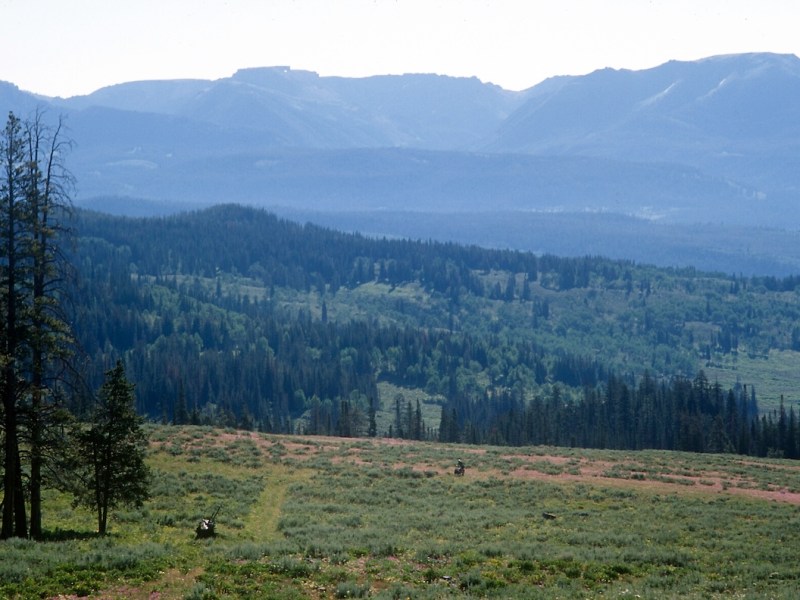
“I’m alarmed,” Madson said. “Anybody who spends any time on the public domain knows, just by the seat of his jeans, that deer and elk move away from motorized disturbance. And the more disturbance, the farther away they move.”
Craig Benjamin, executive director of the Wyoming Wildlife Federation, said that he has “tremendous respect” for Game and Fish, but he argued the agency missed its mark in asking to eliminate roadless areas.
“Wyoming’s forests need active management, and our wildlife needs intact habitat,” Benjamin said in a statement. “We can do both. If there are barriers to good management, let’s identify them and fix them rather than eliminate the entire Roadless Rule.
“In Wyoming, we fix things,” he added. “We don’t throw them away.”
Ed’s note: This story has been updated with new information about other state agencies that have commented on the Roadless Rule.

How many times do we have to say no to rescinding the roadless rule? What part of “NO” isn’t understood?
In your articles, could you please include email addresses and phone numbers of governmental agencies and politicians so that readers can respond not only here to Wyofile but directly to those involved entities.
Thank you and your doing a great job!
“Industry groups — including timber and logging, mining and energy, ranching and grazing and motorized recreation — accounted for the majority of parties wanting to wipe out roadless area protections. ” Gee that’s a surprise. Each area that is now inventoried as roadless went thru a review and public comment period before it transitioned to roadless. You can find illegal trails through just about every one of these “roadless” areas that self indulgent people have created over the years. Let us and wildlife have a place where there is peace and quiet away from industries and motorized recreationalists.
The roadless rules were a mistake. They need to be managed locally.
No it isn’t. It is federal land, not state land.
Once again, I believe WGFD has lost their way, if not their soul, and surely their spine. I believe this recommendation is coming from pressure outside the agency. The notion of local control is not a scientifically-based recommendation to support wildlife, habitat, or associated recreation. The official WGFD letter is totally inconsistent with the numerous past official WGFD comments regarding road (area) closures, motorized recreation, timber sales, and individual National Forest, Grasslands and BLM Land and Resource Management Plans. Check the record out for yourselves.
During my employment with WGFD, I evaluated and wrote numerous comments on the above proposals that went out in the official WGFD comments, as did other biologists. Most of my comments regarded the Medicine Bow – Routt National Forests, and paricularly up in the Snowy Range, Sierra Madres and the Laramie Range. But, you will find similar recommendations across the state.
The adverse effects of roading on wildlife have been well documented, especially regarding logging, escape cover, and obtaining harvests on public lands. The increase in planned and user-created roads with associated increases in traffic by ATVs and 4WDs has displaced wildlife off public lands to adjacent private lands where they are often inaccesible for harvest for managing for publicly approved population goals. These issues have been studied and documented for decades (e.g., go find a copy of the Elk, Logging, Roads Symposium proceedings). Large blocks of roadless habitat help maintain a wide variety of wildlife populations on public lands. In addition, authorized and unauthorized roads are known to cause impacts to streams and other habitats. Even designed forest system roads impact hydrology. Go look downstream from a culvert on the Sand Lake Road and you will often find extreme erosion.
Sportspeople are their own worst enemies. I sympathize with people who have mobility issues, but we generally do not need wide open motorized travel. The white-arrow programs for travel management (which WGFD uses on their own lands) is often ignored by some users.
I think that WGFD should base their comments on what’s best for the wildlife and habitat.
What’s up Wyoming Game and Fish? I find it difficult to wrap my head around your stance on this issue. It’s like you, as an agency, are turning your backs to your highly-qualified and dedicated staff and well as the vast majority of we citizens of Wyoming!
Not all hunters and anglers are against getting rid of the roadless rule. Lots of designated wilderness you can go to if you don’t want to see or hear motorized vehicles. Get rid of the berms and gates and go back to how it was in the 80s.
Most of the 99.1% of comments opposed are identical form letters that environmental groups give to their members. They do it to inflate the appearance of the amount of opposition.
The WYGF comments in support of rescinding the Roadless Rule echo some of the same support for recission from Rocky Mountain Elk Foundation. If you really want a reasonable, nuanced position, check out RMEF’s position statement that lays out it’s concerns as well as it’s support. It makes far more sense than the “the sky is falling” position of environmental groups like Backcountry Hunters and Anglers, Wyoming Wilderness Association, Greater Yellowstone Coalition, and Wyoming Outdoor Council.
It’s interesting that RMEF wants the Roadless Rule to be eliminated. I just read their position about how the Roadless Rule has both detrimental and beneficial effects on elk habitat, and why it’s best that the Roadless Rule should go away. I have a lot of respect for RMEF and it’s always good to hear different perspectives.
There is no opposition inflation. If someone signs the letter, they agree with its content.
Public comments on agency proposals are not a voting contest. One well-reasoned, substantive comment with scientific data or legal analysis carries far more weight in the comment process than thousands of identical form letters. Form letters are grouped together and counted as one comment. The environmental groups are aware of this, yet still have members send form letters simply to create a percentage that appears to further their agenda.
Yes, science-based facts are the best, and there are some out there. The roadless rule is best for wildlife, period.
I like the roadless rule and don’t want it to be rescinded, but if conservation groups like Rocky Mountain Elk Foundation think it should be rescinded, then there are clearly some good reasons to do so.
The facts are that Elk are at or above objectives in WY, MT, ID,
Why are they pushing for rescinding the Roadless Rule? RMEF explicitly acknowledges that roadless protections provide wildlife security—and that roads and recreation can harm elk reproduction and distribution.
They also want to delist Grizzlies & Wolves federally. Their argument is incomplete when they use population as the focus of their argument. Population counts are relevant evidence, but an ESA decision must also address threats, habitat, genetic health, connectivity, and whether protections after delisting will be adequate. Courts have previously found shortcomings involving those very issues in Yellowstone grizzly delisting.
Their documented wolf advocacy emphasizes delisting, state control, hunting, and trapping. They “support” wolves remaining on the landscape, but their approach differs substantially from preserving federal protections and prioritizing nonlethal coexistence.
They argued for:
More habitat treatment: arguing that restrictions have sometimes reduced opportunities to improve forage and water availability.
Fire management near communities: They favor greater flexibility for fuel treatments and, where justified, strategically placed roads.
Local decisions: They prefer individual national forests deciding where treatments, roads, and protections are appropriate.
RMEF also explicitly acknowledges that roadless protections provide wildlife security—and that roads and recreation can harm elk reproduction and distribution.
I would argue: Why remove broad habitat safeguards when targeted treatments are already allowed—and what enforceable protections would prevent a net loss of wildlife security?
Mike, Thank you for shedding some daylight on ONE MORE action, taken by our own WGFD that would prove detrimental to our Wildlife Populations, the very resource that our Game & Fish Department is entrusted to defend.
yea this doesn’t pass the sniff test
follow the money?
State agency appointed/hired by the Governor
Campaign contributors?
Against constituents they represent.
Read the Forest Service’s Environmental Impact Statement concerning rescinding the roadless rule! The U.S. Forest Service’s Own Report (p.105) found that roadless areas had a “LOWER NUMBER, FREQUENCY, & DENSITY of WILDFIRE IGNITIONS compared to other Nat. Forest Lands”! It also concluded that building roads “WOULD HARM 327 ESA-LISTED SPECIESs” (p. 165)! Read for yourself what idiots Trump, Rollins, & Schultz are for killing the roadless rule which their own agency shows works! Building more roads will cause MORE FIRES & HARM THREATENED SPECIES. https://www.regulations.gov/document/FS-2025-0001-224064?_ga=2.198106088.631802981.1787931816-2009872665.1787931816
It is a little difficult for me to comprehend WG&F opposition to the roadless / Wilderness rules.
Do away with “wyoming” game and fish and start over with a clean sheet of paper. Over 99% of comments are against doing away with the roadless rule. How can the game and fish be so out of step with the people? Is it just because the leadership learned his craft in Colorado? You just have to ask yourself, why would they want more roads?
The people that are fighting the repeal mostly haven’t bothered to read it. It does not effect designated wilderness areas. I remember the time before the roadless rule and we had a lot more wildlife than today, the roads didn’t seem to bother it. I am more concerned with disabled americans having access than I am horse outfitters being able to protect their little areas. All people should have access to these areas not just young able bodied hunters and fishermen. The other reason to support it is for forest fire management. Logging is a very good way to manage old growth timber and create young growth that has always been beneficial to wildlife. The forest service is not building new roads they are just opening existing roads back up and maintaining them and not all of them.
How does WGFD miss the mark so badly here? Roadless areas are the last bastion for wildlife. People and wildlife need wild places to get away from the noise and crowds.
Disappointing to say the least. WGF has chosen to play politics rather than do what’s best for Wyoming’s wildlife. I doubt that any rank and file WGF biologists support rescission of the roadless rule. Obviously, the politically appointed WGF Commission feels like they know better. Wyoming politicians are hopelessly out of touch!
As a hunter and recreationist I am strongly opposed to opening up the roadless areas to allow more access to off road vehicle traffic. Looking at the present large number of miles of USFS roads indicates to me we do no need more roads for this activity, but instead need to have areas of the forest without motor vehicle noise and pollution where wildlife can occur without this harassment. The forest also has many areas for timber cutting and stock grazing. The USFS personnel cannot oversee these grazing areas or control out of control off road vehicles with the situation at present. Roads do more harm than good. If the majority of Wyoming users of the forest want to keep the roadless areas then the Game and Fish Dept. should go with these wishes.
I was so hopeful that the recent change in G&F leadership would help the Department once again find its backbone and stand tall for the good of the public’s wildlife. Sadly, that doesn’t seem to be the case. It saddens me to no end how far our G&F Department has fallen. It used to be that the Department could be counted on to uphold Aldo Leopold’s dictum: “A thing is right when it tends to preserve the integrity, stability, and beauty of the biotic community. It is wrong when it tends otherwise.” Sadly, this is no longer the case.
It looks like the Wyoming Game and Fish Dept. is NOT representing the people or wildlife. We need an explanation. Is this driven by the Governor?
Teddy Roosevelt, Gilford Pinchot, John Muir and others worked hard to preserve our forests in the early 1900s. They lost many battles to Railroads, Timber, and Mining interests but were able to salvage a small part of the country’s forests. The remaining forests have been managed for timber and recreation proposes ever since while fighting corporate industries. Allowing offroad vehicles to harm the forests and wildlife would make them turn over in their graves. There will not be money to repair the damage done to abandon roads and trails by motorized vehicles. As a result erosion will harm the forest and lead to flooding problems. Fires will be started from the heat and sparks from these vehicle. The forest service budget cannot pay for additional forest fire fighting. Big game will be affected in calving grounds. Harried game will flock to private land to escape and ranchers will need to be compensated from range damage. What a terrible impulsive dumb idea to open up the forest to more motorized vehicles. Wyoming Game and Fish is right to oppose these compulsive political agendas that harm wildlife, landowners, outdoor enthusiast’s, anglers, hunter, etc. Our state managers understand local forest management and its users. Keep politicians and big money away from our forests, please.
Why is it that the Wyoming Game & Fish is constantly going against the outdoors people in Wyoming? They’ve obviously sold their souls years ago to the big landowner interests and the welfare public land grazers and continually attempt to pinch the everyday citizen of this state. Extremely poor leadership and I agree with many, many others that this org needs a serious reboot starting with purging the over their heads clowns at the state HQ
How do we fire Wyoming Game and Fish management and start over?
It’s pretty obvious to most of the serious sportsman and women of Wyoming that the WY G and Fish has lost their way. Clownage running the show in Cheyenne, being bootlickers to the cattle barons and to top it off, this Deputy Director Jeff Davis was ousted from the Colorado Dept of Parks and Wildlife. A top to bottom overhaul of this Agency is past due